Inspiration
Industrial quality teams can detect an out-of-target measurement long before its investigation, supporting evidence and follow-up work become connected. Spreadsheets describe the deviation; work trackers describe the task. ContextIQ connects the reasoning between them.
What it does
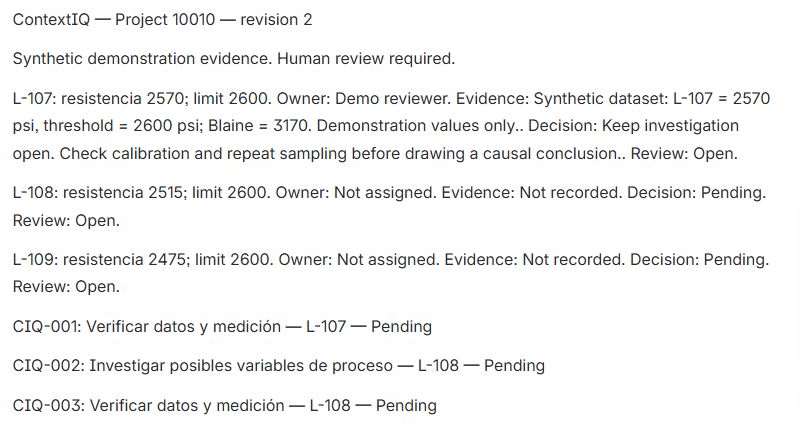
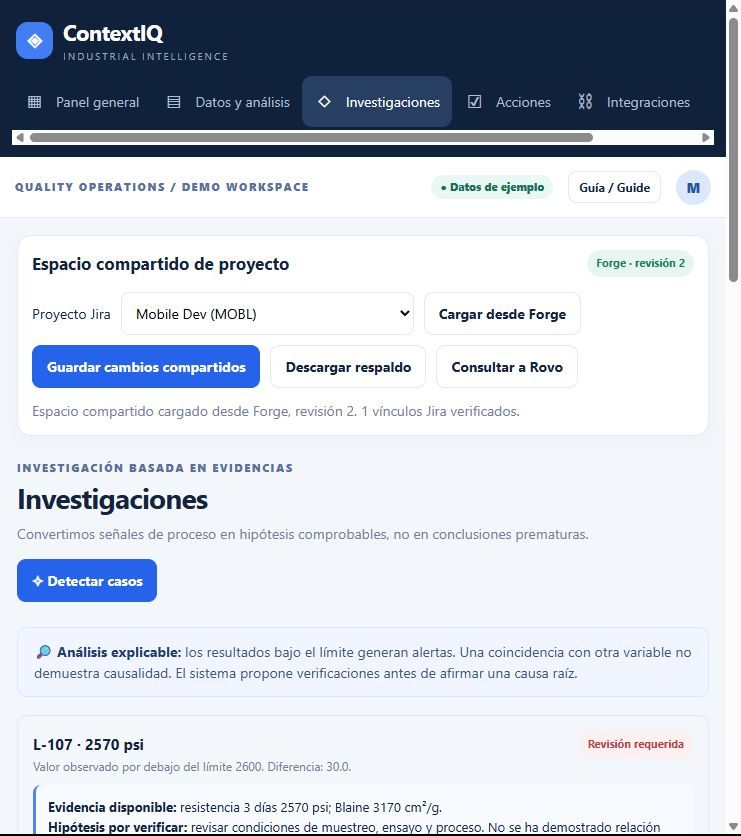
ContextIQ turns quality observations into shared investigations, reviewed decisions and traceable Jira actions. A transparent threshold check identifies measurements requiring review. Each investigation brings together recorded observations, hypotheses, missing evidence, a reviewer and a justified decision. Closing a review requires a reviewer, evidence and a decision.
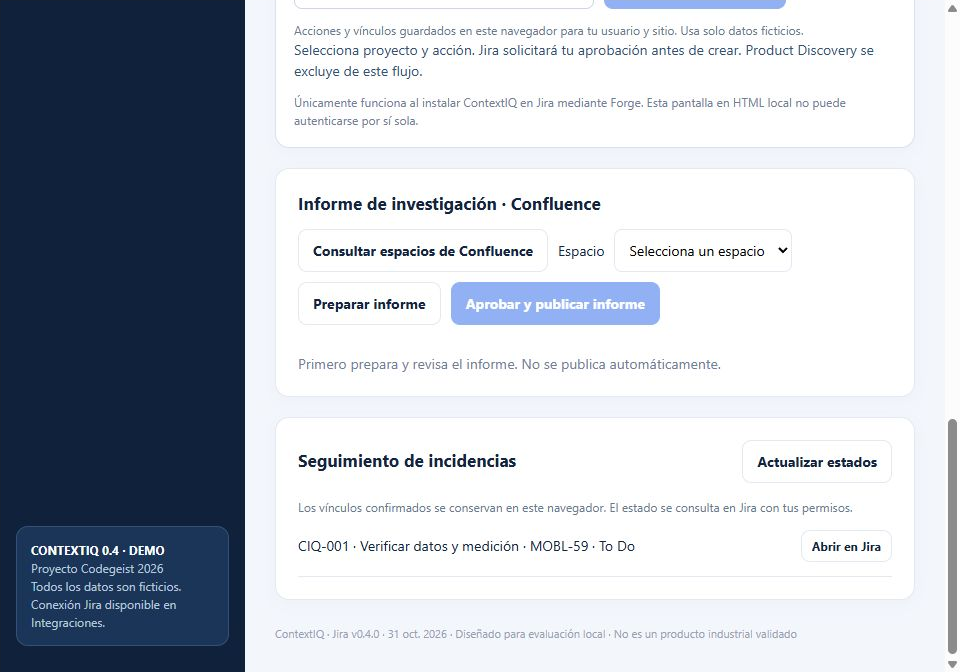
The team saves project context in Forge, opens Jira's native creation form and approves the real issue before it is created. ContextIQ preserves the link and retrieves the Jira workflow status. ContextIQ Investigator, a read-only Rovo agent, reviews the same saved evidence. A reviewed snapshot can be published to Confluence after an explicit preview and approval.
How we built it
The application uses Forge Custom UI with Vite and the Forge bridge, Forge backend resolvers, Forge KVS, Jira Cloud APIs, a rovo:agent with a permission-checked GET action, and Confluence REST API v2. Jira is required; Confluence is optional. No external LLM endpoint or external API credentials are embedded in the application.
Shared workspaces use immutable revisions and conditional writes to prevent silent concurrent overwrites. Backend operations check the current user's Jira project permissions. Action reservations, UUID labels and reconciliation protect the issue-creation workflow while keeping the user in control. Browser storage provides a recovery copy, and a downloadable backup preserves local work.
Challenges we ran into
Forge resource paths and content security policy initially prevented the Jira bridge integration from loading. Relative build paths, external modules and explicit startup errors resolved that failure. Jira projects can have different issue types and required fields, so we use the native Jira form rather than assuming one universal schema. We also handled uncertain writes, resolver initialization and the trusted caller context used by the Rovo tool.
Accomplishments
The deployed app retrieved 24 visible Jira projects and created real synthetic test issues through human approval. It recovered a verified issue link from Forge after a reload, retrieved saved investigation evidence through the Rovo agent and published an approved Confluence report. The application passed 27 automated tests, a Vite build and Forge lint; its dependency audit reported zero vulnerabilities at validation time.
What we learned
A useful industrial assistant must preserve uncertainty and accountability. An alert is not a root cause, and a generated suggestion is not an approved decision. Shared evidence, permissions, revision history and native review steps matter as much as the AI response.
Best Agents: ContextIQ Investigator
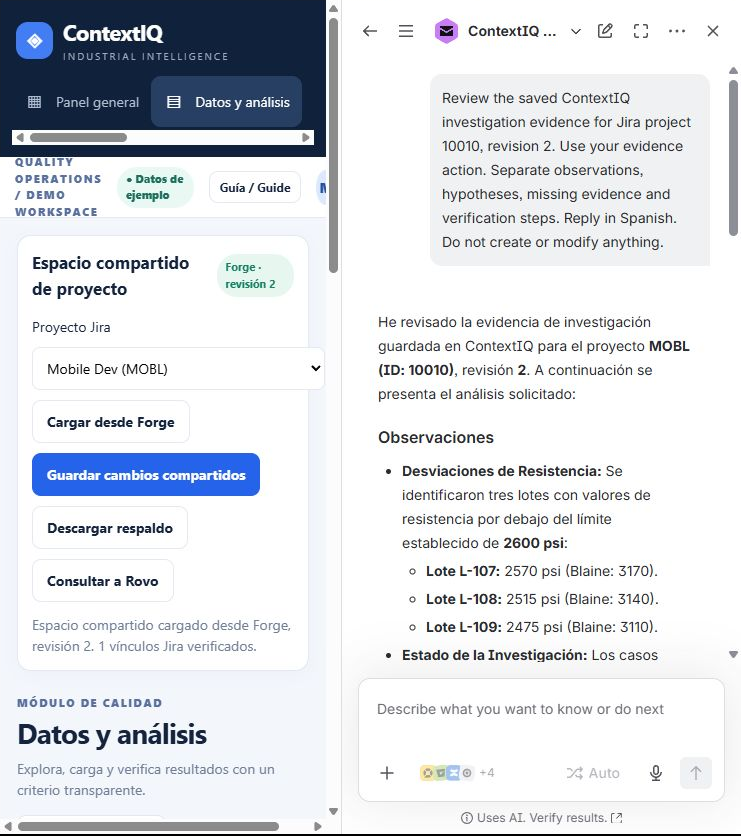
Our Forge Rovo agent retrieves permission-checked saved project evidence and identifies its revision. It separates observations, hypotheses, missing information and verification steps. Its GET action cannot create issues, transition workflows or publish reports. Industrial decisions remain subject to professional review.
Try it and test it
Installation, support and privacy: https://contextiq-support-mauricio.tastyeel65.chatgpt.site Bilingual user guide: https://contextiq-support-mauricio.tastyeel65.chatgpt.site/guide.html
An Atlassian administrator must install the app and approve its scopes. Use a test Jira project where you can browse and create issues. Check Jira in Integrations, select the project in the shared-workspace selector and load Forge. Analyze the 12 synthetic samples with a minimum resistance of 2600 psi: three are below the limit. Record review evidence, create an action and save the shared revision. Create an approved Jira issue and refresh its status. Ask ContextIQ Investigator to review the saved project. If Confluence is connected, fetch spaces, prepare the report, review it and approve publication. Rovo must be available on the test site; Confluence publishing requires page-creation permission.
Scope and next steps
The demonstration uses synthetic data and genuine captured interface states. We do not claim measured production savings, causal inference accuracy or industrial certification. Independent-site and second-account acceptance have not been performed. Shared saves are explicit rather than real-time co-editing. Future work includes larger-workspace pagination, retention controls and broader multiuser acceptance.
Created by Mauricio de jesus jimenez. Support: [email protected].
Built With
- atlassian-forge
- confluence
- javascript
- jira
- rovo
- vite
