-
-
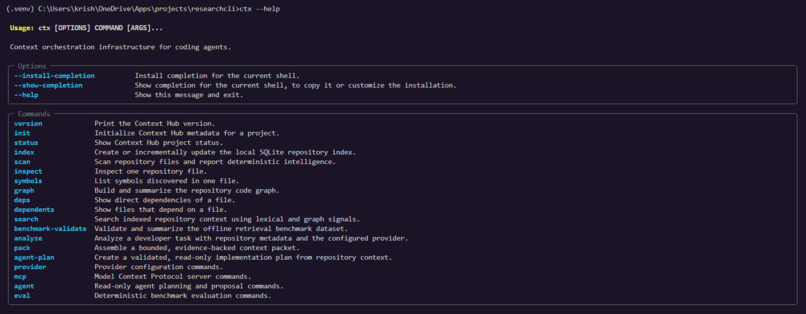
ctx --help
-

ctx analysis
-

ctx provider status
-
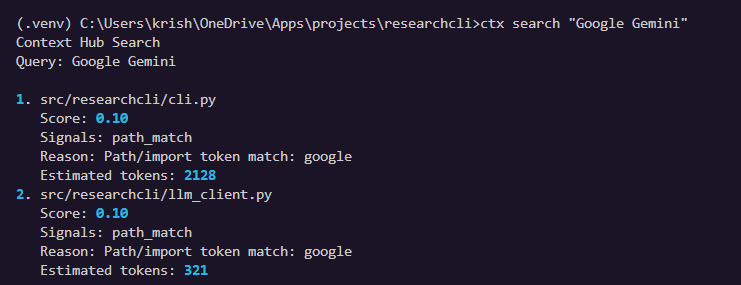
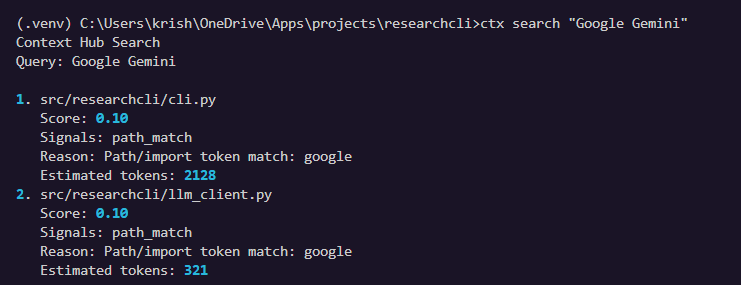
ctx search
-
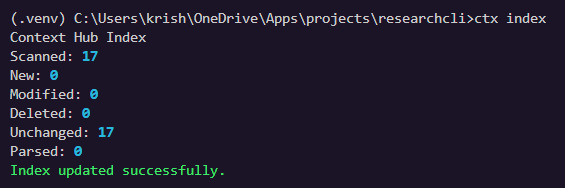
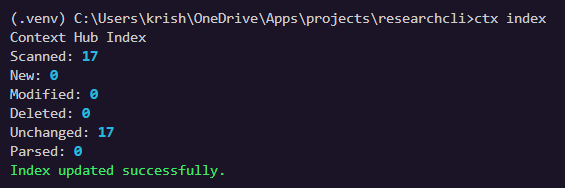
ctx index


Inspiration
AI coding assistants are powerful, but they often lack reliable understanding of the repository they are working in. I wanted to create a local-first tool that helps an LLM understand a codebase through evidence instead of guesswork.
What it does
ContextHub indexes a repository into a local SQLite-based context store. It scans files, discovers symbols and dependencies, builds a code graph, and supports lexical and graph-aware search.
Developers can inspect files, explore relationships between modules, assemble bounded context packets, and ask a configured LLM to analyze the architecture or create an implementation plan. ContextHub also exposes MCP and agent workflows so repository context can be reused by AI tools.
How I built it
I built ContextHub as a CLI-first developer tool with deterministic repository analysis at its core.
The pipeline is:
Repository
    ↓
File scanning and indexing
    ↓
Symbols, dependencies, and code graph
    ↓
Search and context retrieval
    ↓
Evidence-backed context packet
    ↓
LLM analysis or agent plan
The local index keeps project data available for fast searches while provider configuration controls optional LLM analysis.
Challenges I ran into
The biggest challenge was balancing useful context with bounded context. Sending an entire repository to an LLM is expensive, slow, and noisy, so ContextHub needed to select relevant evidence instead.
I also had to handle incomplete projects, unsupported files, dependency relationships, provider configuration, and the difference between deterministic repository facts and LLM-generated explanations.
Accomplishments that I'm proud of
I built a working end-to-end workflow for repository intelligence:
- Project initialization and status reporting
- Incremental indexing
- Repository scanning and file inspection
- Symbol and dependency discovery
- Code-graph construction
- Lexical and graph-aware search
- Evidence-backed context packing
- LLM-powered repository analysis
- Read-only implementation planning
- Provider and MCP integration points
The result is a tool that gives developers and coding agents a more reliable, inspectable view of a codebase.
What I learned
I learned that good AI results depend heavily on the quality and structure of the context provided to the model. Deterministic indexing and relationship analysis make LLM responses more grounded and easier to verify.
I also learned that a useful developer tool should make its evidence visible: users should be able to trace an answer back to files, symbols, dependencies, and search results.
What's next for ContextHub
Next, I want to expand language and framework coverage, improve semantic retrieval, add richer graph exploration, and provide stronger integrations with coding agents.
I also plan to improve provider configuration, add more MCP workflows, support repository change tracking, and make architecture analysis more visual and interactive.
