-
-
title
-
demo-home
-
policy
Inspiration
I work on several AI-assisted projects at the same time. The careful way to handle a long session is to maintain a Markdown handoff, compact around a personal threshold, and explain the state again in the next thread. That works, but it makes the user operate a second system just to keep the AI on track.
I wanted to know whether that ritual could become safer and less repetitive. Research changed my first idea. A Codex plugin cannot honestly claim that it replaces the native compactor, and fewer tokens do not prove that exact coding constraints survived. So I built a narrower tool: a reversible control plane around compaction.
What it does
ContextGC packages a Codex skill, six lifecycle hooks, and six local MCP tools. It turns the current task into a bounded Task Frame and separates information into three actions:
- KEEP exact goals and constraints active;
- SUMMARIZE eligible explanation; and
- EXTERNALIZE sanitized source to a local hash-addressed archive.
There is deliberately no DROP action. Before compaction, ContextGC verifies the checkpoint, snapshot, and hook state. If that protection boundary is not valid, automatic compaction stays paused. After compaction or in a fresh thread, it can load the verified Task Frame and selectively rehydrate archived evidence.
Normal installed use keeps data local. Model-visible results contain an opaque store ID rather than an absolute path. Common credential, email, phone, and home path patterns are minimized before persistence, but this is not a claim of complete PII detection or encryption.
What I demonstrated
The release was tested in two different ways.
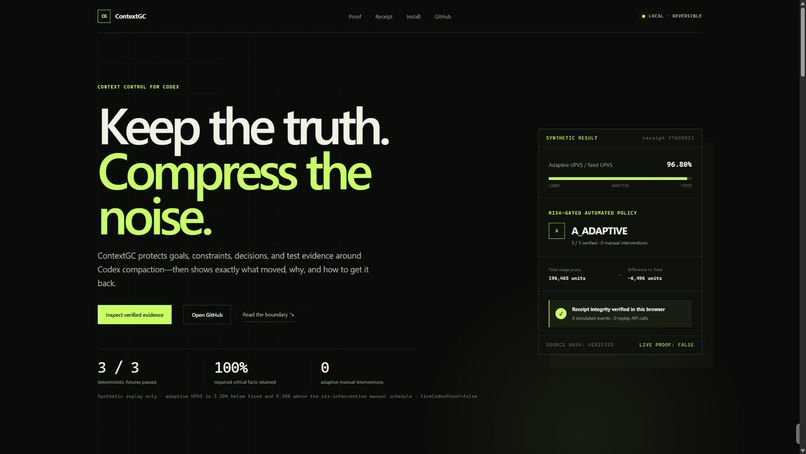
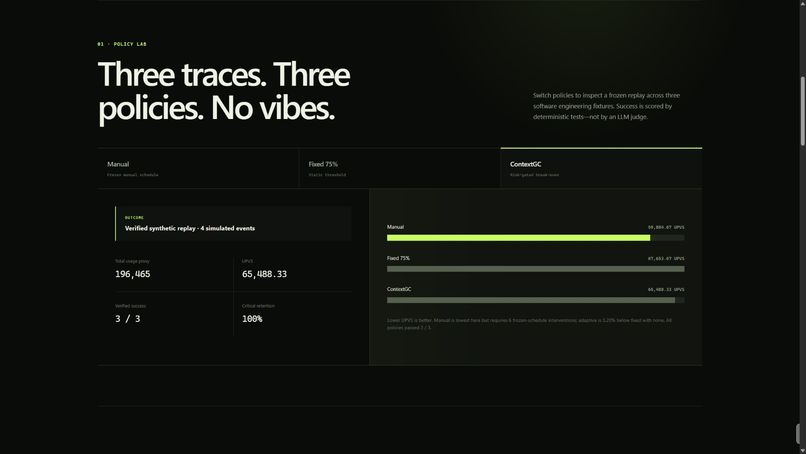
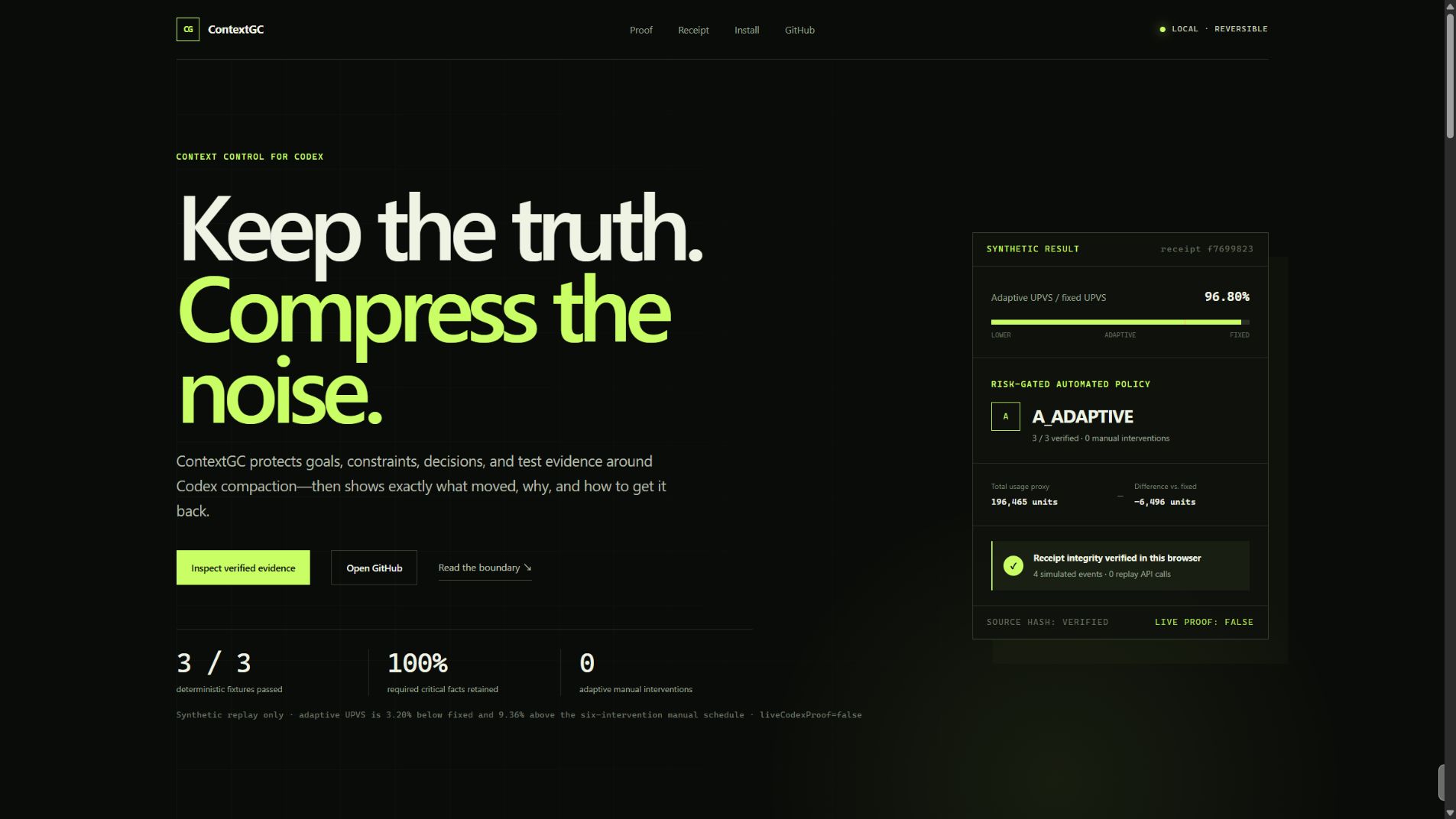
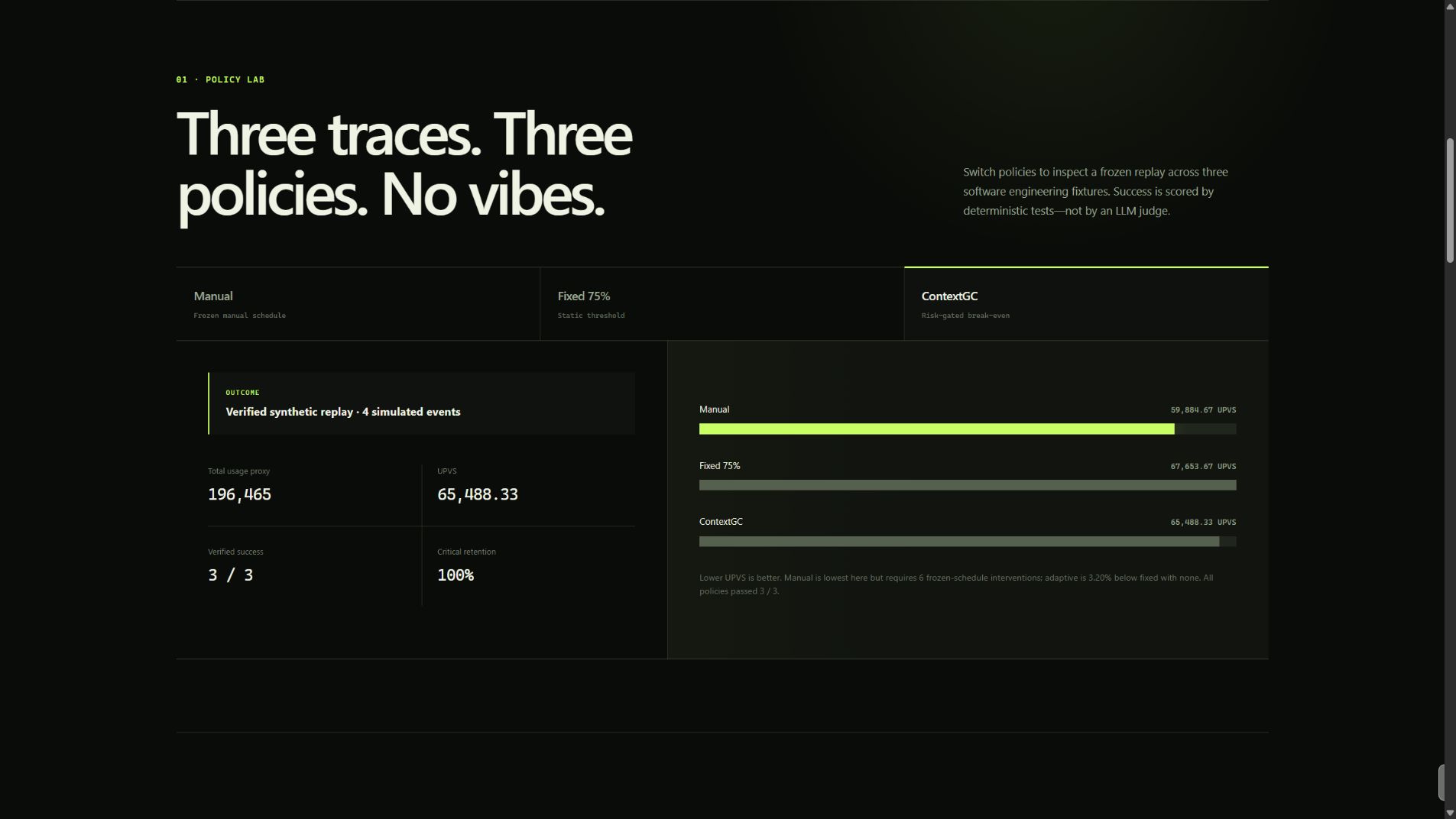
First, three frozen software-engineering traces compare a manual schedule, a fixed 75% threshold, and the adaptive ContextGC policy. Hidden deterministic oracles check exact facts and forbidden changes; an LLM does not grade its own work. Every policy completed 3/3 tasks with 100% critical retention. ContextGC used 3.20% less UPVS than the fixed policy, but 9.36% more than the frozen manual schedule. That means the project's 15%-versus-both savings gate failed.
Second, I tested the installed plugin through the real Codex lifecycle. I reviewed and trusted all six hooks, created a verified checkpoint, completed native compaction, and opened a completely fresh thread. SessionStart recovered the same protected Task Frame, and the acceptance report exposed no local absolute path.
This is why I describe ContextGC as a continuity and audit tool, not as a proven credit-saving product.
How I built it
- TypeScript policy and reversible local runtime
- SHA-256 content-addressed evidence archive
- Atomic checkpoint, mirror, and latest-pointer publication
- Codex skill, MCP server, CLI, and lifecycle hooks
- Frozen fixtures, hidden deterministic oracles, and negative controls
- React/Vinext evidence explorer deployed with OpenAI Sites
- Prebuilt CLI and MCP bundles for no-rebuild judge testing
Hardening work covered stale plugin caches, corrupt checkpoint lineage, transactional publication, bounded state reads, unknown compaction triggers, and normalized local file URI redaction.
How I used Codex and GPT-5.6
Codex with GPT-5.6 was my primary engineering collaborator. I used it to turn the original idea into a testable architecture, verify OpenAI's documented integration boundaries, implement the TypeScript core and plugin, construct fixtures and tests, run adversarial privacy and integrity reviews, repair a real PreCompact liveness deadlock, and integrate the release package.
I made the binding product decisions: Windows-first, local-first persistence, no automatic deletion, a reversible checkpoint boundary, no unsupported token-to-credit estimate, and an honest failed economics gate.
The product itself may ask the active Codex model for one structured Task Frame at a selected lifecycle boundary. Deterministic code validates that frame, selects actions, stores evidence, and evaluates the frozen traces. The benchmark contains no model-as-judge step and makes no out-of-band API call.
Challenges
- Separating native compaction from the state a plugin can safely control
- Protecting exact software constraints without calling every summary lossless
- Making checkpoint publication recoverable under partial failure
- Preventing local paths and session metadata from leaking through the tool
- Comparing policies without turning a usage proxy into a billing claim
- Shipping a public package without exposing private development history
What I learned
Compaction is not only a summarization problem. It is a control problem across future work, exact invariants, cache continuity, retrieval cost, and recovery. The best first version was not a grand memory theory. It was a small controller whose decisions and failures could be inspected.
I also learned that a failed promotion gate is useful product information. The manual policy remained more efficient on the frozen proxy, so ContextGC's verified value is reducing memory-risk and recovery work. Live before/after token receipts are the next measurement milestone.
What's next
- Privacy-preserving live CompactionReceipts
- Markdown handoff import and export
- Calibration on consented real task traces
- User-configurable lifecycle and risk policies
- Version-pinned managed mode for app-server-owned threads
- Cross-platform hook packaging after the Windows contract is stable
Built With
- codex
- gpt-5.6
- mcp
- node.js
- openai
- react
- typescript
- vinext

Log in or sign up for Devpost to join the conversation.