ContextCI
Context-Aware CI. Zero Breaking Changes.

The 3am page
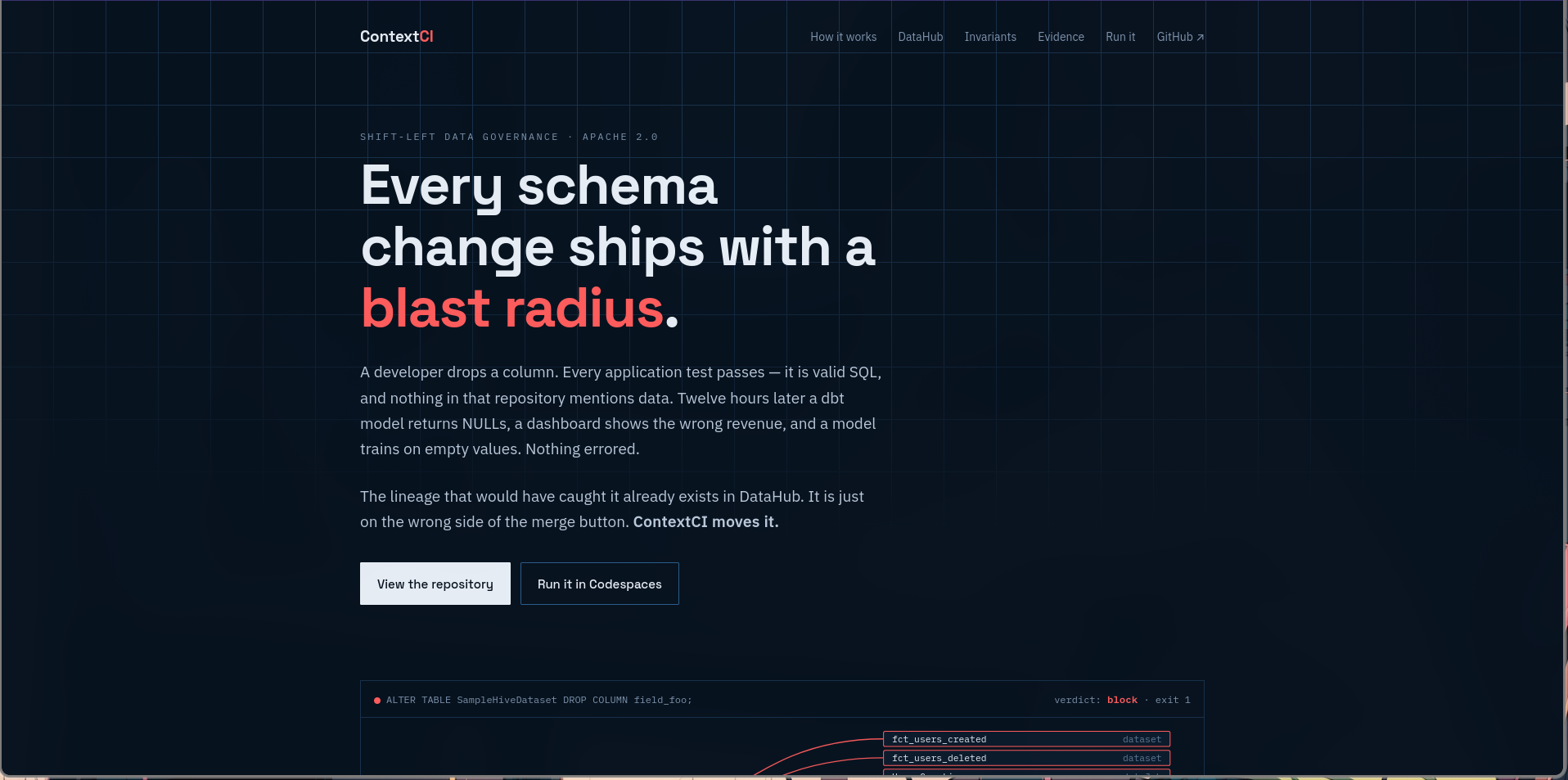
A backend engineer renames user_id to account_id in a migration. Every application
test passes — it is valid SQL, and nothing in that repository mentions data.
Twelve hours later the nightly dbt run produces NULLs, an executive dashboard shows the wrong revenue number, and a recommendation model quietly starts training on empty values. Nobody gets an error. The on-call data engineer spends the morning grepping commit history across ten repositories to find out who changed what.
The lineage that would have caught this already exists in DataHub. It is just on the wrong side of the merge button.
ContextCI moves it. It runs as a GitHub Action: when a pull request alters a schema, it traces the change through DataHub's column-level lineage, decides whether anything downstream breaks, writes the backward-compatible migration, comments on the PR, and tags the affected datasets back in DataHub so the catalog records that a change is in flight.
DataHub is treated as a two-way operating system, not a read-only catalog.
Try it — one command, nothing to install
Click the Codespaces badge above (pick the 4-core machine), then:
make demo
That boots DataHub, ingests sample metadata with real column-level lineage, runs the gate
against a breaking DROP COLUMN, and prints the exact PR comment it would post. Roughly
10–15 minutes on a cold start, almost all of it pulling DataHub's images.
4/4  Running the gate against a breaking schema change
      ALTER TABLE SampleHiveDataset DROP COLUMN field_foo;

ContextCI verdict: block (risk: critical)
  Exit code 1 — 1 means the gate would block the merge.
  DataHub UI:  https://…-9002.app.github.dev   (login datahub / datahub)
Then open the DataHub UI it prints and search SampleHiveDataset — the tags ContextCI
just wrote are on the dataset, on the field_foo column itself, and on every downstream
asset. That round trip, catalog → decision → catalog, is the whole idea.
make help lists the rest (make test, make gate DIFF=…, make token).
To let GitHub Actions reach that DataHub — so CI resolves real lineage instead of degrading to diff-only — see Hosting DataHub on Codespaces.
The four phases
| Phase | Module | What happens |
|---|---|---|
| 1. Parse | src/diff_parser.py |
Extract schema changes from the PR diff — raw SQL DDL, Alembic migrations, dbt schema.yml column removals, dbt model select-list drops |
| 2. Context | src/datahub_mcp_client.py |
Resolve each table to a dataset URN, pull column-level lineage, ownership, glossary terms, tags, the dataset profile, and real query history |
| 3. Analyze | src/blast_analyzer.py, src/code_generator.py |
Claude judges the blast radius against the real lineage and writes runnable migrations; a compliance gate blocks regulated changes outright |
| 4. Act | src/github_reporter.py, src/datahub_mcp_client.py |
Post the PR comment, optionally commit fixes, tag the affected datasets and the changed column in DataHub, fail the build on a block verdict |
What DataHub gives it
| DataHub feature | How ContextCI uses it |
|---|---|
| Column-level lineage | searchAcrossLineage finds downstream assets; each one's upstreamLineage.fineGrainedLineages is checked for the changed column's schemaField URN, so "reads this table" and "reads this column" are reported differently |
| Ownership | Owners of the breaking assets are listed in the PR comment, and @-mentioned when you opt in |
| Glossary terms and tags | PII / GDPR / PHI / Tier-1 markers drive the security gate; other terms escalate risk |
| Dataset profile | Row count, size, and the changed column's null fraction and distinct count size the migration — a backfill on four million rows is not the same as on a staging stub |
| Usage stats and query history | topSqlQueries and per-column fieldCounts ground generated migrations in SQL people actually run, and prove how heavily the column is queried |
| Tag mutations | Schema-Change-Pending, PR-Under-Review, Security-Review-Required on the dataset, Blast-Risk-{level} downstream, plus a field-level tag via editableSchemaMetadata |
| Institutional memory | The pending-change note is attached as a link keyed by the PR URL, so the catalog records why the dataset is flagged |
The compliance gate
Risk heuristics decide engineering impact. They do not get to wave through a compliance decision. A destructive change to a column carrying a PII, GDPR, PHI, HIPAA, PCI, Tier-1, regulated or SOX marker — on the dataset itself or on anything downstream — forces a block and a security review, whatever the blast radius says. Additive changes never gate, and the gate can raise a verdict but never soften one.
What makes a change "breaking"
The analyzer weighs evidence rather than counting rows:
- Column-level lineage confirmed — DataHub's fine-grained lineage proves a downstream asset reads the specific column. Strongest signal.
- Table-level only — the asset reads the table, but DataHub cannot prove it touches the column. Weighed lower, never ignored: absent lineage is not evidence of safety.
- Asset type — dashboards and ML models fail silently, so they escalate risk further than another table would.
- Governance —
PII,GDPR-SensitiveandRevenue-Criticalglossary terms escalate.
block fails the Action (exit 1) and stops the merge. warn comments and passes. approve
is silent.
Quick start for judges
1. Point ContextCI at a DataHub instance
Local quickstart (the DataHub CLI ships with it):
python3 -m venv .venv && source .venv/bin/activate
pip install acryl-datahub
datahub docker quickstart          # GMS on :8080, UI on :9002
If port 8080 is taken, run DATAHUB_MAPPED_GMS_PORT=8081 datahub docker quickstart and use
that port below. The quickstart needs about 13 GB of free Docker disk space.
Load the sample data so there is lineage to trace:
datahub docker ingest-sample-data
1b. Turn on real authentication (recommended)
The quickstart ships with METADATA_SERVICE_AUTH_ENABLED=false, which is why
DATAHUB_GMS_TOKEN can be left blank — the metadata service accepts anonymous
calls. No real deployment runs that way. To make ContextCI authenticate the way it
would in production, flip the flag on GMS and mint a token:
# 1. GMS with metadata auth on (state lives in MySQL/OpenSearch, so recreating GMS is safe)
docker inspect datahub-datahub-gms-quickstart-1 > /tmp/gms.json   # keep its 74 env vars
# recreate with METADATA_SERVICE_AUTH_ENABLED=true and the datahub-gms network alias

# 2. Mint a personal access token straight into .env
python scripts/make_datahub_token.py
scripts/make_datahub_token.py logs into the DataHub frontend, creates a
PERSONAL access token via GraphQL, and writes it to .env as
DATAHUB_GMS_TOKEN, replacing any existing or commented-out line. Options:
--frontend, --user, --password, --duration, --name.
Verify the token is genuinely required:
curl -s -o /dev/null -w '%{http_code}\n' -X POST localhost:8081/api/graphql \
  -H 'Content-Type: application/json' -d '{"query":"{ me { corpUser { username } } }"}'
# 401 without a token; 200 with `Authorization: Bearer $DATAHUB_GMS_TOKEN`
Once the token is in .env, every read and every mutation ContextCI performs is
authenticated — nothing else in the project changes.
The
datahub-gmsnetwork alias matters: the frontend resolves GMS by that name, and a recreated container that only carriesdatahub-gms-quickstartwill make login fail withUnknownHostException: datahub-gms.
2. Configure the repository
Add these repository secrets (Settings → Secrets and variables → Actions):
| Secret | Purpose |
|---|---|
DATAHUB_MCP_URL |
DataHub GMS endpoint, e.g. http://localhost:8081 or https://<instance>.acryl.io/gms |
DATAHUB_GMS_TOKEN |
DataHub personal access token (omit for an unauthenticated local quickstart) |
ANTHROPIC_API_KEY |
Enables LLM analysis and code generation with Claude |
GROQ_API_KEY |
Alternative provider. Used when no Anthropic key is set; without either, ContextCI falls back to deterministic rules |
GITHUB_TOKEN is provided by Actions automatically.
Optional repository variables:
| Variable | Default | Purpose |
|---|---|---|
DATAHUB_PLATFORM |
postgres |
Platform used when resolving a table name to a dataset URN |
DATAHUB_ENV |
PROD |
Environment segment of the URN |
CONTEXTCI_AUTOFIX |
false |
Commit generated migrations to the PR branch |
CONTEXTCI_MENTION_OWNERS |
false |
@-mention DataHub owners in the comment (see the note below) |
DATAHUB_FRONTEND_URL |
— | Base URL used to link assets in the comment, e.g. http://localhost:9002 |
TOOLS_IS_MUTATION_ENABLED |
true |
Set false for a read-only run — every graph write logs what it would have done and changes nothing. Same switch name the DataHub MCP Server uses |
The workflow at .github/workflows/contextci-gate.yml is already wired up — it runs on every
pull request against main.
3. Open a breaking PR
-- migrations/007_drop_customer_id.sql
ALTER TABLE analytics.orders DROP COLUMN customer_id;
ContextCI comments with the blast radius, the migration, and the owners; the check fails; the
Schema-Change-Pending tag appears on the dataset in the DataHub UI.
examples/sample_pr_comment.md and examples/sample_dbt_fix.sql show real output.
4. Try it without a pull request
--diff runs phases 1–3 against a diff on disk and prints the exact comment it
would post. Graph writes stay off unless you ask for them:
python -m src.main --diff examples/breaking_change.diff
Against a live catalog, pointing at a dataset that really has lineage:
DATAHUB_GMS_URL=http://localhost:8081 \
DATAHUB_PLATFORM=hive \
TOOLS_IS_MUTATION_ENABLED=true \
python -m src.main --diff my_change.diff
This is the run recorded under "Verified end to end" below.
5. Run it locally
pip install -r requirements.txt
export GITHUB_TOKEN=ghp_...
export GITHUB_REPOSITORY=owner/repo
export PR_NUMBER=128
export DATAHUB_MCP_URL=http://localhost:8081
export ANTHROPIC_API_KEY=sk-ant-...
python -m src.main
Or containerised:
docker build -t contextci .
docker run --rm --network host \
  -e GITHUB_TOKEN -e GITHUB_REPOSITORY -e PR_NUMBER \
  -e DATAHUB_MCP_URL -e ANTHROPIC_API_KEY contextci
Reasoning providers
| Provider | Env var | Default model | Notes |
|---|---|---|---|
| Anthropic | ANTHROPIC_API_KEY |
claude-opus-5 |
Structured output via messages.parse |
| Groq | GROQ_API_KEY |
openai/gpt-oss-120b |
Override with CONTEXTCI_GROQ_MODEL |
| None | — | — | Deterministic rule-based analyzer |
Anthropic wins when both keys are set. A provider failure is never fatal — ContextCI logs it and falls through to the rules.
Groq free-tier limit. The free tier allows 8000 tokens per minute and counts
max_tokens against that budget, so ContextCI asks Groq for 4000 rather than the
16000 it asks Claude for. Raise it with CONTEXTCI_GROQ_MAX_TOKENS on a paid
tier. Not every Groq model supports strict JSON schema (openai/gpt-oss-120b
does, llama-3.3-70b-versatile does not); ContextCI detects the rejection and
retries in JSON mode automatically.
Verified end to end
Run against a DataHub v1.7.0 quickstart (GMS on :8081, UI on :9002) loaded
with the standard bootstrap_mce.json sample metadata — 105 events, 7 datasets
with real lineage, ownership and ML features.
Input diff: ALTER TABLE SampleHiveDataset DROP COLUMN field_foo;
| Phase | Result |
|---|---|
| 1 | Change parsed from the diff: drop_column SampleHiveDataset.field_foo |
| 2 | Resolved to urn:li:dataset:(urn:li:dataPlatform:hive,SampleHiveDataset,PROD); 13 downstream assets found — 2 dbt-style datasets, 2 data jobs, 4 ML features, 3 ML primary keys, an S3 backup; owners John Doe, DataHub |
| 3 | Verdict critical / block, with a staged-deprecation compatibility view generated |
| 4 | 17/17 graph mutations applied |
What landed in DataHub, read back from the graph afterwards:
dataset tags:     Legacy, Schema-Change-Pending, PR-Under-Review   ← existing tag preserved
field tag:        field_foo → Schema-Change-Pending                ← column-level write-back
downstream tags:  fct_users_created → Blast-Risk-Critical
note:             file:///…/live_demo.diff → "Pending …: drop column on `field_foo`.
                  Blast radius: 13 downstream asset(s)…"
Re-running holds at 17/17 with no duplicated tags and the note updated in
place, not appended.
The LLM path is verified too, via Groq (openai/gpt-oss-120b) against the
same catalog. Three consecutive runs were served by the model with no rate-limit
failures. On this data it returns medium / warn where the rules return
critical / block — a defensible disagreement: there are 13 downstream assets but
DataHub confirms column-level lineage for none of them, and the model weighs that
uncertainty rather than counting neighbours. Its summary and generated view:
Dropping
field_foomay break downstream assets that read it; column is used in queries but no confirmed lineage.
CREATE OR REPLACE VIEW SampleHiveDataset_compat AS
SELECT field_foo, field_bar FROM SampleHiveDataset;
The Claude path has not been exercised against the live API here — no Anthropic key was available on this machine.
Level 4: a real pull request
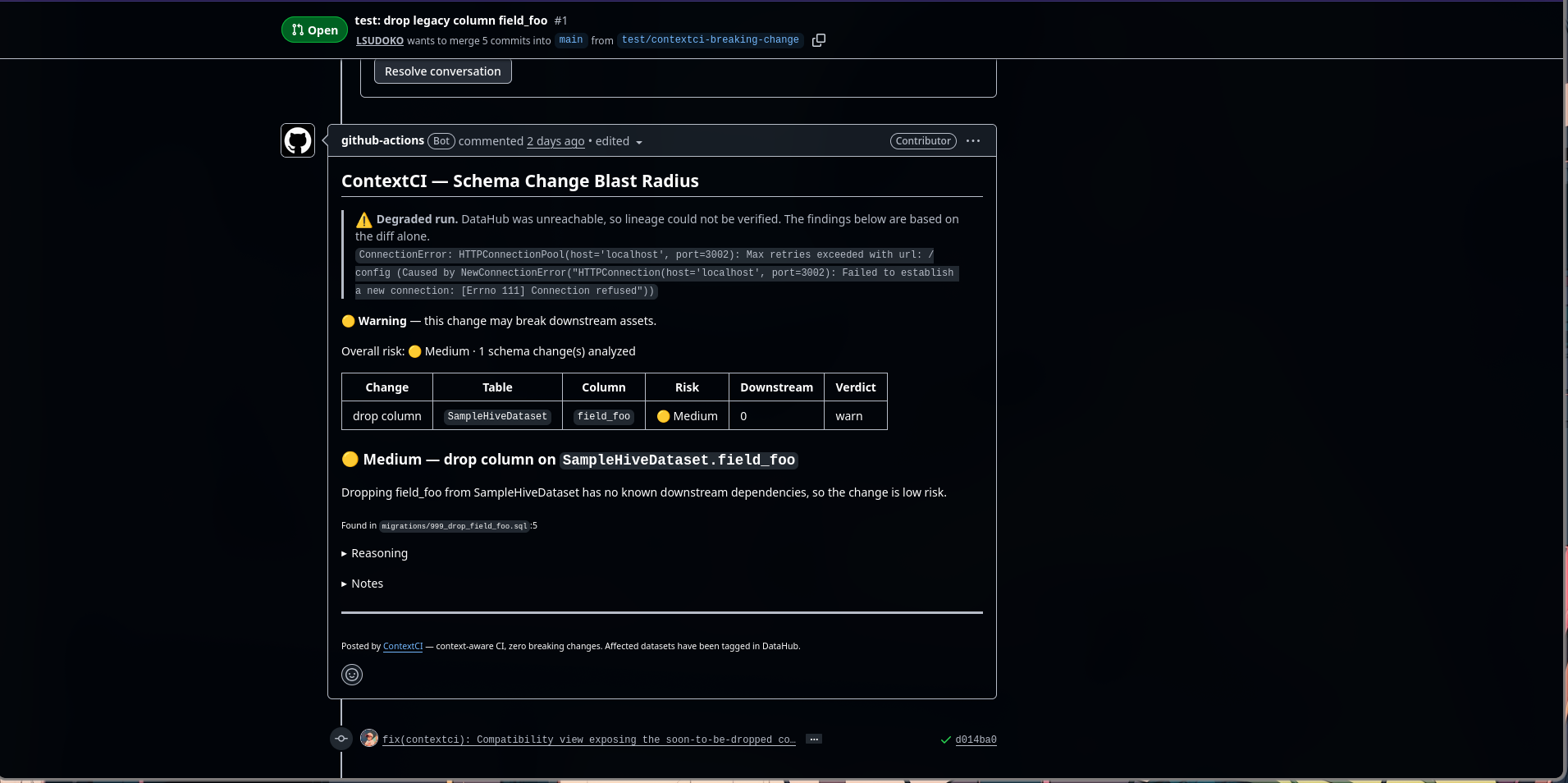
Run against LSUDOKO/ContextCI#1,
a PR whose only content is ALTER TABLE SampleHiveDataset DROP COLUMN field_foo;.
| Checked | Result |
|---|---|
| Diff read from the GitHub API | 1 change found in migrations/999_drop_field_foo.sql |
| Lineage resolved | 13 downstream assets |
| Verdict | block / critical, exit code 1 — merge is stopped |
| PR comment | posted once, then edited in place across five further runs (created 11:12, updated 11:15, one comment carrying the marker) |
| Auto-fix | with CONTEXTCI_AUTOFIX=true, fix(contextci): … committed a compatibility view to the PR branch |
| Graph write-back | 17/17 mutations; Blast-Risk-High from an earlier run replaced by Blast-Risk-Critical, not stacked |
Through authenticated DataHub
The same PR run with METADATA_SERVICE_AUTH_ENABLED=true and a real
DATAHUB_GMS_TOKEN: anonymous GraphQL and OpenAPI both return 401, the token
resolves as urn:li:corpuser:datahub, and the run reads 13 downstream assets and
applies all 17 mutations through the authenticated endpoint.
In GitHub Actions
The workflow has run on PR #1 for real, not just locally (runs):
phase 1: 1 schema change(s) detected              ← diff read from the GitHub API
phase 3: verdict from groq                        ← AI reasoning on the runner
phase 4a: comment …#issuecomment-5225846936       ← posted by github-actions[bot]
DataHub is unreachable from a GitHub-hosted runner if it only exists on your
laptop, and the run degrades to diff-only analysis with a banner saying so — which
is the designed behaviour, not a failure. For full lineage in CI you need DataHub
reachable from the runner: a hosted/cloud DataHub, a self-hosted runner on the
same network, or a tunnel. Set DATAHUB_MCP_URL to that endpoint.
Two CI-only bugs came out of this, both fixed: the workflow never forwarded
GROQ_API_KEY (so CI silently ran rule-based), and an unset Actions vars.X
interpolates to the empty string, which os.getenv(name, default) returns
verbatim — Groq was being called with an empty model name. Config reads now use
os.getenv(x) or default throughout.
Three more bugs surfaced from the live reruns, all fixed:
- Risk tags accumulated instead of replacing, so one asset carried
Blast-Risk-Critical,-Mediumand-Highat once. - A non-breaking verdict skipped write-back entirely, leaving markers from an earlier breaking run on the dataset forever.
- The verdict was not reproducible. The same input returned
high / blocktwice andmedium / warnon the third run.temperature=0does not fix this — MoE batching on hosted inference is nondeterministic by construction. The deterministic rules are now a floor: the model writes the summary, reasoning and migration and may escalate, but can never rule a change safer than the rules would have. Four consecutive runs then returnedblock / criticalidentically.
Quickstart gotchas hit on the way, in case you hit them too:
- The quickstart refuses to start below 13 GB of free Docker disk.
- If another process already holds host port
3306, the quickstart's MySQL container can end up detached fromdatahub_network, and the system-update job then fails withTimeout waiting for TCP mysql:3306. - Below ~5% free disk, OpenSearch sets a persistent
cluster.blocks.create_index, and system-update fails atBuildIndicesStepwith403 index_create_block_exception. Free disk, then clear it:curl -XPUT localhost:9200/_cluster/settings -H 'Content-Type: application/json' -d '{"persistent":{"cluster.blocks.create_index":null}}'
Who this is for
| Role | What changes on Monday |
|---|---|
| Data / analytics engineers | Downstream breakage is caught before merge, not at 3am. The blast radius and a working migration arrive on the PR, so MTTR drops from hours of git archaeology to reading one comment. No more reviewing every backend PR by hand hoping to spot a schema change. |
| Software engineers | Feedback in the tool they already use. No DataHub login, no dbt knowledge, no waiting on a data team review — the PR tells them what they are about to break and hands them the fix. |
| ML platform teams | The failure mode ML actually has: a dropped feature does not raise, it feeds NULLs into training and the model silently degrades. ContextCI treats ML features and models as first-class downstream assets and escalates them above ordinary tables, because they fail quietly. |
| Data leadership | Fewer broken dashboards during business hours, less compute burned on pipelines that were doomed at merge time, and a catalog that records why a dataset is flagged instead of going stale. |
Where it stops
Stated plainly, because a gate you cannot trust is worse than none:
- Lineage quality is DataHub's, not ours. On an uninstrumented warehouse you get
table-level lineage only, and ContextCI says so on every asset (
⚠️ table-level only) rather than implying certainty it does not have. - Table-name resolution assumes one platform per repository. A repo spanning Postgres
and Snowflake needs
DATAHUB_PLATFORMper run. - The migration is a starting point, not a merge-ready commit. It is generated from real schemas and real query history, and a human still reviews it — the same as any other suggested change.
Roadmap — other surfaces
The GitHub Action is the right primary surface: no new UI, no new credentials, and it lives where the decision is already being made. Two extensions are worth naming:
- Hosted service / GitHub App — "connect your repo, paste your DataHub URL" for teams without CI expertise. Deliberately not built here: it means holding other people's DataHub credentials, and the Action already installs in three lines of YAML.
- VS Code extension — show the blast radius inline while the migration is being written, before commit. The interesting version is a thin client over the same analyzer, not a second copy of it.
Design decisions worth knowing
Owner @-mentions are opt-in. DataHub owner names are not necessarily GitHub handles, and
a wrong guess pings an unrelated person on every pull request. ContextCI renders owners as
plain names until you set CONTEXTCI_MENTION_OWNERS=true.
Idempotent by construction. The PR comment is keyed by an HTML marker and edited in place, so pushing to the branch never stacks duplicates. DataHub tags are read before write, and the pending-change note is keyed by the PR URL, so re-running mutates nothing twice.
Degrades instead of crashing. If DataHub is unreachable the client stays constructed but
reports available = False; reads return empty, writes return False, and the PR comment
carries a "degraded run" banner. If no ANTHROPIC_API_KEY is set, the rule-based analyzer
takes over. The gate always produces a verdict.
Only added lines count as DDL. Deleting an old migration file is not a schema change being shipped, and commented-out DDL is ignored.
ContextCI ignores its own tags. Blast-Risk-Critical written by a previous run
would otherwise match the critical Tier-1 marker and gate a change that was never
regulated. Every tag ContextCI writes is excluded from governance evaluation; a real
Business-Critical tag still gates.
No LangChain. The analysis is a single structured-output call —
client.messages.parse(output_format=...) — so a chain framework would add a
dependency and an abstraction layer without removing a line of code.
Development
cp .env.example .env          # then fill in your keys
pip install -r requirements-dev.txt
pytest -q
74 tests cover diff parsing across four dialects, the risk-escalation rules, the compliance gate, the rule floor, the DataHub write path (against a fake graph that records emitted aspects), local diff splitting, and comment rendering. No network, no DataHub, no LLM API.
Repository layout
├── src/
│   ├── main.py                 # orchestrates the four phases; exits 1 on block
│   ├── models.py               # Pydantic contracts shared between phases
│   ├── diff_parser.py          # phase 1 — parse the PR diff
│   ├── datahub_mcp_client.py   # phase 2 reads + phase 4 writes
│   ├── blast_analyzer.py       # phase 3 verdict (LLM + rule floor + compliance gate)
│   ├── code_generator.py       # phase 3 migrations (prompt + templates)
│   └── github_reporter.py      # phase 4 PR comment and auto-fix commits
├── tests/                      # 74 tests, no network or external services
├── examples/
│   ├── demo_sample_hive.diff   # targets the DataHub sample data — use this for the demo
│   ├── breaking_change.diff    # SQL + Alembic + dbt YAML, shows parser breadth
│   ├── sample_dbt_fix.sql      # a generated migration
│   └── sample_pr_comment.md    # a real posted comment
├── scripts/
│   └── make_datahub_token.py   # mint a DataHub PAT into .env
├── .github/workflows/
│   └── contextci-gate.yml      # the GitHub Action
├── .devcontainer/
│   └── devcontainer.json       # Codespaces: Python 3.11 + docker-in-docker, 4-core
├── Makefile                    # make demo / test / gate / token
├── scripts/demo.sh             # the one-command demo
├── .env.example                # every setting, documented
├── TESTING.md                  # four-level manual test guide
├── Dockerfile
└── LICENSE                     # Apache 2.0
Agent and IDE tooling (.agents/, .cursor/, .claude/, .windsurf/,
.clinerules/, .opencode/, AGENTS.md) is local developer config and is
gitignored — the DataHub Skills those directories vendor are installed as a
plugin, not committed here.
License
Apache 2.0 — see LICENSE.
Built With
- datahub
- githubcodespace
- python


Log in or sign up for Devpost to join the conversation.