-
-

Landing page
-

Inspiration
Creating content often starts with a guess: What should I publish next?
Creators can have access to thousands of comments, questions, discussions, and audience reactions, but turning this raw feedback into a clear content strategy is difficult. The most visible signal is not always the most valuable one.
We wanted to build a system that starts with evidence instead of content generation.
That led to ContentPulse: a platform designed to transform raw audience signals into validated content opportunities.
What it does
ContentPulse follows an evidence-first workflow:
Audience Signals → Analysis → Insights → Opportunities → Evidence → Content
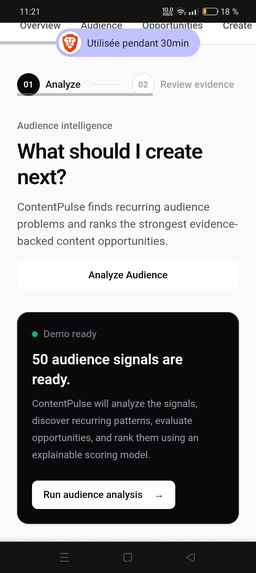
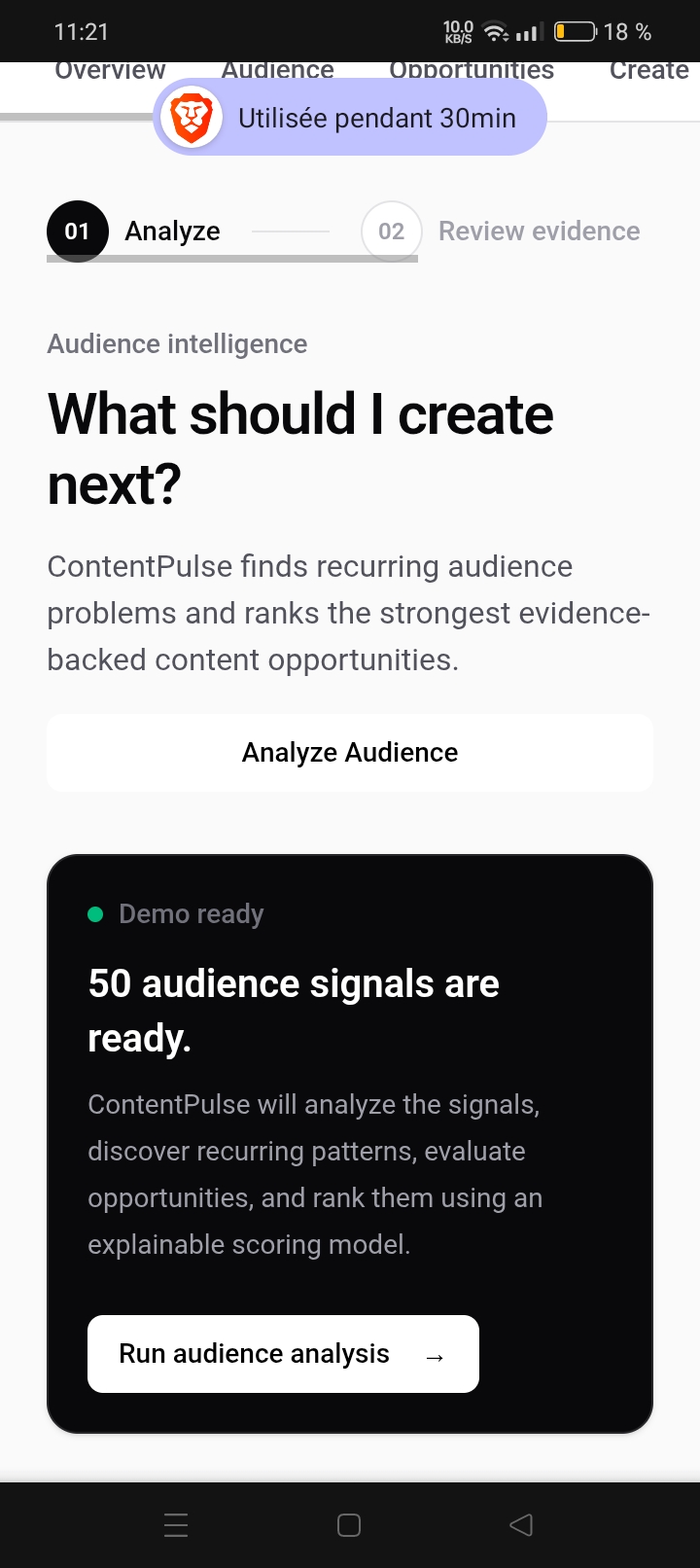
Users provide audience signals such as comments, questions, and discussions. ContentPulse analyzes them to identify recurring problems, topics, intent, sentiment, and pain intensity.
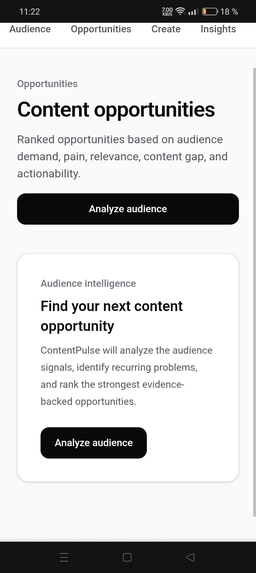
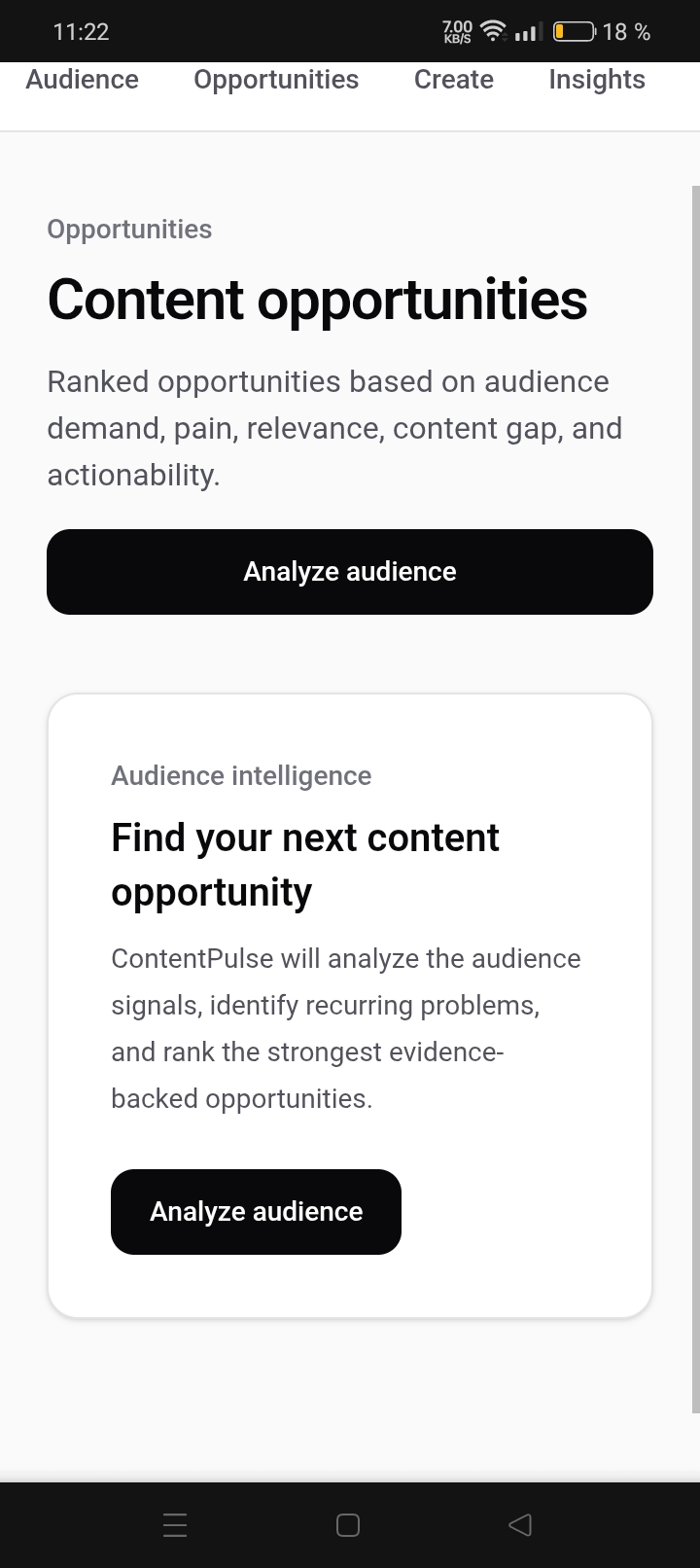
These signals are then transformed into audience insights and ranked content opportunities using multiple factors, including demand, pain, relevance, gap, and actionability.
Before creating content, users can inspect the evidence behind an opportunity and understand why it was selected.
Once an opportunity is validated, ContentPulse creates a structured Content Atom containing the core problem, insight, audience, angle, evidence, promise, and call to action. This foundation can then be transformed into platform-specific content.
How we built it
ContentPulse was built as a full-stack Next.js application.
The frontend uses Next.js, React, TypeScript, and Tailwind CSS.
The backend uses Next.js API routes, Google Gemini for AI analysis and content generation, and Supabase/PostgreSQL for the application data layer.
The application is deployed on Vercel.
The system separates the main stages of the workflow into independent components: signal analysis, insight generation, opportunity scoring, evidence exploration, content atom creation, content generation, and performance evaluation.
Challenges
One of the main challenges was avoiding the common pattern of simply sending audience data to an LLM and asking it to generate content.
We instead designed the product around structured intermediate representations. Raw signals become analyzed signals, analyzed signals become insights, and insights become scored opportunities before content is generated.
Another challenge was keeping the application simple enough for an MVP while maintaining a clear architecture that could support future improvements.
We also had to make the AI output predictable enough for the application to consume reliably. Structured validation and scoring were therefore important parts of the implementation.
What we learned
The biggest lesson was that content generation is not necessarily the hardest part of the problem.
The harder question is deciding what deserves to be created in the first place.
An AI system can generate hundreds of posts, but generating more content does not solve the problem of choosing the right problem to address.
ContentPulse therefore focuses on the decision before creation:
«Find the signal. Prove the opportunity. Then create.»
Future direction
The current version is an MVP focused on the core evidence-to-content workflow.
Future versions could expand the number of audience sources, improve semantic clustering, introduce stronger historical performance feedback, and create a continuous learning loop connecting audience evidence with content performance.
The long-term goal is to make ContentPulse a decision layer between what an audience says and what a creator publishes.
Built With
- ai
- css
- gemini
- next
- postgresql
- react
- supabase
- tailwind
- typescript
- vercel

