-
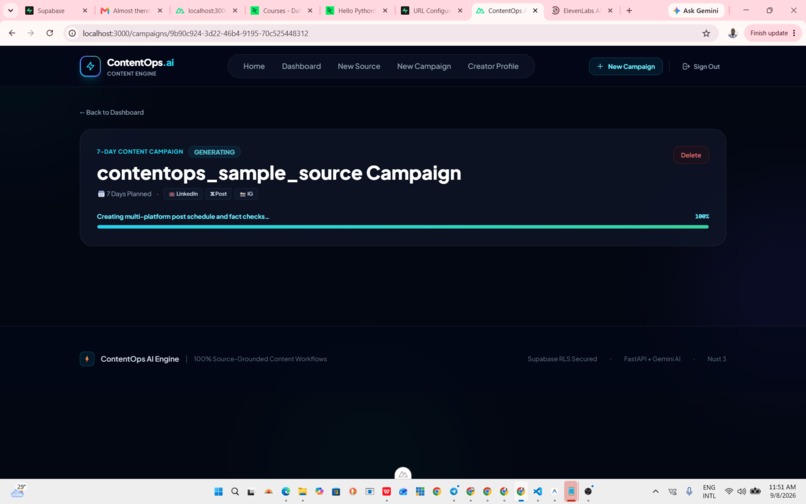
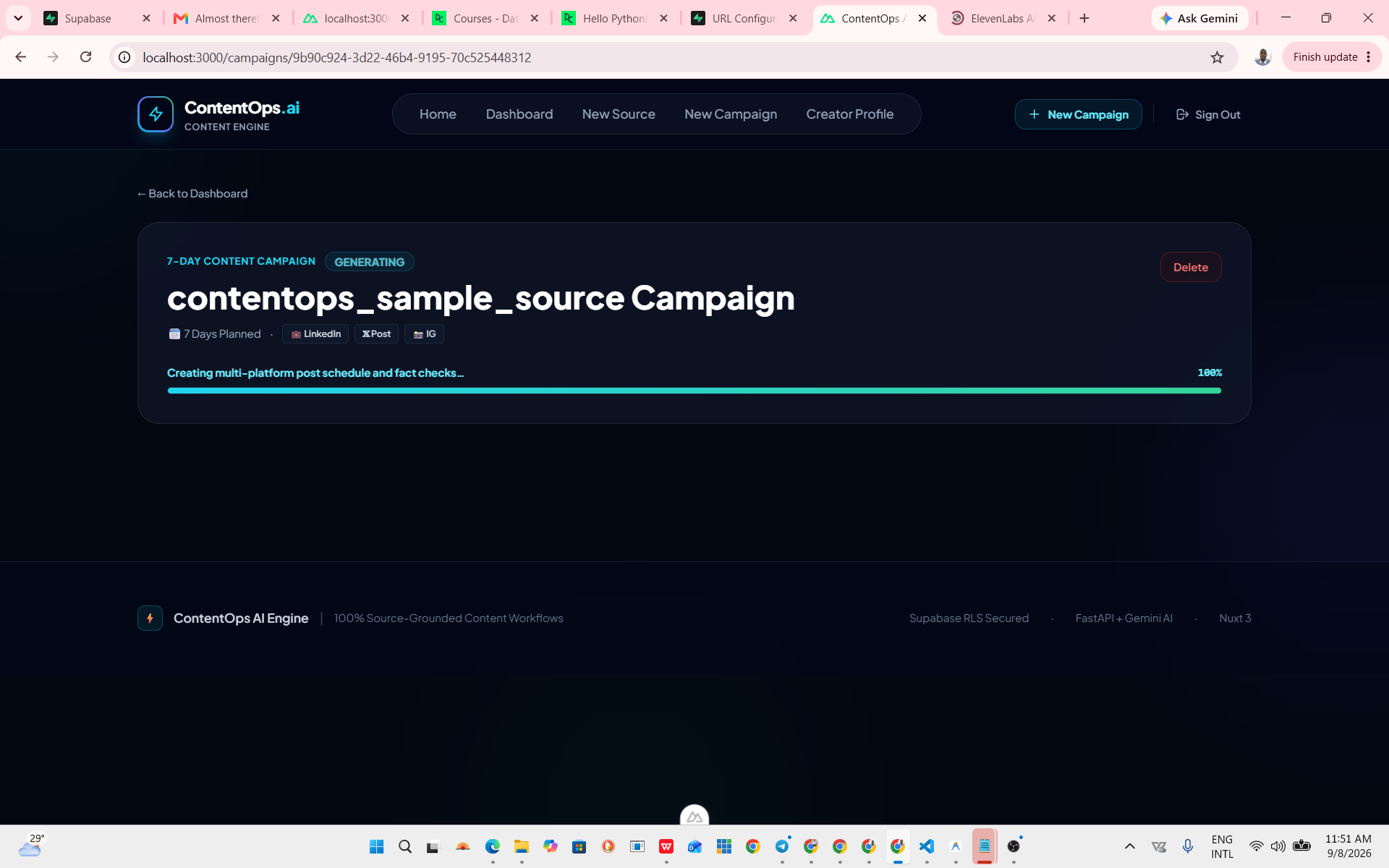
Generating 7-days content campaign
-
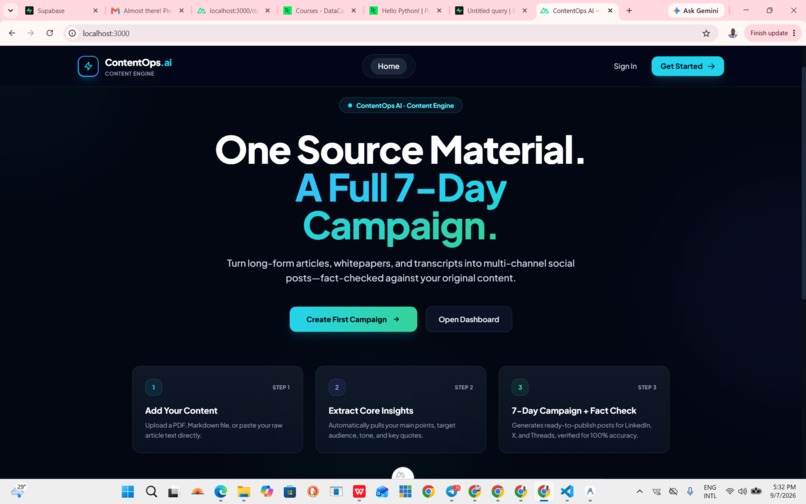
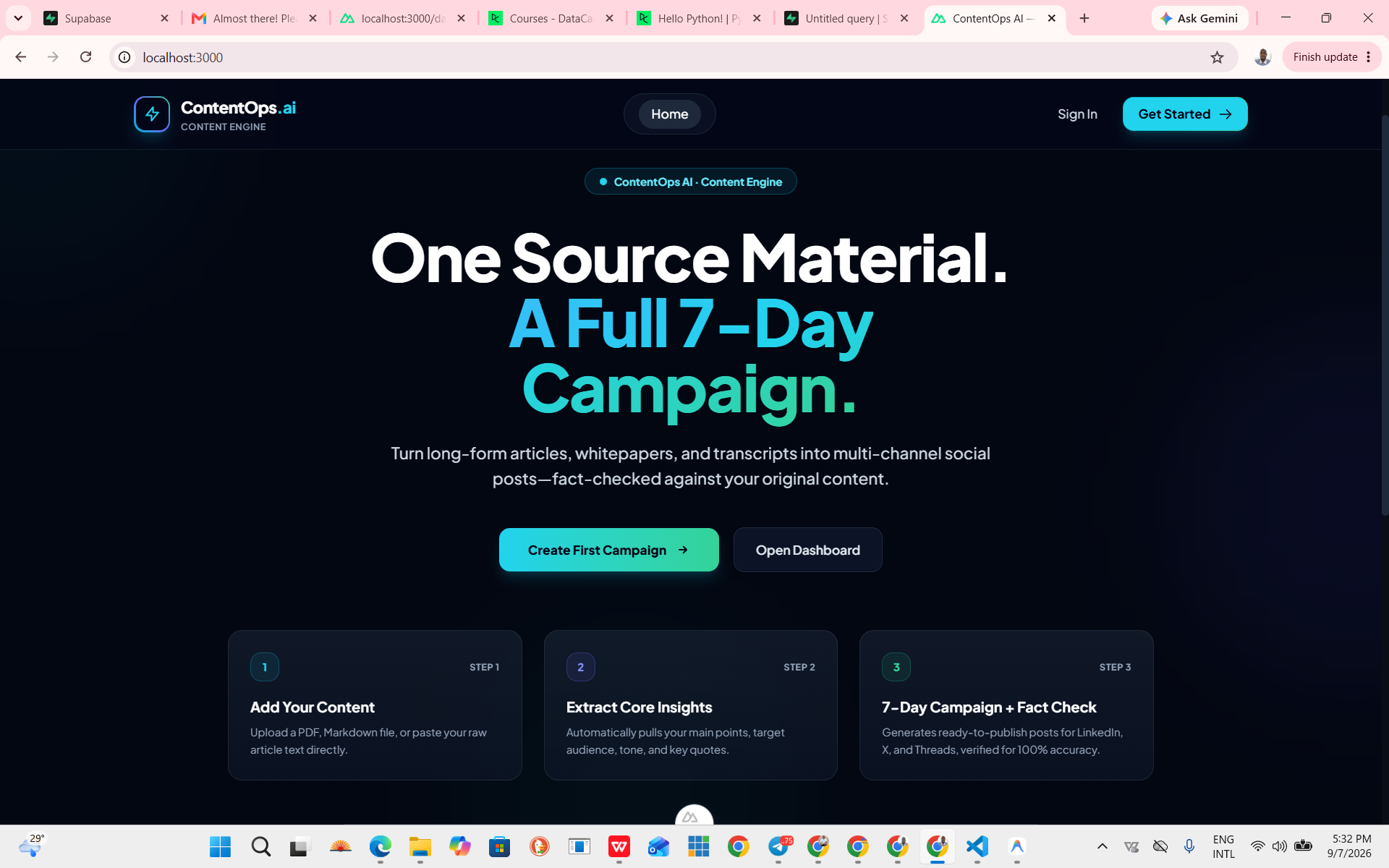
Homepage
-
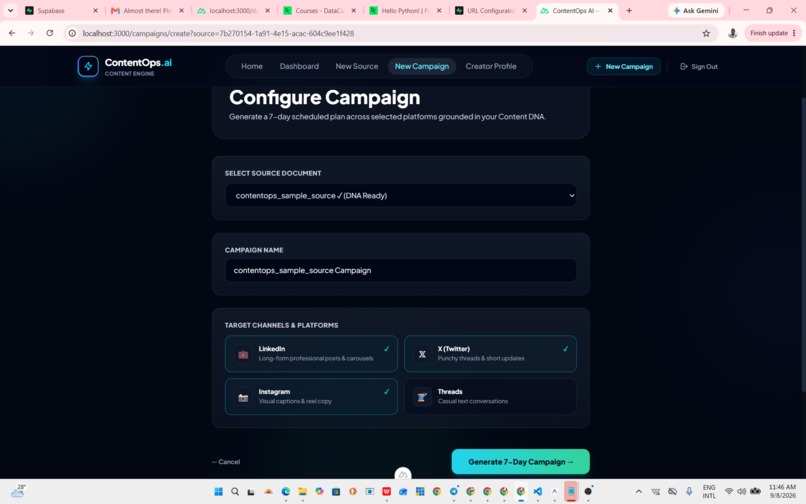
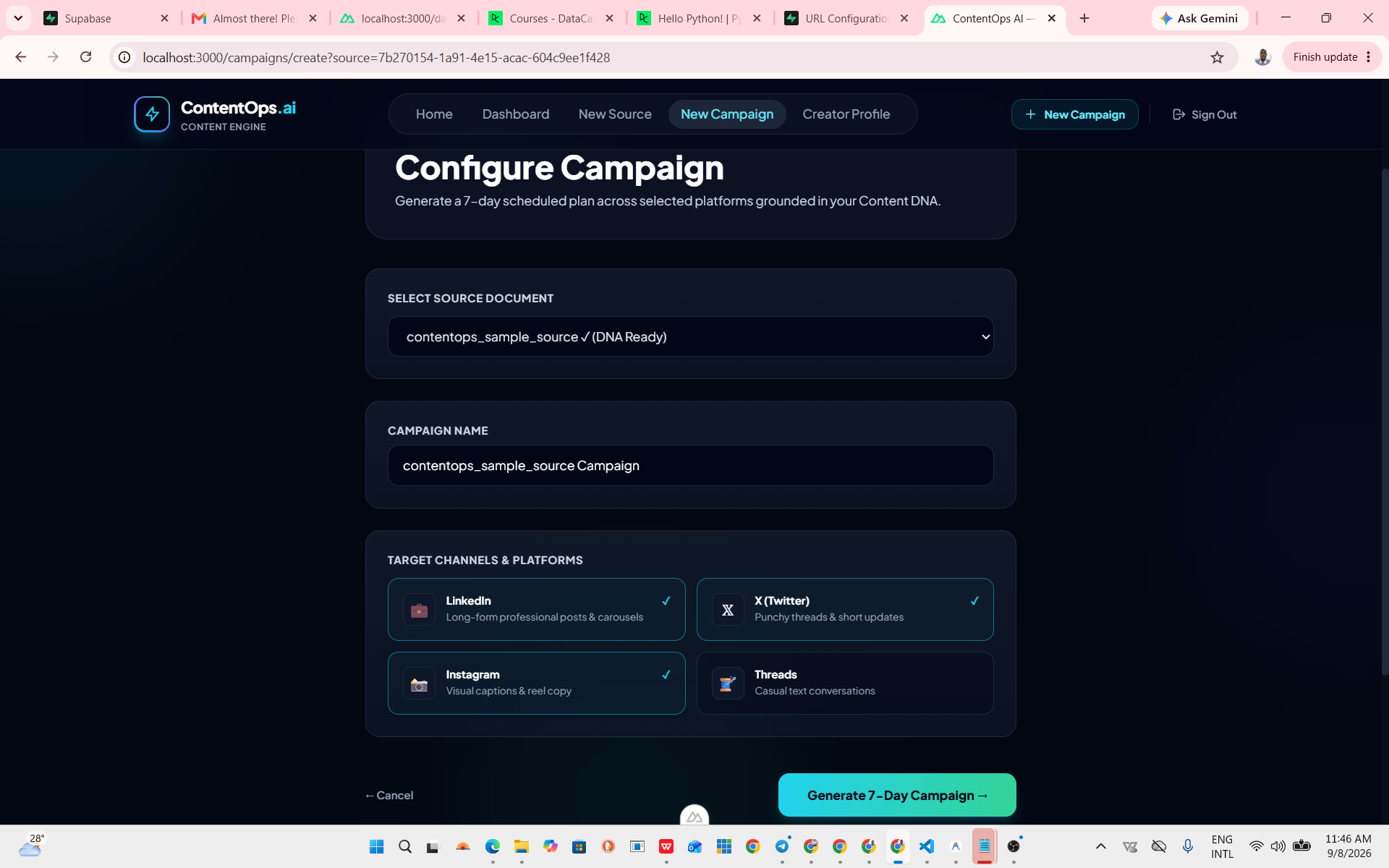
Campaign configuration
Inspiration
Creating content is not always the hard part.
The hard part is what comes after.
A creator can spend hours writing one good article, recording a podcast, publishing a video, or putting together a detailed piece of research. That one piece of content can contain enough ideas for an entire week of LinkedIn posts, X posts, Instagram content, and SEO material.
Turning it into all of those things usually means copying and pasting, rewriting, planning, scheduling, checking the details, and repeating the process for every platform.
AI makes the writing part faster, but it introduced another problem: how do you know the AI stayed faithful to the original content?
An AI-generated post can sound great while quietly changing a statistic, inventing a claim, or making the creator sound completely different.
That was the problem I wanted to solve.
ContentOps AI started from a simple idea:
What if a creator could give us one good piece of content and get an entire, organized campaign back — without losing the meaning of the original?
What it does
ContentOps AI turns one source of content into a complete 7-day, multi-platform content campaign.
The workflow is:
One Source → Content DNA → Campaign Strategy → Platform Content → QA → Publishing Calendar
The first step is extracting what I call the Content DNA.
Instead of repeatedly asking an AI model to read the original content and generate something new, ContentOps AI first identifies the important information in the source: the main thesis, key points, claims, statistics, target audience, tone, keywords, stories, entities, and call to action.
That Content DNA becomes the source of truth for the rest of the workflow.
From there, the system creates a campaign strategy and generates platform-specific content for LinkedIn, X, and Instagram, as well as SEO content.
The generated content then goes through a QA and faithfulness check against the original source before it is presented as ready.
The final step is the publishing schedule.
Rather than giving the creator seven unrelated AI-generated posts, ContentOps AI organizes them into a 7-day campaign with a platform, objective, recommended publishing time, status, and QA result for each piece.
The campaign can move from awareness to engagement, education, trust, value, and finally conversion.
So the result is not simply "AI-generated content."
It is:
One source. One workflow. A complete 7-day campaign.
How we built it
I built ContentOps AI as a full-stack web application.
The frontend uses Nuxt 3, Vue, TypeScript, and Tailwind CSS. The backend is built with Python and FastAPI, while Supabase/PostgreSQL handles application data and storage. OpenAI powers the content analysis, strategy, generation, and QA stages.
I deliberately kept the architecture simple.
Rather than creating a large collection of AI agents or introducing unnecessary infrastructure, the backend coordinates four focused stages:
- Content analysis
- Campaign strategy
- Content generation
- Content quality and faithfulness checking
The stages are connected through structured data, with Content DNA acting as the common reference point.
The calendar itself is not generated as an arbitrary AI response. The AI produces a campaign strategy, and the backend validates that strategy and turns it into structured content assets with dates, objectives, platforms, and publishing times.
This separation was important because it means the application is not simply trusting an AI model to produce the entire workflow in one response.
Challenges we ran into
The biggest challenge was not generating text.
Generating text is easy.
The difficult part was making the generated content useful while preventing the AI from drifting away from the original source.
A fluent AI response can still contain an incorrect statistic, exaggerate a claim, or introduce information that was never present in the source.
That changed the architecture of the application.
I separated the workflow into structured stages and made Content DNA the common source of truth. I then added a QA layer that evaluates generated content against the source instead of simply assuming that a well-written response is a correct one.
Another challenge was deciding how much to build.
There are many things that could be added to a content platform — social publishing APIs, analytics, thumbnails, transcription, team collaboration, more platforms, and more.
For the hackathon, I had to resist the temptation to build everything.
I focused instead on making one complete workflow work from beginning to end.
Accomplishments that we're proud of
The biggest accomplishment is that ContentOps AI is a working end-to-end workflow rather than a collection of disconnected AI features.
A user can start with a piece of content and move through the entire process:
Source → Content DNA → Campaign → Platform Content → QA → 7-Day Calendar
I'm particularly proud of the Content DNA concept because it gives the system a structured understanding of the source before content generation begins.
I'm also proud of the faithfulness/QA layer.
The goal wasn't just to make AI generate content that sounds good. It was to make the system ask an additional question:
"Did we actually stay true to the source?"
The publishing calendar was another important part of the final product. It turns the generated assets into something a creator can actually use as a weekly content plan.
Most importantly, I was able to bring the idea from problem definition to a functioning full-stack application within the hackathon scope.
What we learned
I learned that a useful AI workflow does not have to be complicated to be powerful.
The first instinct when building an AI product can be to add more agents, more integrations, and more features.
For this project, I went in the opposite direction.
I focused on one complete workflow and made each step contribute to the final result.
I also learned that the user experience around AI matters just as much as the model itself.
A creator doesn't really want "AI output."
They want to know:
- What should I publish?
- Where should I publish it?
- When should I publish it?
- Can I trust what was generated?
- Can I edit it if I don't like it?
Those questions shaped the product.
The project also reinforced something important about building with AI: generation and validation should not always be treated as the same problem.
A good AI application needs to think about what happens after the model generates an answer.
What's next for ContentOps AI
This version focuses on proving the core workflow.
The next stage would be connecting the campaign directly to the platforms where creators publish.
That could include direct publishing to LinkedIn, X, Instagram, and other supported platforms, along with historical analytics that could be used to recommend better publishing times and content strategies.
I would also like to add YouTube and podcast ingestion, so creators could provide a video or audio source instead of manually preparing text.
Other possibilities include newsletter generation, AI-assisted thumbnails, campaign performance analytics, and team collaboration.
But those features come after the foundation.
The first goal was to prove that one source of content can become a useful, organized, and source-grounded campaign without the creator having to do all of the repetitive work manually.
That's what ContentOps AI is built to demonstrate.
Built With
- fastapi
- nuxt
- openai
- qa
- supabase
- vue


Log in or sign up for Devpost to join the conversation.