Project Story
About the Project
The Content Writer Assistant project was born out of a desire to empower writers with advanced AI technology to enhance their writing process. Inspired by the challenges faced by writers in brainstorming ideas, overcoming writer's block, and refining their content, our team embarked on a mission to develop an AI-powered assistant capable of providing valuable insights, suggestions, and creative inspiration.
Inspiration
The inspiration for the Content Writer Assistant stemmed from our recognition of the evolving landscape of content creation and the increasing demand for high-quality, engaging content across various platforms. We observed the struggles faced by writers in generating fresh ideas, structuring their content effectively, and maintaining consistency in their writing style. Motivated by the potential of AI to augment human creativity, we envisioned a solution that could serve as a reliable companion to writers, offering support and guidance throughout the writing process.
What We Learned
Throughout the development journey, we gained valuable insights into the intersection of AI technology and creative writing. Some key learnings include:
- Natural Language Understanding: Understanding the intricacies of natural language processing (NLP) and training models to comprehend and generate human-like text.
- Creative Collaboration: Exploring ways to integrate AI seamlessly into the writing workflow, fostering collaboration between writers and AI assistants.
- Model Fine-tuning: Fine-tuning AI models to generate contextually relevant and coherent responses tailored to specific writing tasks and genres.
- User Experience Design: Designing an intuitive and user-friendly interface to facilitate smooth interaction between writers and the AI assistant.
How We Built It
The development process involved several key steps:
- Model Selection: We selected a pre-trained language model suitable for text generation tasks, leveraging the Hugging Face Transformers library.
- Tokenization: We implemented tokenization techniques to preprocess input text and manage input lengths efficiently.
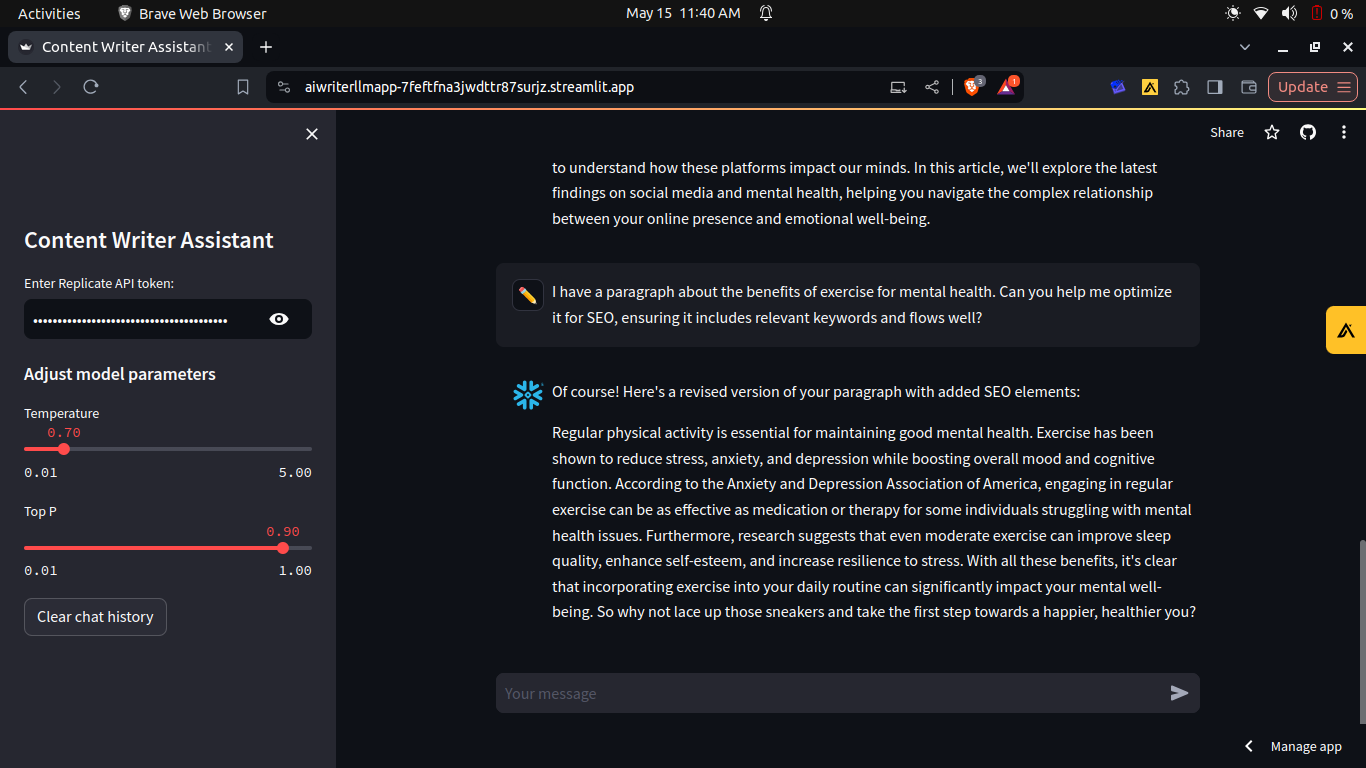
- Integration with Replicate API: We integrated the Replicate API for model inference, enabling real-time interaction between users and the AI assistant.
- User Interface Design: We designed a user-friendly interface using Streamlit, allowing writers to input text, adjust model parameters, and view AI-generated responses seamlessly.
- Iterative Testing and Feedback: We conducted iterative testing and gathered feedback from writers to refine the assistant's capabilities and improve the user experience.
Challenges We Faced
- Model Performance: Optimizing the performance of the AI model to balance response quality, speed, and resource efficiency.
- Contextual Understanding: Training the model to understand and generate contextually relevant responses tailored to different writing tasks and styles.
- Data Privacy: Implementing robust security measures to protect user data and ensure compliance with privacy regulations.
- User Acceptance: Addressing concerns and skepticism regarding the role of AI in creative writing and building trust with users.
Accomplishments We're Proud Of
- Successfully developing an AI-powered assistant capable of providing valuable insights, suggestions, and creative inspiration to writers.
- Designing an intuitive and user-friendly interface that enhances the writing experience and fosters collaboration between writers and AI.
- Overcoming technical challenges and optimizing the assistant's performance to deliver fast and accurate responses.
- Building a supportive community of writers and garnering positive feedback and testimonials about the assistant's effectiveness and utility.
What's Next for Content Writer Assistant
- Enhanced Feature Set: Continuously improving the assistant's capabilities with features such as genre-specific writing prompts, style analysis, and plagiarism detection.
- Integration with Writing Tools: Integrating with popular writing tools and platforms to provide seamless access to the assistant's features within existing workflows.
- Multimodal Support: Expanding the assistant's capabilities to support multimodal content generation, including text, images, and multimedia.
- AI Ethics and Bias Mitigation: Implementing measures to mitigate biases and promote ethical AI practices in content generation.
- Community Engagement: Building a vibrant community of writers and AI enthusiasts to exchange ideas, share best practices, and contribute to the ongoing development of the assistant.

Log in or sign up for Devpost to join the conversation.