-
-
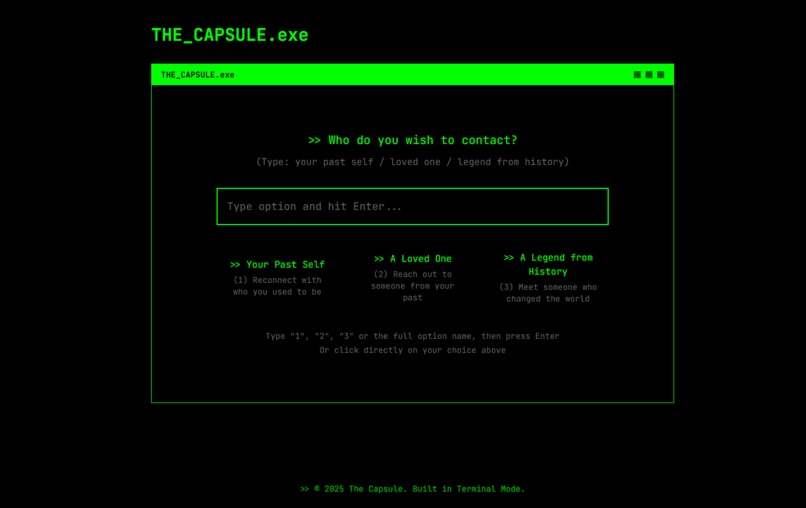
Chose who you want to speak to
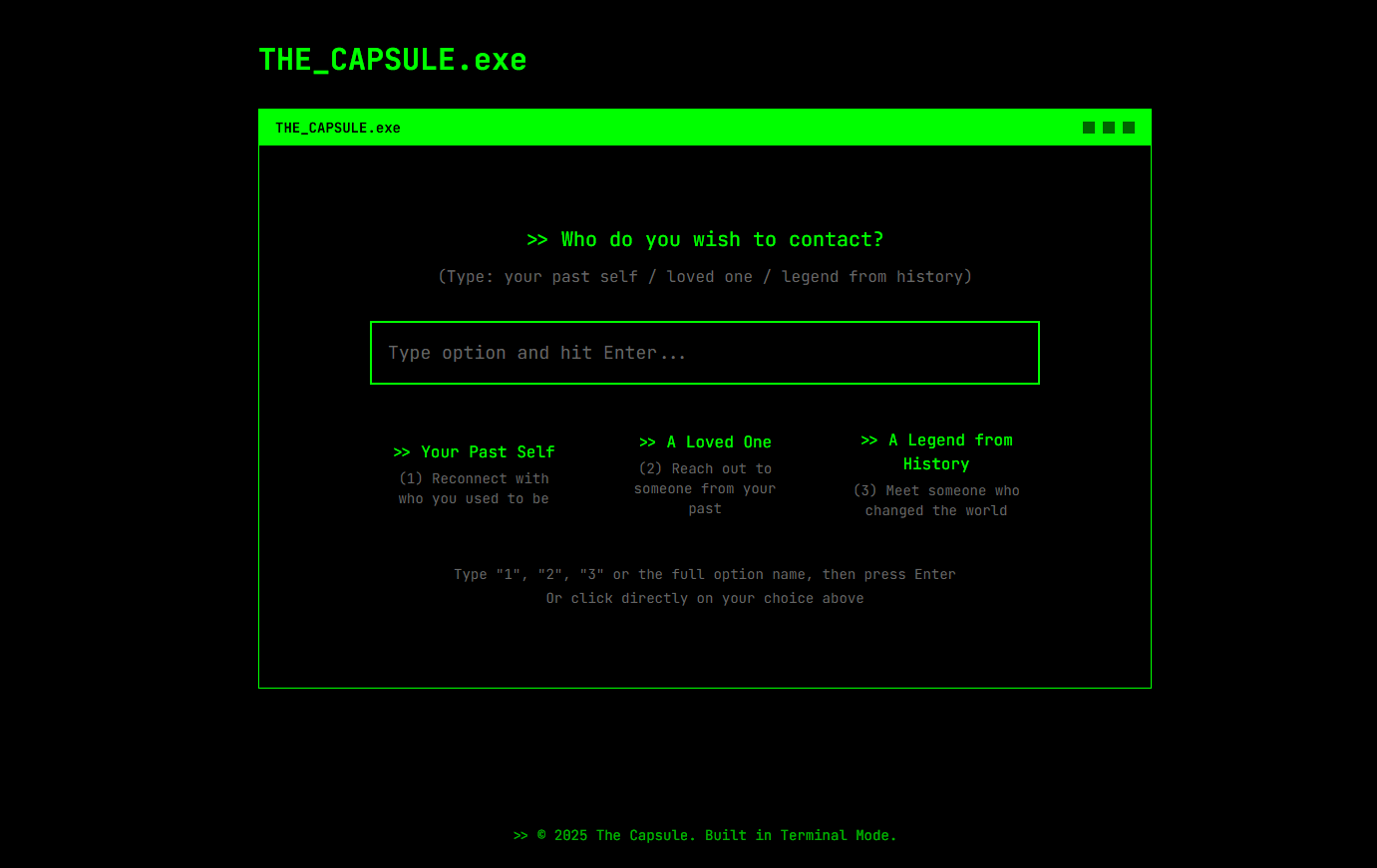
Project Story: The Capsule
While many people are obsessed with the future, I’ve always been drawn to the past — to the idea that who we are today is shaped by countless, invisible moments.
I’ve often asked myself: What if I could talk to my younger self? Not as a gimmick, but as a way to reflect, encourage, and reconnect with a version of me untouched by the weight of the world.
I’ve also wondered what my late grandfather might say if I told him that his great-grandson — the one he never met — behaves just like him. Or what someone like Steve Jobs would think of the ideas I’m building — ones that challenge norms and imagine a different future. These questions, and the curiosity behind them, sparked this project.
I originally intended to create a YouTube video around this concept, and even mapped out the entire tech stack. But I was intimidated. It felt like a great idea I didn’t have the means to execute. That changed when I discovered no-code tools like Bolt. Suddenly, what once felt like a distant dream became possible — and within reach.
I could build it. And fast. So I did.
What It Does
The Capsule lets people have conversations with past versions of themselves, lost loved ones, or even famous historical figures — powered by memory artifacts and artificial intelligence.
For personal conversations, users can upload things like voice notes, diary entries, photos, or messages — anything that captures the essence of a specific time, emotion, or relationship. These artifacts help reconstruct a digital version of that person, allowing users to have meaningful, in-character conversations.
For historical figures, the app pulls from publicly available data to simulate thought-provoking dialogue grounded in what we know about them — their life, ideas, and worldview.
How I Built It
I built the project using Bolt, OpenAI, and a wildly vivid imagination. I styled the interface with a retro terminal look to give the whole experience a nostalgic, time-travel feel — one that makes users feel like they’re stepping into a memory machine.
Challenges I Faced
This was my first time building something at this scale using no-code tools. Naturally, I hit roadblocks. The biggest challenge was integrating OpenAI’s API — error messages with no clear direction, broken flows, unexpected limitations. There were moments I genuinely didn’t know if I’d pull it off. But I stuck with it, trialed different paths, and found a way through.
Accomplishments I’m Proud Of
Honestly? Getting the AI to work and having an actual conversation with Albert Einstein — felt surreal. I literally ran around the house celebrating like a little kid.
More than anything, I’m proud that this was a product led by imagination. Seeing tools like Bolt and OpenAI come together in service of a deeply personal idea reminded me of something important: building isn’t just technical. It’s creative. Emotional. Human.
What I Learned
I learned how much I love building tools rooted in storytelling. I’ve always told stories through content — but this experience showed me that I want to build the platforms stories live on too. And this project, I realized, goes beyond entertainment.
What’s Next for The Capsule
The Capsule could help people process grief. It could support therapeutic reflection. It could preserve family memory, reconnect people with lost heritage, or even serve as a tool for intergenerational wisdom.
As a result, I plan to:
- Refine the conversation frameworks
- Strengthen the personality modeling
- Build a seamless experience that makes these time-travel conversations feel even more real
Because this isn’t just about nostalgia. It’s about using the past to understand who we are — and helping people move into the future with clarity, meaning, and hope.
Bonus Challenges
I want to submit The Capsule for the following challenge:
- Deploy Challenge (Use Netlify to deploy your full-stack Bolt.new application.) - This was successfuly done - https://delightful-daffodil-d898a5.netlify.app/.
Built With
- bolt
- openai


Log in or sign up for Devpost to join the conversation.