-
-
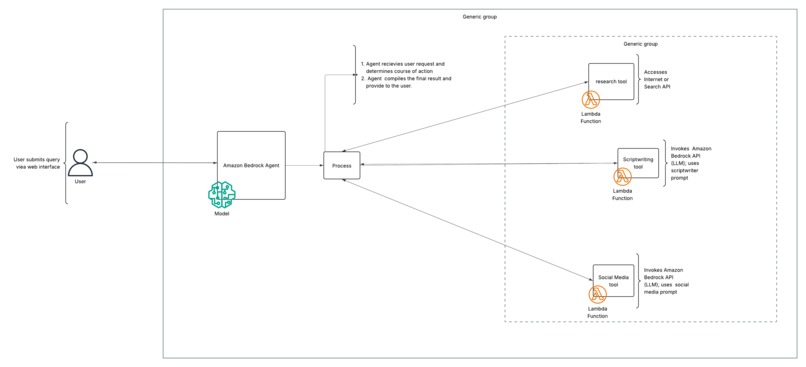
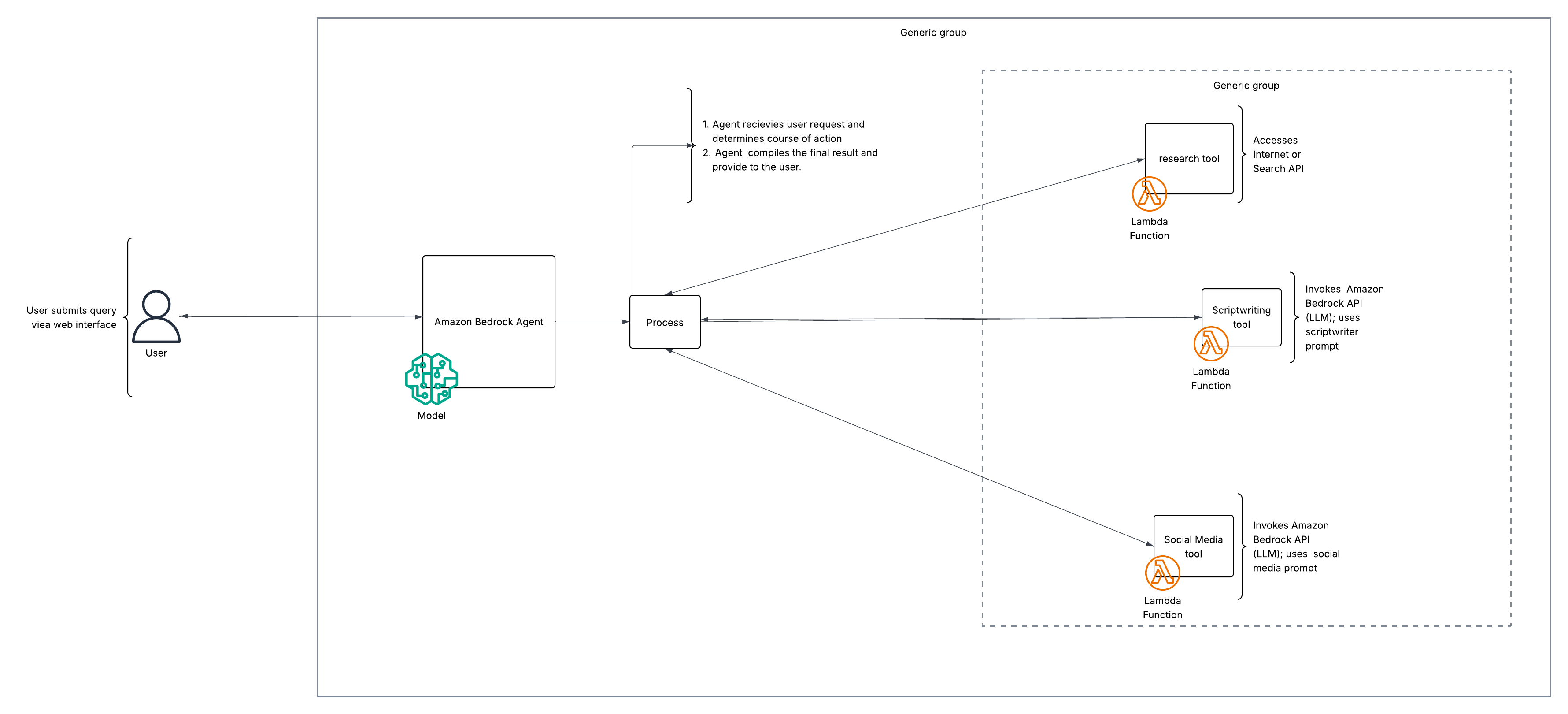
Architecture Diagram
About the Project As a content creator myself, I'm intimately familiar with "the grind"—that frustrating, time-consuming gap between a great idea and the moment you finally press "record." I was inspired to build Creator's Co-Pilot to solve my own problem: the hours spent on the repetitive, yet essential, pre-production tasks of research, ideation, scriptwriting, and content repurposing. While existing LLMs are powerful tools, they still require significant manual prompting and context-switching. I wanted to build a true, autonomous partner that could manage the entire workflow.
How We Built It: A Cloud-Native Agentic Architecture We built this project from the ground up on AWS, focusing on a robust, scalable, and fully autonomous agentic architecture. Our design philosophy was "Smart Orchestrator, Simple Tools." The Brain (The Orchestrator): The core of our project is an Amazon Bedrock Agent. We engineered a detailed, multi-phase master prompt to serve as the agent's "standard operating procedure." This prompt instructs the agent to first analyze the user's topic and then execute a precise, five-step autonomous workflow.
The Toolbox (Specialized Lambda Functions): The agent is empowered with a suite of specialized tools, each implemented as a serverless AWS Lambda function: query_generation_tool: Strategically brainstorms what to research. research_tool: Gathers in-depth information using the Tavily API. ideation_tool: Analyzes the research to find the core emotional angle and a compelling video title. scriptwriting_tool: Writes a full, structured YouTube script. social_media_tool: Creates promotional posts for different platforms. file_saver_tool: Consolidates the final assets and provides a secure download link.
The "Data Bus" (Managing Context with S3): We quickly learned that passing large amounts of research between functions would overload the LLM's context window. We solved this by implementing a cloud-native "data bus" pattern. Large data payloads, like the initial research and the final script, are written to an Amazon S3 bucket. The agent then passes the lightweight S3 URI between tools, allowing our functions to access deep, factually rich context without ever hitting a context limit.
The Frontend (The User's Doorstep): We built a clean, simple web interface using HTML and vanilla JavaScript, hosted as a static website on Amazon S3. This UI communicates with our backend via a secure Amazon API Gateway endpoint.
Challenges We Faced (and How We Overcame Them) This project was a journey through the real-world challenges of building a production-ready AI application.
The CORS Nightmare: Our biggest hurdle was a persistent CORS error. After trying to configure the API Gateway in our template.yaml and manually in the console, we ultimately solved it by implementing the most robust pattern: handling CORS directly inside our api_handler Lambda. This taught us that for serverless APIs, the function code itself can provide the most reliable control over headers.
Context Window Overload: Our agent was initially "drowning" in data. Our "Aha!" moment was realizing we couldn't just pass massive text blocks in memory. This led us to design the S3 data bus architecture, which not only solved the context window error but also made our application far more scalable and robust.
Agent Hallucination and Confusion: Early versions of our master prompt were not specific enough, causing the agent to get stuck in loops or fail to format its tool calls correctly. We learned that effective agent orchestration requires being hyper-specific in your instructions, providing exact JSON examples, and clearly defining the flow of data from the output of one tool to the input of the next. What We Learned
Building Creator's Co-Pilot was an incredible learning experience. We moved from simply using an LLM as a text generator to orchestrating a complex, multi-tool agent that can reason, recover from errors, and execute a mission from start to finish. We learned the critical importance of robust error handling, managing context in a stateless environment, and the art of crafting precise instructions to guide an intelligent agent. This project is more than a hackathon submission; it's a blueprint for the future of creative collaboration between humans and AI.
Built With
- amazon-web-services
- bedrock
- gatewayapi
- python
- s3
- strands

Log in or sign up for Devpost to join the conversation.