Inspiration
Due to its extreme contagiousness and incubation period, the spread of SARS-CoV-2 is particularly difficult to track. Because it is airborne and can be asymptomatic for up to two weeks, there are many opportunities for one to become infected by another person or to spread the virus to someone else.
What it does
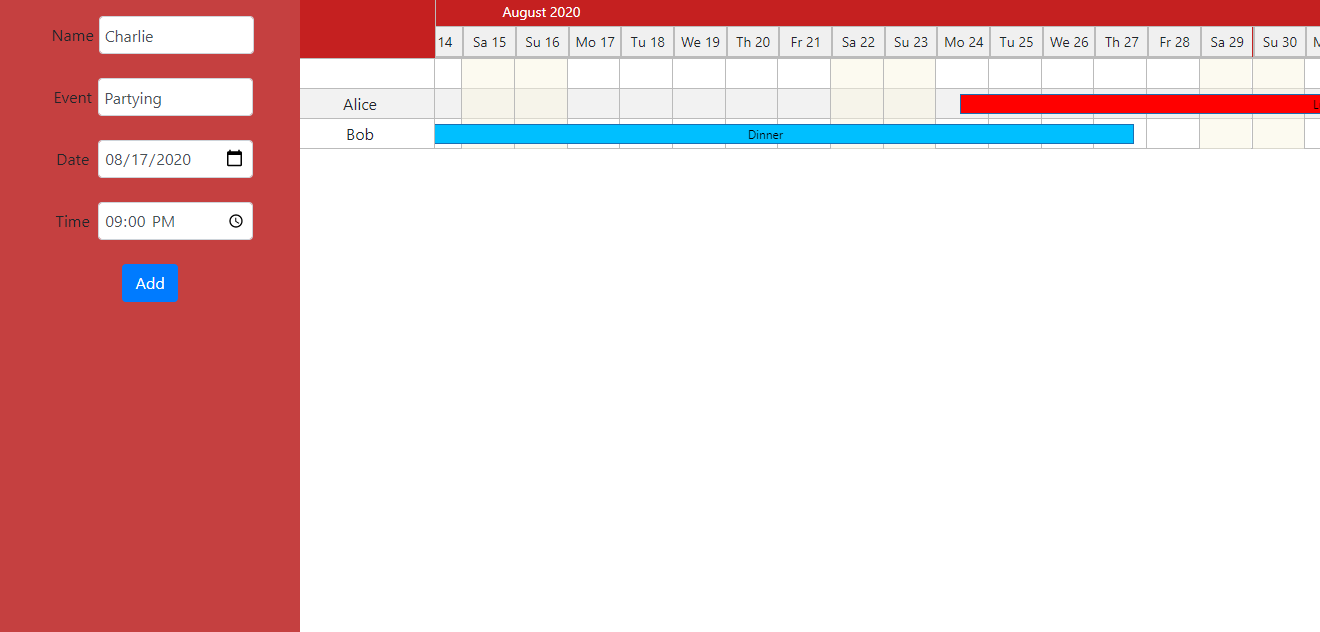
This application records the contact that the user makes with other people during quarantine. Each other person is recorded with the time of contact separately. If the user becomes infected, the record can be used to assist in determining where the virus came from and whom the user may have exposed during the dormancy period. A timeline records possible exposures in red, and if two weeks pass, changes the records to blue to indicate non-exposure.
How I built it
The application is built entirely in React. The display for the timeline was implemented using the react-calendar-timeline library.
Challenges I ran into
Learning how to use React was a big challenge. In particular, figuring out how to get data transferred between the components was difficult and made harder by not using other helpful libraries like Redux.
Accomplishments that I'm proud of
I am proud to have finally made a front end using more than plain JavaScript. I am also proud to have participated in my first hackathon.
What I learned
During the development of this project, I learned how to create a single-page application and how to use React in order to do it.
What's next for Contact Tracer
Contact Tracer can be functionally improved by adding records for more degrees of separation and/or combining data from other users to increase the potential to identify the spread of COVID-19. It can be technically improved by utilizing Redux to manage the application's state.

Log in or sign up for Devpost to join the conversation.