-
-
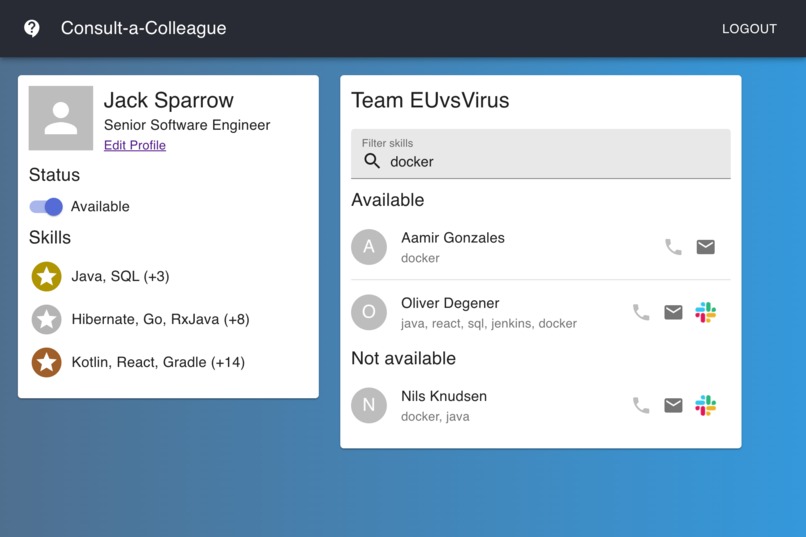
Prototype Screenshot
-
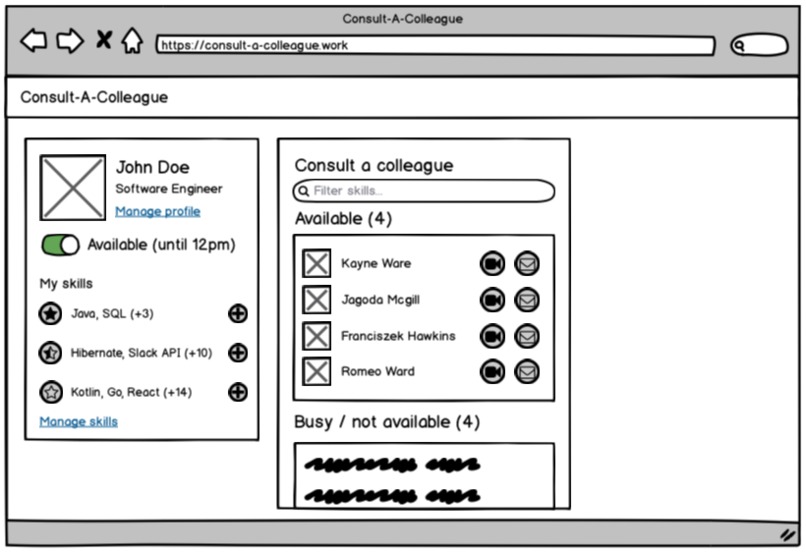
Application Mockup
Inspiration / The problem our project solves
The Covid-19 pandemic led to a global work-from-home movement and dramatically changed the way how businesses operate. While technology facilitates a wide area of day-to-day business, many employees experience a lack of social company and struggle to maintain their productivity. Video conferencing enables teams to keep up their meetings, but casual social contacts like walking over to a colleague’s desk or a quick chat at the coffee maker disappeared as employees are suddenly working from home full-time. The crisis poses additional challenges for many people, such as homeschooling or caring for elderly family members, making it harder to plan their working day. Many employees feel isolated and try to solve their problems themselves because they find it difficult to get in touch with colleagues. To enable collaboration across team members and improve productivity, we built Consult-a-Colleague.
The solution you bring to the table
Consult-a-Colleague is an online tool that connects employees who need support with those, who are familiar with the problem domain and are currently available, thus enabling a quick and uncomplicated transfer of knowledge.
We have identified the following problems that currently stand in the way of good home office collaboration:
- The lack of direct communication in the office must be replaced by new communication channels.
- Asking for help quickly becomes unpleasant and can create the feeling of disturbing colleagues at work.
- By working in the home office, individual problems often remain unnoticed.
- New employees do not get to know their colleagues personally and are not aware of their strengths and weaknesses.
We solve these problem by having users provide their expertise and current availability status. Those seeking help can then quickly find someone in this directory who has the time and knowledge to assist.
Our application works in a wide variety of working environments because the underlying concepts can be used across domains and we can integrate with many communication tools. Consult-a-Colleague concentrates on mediation, the communication itself takes place within the usual tools (Slack, Zoom, etc.).
What you have done during the weekend
Before the weekend there was only the idea. Now we have a first working prototype - we are proud of it!
First we concretised the idea, created mockups and made the first technological decisions.
Through the University of Hamburg we got access to virtual machines and set up a continuous integration pipeline. Then we started hacking. The backend is a Java app based on Spring Boot that offers an API and persists all data in H2 or Postgres database, for the frontend we use React. All components are packaged with Docker and are run behind an nginx instance.
As the prototype slowly took shape, we gathered more information about the problem with a survey. In the results we saw that the most frequent communication in the office is personal contact. In the home office, the situation is more dispersed and spread over several channels. So we focused on possible integrations and developed a seamless integration with Slack.
All in all, we are delighted with how much was achieved over the weekend.
The solution’s impact to the crisis
The crisis led to a global work-from-home movement. Many companies are overwhelmed by the situation and have few clear guidelines - at the expense of the employees. We support employees to work effectively in the home office and thus help companies in the crisis.
The necessities in order to continue the project
- UI/UX improvements
- Branding
- Integrations to flawlessly update the availability status (eg. browser extensions, mobile apps, integrations into developer tools)
- Ready for production
The value of our solution after the crisis
Our solution will still be useful after the crisis, as we assume that many more companies will offer home office in the future.
Furthermore, our application can also be used outside the business area, for example within non-profit organizations, universities, study groups and associations.


Log in or sign up for Devpost to join the conversation.