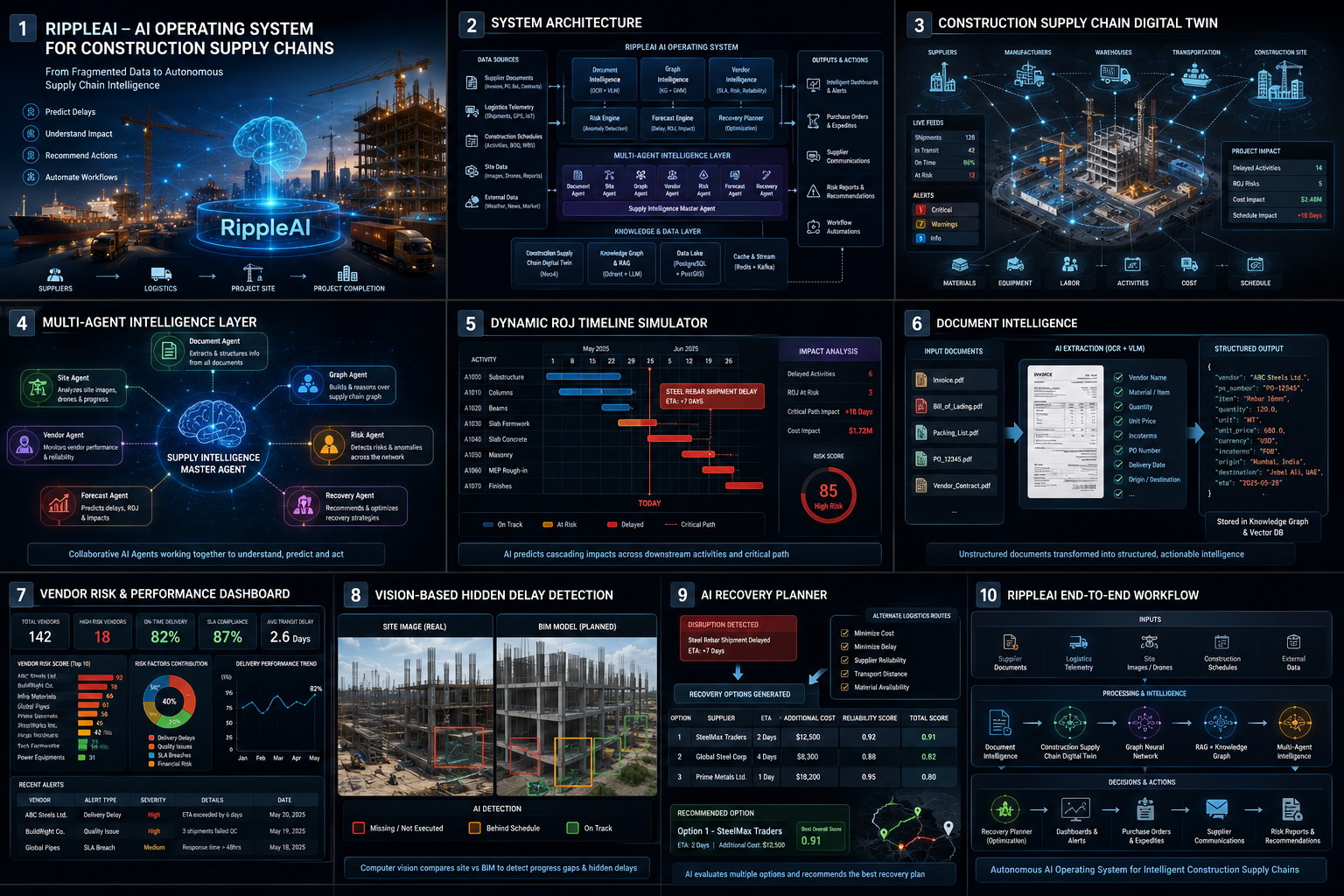
Construkt AI – Autonomous AI Operating System for Construction Supply Chains
Inspiration
Construction is one of the world's largest industries, yet its supply chains still rely on fragmented documents, disconnected software, and reactive decision-making. Project managers constantly struggle to answer simple but critical questions:
- Where is my material?
- Will it reach the jobsite on time?
- If it is delayed, which downstream activities will be affected?
Existing ERP and logistics platforms provide shipment visibility but lack the intelligence to understand project dependencies, predict cascading impacts, or recommend recovery actions. We wanted to build a system that doesn't just monitor the supply chain—it understands it, reasons about it, predicts future risks, and proactively assists project teams before disruptions reach the jobsite.
This inspired ConstruktAI, an AI Operating System that transforms fragmented construction data into autonomous supply chain intelligence.
What it does
Construkt AI continuously ingests procurement documents, supplier updates, logistics telemetry, project schedules, and site imagery to create a live Construction Supply Chain Digital Twin.
Using multimodal AI, graph reasoning, predictive machine learning, Retrieval-Augmented Generation (RAG), Knowledge Graphs, mathematical optimization, and a collaborative Multi-Agent Intelligence Layer, Construkt AI can:
- Predict Required-on-Jobsite (ROJ) delays before they occur.
- Detect hidden execution delays from site imagery.
- Evaluate supplier reliability and supply chain risks.
- Estimate schedule and cost impacts.
- Recommend optimal recovery strategies.
- Generate purchase orders, supplier communications, risk reports, and procurement workflows while keeping humans in the loop for approval.
Instead of simply tracking materials, Construkt AI transforms construction supply chains from reactive monitoring into proactive decision intelligence.
How we built it
Construkt AI is designed as a modular AI platform.
Frontend
- Next.js
- React
- Tailwind CSS
- Mapbox GL
Backend
- FastAPI
- Apache Kafka
AI & Machine Learning
- Qwen2.5-VL (Document Intelligence)
- LangGraph (Multi-Agent Orchestration)
- Graph Neural Networks (PyTorch Geometric)
- XGBoost (Delay Forecasting)
- Google OR-Tools (Recovery Optimization)
Databases
- Neo4j (Construction Dependency Graph)
- PostgreSQL + PostGIS
- Qdrant (Vector Database)
- Redis
Construkt AI begins by processing supplier invoices, bills of lading, fabrication reports, logistics events, project schedules, and site imagery. The extracted information is transformed into structured knowledge and linked together inside a Construction Supply Chain Digital Twin.
Graph reasoning and predictive machine learning estimate schedule delays and cascading impacts, while the Multi-Agent Intelligence Layer evaluates recovery options and orchestrates procurement workflows.
Since public construction supply-chain datasets are scarce, Construkt AI initially generates synthetic disruption datasets by simulating supplier delays, logistics disruptions, material shortages, and schedule variations. As the platform is adopted across projects, it continuously builds its own Construction Supply Chain Knowledge Base and Dependency Graph Dataset from project documents, logistics events, supplier records, material SKUs, and historical execution data, enabling continual learning and improving prediction accuracy over time.
Challenges we ran into
One of the biggest challenges was designing a solution that goes beyond a traditional chatbot.
Construction supply chains involve thousands of interconnected dependencies where a single delayed shipment can propagate through multiple downstream activities. Building an architecture capable of understanding these relationships while combining multimodal AI, graph reasoning, predictive machine learning, optimization, and collaborative AI agents into a single explainable workflow required significant system design.
Another challenge was the lack of publicly available construction-specific datasets, which motivated us to design a synthetic data generation pipeline capable of producing realistic disruption scenarios for model training and evaluation.
What we learned
Through Construkt AI, we gained practical experience in applying multimodal AI, Graph Neural Networks, Retrieval-Augmented Generation, Knowledge Graphs, optimization algorithms, and collaborative multi-agent systems to solve real-world enterprise problems.
More importantly, we learned that impactful AI systems are built by integrating multiple specialized models into a unified decision-making framework rather than relying solely on large language models.
What's next for Construkt AI
Construkt AI is designed to become a continuously learning AI Operating System for the construction industry.
Future enhancements include:
- Cross-project material pooling
- Smart contract and SLA automation
- IoT sensor integration
- Drone-assisted site monitoring
- Smart-glass support for field engineers
- Carbon-aware logistics optimization
- Autonomous supplier negotiation
- Continual learning from every completed construction project
As Construkt AI evolves, every completed project strengthens its knowledge base, enabling increasingly accurate predictions, smarter recovery planning, and more resilient construction supply chains.
Built With
- claude
- zoho



Log in or sign up for Devpost to join the conversation.