CSDL: Teaching Humans and AI the Same Visual Language
### About the project
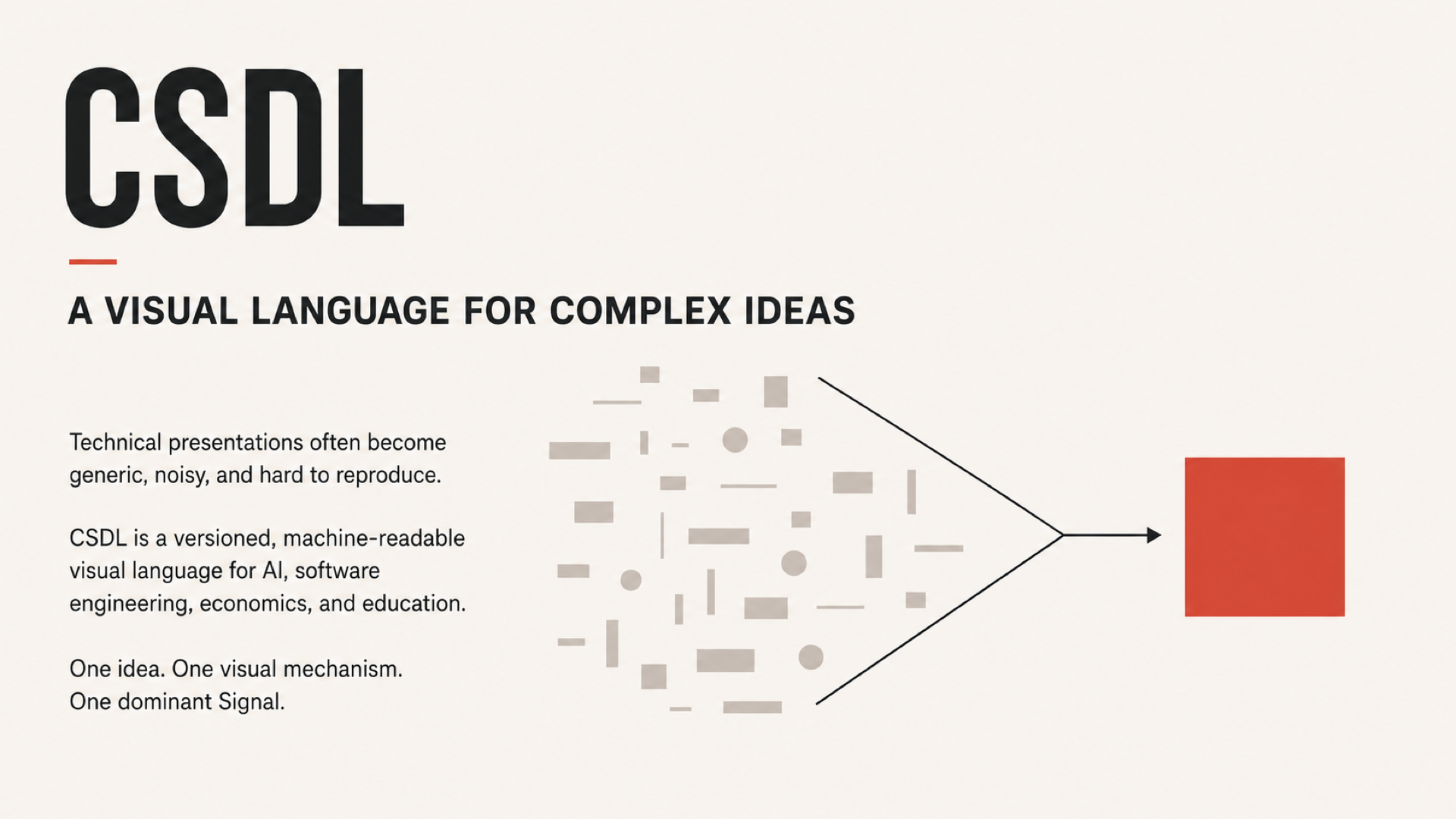
Constructive Signal Design Language, or CSDL, is a versioned, machine-readable visual language for explaining complex ideas in AI, software engineering, and economics.
Technical presentations often fail in one of two ways. Templates produce consistency but make every story look the same. Open-ended style prompts offer more freedom, but the result drifts between slides, loses important details, or becomes visually noisy.
CSDL explores a third approach: define the meaning of visual elements instead of fixing their coordinates.
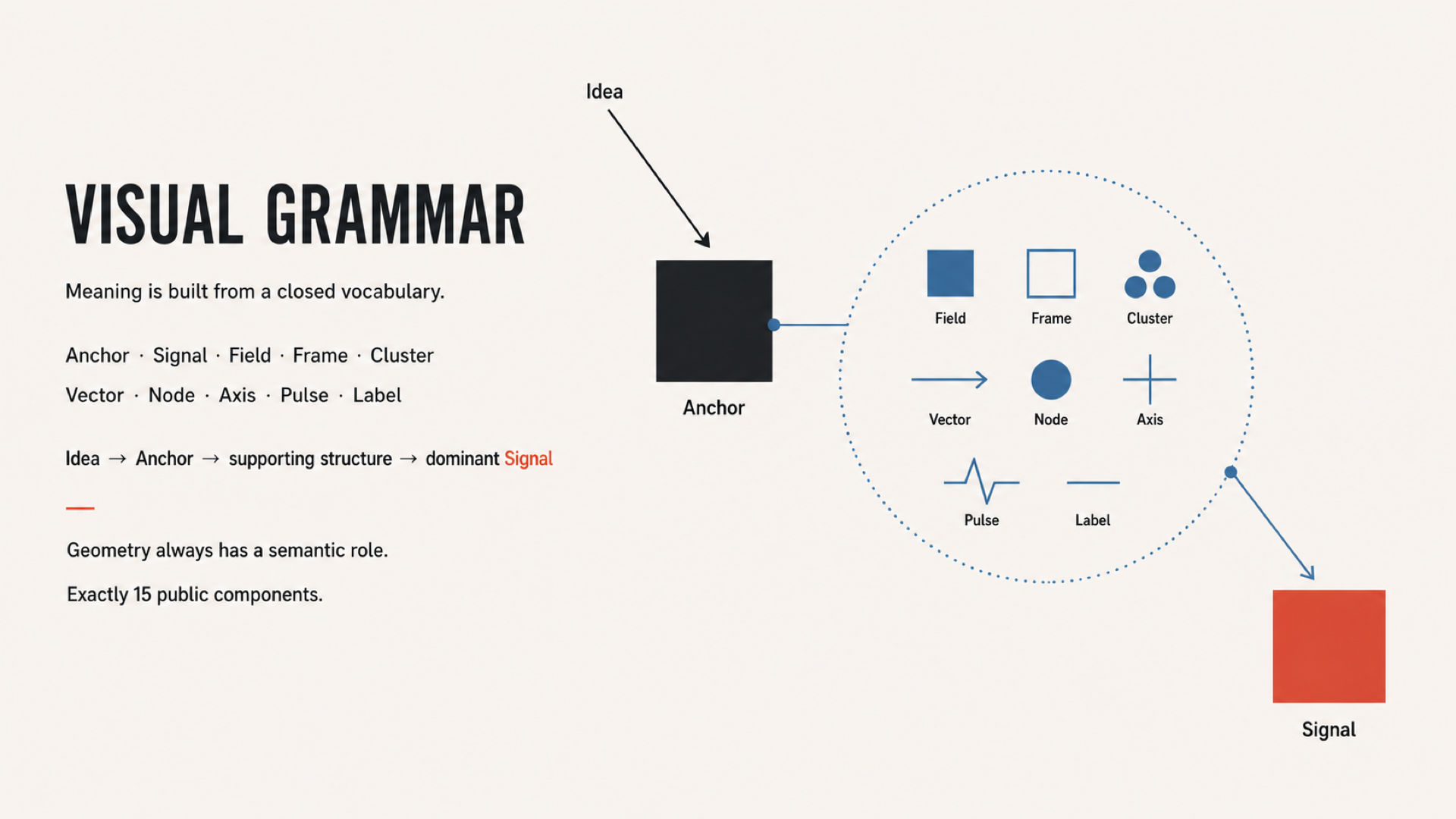
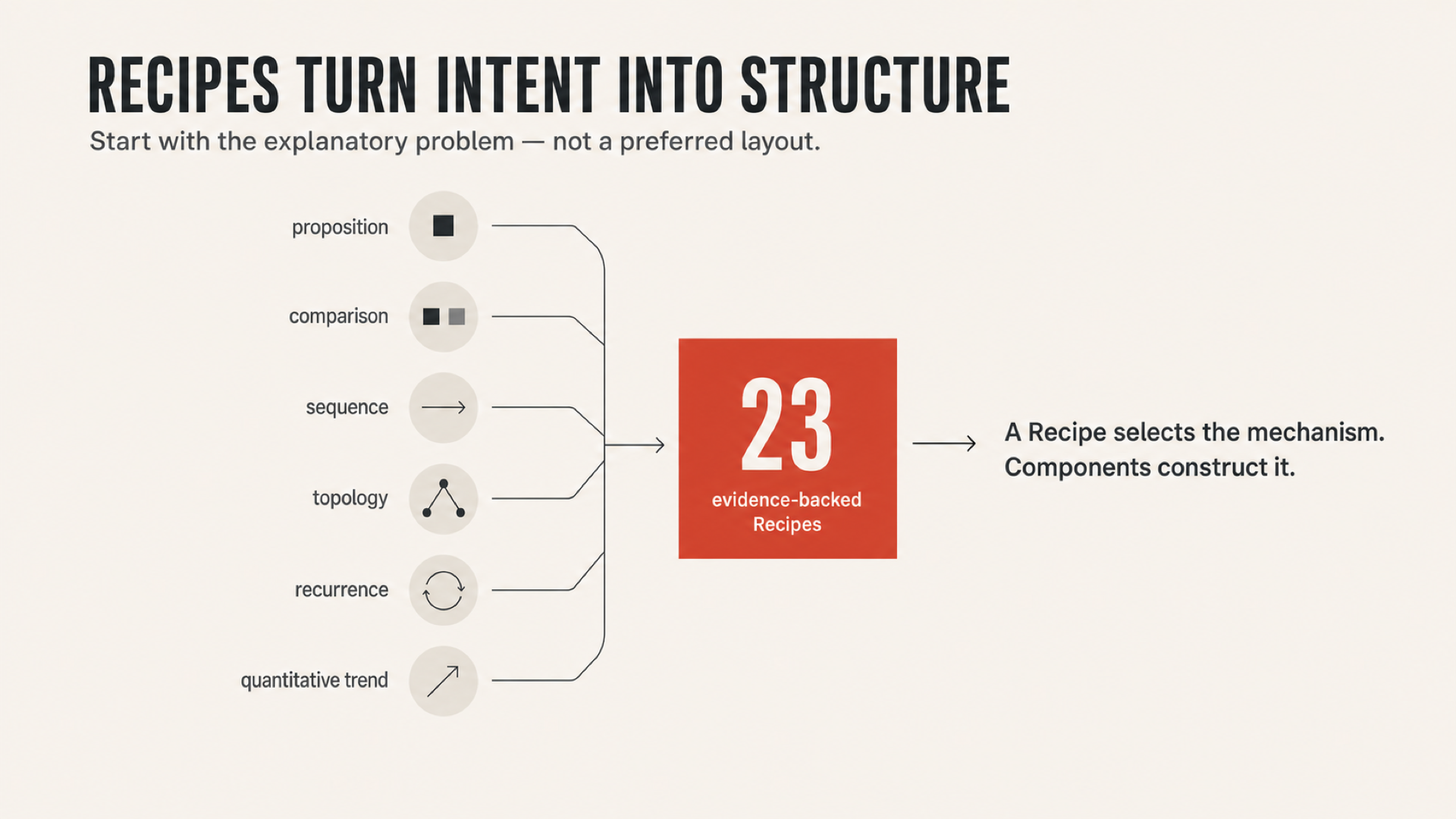
A Signal represents emphasis. A Vector communicates direction. A Frame establishes ownership. A Loop shows repetition. Recipes such as Comparison, Workflow, Formula, and Dashboard describe recurring explanatory problems without prescribing a rigid layout.
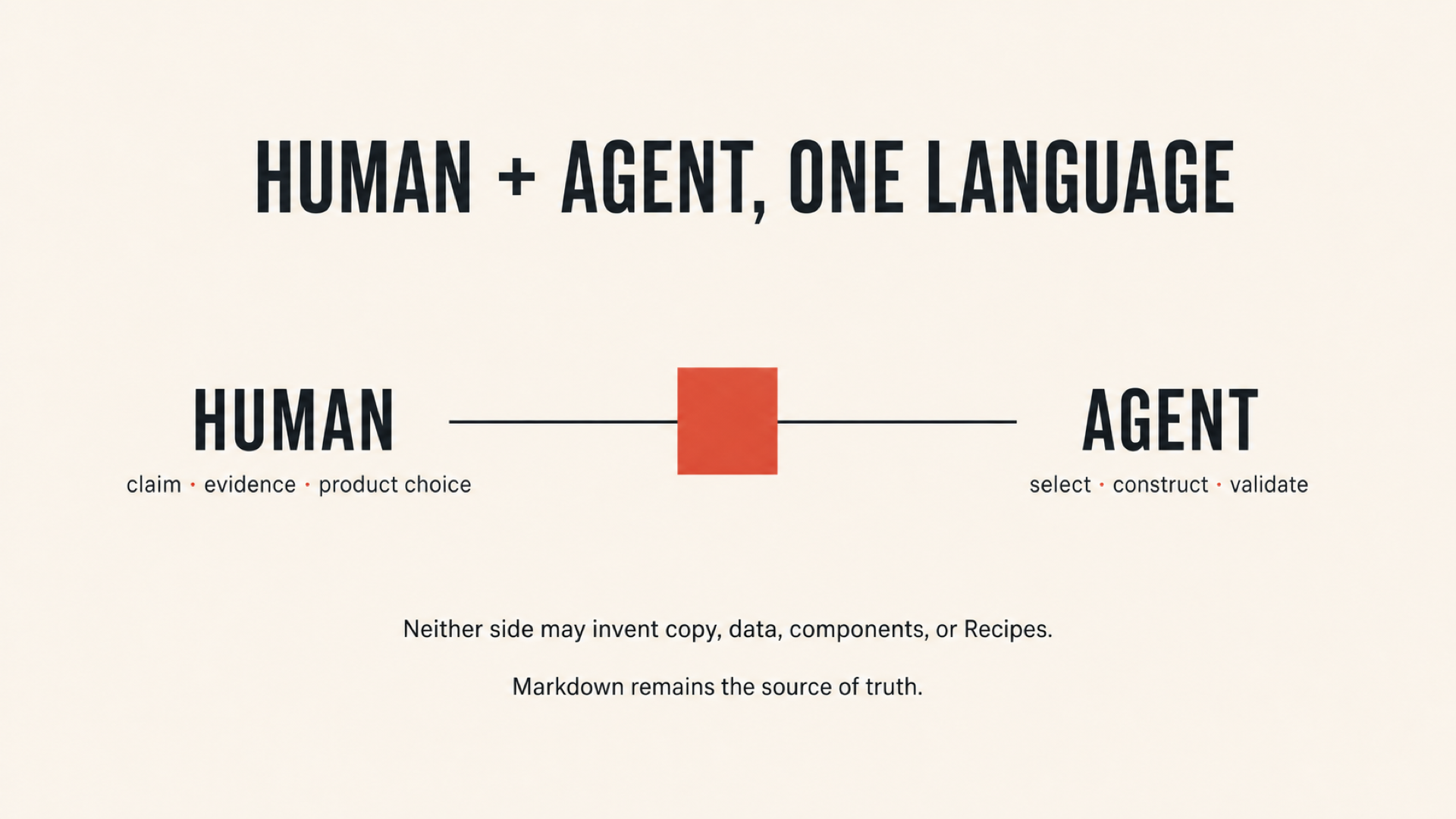
This gives humans and generative models a shared design vocabulary. Both can work from the same Markdown specifications, YAML contracts, components, recipes, constraints, and validation rules.
### What inspired us
The project began with a practical question:
Can an AI-generated presentation remain coherent, readable, and reproducible without becoming a collection of rigid templates?
An important historical reference was MoMA’s presentation of Merz, no. 4 (1923), which published El Lissitzky’s “Topography of Typography.” Its ideas—that words are also visual forms, expression should be economical, composition should respond to the pressure of its content, and pages should work as a continuous sequence—helped shape CSDL’s approach. View the reference at MoMA (https://www.moma.org/slideshows/43/793).
We translated those principles into a contemporary, machine-readable system. Geometry does not decorate the background; it communicates relationships. Scale, distance, containment, collision, and direction help the audience understand a concept before reading every word. A presentation is treated as a designed sequence rather than a collection of unrelated images.
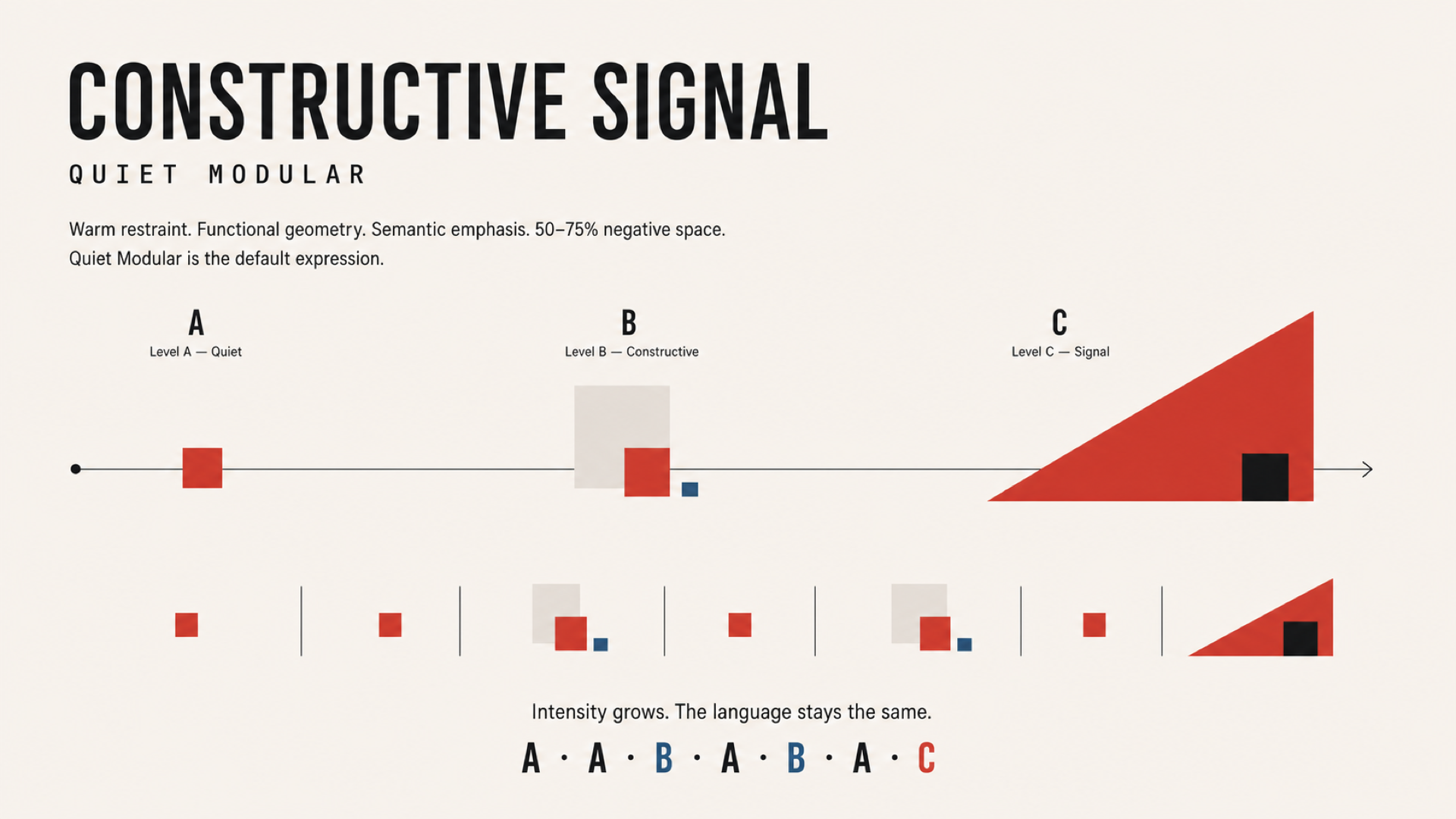
CSDL borrows this method, not its historical visual or political context. We deliberately avoid revolutionary symbolism, imitation-1920s typography, propaganda aesthetics, and decorative nostalgia. The result is a contemporary direction called Constructive Signal, with a restrained default expression called Quiet Modular.
The first pilot explained agentic development discipline. Its core message was that a capable agent does not automatically produce a reliable result. Reliability appears when process, verification, boundaries, and retained learning work together.
### How we built it
We began with a seven-slide, 16:9 presentation rather than trying to design an abstract system from scratch. Each slide had one idea, ne visual mechanism, and one dominant signal.
For every slide, we:
- Defined the exact copy and semantic intent.
- Selected an expression level: Quiet, Constructive, or Signal.
- Described the composition using semantic components.
- Generated three independent candidates with GPT Image 2.
- Rejected candidates with incorrect text, generic layouts, decorative geometry, weak hierarchy, or poor presentation readability.
- Selected one canonical candidate and recorded its provenance, dimensions, color mode, evaluation score, and the reasons behind the decision.
Once the pilot worked, we extracted the reusable grammar behind it. The project grew into several versioned layers:
- 20 Visual DNA families covering editorial, structural, process, and analytical explanations;
- exactly 15 public semantic components;
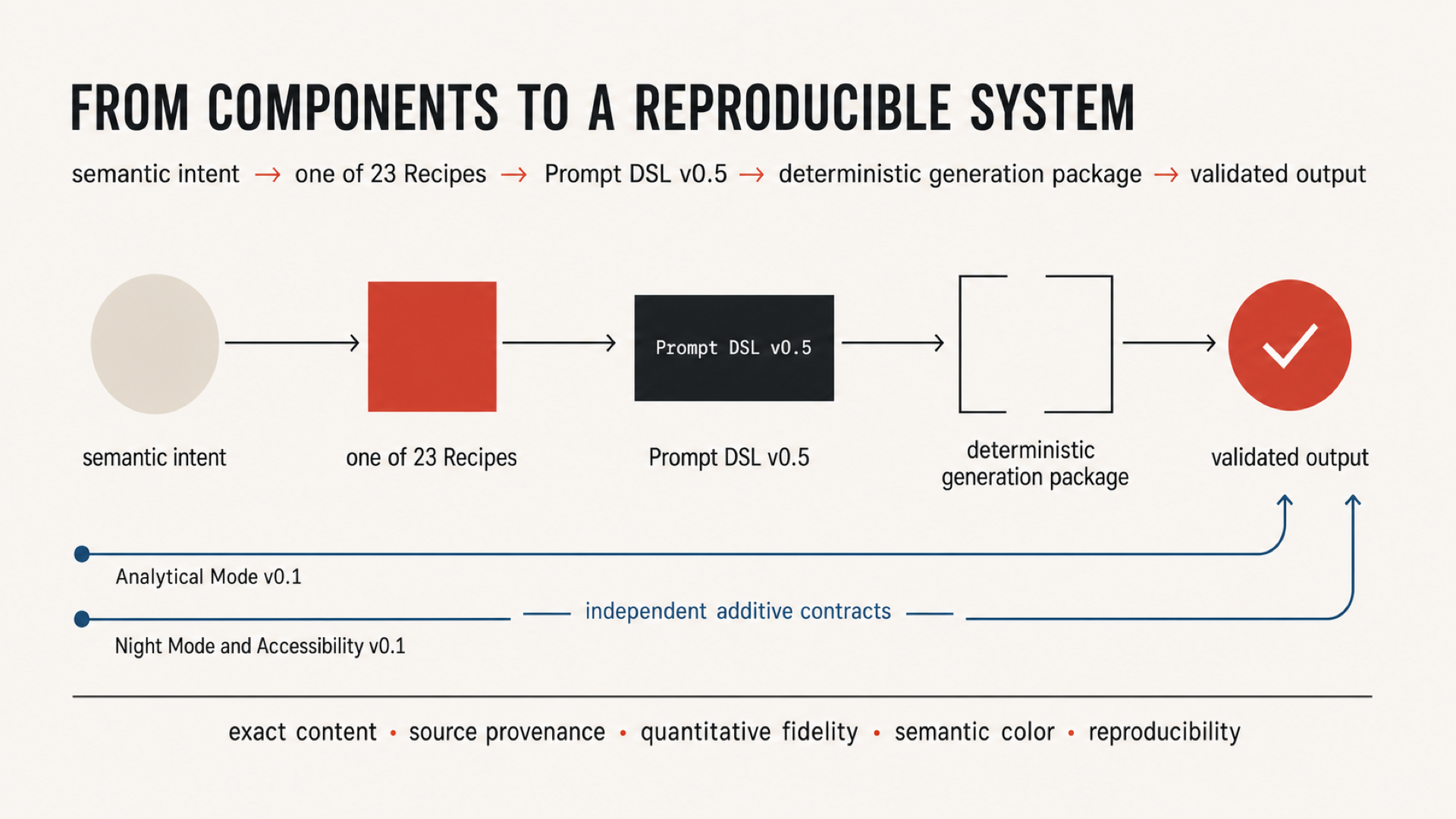
- 23 evidence-backed Recipes;
- Prompt DSL v0.5 for declarative generation packages;
- Analytical Mode v0.1 for data fidelity, uncertainty, transformations, and quantitative graphics;
- accessibility profiles for light, night, monochrome, and projector conditions;
- a 32-page Cookbook and Design Book generated from canonical Markdown.
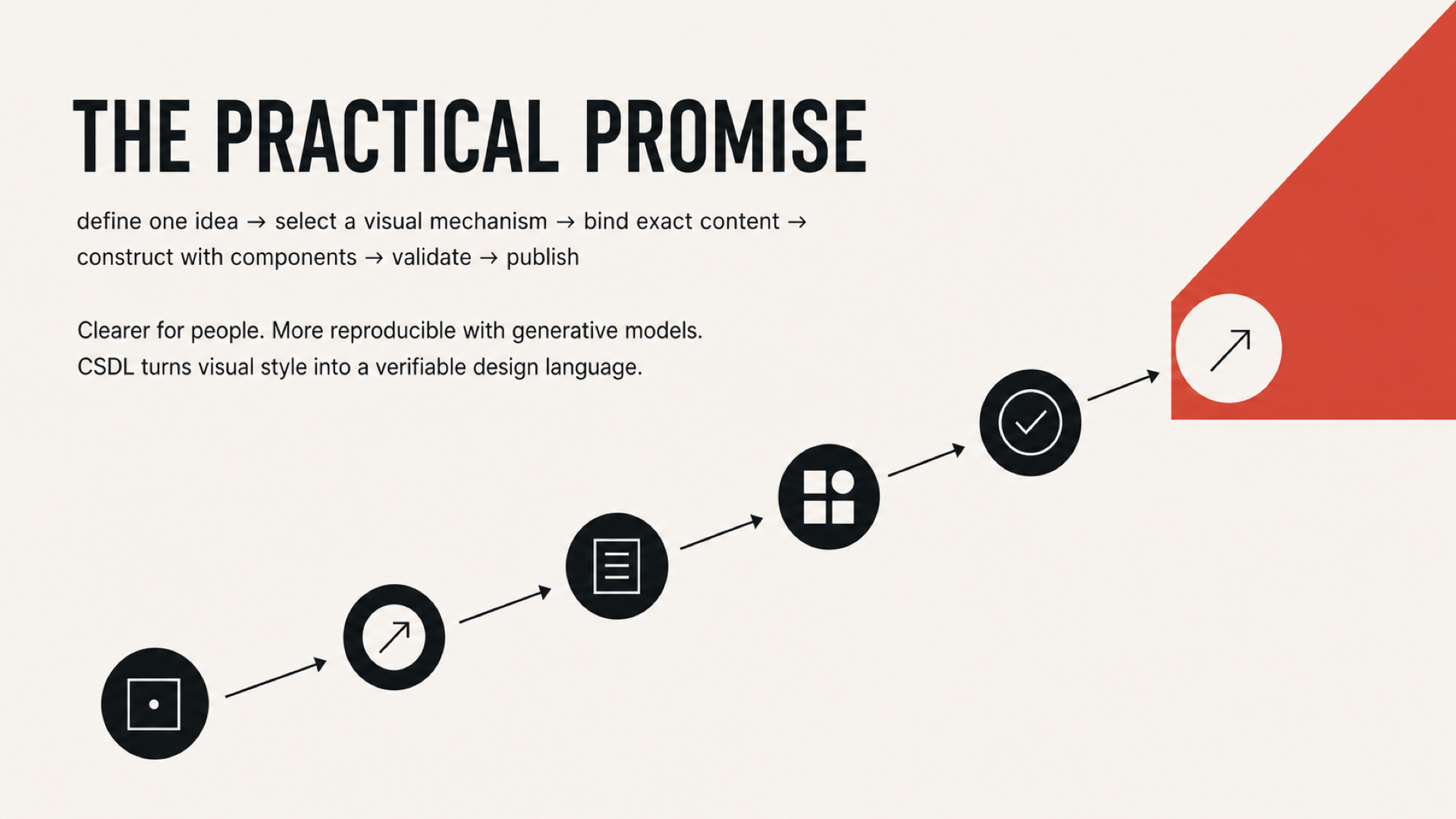
The complete workflow became: Explanatory intent ↓ One of 23 Recipes ↓ 15 semantic components ↓ Prompt DSL v0.5 package ↓ Reference-first image generation ↓ Review and deterministic validation
Markdown remains the source of truth. YAML makes the language machine-readable. Raster images serve as reviewed evidence rather than silently becoming the specification.
We also built deterministic Python tooling to validate manifests, contracts, indexes, dimensions, color modes, scores, analytical data, accessibility behavior, and accepted asset hashes. The current repository has 167 passing automated tests and preserves hashes for 60 accepted raster assets.
### Challenges we faced
The hardest challenge was balancing consistency with creative range.
When the constraints were too vague, generated slides drifted toward generic centered infographics. When they were too specific, the system behaved like a rigid template library.
The breakthrough was to constrain semantics rather than pixels. CSDL says what a relationship means and which components participate, while leaving enough compositional freedom for meaningful variation.
Text fidelity was another major challenge, especially with Ukrainian content. A visually strong candidate still had to be rejected if it changed a word, introduced an extra label, or used typography that weakened readability. Generating three candidates per asset became essential rather than optional.
We also discovered that individual images could look successful while the complete series failed. Several early designs were acceptable in isolation but collapsed into the same centered composition when viewed together. Contact sheets and series-level reviews exposed repetition that single-image evaluation missed.
Analytical graphics introduced a different problem: beauty could not override truth. Values, order, units, domains, missing data, uncertainty, and transformations all needed explicit contracts.
Accessibility created a similar requirement for semantic preservation. Light, night, monochrome, projector, and color-vision-deficiency conditions could change the presentation, but they could not change its meaning.
Finally, the language had to evolve without invalidating previously accepted evidence. We addressed this with additive, versioned layers, deterministic builds, provenance records, negative test fixtures, and hash-based protection for canonical assets.
### What we learned
We learned that constraints do not reduce creativity when they describe meaning instead of coordinates.
We learned that negative space is not unused space. It protects hierarchy and gives important elements visual weight.
We learned that AI generation needs an evaluation system, not merely a good prompt. Candidate comparison, explicit rejection reasons, exact-copy review, contact sheets, and reproducible validation dramatically improved the final result.
We also learned that visual quality must be evaluated at several levels:
- the accuracy of one asset;
- the clarity of one slide;
- the rhythm of the complete series;
- the integrity of the underlying system.
Most importantly, we learned that a design system for generative models must be both visual and computational. If its rules exist only in someone’s intuition, an agent cannot reliably reproduce them. If they exist only as schemas, humans cannot judge whether the result communicates well.
CSDL connects those two sides: a language people can understand, a contract machines can execute, and evidence both can review.
### Where the project is today
CSDL now includes a complete foundation, Visual DNA catalog, component and Recipe libraries, Prompt DSL, Analytical Mode, accessibility profiles, two applied presentation pilots, and a 32-page Cookbook and Design Book.
What started as one experimental presentation has become a tested visual language for turning difficult concepts into explanations that are clear, memorable, accessible, and reproducible.
Our long-term goal is to make generative design less dependent on lucky prompts. We want people and AI agents to collaborate through an explicit visual language—one in which creativity remains open, meaning remains stable, and every important decision can be understood and verified.

Log in or sign up for Devpost to join the conversation.