-
-
Logo
-
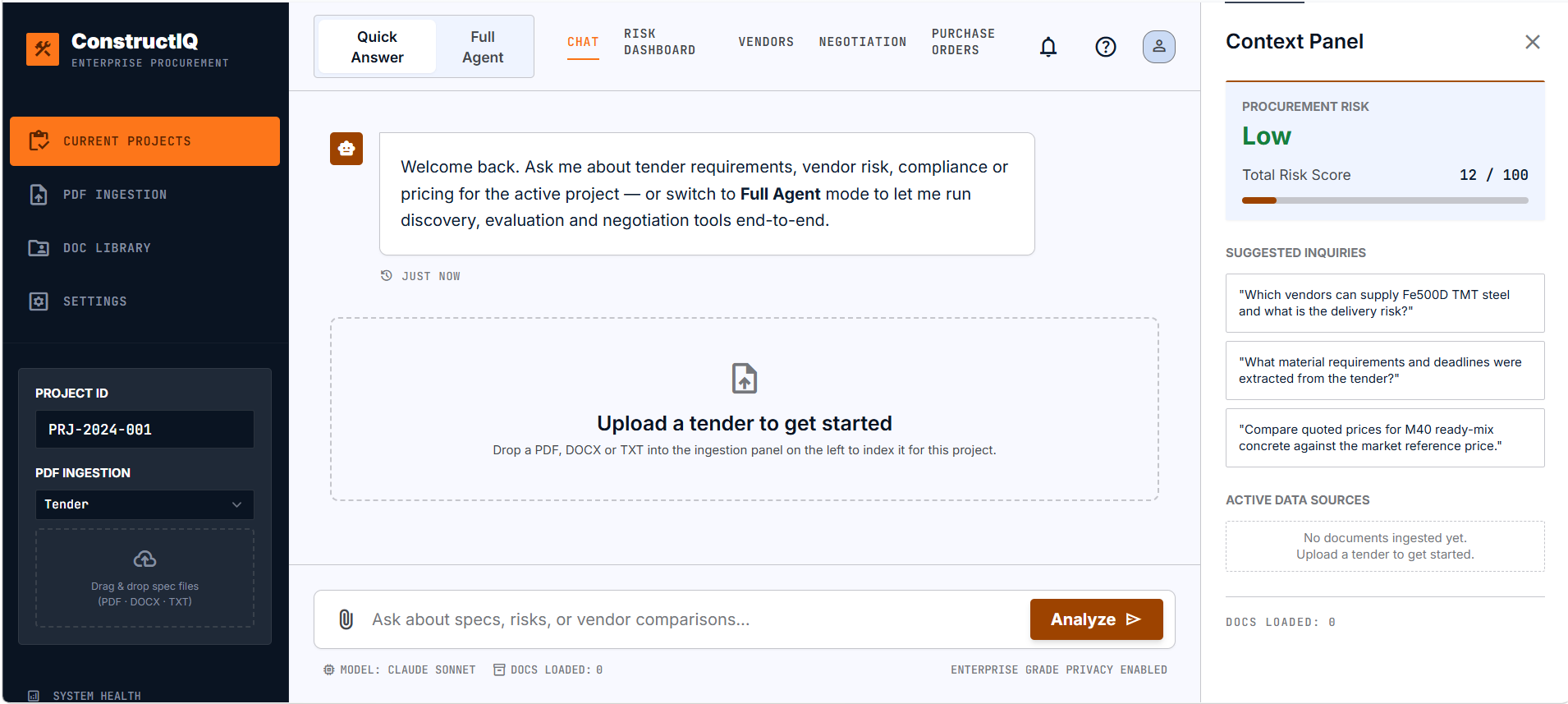
Home Page
-
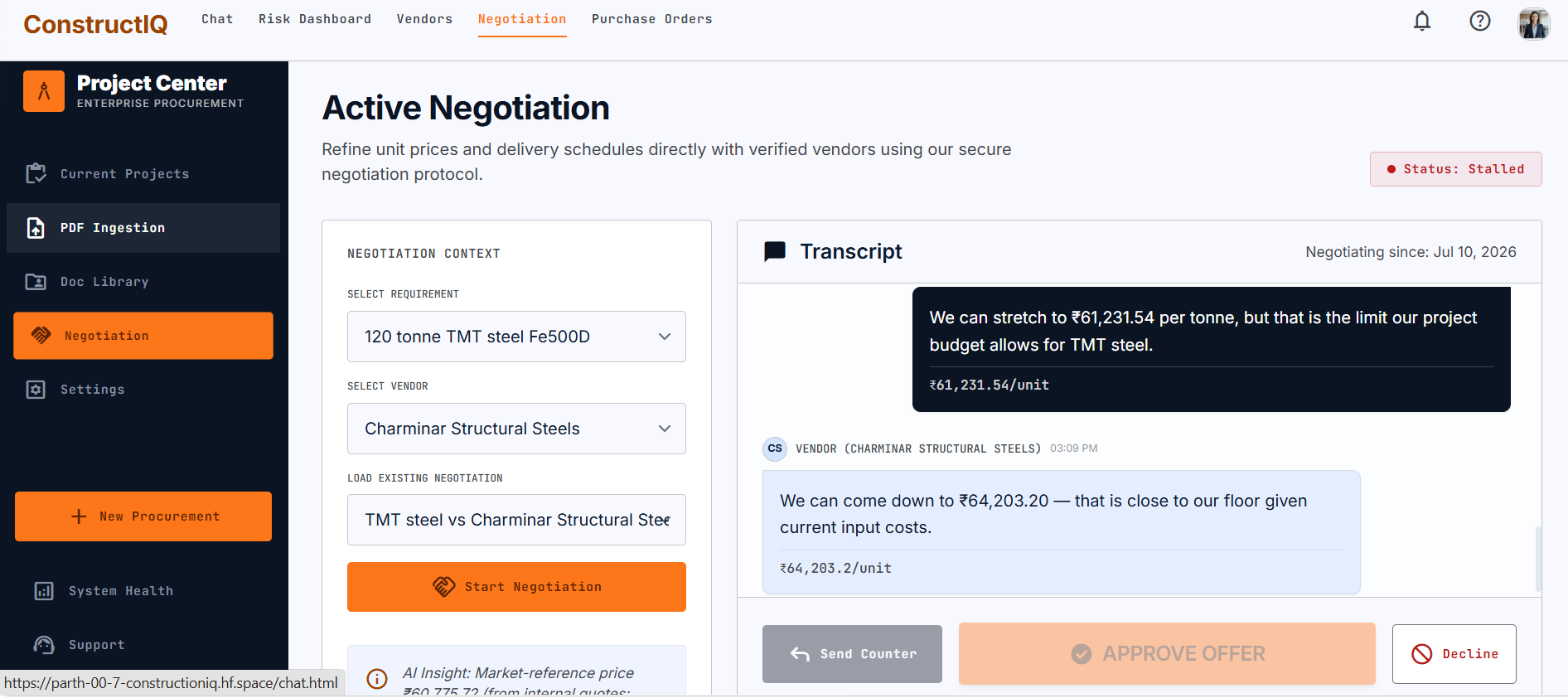
Negotiation
-
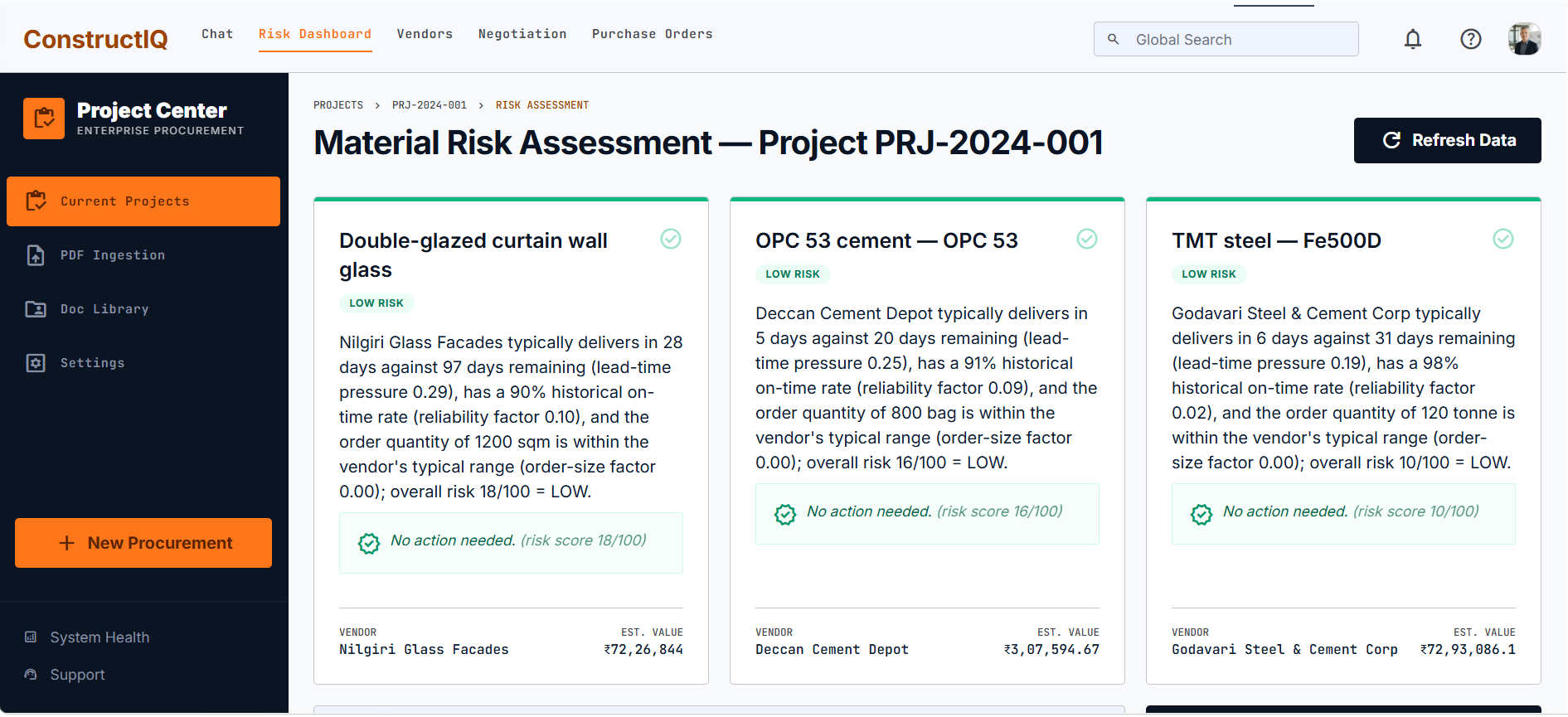
Risk Management
Inspiration
A 900-page tender document arrives. A procurement engineer spends three days reading clauses, calling vendors, and comparing quotes on a spreadsheet — hoping they didn't miss a certification requirement on page 647.
Generic AI chat tools have no persistent project memory. Enterprise platforms like Kaya AI's Amber are built for large contractors with full procurement teams. The gap we saw: no tool takes a single project's documents and runs the complete procurement decision loop from first read to signed purchase order. ConstructIQ is built to close that gap.
What it does
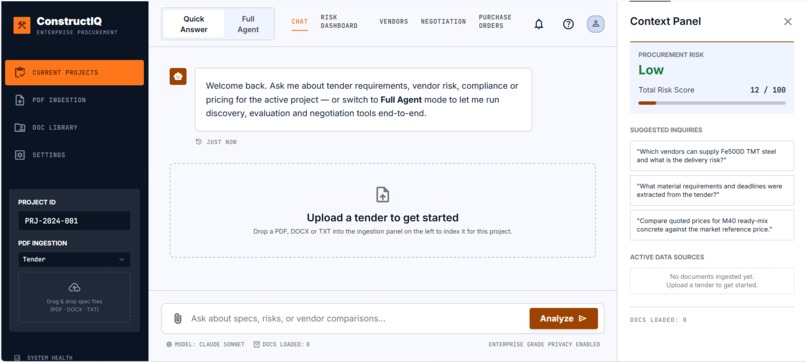
ConstructIQ is a 10-stage AI procurement intelligence system for construction projects. Upload your documents once; the system runs the full loop on demand:
Ingest → Extract → Discover → Evaluate → Comply → Risk → Recommend → Negotiate → Purchase Order → Track
Key behaviours:
- Catches that Fe500 steel ≠ Fe500D steel (different IS 1786 grades) and flags it with a plain-English explanation — not a silent mismatch
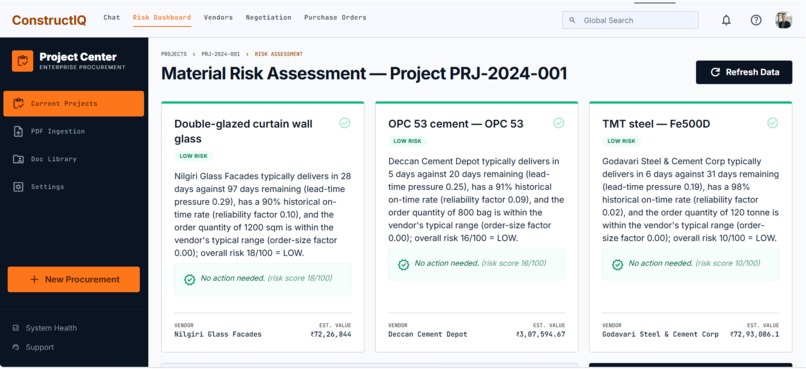
- Scores delay risk as $$S = 0.5 \cdot P_{lead} + 0.35 \cdot (1-R_{vendor}) + 0.15 \cdot D_{order}$$ — a formula you can read and verify, not a black-box prediction
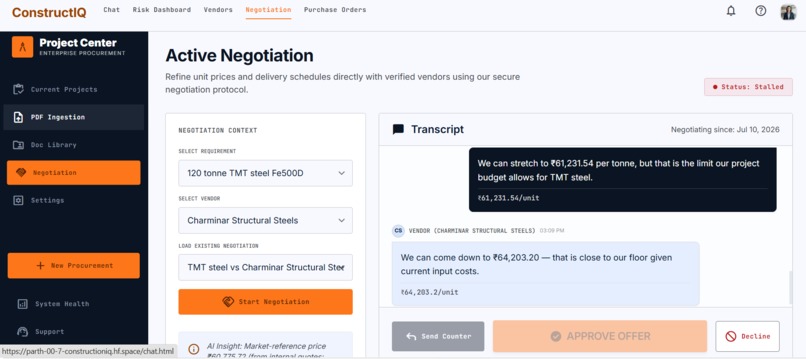
- Runs a multi-round Buyer ↔ Vendor negotiation where concessions are computed by $$P_{new} = P_{prev} - \delta \cdot f_{flex}$$ not improvised by the LLM
- Generates a signed PO PDF on human approval and tracks delivery status through a forward-only state machine
Core design principle: every AI judgment is a transparent, inspectable calculation the LLM explains in plain English — never an unexplained opinion.
How we built it
                       Streamlit Dashboard
                                │ HTTP
                         FastAPI Backend
                    ┌───────────|──────────────────┐
               ChromaDB       SQLite        Claude Agent SDK
              (vectors)   (structured)   (8 procurement tools)
                                    │
           Document pipeline (PyMuPDF + pdfplumber + python-docx)
- PDF parsing: PyMuPDF for body text, pdfplumber for BOQ tables — both are needed because one library mangles what the other handles well
- Embeddings: sentence-transformers running locally (all-MiniLM-L6-v2) so the demo works fully offline — no API call to fail in front of judges
- RAG: ChromaDB filtered by
project_id; every retrieval returns a confidence score so low-quality matches are flagged, not silently trusted - Agent: 8 Claude tools chained autonomously; tool-call log is screen-shareable during Q&A to show the full reasoning chain
- Negotiation: prices computed in Python, LLM only writes the message — the model narrates a calculation, it never freelances a number
Stack: Python 3.11 · FastAPI · SQLite · ChromaDB · Anthropic SDK · Tavily · ReportLab · Streamlit · Docker
Challenges we ran into
Scope under ambition. A 6-stage MVP became 10 stages, 5 document sources, a negotiation engine, and a tracking state machine within two days of planning. We maintained a hard CORE vs DEFERRED boundary in writing and re-read it before adding anything. Daily standup rule: "I started on a deferred item" is a blocker, not a status update.
Credible negotiation. Two free-roaming LLM personas agreed too quickly and couldn't survive a judge asking "is the vendor just saying yes to look good?" We removed the model from price calculation entirely — the Vendor agent's concession is a formula, the LLM only writes the in-character sentence around the result.
Table extraction. Construction tenders mix body text with Bill-of-Quantities tables. PyMuPDF alone garbles them; pdfplumber is slower but table-aware. Solution: PyMuPDF for text, pdfplumber targeted only at detected table pages. Tables serialised as Markdown strings so the LLM reads structure correctly.
Accomplishments that we're proud of
- Every score is auditable — open the source, trace any output in under a minute
- The compliance gap detection is domain-aware, not just keyword matching
- The full 10-stage loop closes end-to-end: tender PDF in, PO PDF out
- Demo runs fully offline — rehearsed once with wifi disabled to confirm
What we learned
- RAG quality lives in the chunking strategy and chunk metadata, not the LLM
- In agentic systems, let the LLM narrate computations — never compute inside the prompt
- Scope discipline is a technical skill that requires the same deliberateness as writing code
- Synthetic demo data is fine; disclosing it honestly is what makes it credible
What's next for ConstructIQ
- Multi-source ingestion: WhatsApp export, bulk email, drawing descriptions via vision
- Knowledge graph: connect Project → Material → Vendor → Region for multi-hop queries ("which projects are exposed if Vendor X fails?")
- Portfolio view: cross-project risk dashboard for procurement directors
- Real vendor data: GeM and CPWD e-procurement portal integrations
The risk weights {0.5, 0.35, 0.15} are a calibrated starting point. The production model trains on real delay outcomes:
$$\hat{S} = \mathbf{w}^{\top}\phi(\mathbf{x}), \quad \mathbf{w} = \arg\min_{\mathbf{w}} \sum_{i} \mathcal{L}(S_i, \hat{S}_i)$$
That dataset doesn't exist at hackathon scale — but it accumulates naturally once the product is in production use.


