Inspiration
My neighbor has run construction projects for Kaiser for years. I sat on his porch one afternoon and asked him what actually goes wrong on a jobsite.
His answer reframed how I thought about the whole space. The expensive conflicts aren't two pipes crashing in a 3D model as the BIM clash detection already catches those. The expensive conflicts are contextual: the crew that shows up on day six to a site that isn't ready. The concrete truck that arrives before the foundation's poured. The electrician shortage that cascades into a $900K total cost exposure over 90 days.
Current tools don't catch those. They get discovered in the field, when it's too late to fix them cheaply.
He knows construction. I build software. So I built the tool he said didn't exist.
What it does
ConstructionIQ is a pre-construction simulation platform, an AI-powered digital twin that lets project managers design a construction site, configure a realistic project plan, and then run a day-by-day simulation that stress-tests the whole build before ground breaks.
The system produces three layers of intelligence:
1. Sketch-to-Site Parsing
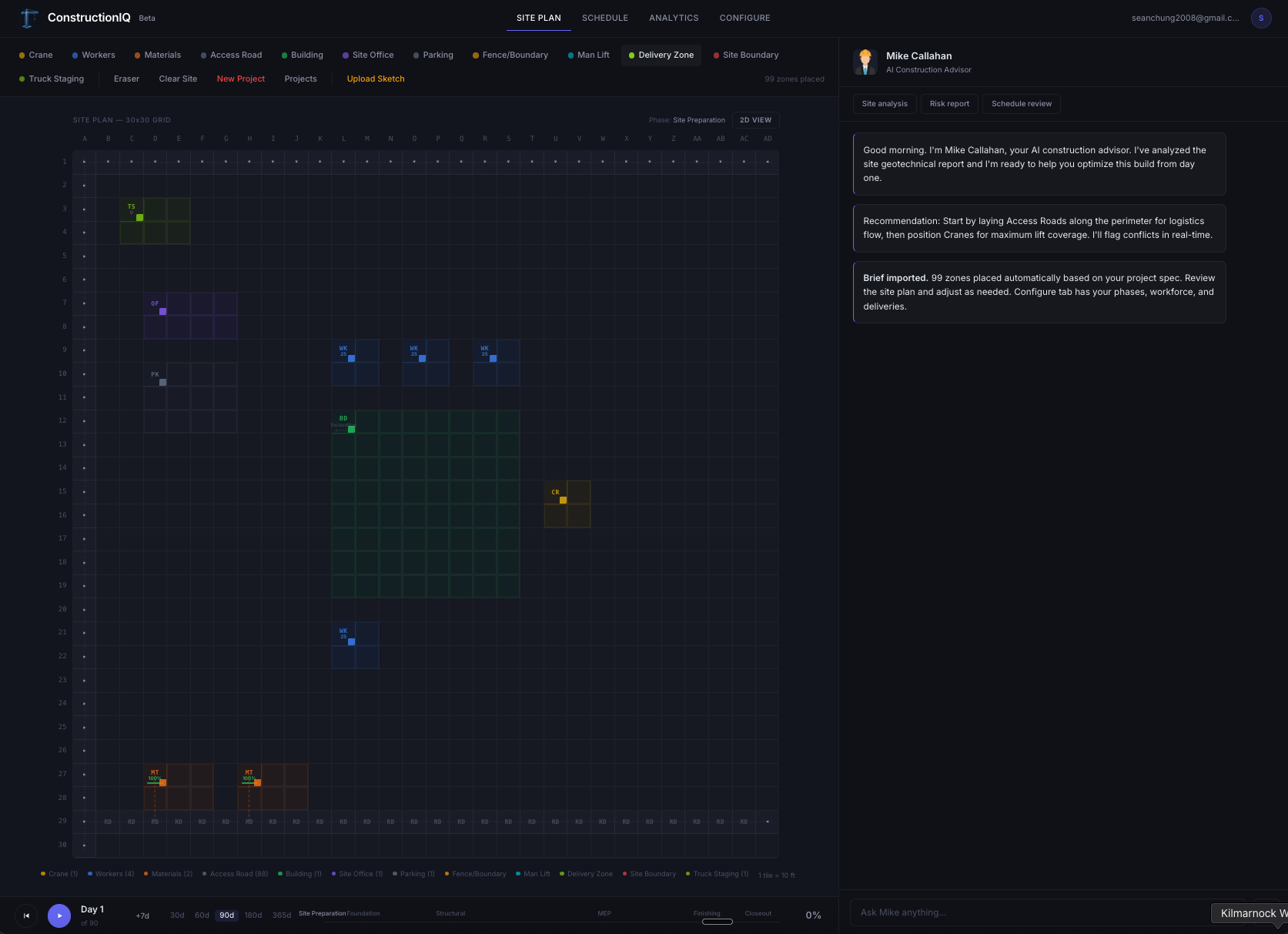
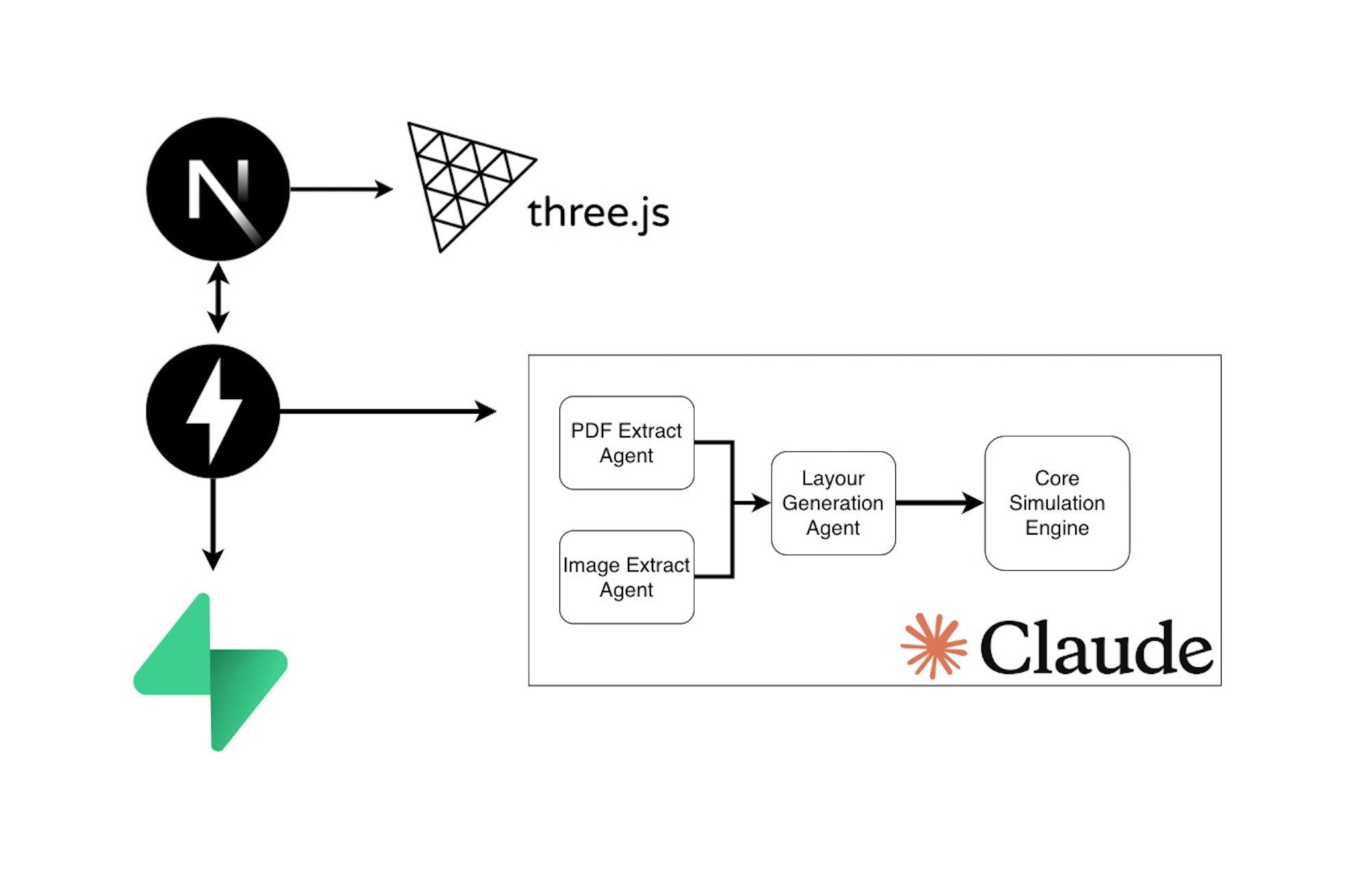
PMs don't start at a computer. They sketch on paper. ConstructionIQ meets them there: print a 30×30 grid template, sketch your layout with a highlighter, label the zones, snap a photo. Claude's vision API parses the image into a structured zone layout in under 10 seconds.
2. Day-by-Day Simulation with an AI Superintendent
The simulation engine runs a critical-path scheduling pass and detects six categories of conflicts: schedule slips, crew shortages, material stockouts, equipment bottlenecks, spatial conflicts, and milestone risks. Every conflict is flagged by Mike Callahan: an AI construction superintendent powered by Claude who surfaces each issue with severity, cost exposure, and a concrete recommendation in plain English.
3. 3D Digital Twin with Fast-Forward Playback
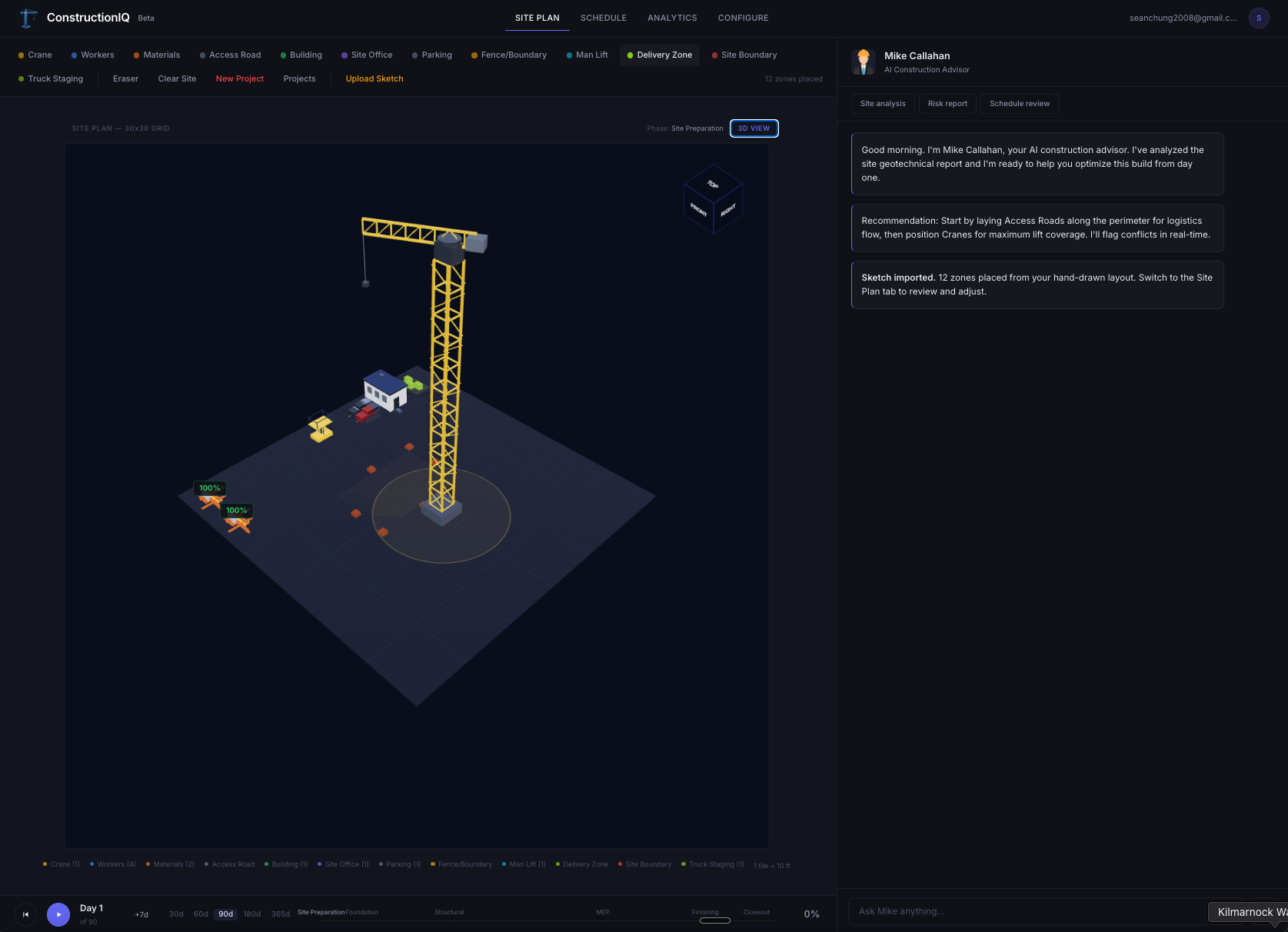
A React Three Fiber scene renders the full site in real-time with animated cranes, moving workers, inbound delivery trucks, and phased building geometry that evolves from excavation through closeout. Users can rewind, pause, or fast-forward weeks of construction in seconds.
On a 90-day Meridian Data Center test build, the system surfaced 39 conflicts across the project timeline, with total cost exposure reaching $928,750 and projected overhead overrun of $120,000, all flagged before day one of actual construction.
Challenges I ran into
PDF-to-simulation schema alignment. The PDF parser extracted project configs cleanly but the simulation engine expected a different shape for crane positions (position.x/y vs gridX/gridY) and delivery schedules (scheduledDays vs days). Every config flowed correctly but some fields silently degraded, caught it during end-to-end testing.
State management at scale. The main application component grew to 4,000+ lines of React local state before I realized no off-the-shelf pattern fit the unique concurrency needs (stale response skipping, playback debouncing, scenario branching). Built custom refs for simulation tick control.
AI output variance. Claude's responses to identical simulation states vary across runs. For the AI superintendent, variance is a feature as it reads human. For the PDF parser, variance is a bug: structured output needs to be deterministic. Solved with JSON retry logic and stricter system prompts.
Accomplishments that I'm proud of
Full end-to-end simulation: sketch input to parsed zones to PDF brief to simulated build to AI debrief, all in a single user flow.
Scenario branching with perturbation injection : users can ask "what if my crane fails on day 30?" and watch the cascading effect against baseline.
A live 3D site that updates as the simulation ticks : building geometry changes with phase, workers animate, trucks route along access roads.
What I learned
The expensive conflicts in any domain are the ones current tools don't catch. Building something useful means finding the gap, not matching the existing feature set.
What's next for ConstructionIQ
AI Contextual Conflict Detector : a deeper pass at the conflicts BIM misses: coordinating crew arrivals, delivery windows, and phase transitions against real site constraints.

Log in or sign up for Devpost to join the conversation.