Inspiration
Construction sites remain among the most hazardous work environments globally. Despite regulations, incidents like hand injuries, falls, and equipment misuse still occur due to gaps in communication, training, and safety awareness.
I was inspired by the idea of using AI agents not just to automate tasks, but to enhance human safety—by generating safety content, analyzing behavior, and ensuring compliance with international standards. The launch of Google’s Agent Development Kit (ADK) presented the perfect opportunity to explore how a multi-agent system could handle complex safety challenges at scale.
I wanted to build something that’s smart, scalable, and actually useful in the field—something a safety officer or HSE manager could rely on to create and verify content, train workers, and reduce risks with less manual effort.
What it does
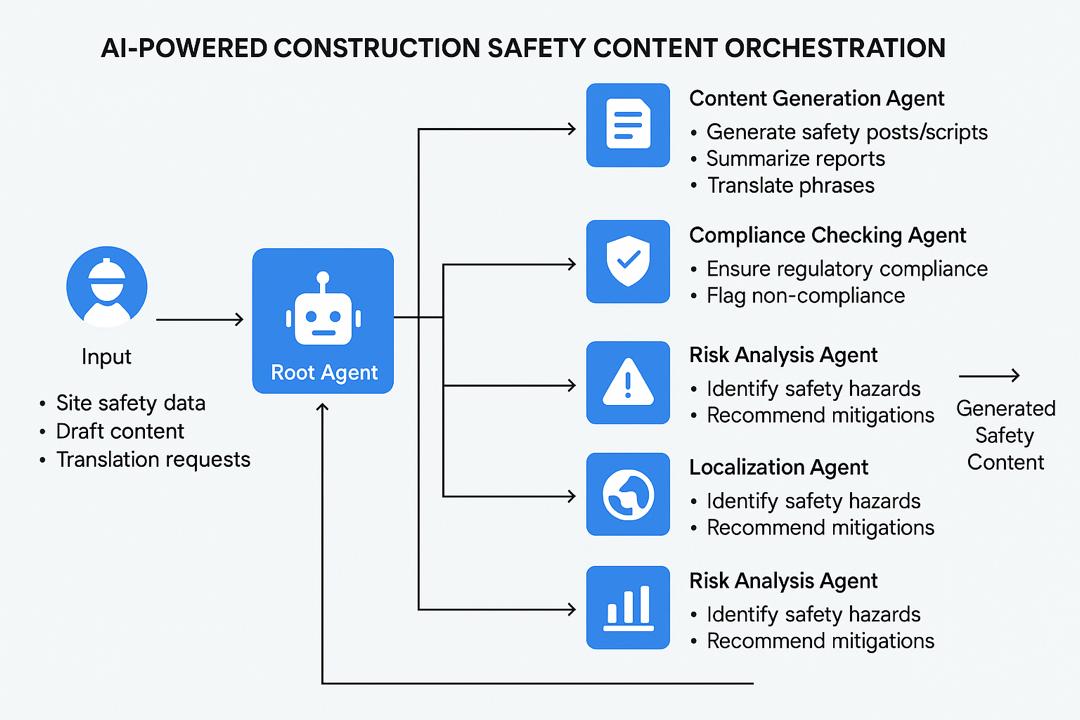
Construction_Safety_Multi_Agent_ADK is a multi-agent system powered by Google’s Agent Development Kit (ADK) that automates safety content creation, compliance validation, and risk analysis for construction environments. It processes incident reports, observations, or safety topics and generates: -Social media safety posts (Instagram, TikTok, etc.) -Voice-over scripts for safety briefings -Compliance checks against global safety standards (OSHA, ISO, HSE) -Multilingual translations and cultural adaptations -Audience and learning effectiveness analysis -Risk assessment insights -Usability and style tone feedback
The system simulates incoming tasks via CSV , and each specialized agent works in harmony to produce safety content that is clear, compliant, and culturally appropriate. It’s built to help HSE professionals like officers, trainers, and safety engineers save time and reduce risk.
How we built it
I built Construction_Safety_Multi_Agent_ADK, a smart construction safety solution, using Google’s Agent Development Kit (ADK) as the foundation of our multi-agent architecture. The development process included:
Modular AI Agent Design: I created 11 task-specific AI agents using Python and ADK’s Agent framework, each assigned a focused safety-related function — from content generation to usability testing and localization.
Gemini Model Integration: Each agent leverages Google’s Gemini 1.5 Pro or 2.0 Pro to process tasks such as analyzing safety tone, creating Instagram captions, performing regulatory compliance checks, and more.
3.Batch Task System via CSV: A CLI-based script (run_batch_from_csv.py) was developed to simulate batch task processing using CSV input. This approach allows offline demoing and makes testing scalable and repeatable.
4.Output Logging and Evaluation: Agent outputs are saved to a structured CSV file (output_responses.csv) after each task is processed, enabling easy review and evaluation of the system’s performance.
5.Asynchronous Multi-Agent Execution: Agents are run through the ADK’s async orchestration model, enabling real-time collaboration between agents like the ComplianceCheckerAgent, TranslatorAgent, and VoiceOverAgent in a single workflow.
Architecture-Driven Planning: I developed a unified agent orchestration plan to simulate end-to-end tasks — such as taking an incident report and automatically generating a voice-over script localized for a non-English audience.
CLI-first, Frontend-agnostic: To keep the system lightweight and hackathon-friendly, I skipped UI dependencies and focused entirely on command-line and programmatic interactions.
Challenges we ran into
Learning the Agent Development Kit (ADK): As this was my first time using Google’s ADK, understanding its structure, lifecycle, and orchestration mechanisms took time. I had to experiment with different ways to chain agents and share context between them.
Handling Task Input and Output Flow: Designing a consistent way to handle inputs and outputs between 11 independent agents was tricky. I opted for a CSV-based system for simplicity but had to ensure every agent could handle and respond to structured prompts appropriately.
Balancing Realism and Simplicity: While simulating realistic safety workflows (e.g., checking compliance or performing risk assessments), I had to simplify some logic due to time constraints and lack of real-time data.
Working Without a UI: Without a web interface or dashboard, everything had to be demonstrated through CLI and CSV files. Making that intuitive and clear required additional logging and formatting efforts.
Latency and LLM Quotas: Using Gemini models within multiple agents sometimes caused latency and occasional API errors, especially when handling parallel requests or larger prompts.
Multi-Agent Coordination: Managing inter-agent communication (e.g., content creation → compliance → translation → voice-over) involved creating fallback logic in case any one agent didn’t return usable output.
Accomplishments that we're proud of
Few weeks i had zero experience on AI orchestration or neither was i in tech , but took an interest in it. This project gave me the opportunity to learn and was able to achieve the following :
Successfully Built an 11-Agent System with ADK: I designed and deployed a fully functional multi-agent system using Google’s Agent Development Kit—something we had never used before.
End-to-End Task Automation from CSV Input to Output: The system takes real-world safety tasks via a simple CSV interface and outputs structured, meaningful content, including captions, voice-over scripts, compliance checks, and more.
Integrated Diverse Safety Use Cases: The agents cover a wide range of critical safety processes—from risk assessments and compliance to translation and audience-specific localization.
Leveraged Google Gemini Models Across Multiple Agents: I used Gemini 1.5 Pro and 2.0 Pro models to generate safety-specific outputs that are both compliant and easy to understand.
Developed a Demo-Ready Architecture: With clear logs, agent-specific outputs, and a robust README, our system is easy to test, scale, and demonstrate.
Streamlined Deployment Without a UI: Even without a graphical interface, I ensured the project could be run entirely through CLI and CSV automation, making it simple and efficient for hackathon judges to test.
What we learned
Hands-on Experience with Google’s Agent Development Kit (ADK): This was our first time using ADK, and we gained a deep understanding of how to define, register, and run agents in a multi-agent orchestration setup.
Prompt Engineering for Safety-Specific Tasks: I learned how to craft effective prompts tailored for construction safety topics—ensuring clarity, compliance, and cultural relevance.
Structuring Multi-Agent Collaboration: I explored how agents can work together by handling distinct roles like content creation, compliance, translation, and risk assessment—leading to a cohesive, intelligent system.
Simulating Real-World Workflows with CSV and Logs: I discovered the power of using simple tools like CSV to batch tasks into the ADK ecosystem, making testing and iteration more efficient.
Balancing Creativity and Safety Regulations: It was a valuable experience learning how to generate creative content while still adhering to safety compliance and ethical guidelines.
Debugging and Enhancing LLM Outputs in ADK: I learned to intercept, inspect, and refine LLM outputs to better serve structured task responses in an automated agent pipeline.
What's next for Construction_Safety_Multi_Agent_ADK
Integrate Real-Time Text-to-Speech Output: Enhance the VoiceOverAgent to generate real-time audio using tools like Google Cloud Text-to-Speech, improving accessibility and training impact on-site.
Connect to Live IoT Data Feeds: Replace the simulated DataStreamer with real-time inputs from IoT sensors or safety observation platforms on active construction sites.
Expand Multilingual Support: Integrate more languages and dialects into the TranslatorAgent and LocalizationAgent for broader cultural adaptability across global sites.
Deploy to a Mobile-First Safety App: Package the multi-agent system into an Android/iOS-compatible safety assistant app for field workers and supervisors.
LMS and Learning Analytics Integration: Connect LearningAnalyticsAgent with real LMS platforms (like Moodle, Google Classroom) to analyze real engagement, not just simulated data.
Create a Plug-and-Play Safety Content API: Offer the system as a public API so construction companies can generate safety posts, voice scripts, and compliance checks automatically via REST endpoints.
Open-Source Contribution and Community Collaboration: Contribute modular agents back to the ADK community and invite collaboration for domain-specific expansions (e.g., mining, oil & gas safety).

Log in or sign up for Devpost to join the conversation.