ConstructAI
Inspiration
Construction is one of the largest industries in the world, yet many projects still suffer from delays caused by poor coordination across the supply chain. During our research, we discovered that materials pass through suppliers, manufacturers, warehouses, transport partners, and finally the construction site. Even when all the required information exists, it is often scattered across different systems and stakeholders.
What inspired us was realizing that the real problem isn't always the delayed material itself—it's the delayed decision. Project managers often identify risks only after they have already disrupted construction activities. We wanted to explore how Artificial Intelligence could help teams move from reacting to problems to preventing them.
That idea became ConstructAI.
What it does
ConstructAI is an AI-powered Decision Intelligence Platform designed for construction supply chains.
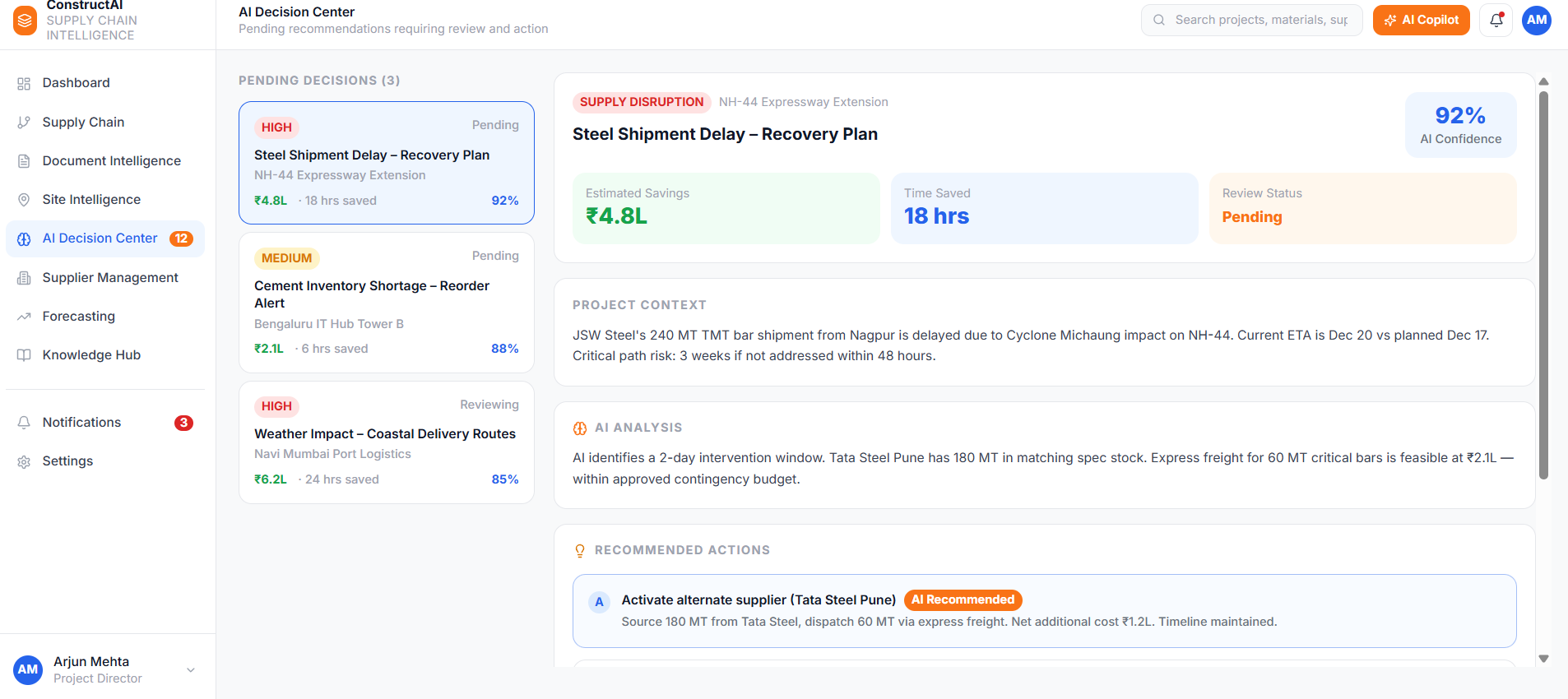
Instead of acting as another project management tool, it works as an intelligent decision-support layer. The platform brings together information from construction documents, supplier updates, logistics, project schedules, and site inspections to provide a complete understanding of project progress.
Using AI, ConstructAI can:
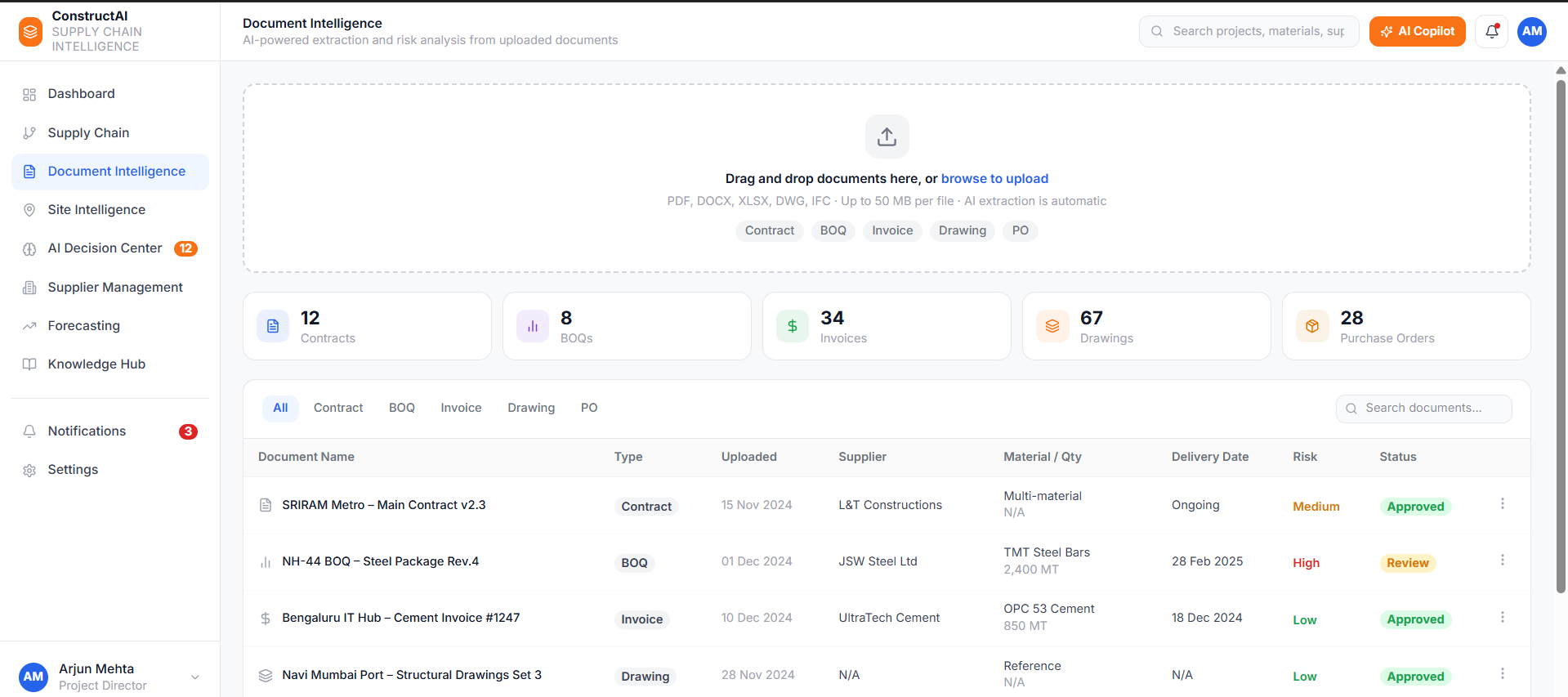
- Read and understand contracts, BOQs, purchase orders, and technical documents.
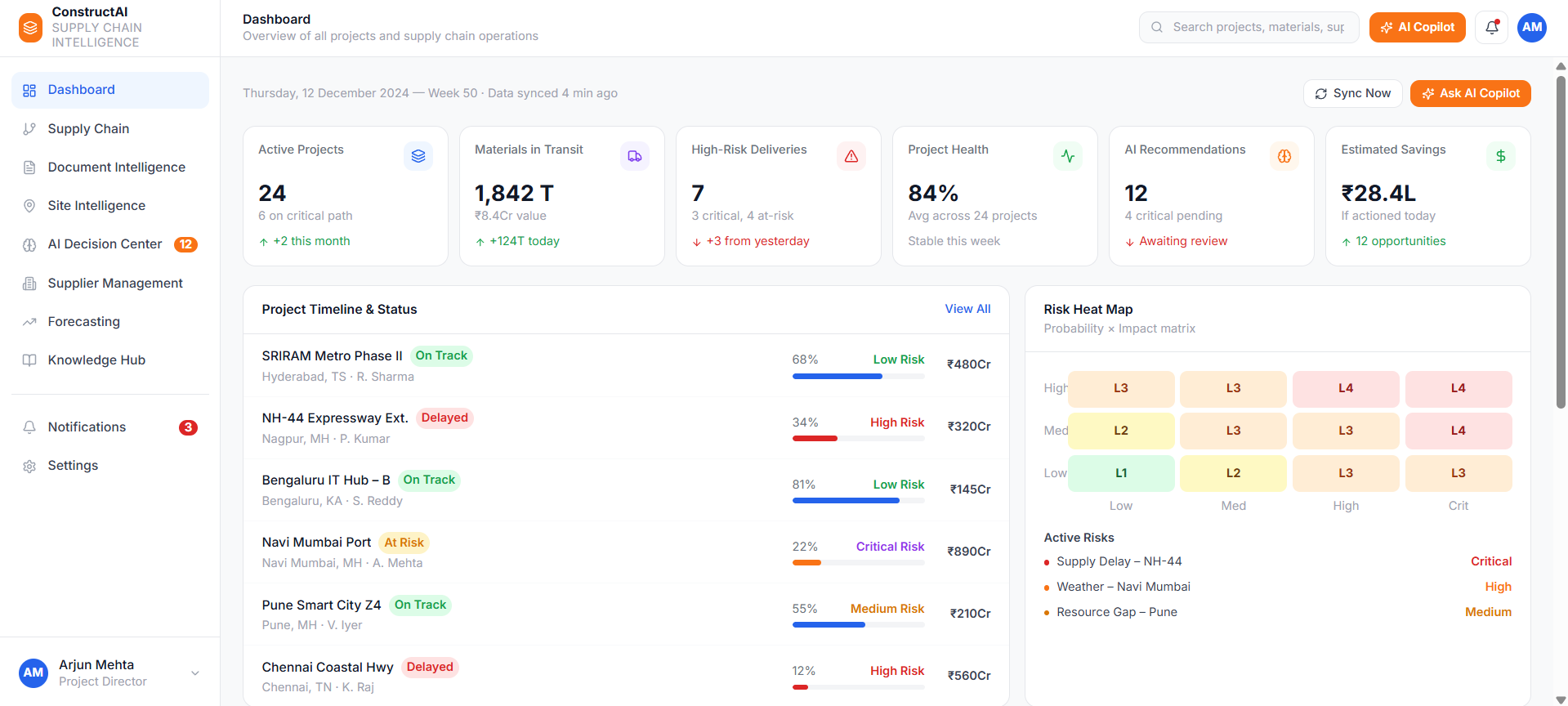
- Monitor supply chain activities from suppliers to construction sites.
- Predict delivery risks before they impact project schedules.
- Analyze site images to monitor construction progress.
- Recommend practical recovery actions with clear explanations.
- Build an organizational knowledge base that learns from previous projects.
The goal is to help construction teams make faster, smarter, and more confident decisions.
How we built it
We first studied the construction supply chain to understand how information flows between different stakeholders and where delays usually occur.
Based on this research, we designed a modular AI platform where different technologies solve different problems.
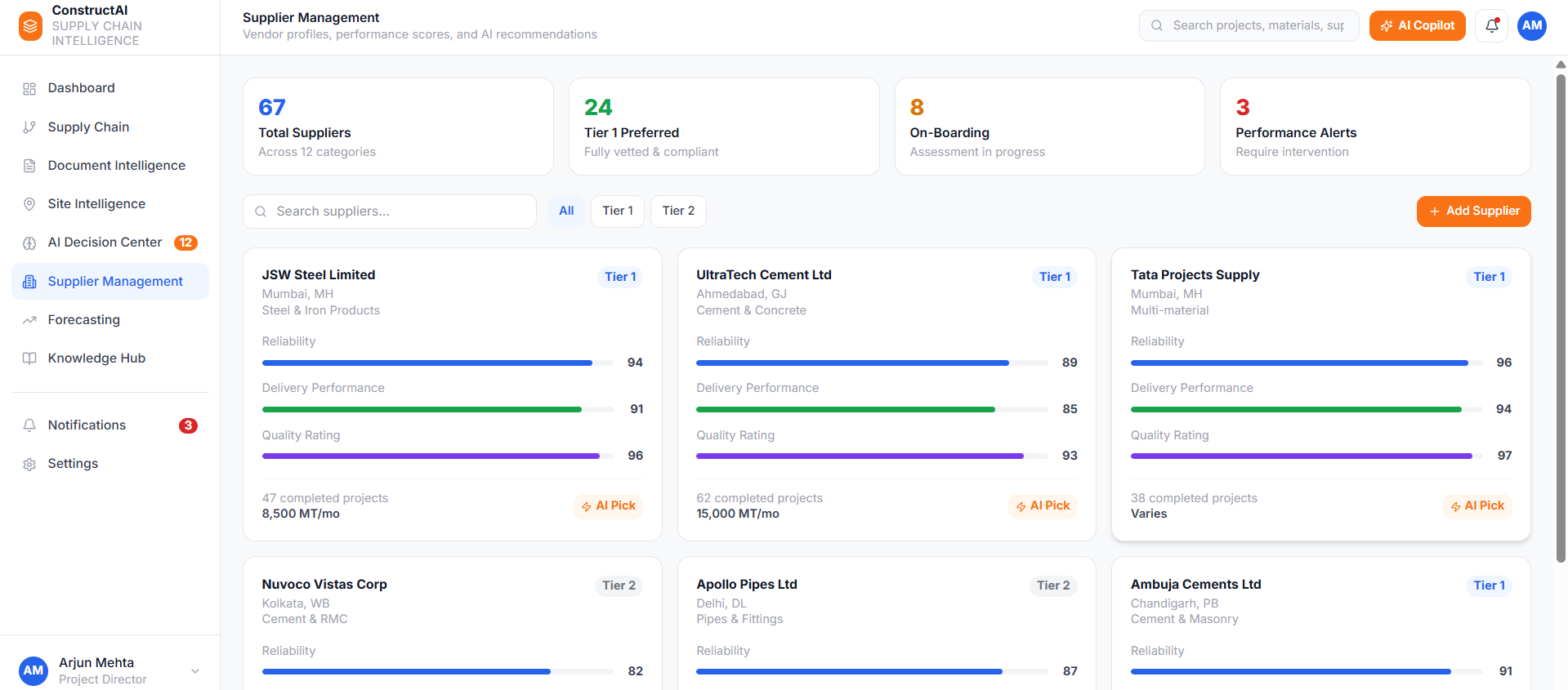
Our frontend prototype was designed using modern enterprise UI principles to provide an intuitive experience for project managers and procurement teams.
The AI architecture combines multiple techniques including:
- OCR for reading construction documents.
- Natural Language Processing (NLP) for understanding technical text.
- Large Language Models (LLMs) with Retrieval-Augmented Generation (RAG) for context-aware answers.
- Vision-Language Models (VLMs) for analyzing construction site images.
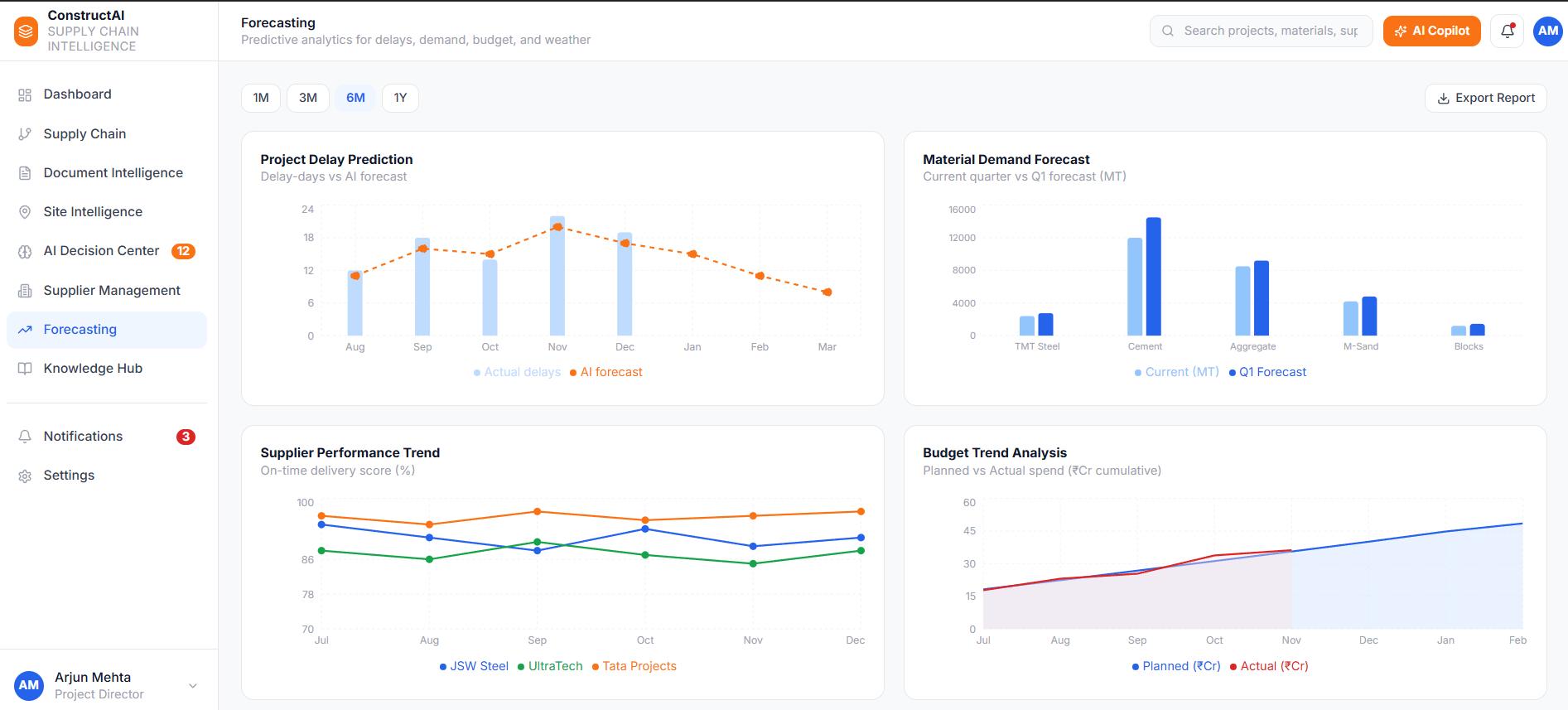
- Machine Learning models for forecasting delivery risks.
- Agentic AI for generating explainable recommendations.
Together, these technologies create a unified decision-support system instead of isolated AI features.
Challenges we ran into
One of the biggest challenges was understanding the construction industry as students. Unlike common AI applications, construction projects involve many independent stakeholders, complex workflows, and highly specialized documents.
Another challenge was ensuring that our solution solved a genuine industry problem rather than simply adding AI to an existing process. We spent significant time researching supply chain operations, studying enterprise construction platforms, and identifying where AI could provide meaningful value.
Designing a system that remains understandable for both technical and non-technical users was also challenging. We wanted project managers to trust the platform, so we focused on explainable recommendations instead of black-box predictions.
Accomplishments that we're proud of
We're proud that ConstructAI goes beyond being just another AI chatbot or dashboard.
Instead of focusing on a single feature, we designed an end-to-end decision intelligence platform that integrates document understanding, visual analysis, predictive forecasting, and AI-assisted decision support into one unified system.
We're also proud of creating an enterprise-style prototype that reflects how such a platform could realistically be used within construction companies.
What we learned
This project taught us that solving real-world problems requires much more than selecting the latest AI models.
We learned the importance of understanding the industry first, identifying the actual pain points, and then choosing technologies that directly address those challenges.
We also gained valuable experience in system design, AI architecture, user experience design, and explaining complex technical concepts in a way that non-technical stakeholders can understand.
Perhaps our biggest learning was that successful AI products are built around human decision-making—not around AI itself.
What's next for ConstructAI
This prototype represents the first step toward a practical enterprise platform.
Our next goal is to develop a working MVP that integrates with real procurement systems, ERP platforms, logistics providers, and construction project management tools.
In future versions, we plan to introduce:
- Real-time integrations with enterprise software.
- Digital twin support for live project monitoring.
- More advanced forecasting using historical project data.
- AI-assisted procurement optimization.
- Multi-project portfolio management.
- Mobile support for field engineers.
- Integration with BIM platforms and IoT devices.
Our long-term vision is to transform ConstructAI into an intelligent decision-support platform that helps construction organizations prevent delays, reduce uncertainty, and execute projects more efficiently.
Built With
- api
- cv
- fastapi
- forecasting
- llm
- natural-language-processing
- ocr
- postgresql
- python
- rag
- react
- typescript
- vlm


Log in or sign up for Devpost to join the conversation.