-
-
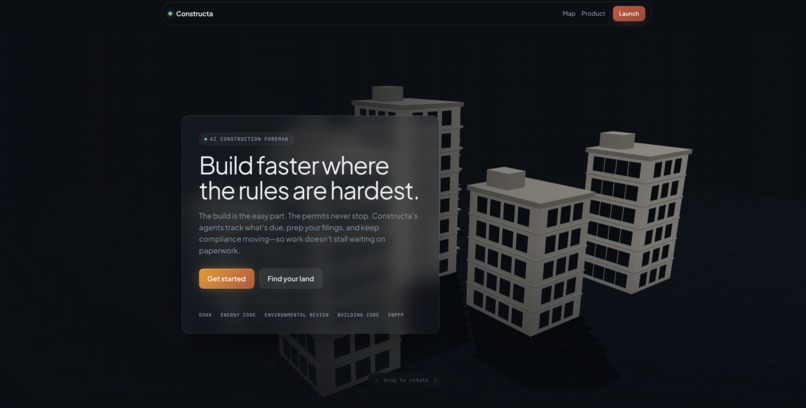
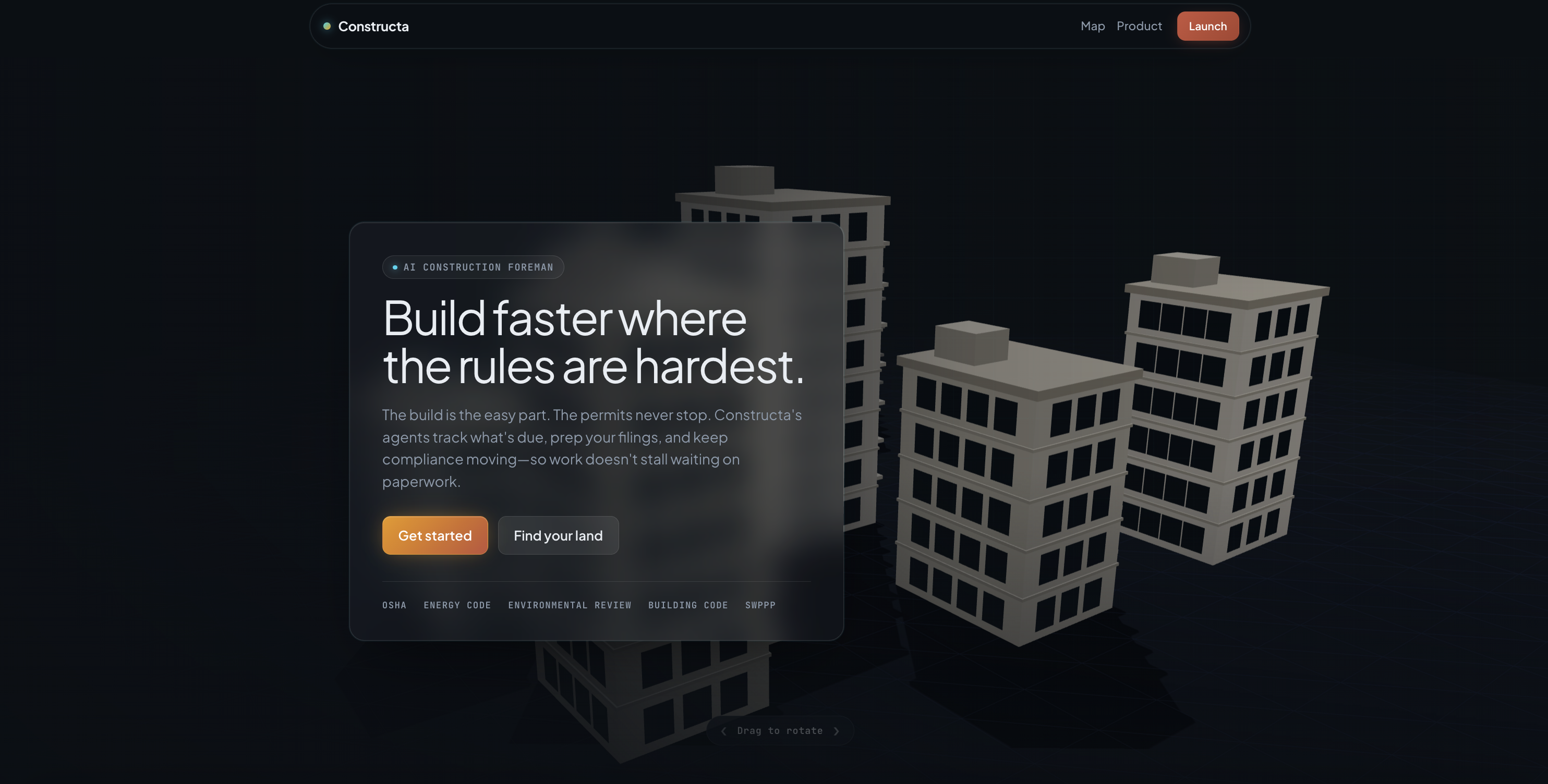
Home page
-
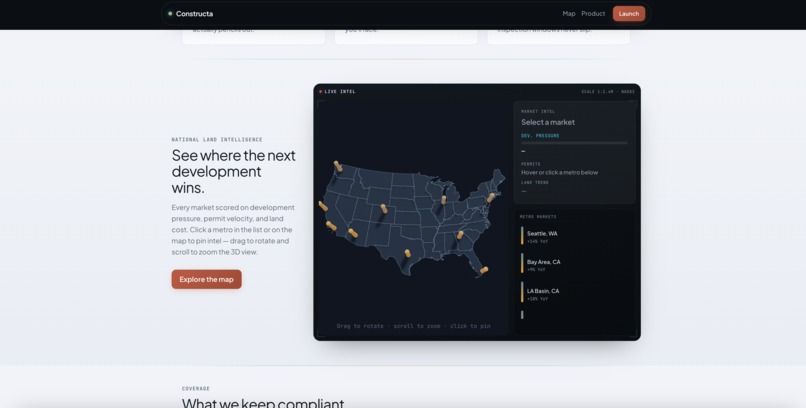
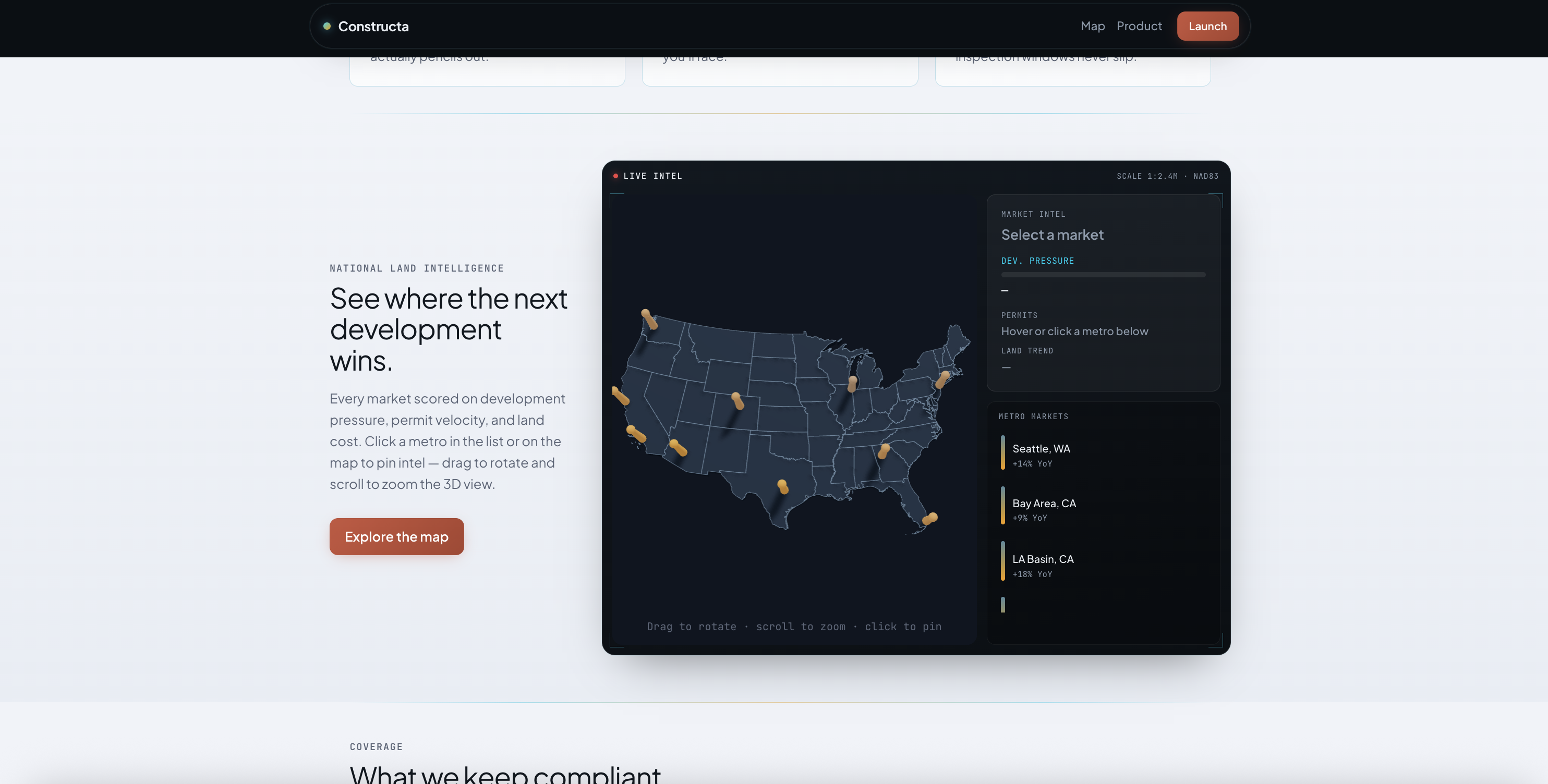
Map + info panel with developer score overview
-
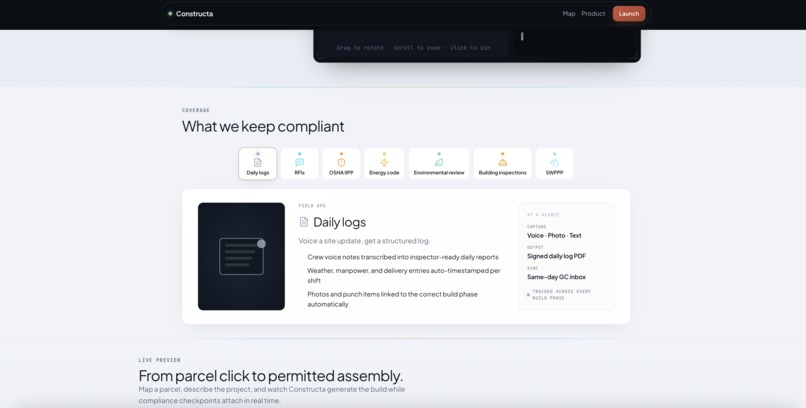
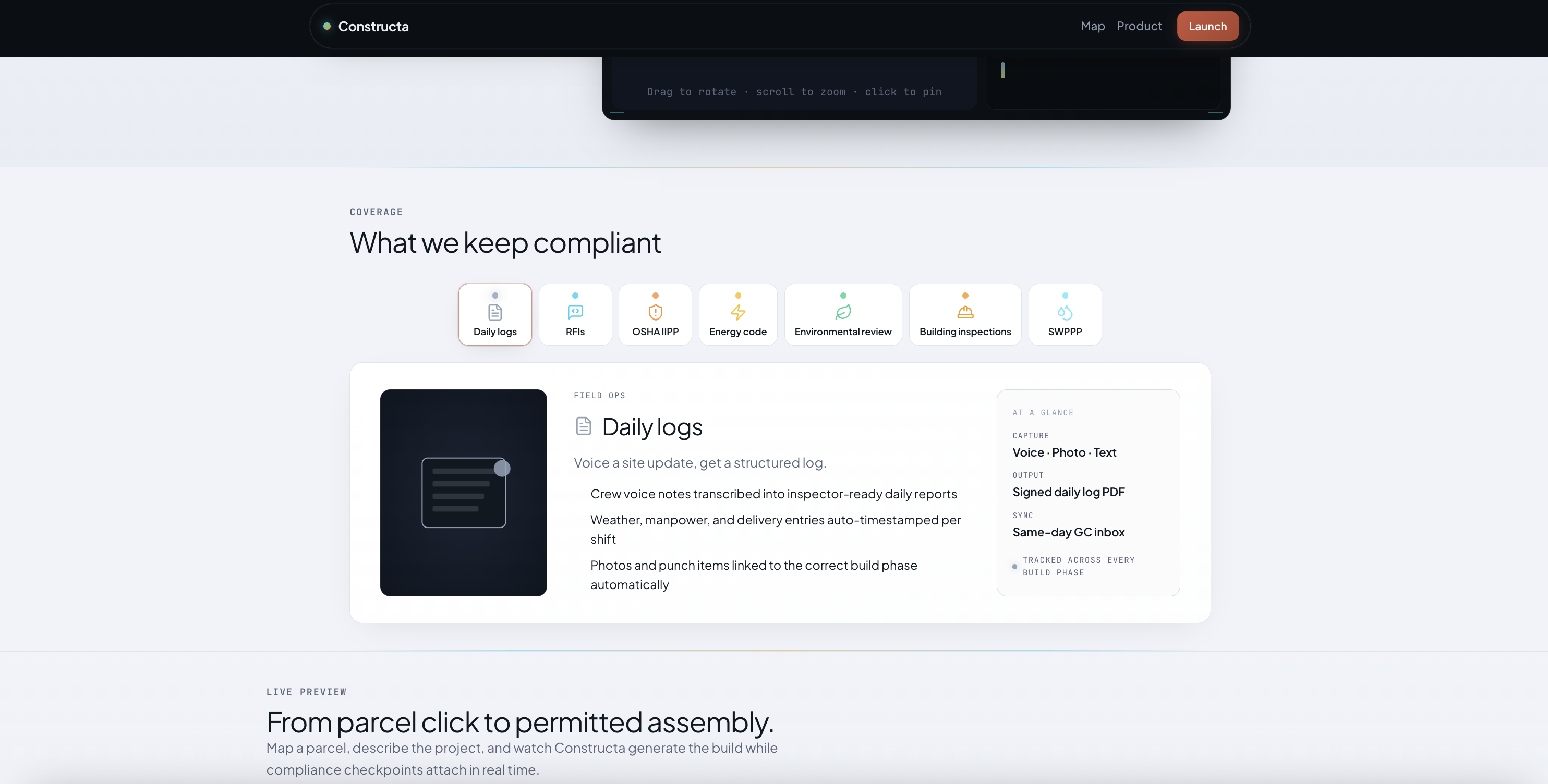
Specific compliance outputs
-
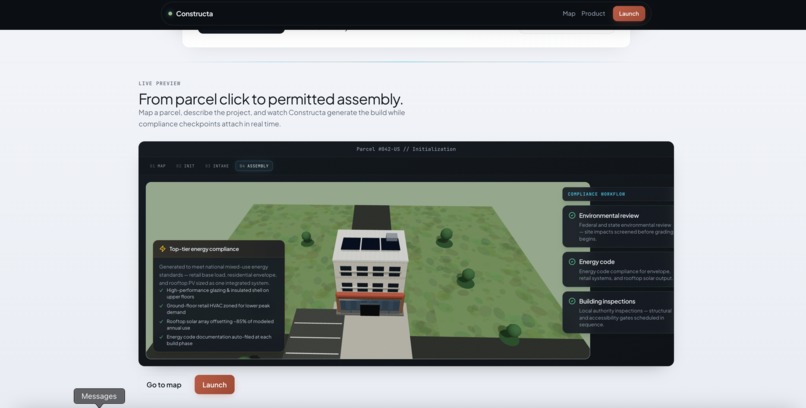
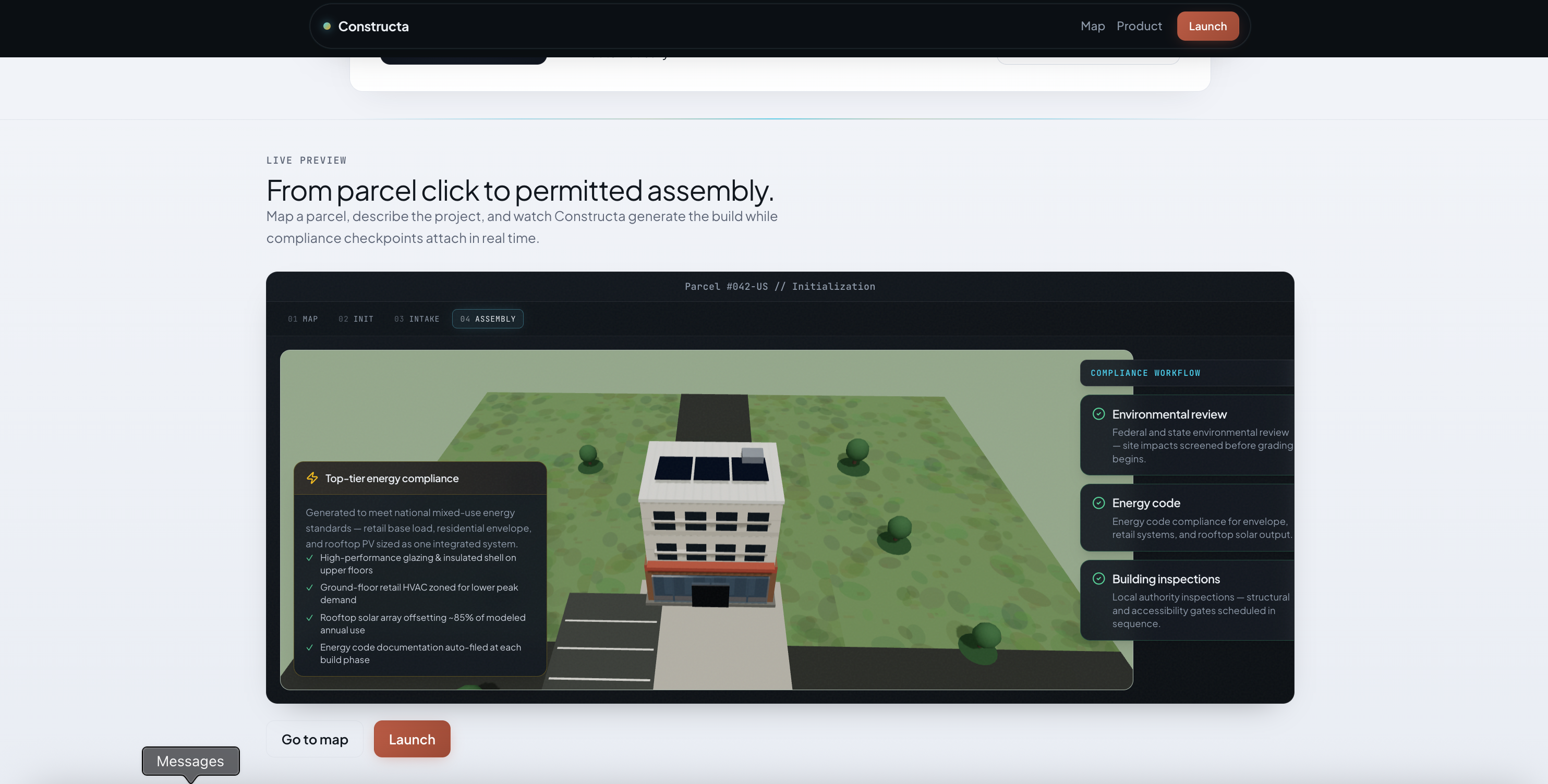
Demo panel with workflow in brief
-
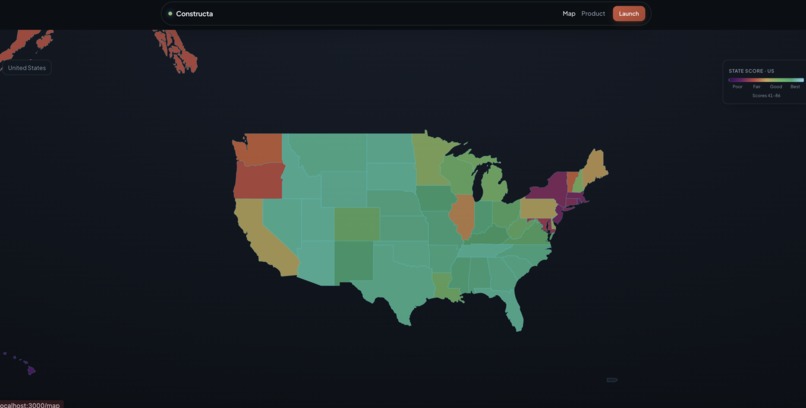
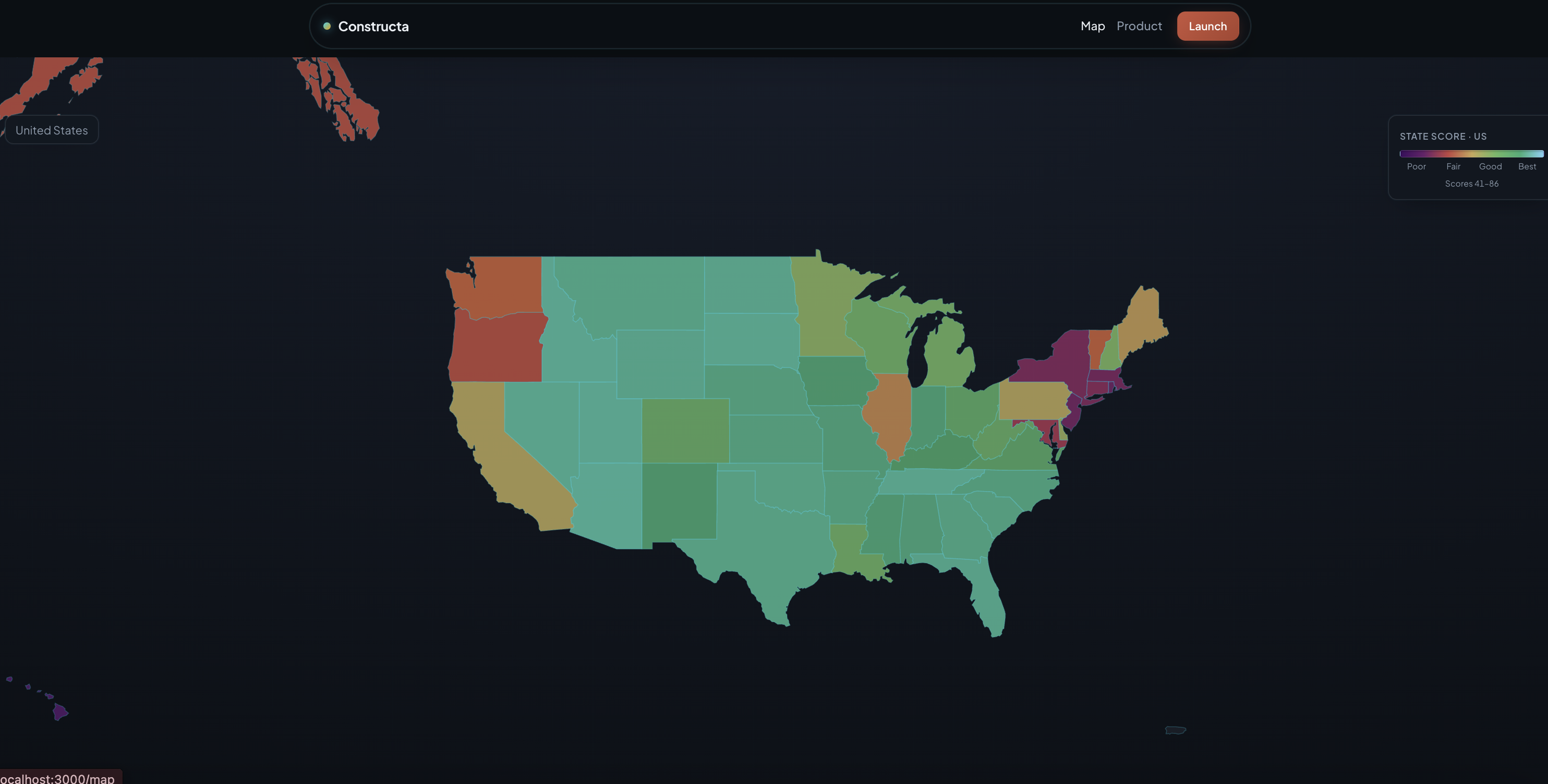
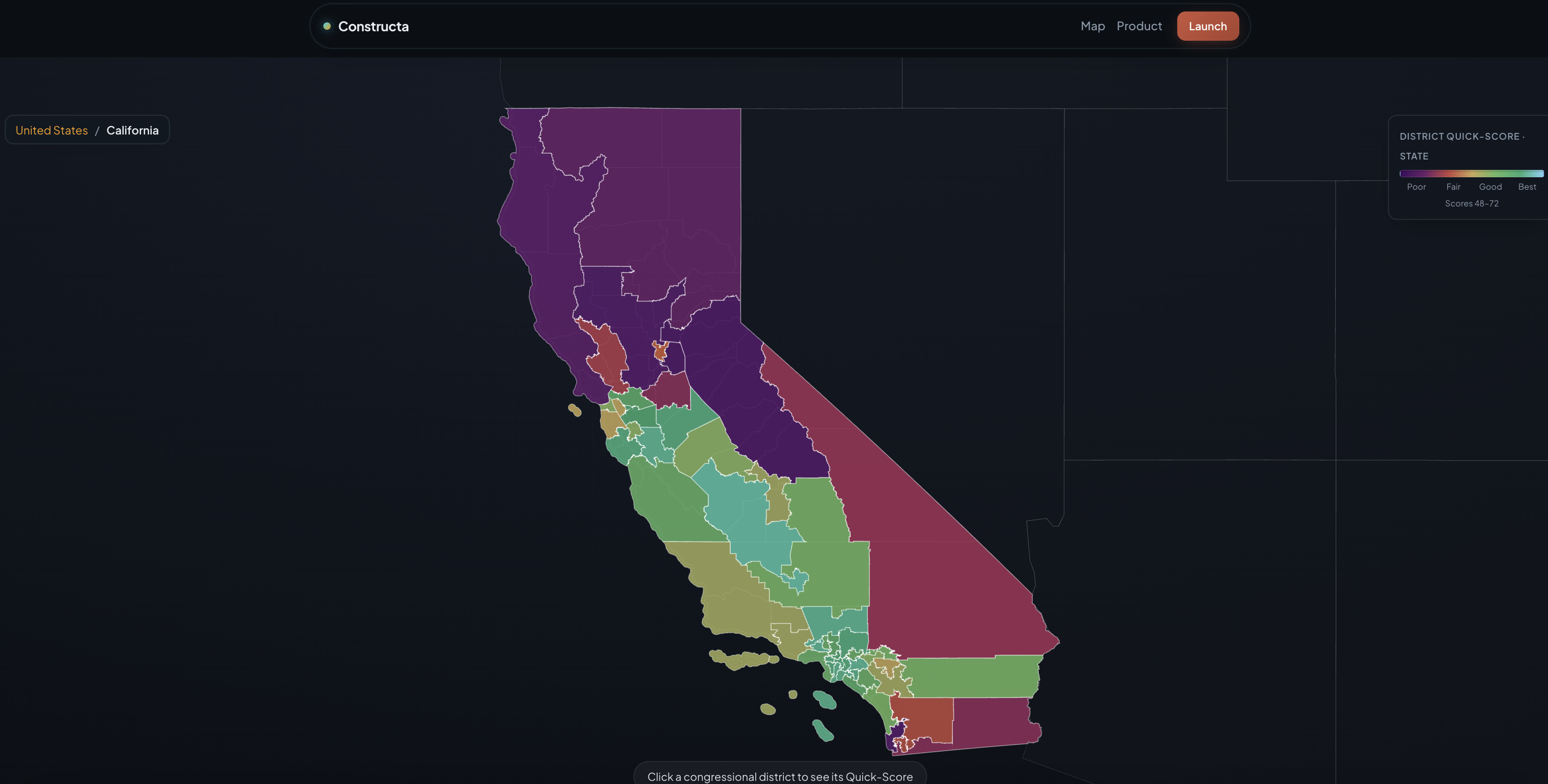
Interactive choropleth map finding land nationwide, broken down by states
-
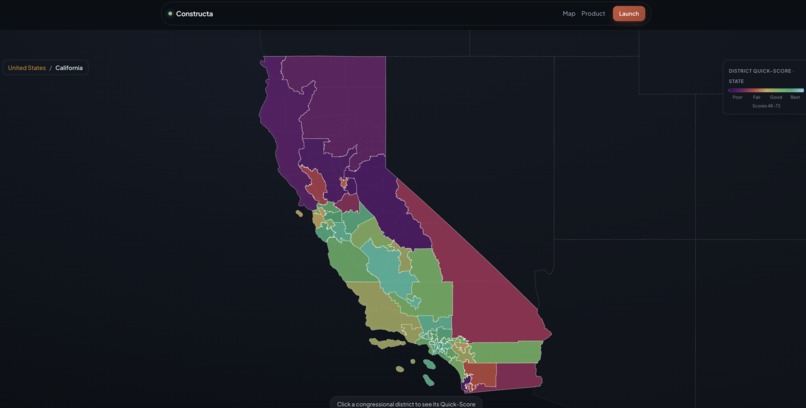
Interactive choropleth map finding land nationwide, broken down by district
-
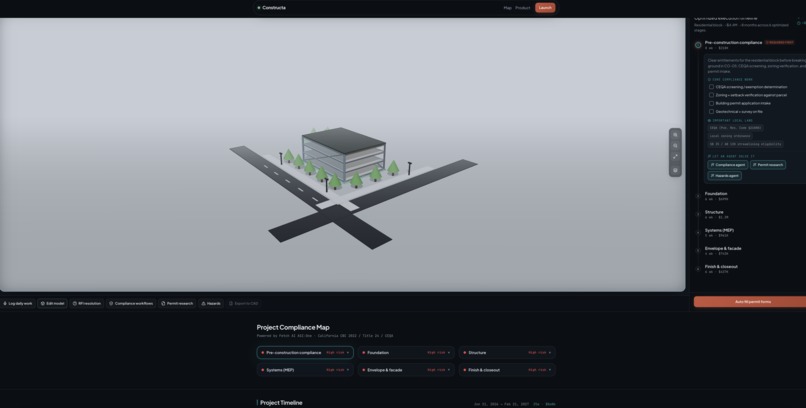
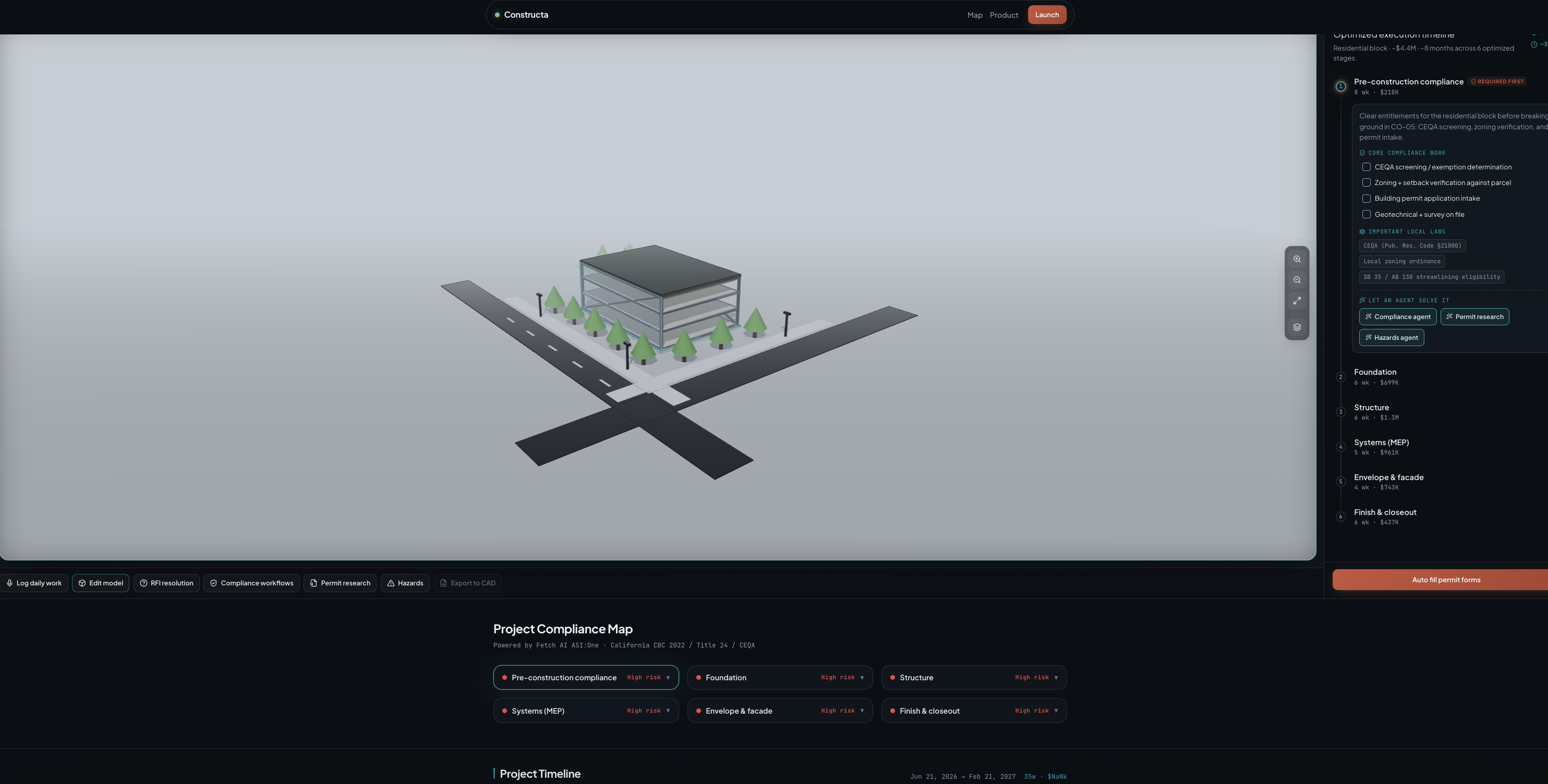
Interactive 3-d model, built after natural language input
Inspiration
We are from California, where construction delays are not an abstract problem; we see them constantly in daily life. Housing, public infrastructure, and commercial projects often run over budget or take years longer than expected, with McKinsey finding an average of one year behind schedule and 30% over budget, and a major reason is how difficult it is to understand and comply with overlapping regulations.
Those delays do not just hurt developers; they affect citizens through higher costs, fewer available buildings, and slower community improvements. In fact, a study of Los Angeles multifamily housing projects found that reducing development approval times by just 25% would have increased housing production by 12.7%.
We started with a simple question: why is it still so hard for construction teams to understand what land is buildable, what regulations apply, and what documents need to be completed? There had to be a simpler way to turn scattered zoning, permit, and compliance information into a usable workflow. That was the inspiration for Constructa. It evolved from a regulation-simplification idea into an end-to-end tool that helps teams find potential sites, evaluate them, visualize a project, and then move through the construction workflow with AI support.
What it does
Constructa is a dashboard for contractors and project managers that answers the questions of "where should we build?" and "how do we actually get it permitted and built?" Users can explore undeveloped or underused land, compare sites using feasibility scores, and review source-backed factors such as zoning availability, regulatory complexity, hazards, infrastructure, market context, and permit-related constraints.
Once a site is selected, a project manager can describe the proposed build in natural language. Constructa turns that input into a 3D model of the proposal in the selected area, along with a click-through project timeline. The timeline walks through pre-construction compliance, foundation, structure, systems/MEP, envelope and facade, and finish/closeout.
Each stage includes estimated cost, estimated timeline, relevant regulations, and a regulatory requirements checklist. Users can also open a live assistant for each stage, with expert, trained agents that answer specific questions about action items, forms, risks, or next steps. At the end, a “Permit Forms” button auto-fills documents including Cal/OSHA DOSH 41-1 and construction RFI’s using the project intake and inferred permit/zoning context.
How we built it
Constructa is a data-first full-stack app with two surfaces: a land-intelligence map and a project workspace that walks a build through compliance step by step.
Browserbase powers the map's live research. When someone drills into a region, we drive a cloud Chromium session through geo-targeted residential proxies, scrape public context (listings, permit and zoning signals, local discussion), compress away the noise, and feed grounded data into scoring and recommendations.
Fetch.ai (ASI:One + Agentverse) is the brain. The land guides, compliance plans, 3D models, and stage-level answers all route through ASI:One. ASI:One acts as lead orchestrator and synthesizes 6 custom uploaded Agentverse agents into one buy/hold/avoid call, and a low-confidence agent gets re-queried once before it's trusted.
Arize sits underneath all of it as our observability layer. Every agent call is instrumented with success and error spans, so we can see exactly which agent failed, stalled, or returned weak output. Pairing that visibility with the fallback pattern is what keeps the experience smooth: a logged error gets caught and answered with a deterministic result natively.
In the workspace, a natural-language building description becomes a 3D model powered by ASI:One who creates a Three.js component instructions that we render with react-three-fiber. The timeline then walks permits → foundation → structure → systems → finish, with the camera focusing on the matching part of the model at each step. Six agent actions (daily log, RFI, compliance, permit research, hazards, model edit) all share the same try → log → fallback contract; cleared steps emit the compliance and permit PDFs.
Redis is the database that keeps both surfaces fast and in sync—it caches map scores, scraped research, liked plots, generated 3D models, and project plans, each with its own TTL. Repeat lookups that would otherwise re-run an expensive scrape or a six-agent synthesis return instantly from cache, which is the difference between an interactive dashboard and a spinner. And the whole thing degrades cleanly without live APIs: seeded data and deterministic fallbacks keep the full flow alive on stage.
Challenges we ran into
Pulling useful live data off the open web, especially images. Every site structures land listings, zoning details, and local context differently, so extracting the same fields consistently was brutal. We also couldn't lean on local cache; repeated lookups on an interactive dashboard would crawl, so scraped results land in Redis with TTLs instead. Browserbase became the cleanest way to automate extraction without hand-coding every site's quirks, and it let us resolve real listing images (via currentSrc after the page settled) rather than placeholder thumbnails.
Reliability: live scraping and LLM calls fail constantly. We treated failure as expected and engineered failsafes. Arize surfaces failed and low-confidence calls per agent, and ASI:One + Agentverse give us a tiered fallback: multistack consensus first, single-agent delegation second, deterministic seeded data last. The result is a system where a flaky network or a bad model response never reaches the user.
3D model generation. Storing and rendering real 3D asset files would be slow and expensive, so instead of shipping geometry we have ASI:One generate Three.js component instructions. Turning free-form language into precise 3D placement threw a lot of errors early on, so we constrained the problem: a dictionary of pre-built, parameterized components—trees, pools, roads, tennis courts, structures—that the model can place and tune safely, instead of inventing geometry from scratch.
Accomplishments that we're proud of
1) We are proud that we used new tools like Browserbase and ASI in a way that actually interacted with one another, instead of just adding them as isolated integrations. Browserbase helped us pull live web context, Redis helped us store and reuse it quickly, and ASI:One helped route, synthesize, and recover agent workflows. It let us explore what AI can do when it is embedded into a real workflow.
2) The “Permit Forms” feature is another highlight because it makes the value concrete. Instead of only telling a project manager what regulations exist, Constructa starts doing the paperwork: filling a Cal/OSHA DOSH 41-1 and construction RFIs from the project details. That is the kind of practical time-saving workflow we wanted to build.
3) More than anything, we are proud that Constructa became more than a workflow optimization tool. It does not only reduce workload or regulatory delay for a principal contractor or developer. It starts with finding locations and continues into during-work support that can help different members of a contracting team: principal contractors, lead architects, project managers, and site foremen.
What we learned
1) We learned the importance of grounding AI outputs in sources and structured data. A site score is only useful if users can understand why the score exists. A compliance checklist is only useful if it connects back to the project type, location, and inferred requirements. That pushed us to design the product around source pulling, caching, structured project documents, and visible reasoning rather than one-off chatbot responses.
2) Technically, we learned that building reliable AI products means designing workarounds before things fail. For scraping, that meant using Browserbase and storing results in Redis so live data could become fast reusable context. For agents, that meant adding Arize and ASI fallback behavior. For 3D generation, that meant limiting the AI to a component dictionary instead of letting it invent arbitrary geometry.
3) We also learned from talking to a mentor that construction users may not want to type everything. People on contracting teams are often on-site, on the go, or, especially, unfamiliar with AI tools, so voice-to-text could make the product much more natural for foremen and field workers.
Overall, it was an amazing experience building something that feels genuinely useful. That was the point of AI for us: saving time on repetitive, confusing work so people can focus on building.
What's next for Constructa
Next, we want Constructa to become a shared workspace for the entire contracting team. That could mean a Slack-style workspace inside the product or integrations with tools teams already use, so architects, project managers, site foremen, compliance leads, and contractors can collaborate around the same project data.
We also want to make the product role-aware. An architect logging in should see different tools than a project manager or site foreman. Architects might get deeper design and code-compliance guidance, project managers might get cost, timeline, and permit-risk tracking, and foremen might get voice-first task logging, safety reminders, and field-specific assistants.
We would also expand the forms and compliance system beyond the initial Cal/OSHA and RFI workflows into broader permit packets, inspection readiness, stormwater, closeout, and safety documentation. The long-term goal is to make sure everyone on a contracting team stays on top of regulations while getting AI help that is actually relevant to their role; this is something still not effectively integrated into the construction field today.
Built With
- agentverse
- anthropic-claude-sdk
- arize-(observability)
- browserbase-(headless-scraping)
- built-with-languages:?typescript
- css-frontend:?react-19
- d3-geo
- data-&-cache:?redis-(ioredis)
- deck.gl
- drei
- gsap-backend:?node.js
- hono-(api-routes-inside-tanstack-start)
- javascript
- maplibre-gl
- optional-python-fastapi-microservice-(agent-service)-3d-/-maps:?three.js
- pdfs:?pdf-lib-(permit-form-auto-fill)
- playwright-(image-verification-with-browserbase)
- python
- react-three-fiber
- tailwind-css
- tanstack-query
- tanstack-router
- tanstack-start
- topojson-ai-&-agents:?fetch.ai-asi:one
- vite


Log in or sign up for Devpost to join the conversation.