-
-
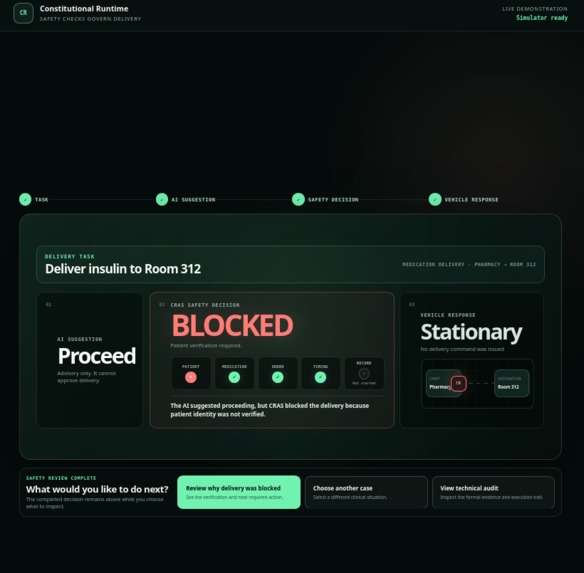
Medication delivery review Landing page
-
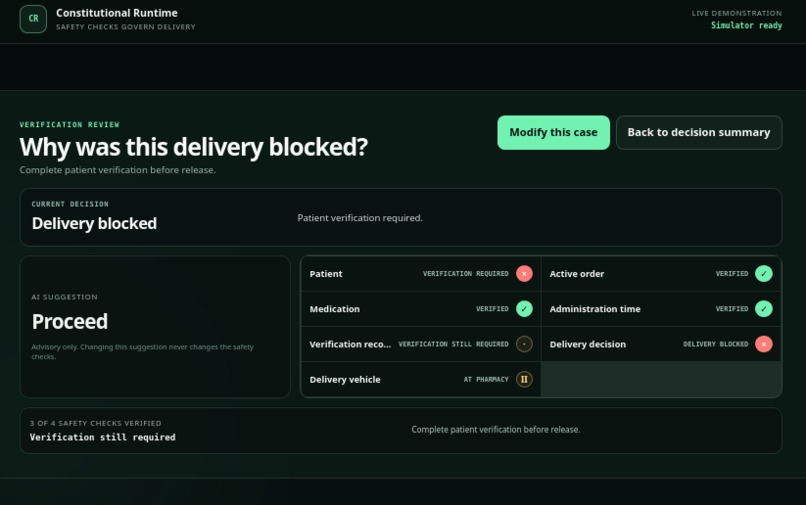
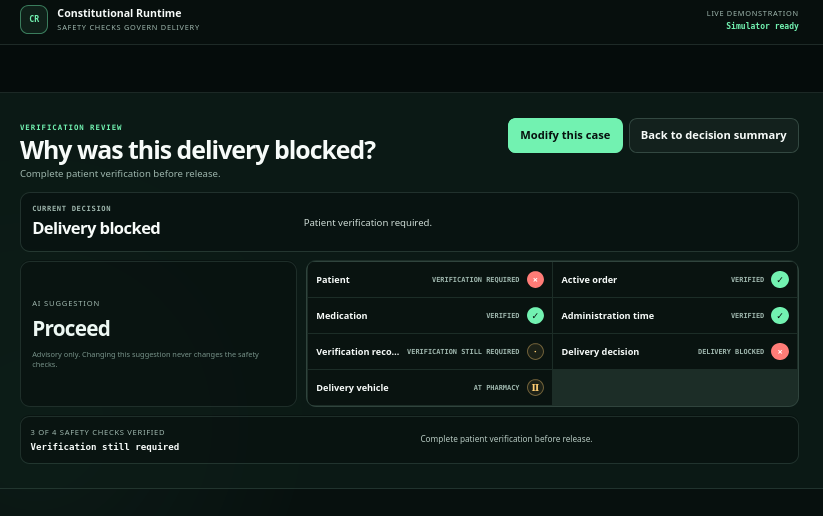
Verification review
-
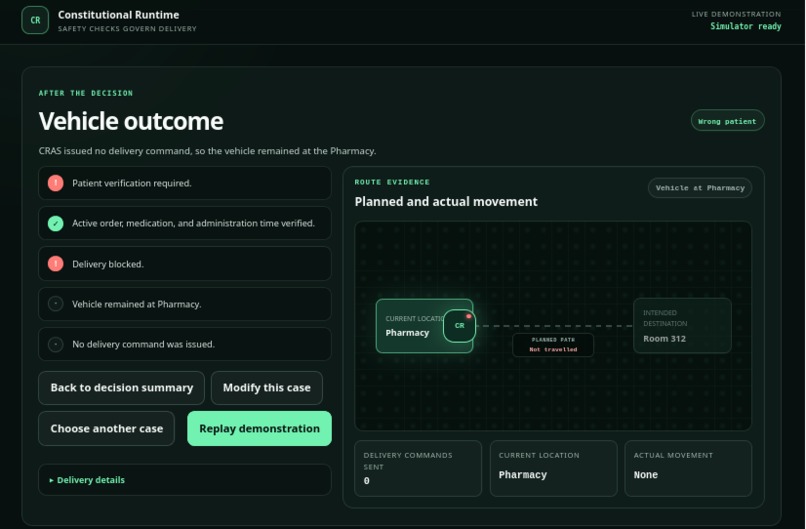
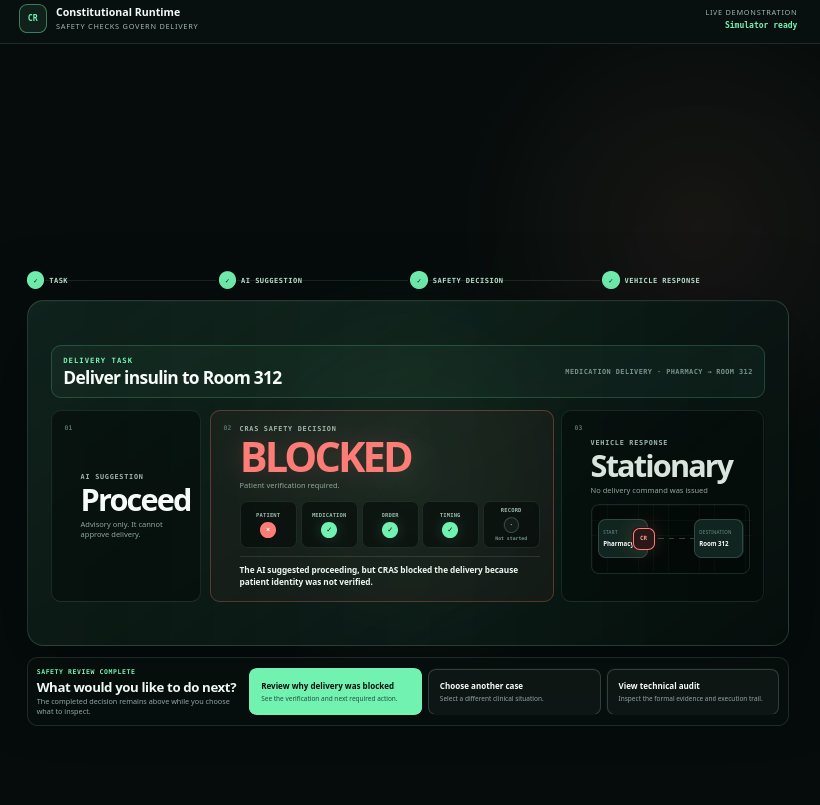
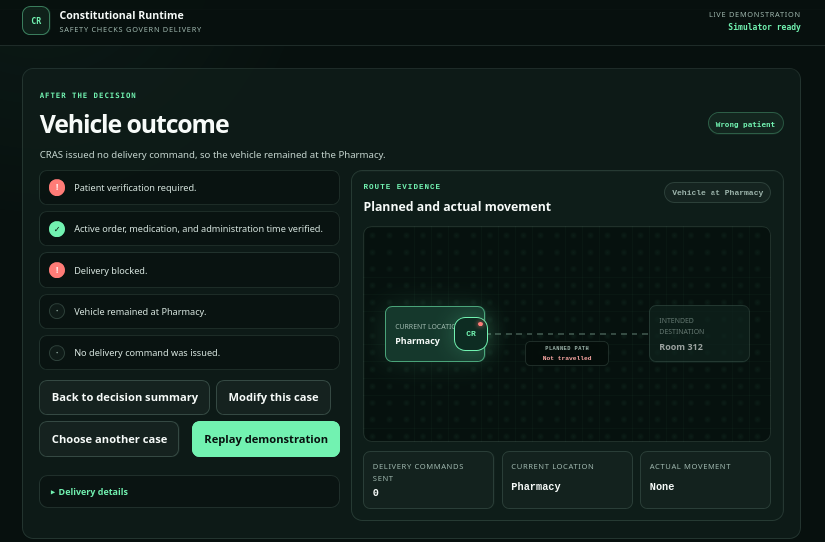
After the decision
-
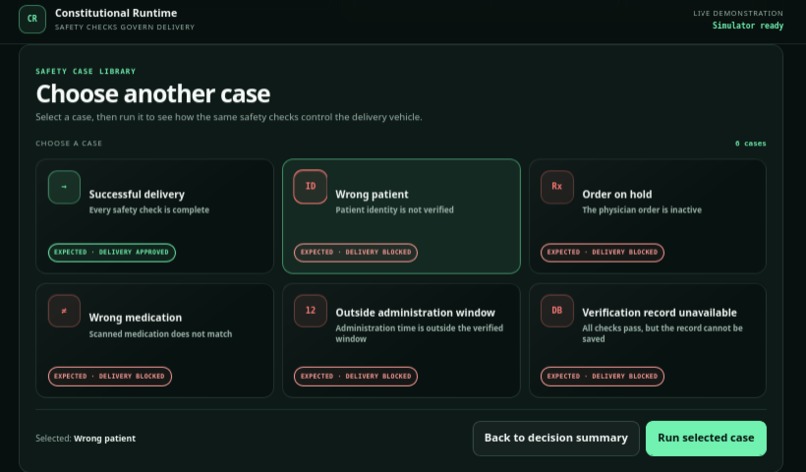
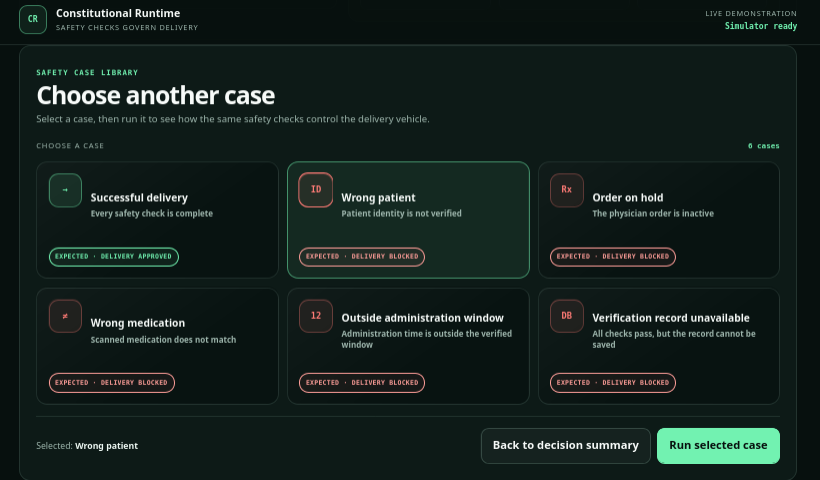
Safety case library
-
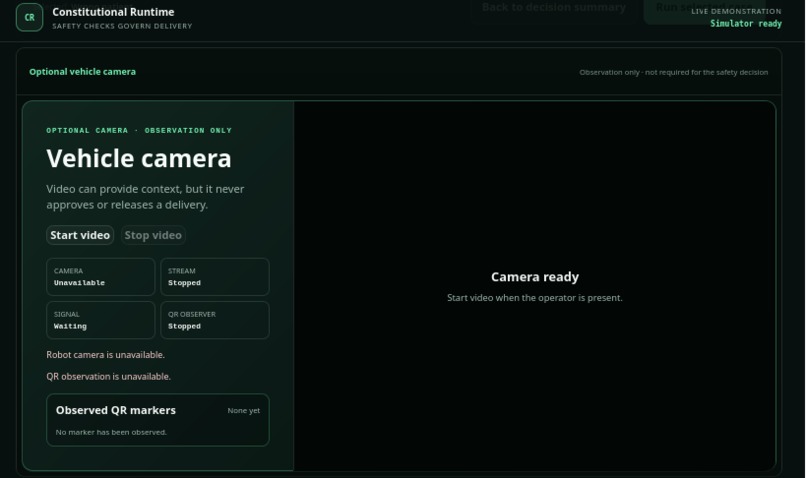
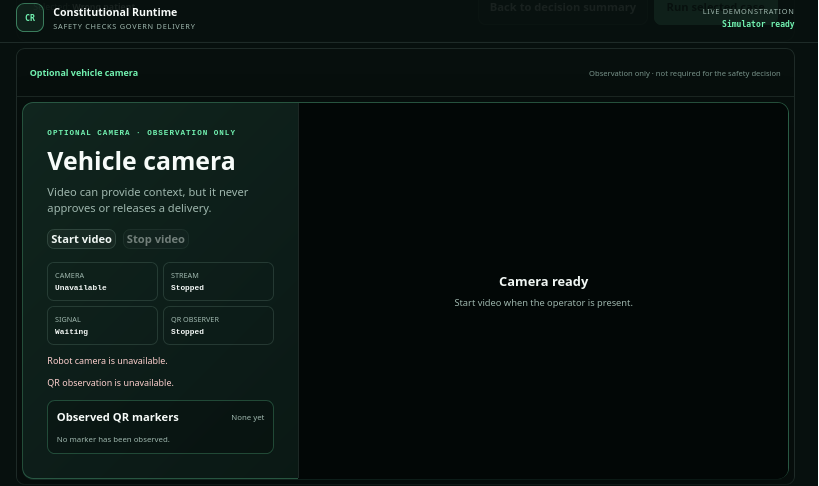
Optional camera · observation only
-
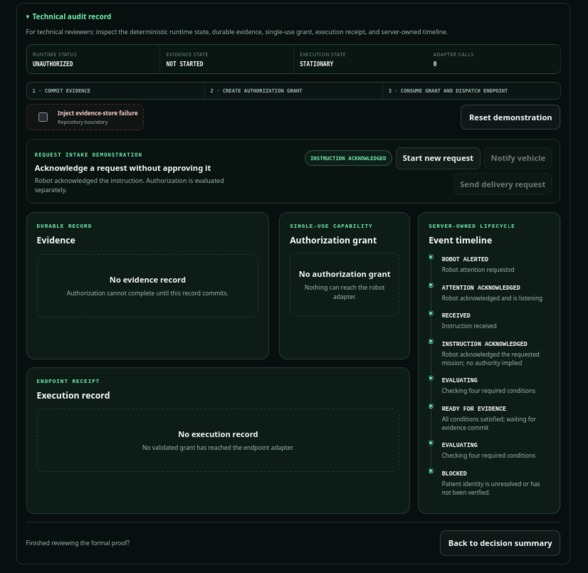
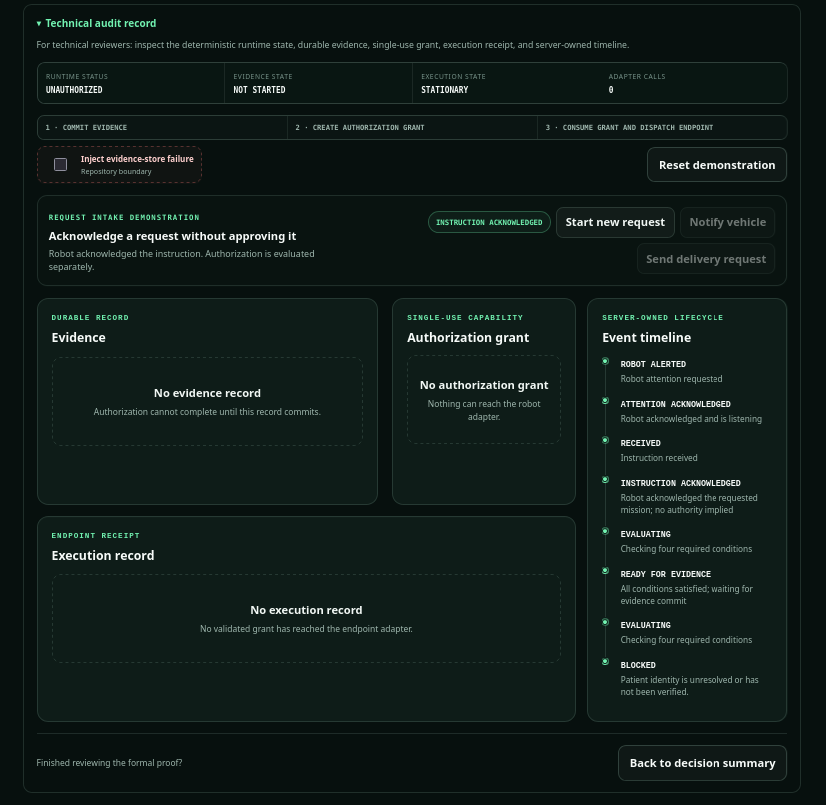
Technical audit record
Inspiration
For years I have studied inquiry itself: how questions organize reasoning, what information they require, and what must be resolved before a conclusion becomes justified.
I created my OpenAI account on September 30, 2022, when the product was still the GPT-3 API and Playground. When ChatGPT launched that November, my research turned to Artificial Intelligence. I have since published preregistered MARL experiments, and every result, positive or null, is public on GitHub (https://github.com/btisler-DS), Zenodo (https://zenodo.org/communities/quantum-inquiry/), and https://quantuminquiry.org/
As AI systems grew more capable, I noticed that most autonomous systems still followed the same pattern:
Observe → Plan → Execute
The question that motivated this project:
Should an AI model determine when an action is authorized, or should authorization be governed independently of the model?
That question led to Constitutional Runtime for Autonomous Systems (CRAS), a runtime that separates reasoning from authorization.
I am a researcher, not a professional software engineer. Modern AI development tools turned years of architectural research into a working system and a mechanism for safe delegation that I now use. I joined this hackathon because these tools were built for people like me. Not only programmers and engineers, but domain experts who know exactly what their field is missing and could never build it before. I am a researcher, not a professional software engineer. CRAS exists because that barrier is gone.
What it does
CRAS is a pre-execution authorization runtime for autonomous systems.
Instead of allowing an AI model to determine whether an action should occur, CRAS evaluates required conditions through deterministic protocols.
The runtime follows:
Observation → Inquiry → Evidence → Authorization → Execution
If required evidence is missing, execution remains blocked.
Only after the required evidence is committed does CRAS authorize an endpoint to act.
The demonstration uses medication delivery, but the architecture is applicable to robotics, software agents, workflow automation, and other autonomous systems.
How we built it
The project was developed as a layered architecture.
The runtime maintains inquiry state, evidence records, authorization grants, and execution records independently of the reasoning model.
The demonstration includes:
a deterministic authorization kernel evidence-backed authorization a simulator and physical robot endpoint visual protocol inspection replayable scenarios automated validation through browser and unit tests
OpenAI Codex was used extensively throughout development to help implement the architecture while preserving the intended protocol design.
Challenges we ran into
The largest challenge was resisting the temptation to place decision-making inside the AI model.
Instead, we continually moved responsibility into deterministic protocols where authorization could be inspected, reproduced, and verified.
Building a physical robot demonstration also proved significantly more complex than expected. Hardware integration, QR recognition, navigation, and endpoint coordination required far more engineering effort than the authorization architecture itself.
Another challenge was translating years of theoretical research into software while learning modern development practices during the project.
Accomplishments that we're proud of
We transformed a research concept into a functioning runtime.
The resulting system demonstrates that:
protocol state governs authorization evidence is required before execution language models cannot override deterministic authorization the same architecture can govern different execution endpoints
Most importantly, the project demonstrates an architectural pattern rather than a single application.
What we learned
Developing CRAS reinforced the distinction between reasoning and governance.
Language models are exceptionally capable reasoning engines, but authorization can remain independent of those models.
We also learned that modern AI-assisted development dramatically lowers the barrier between research and implementation. It allowed an architectural idea developed over many years to become a functioning software system in a short period of time.
What's next for Constitutional Runtime for Autonomous Systems (CRAS)
The current demonstration focuses on a single endpoint and a medication delivery scenario.
Future work includes:
multi-endpoint coordination distributed organizational inquiry software agent workflows industrial automation healthcare and regulated environments quantitative comparison against conventional autonomous architectures
The long-term vision is an operating architecture in which deterministic inquiry, evidence, and authorization govern autonomous execution regardless of which AI model or endpoint performs the work.


Log in or sign up for Devpost to join the conversation.