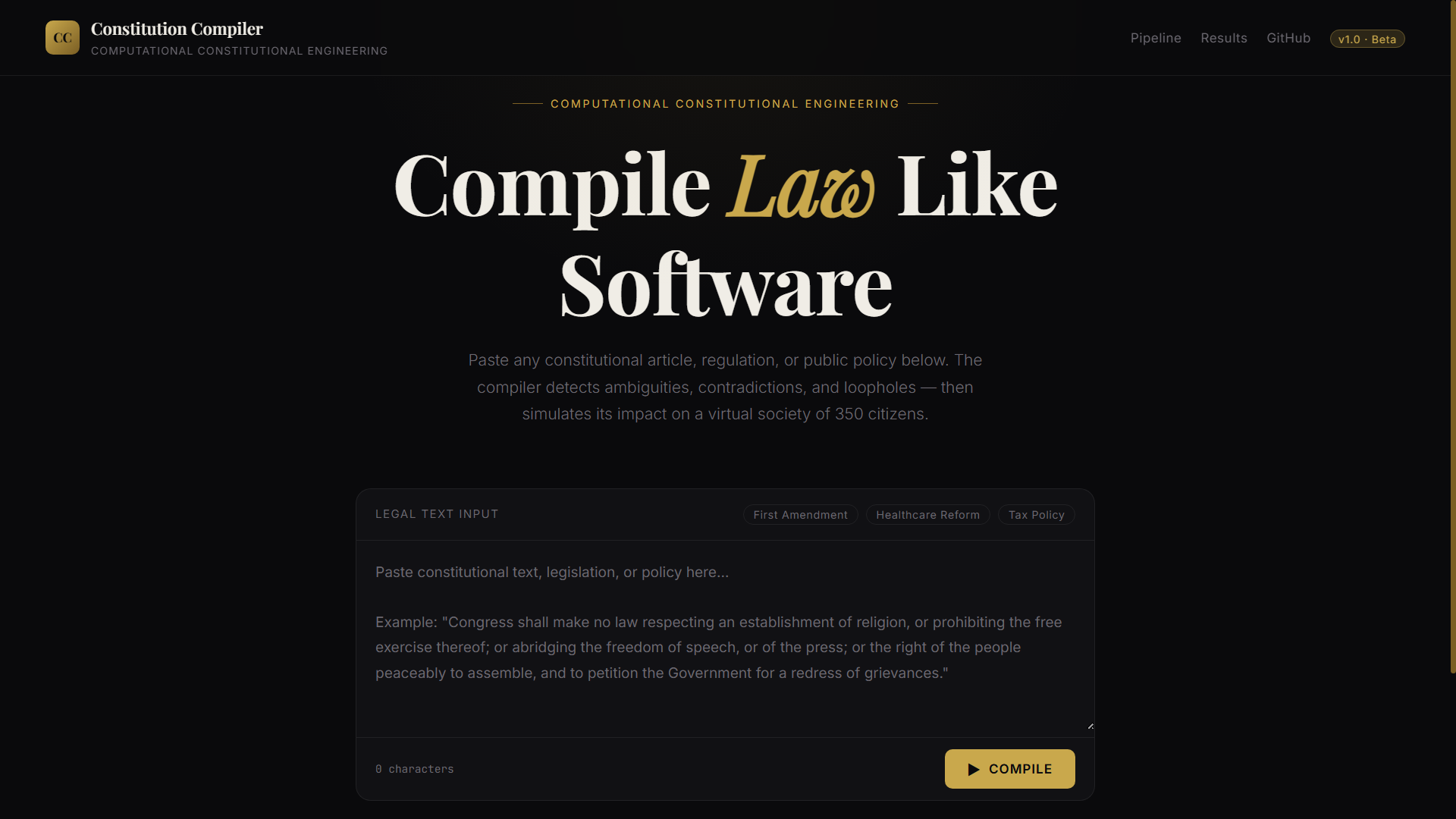
Constitution Compiler: Transforming Human Governance into Executable Systems
Abstract
For thousands of years, humanity has governed itself through natural language. Constitutions, laws, regulations, and treaties are written as prose that must later be interpreted by judges, lawyers, bureaucrats, and citizens. Unlike software, these systems are never compiled, tested, or simulated before affecting millions of lives.
This paper proposes a new paradigm: treating governance as an executable computational system rather than a collection of textual documents. We introduce the concept of the Constitution Compiler, an artificial intelligence framework capable of translating legal language into formal machine-readable rules, detecting ambiguities and contradictions, simulating societal outcomes, and evaluating unintended consequences before implementation.
The objective is not to replace democratic decision-making or human judgment. Instead, the system provides governments with a computational environment in which policies can be validated before they become reality, much like software is tested before deployment.
1. The Misunderstanding Humanity Has Lived With
Civilizations have continuously improved the tools they use for engineering, medicine, transportation, communication, and computation. Yet the technology used to govern society remains fundamentally unchanged.
Modern constitutions are still documents written in natural language.
Natural language is powerful because humans can understand it. However, it is also inherently ambiguous.
Words such as "reasonable," "fair," "adequate," "necessary," or "public interest" possess multiple interpretations depending on context, culture, political ideology, and judicial philosophy.
This ambiguity creates enormous downstream costs:
- conflicting judicial interpretations,
- legislative loopholes,
- regulatory uncertainty,
- unintended economic consequences,
- inconsistent enforcement,
- and decades of litigation.
Society accepts these problems as unavoidable because law has always been written this way.
We argue that this assumption is incorrect.
The problem is not governance itself.
The problem is the medium through which governance is expressed.
2. Why Existing Solutions Are Insufficient
Recent advances in Artificial Intelligence have produced systems capable of summarizing legislation, answering legal questions, searching legal databases, and generating legal documents.
These systems improve accessibility.
They do not improve governance itself.
Current legal technologies remain reactive.
They analyze laws after they have already been enacted.
None fundamentally changes how policies are designed.
Similarly, governments rely on economists, committees, public consultations, and expert predictions to estimate the effects of new legislation.
These approaches remain limited because they cannot exhaustively explore millions of possible interactions among citizens, institutions, and incentives.
Software engineers solved an equivalent problem decades ago.
Before software reaches users, it is:
- compiled,
- statically analyzed,
- tested,
- simulated,
- and debugged.
Governments rarely perform analogous computational validation before laws become binding.
3. First-Principles Insight
The central insight behind this work is simple:
Governance is a rule system.
Every law defines:
- actors,
- conditions,
- permissions,
- obligations,
- restrictions,
- incentives,
- and consequences.
These are computational concepts.
Programming languages exist because natural language is too ambiguous for computers.
We propose extending this principle to governance.
Instead of treating constitutions as documents to be interpreted after implementation, they should become executable specifications capable of being compiled, validated, simulated, and continuously improved.
This transforms governance from a static textual artifact into an engineering discipline.
4. Constitution Compiler
The Constitution Compiler is a computational framework consisting of multiple intelligent modules.
Natural Language Interpreter
The system accepts proposed constitutional articles, public policies, regulations, or legislation written in ordinary human language.
Large language models identify:
- actors,
- conditions,
- actions,
- rights,
- obligations,
- penalties,
- exceptions,
- dependencies,
- and assumptions.
The output becomes structured data.
Rule Compiler
The structured representation is transformed into a formal legal rule language.
Instead of prose, policies become executable logical statements.
This creates a machine-verifiable representation of governance.
Ambiguity Detection Engine
The compiler identifies undefined concepts and subjective terminology.
For example:
- "reasonable income"
- "adequate housing"
- "dangerous behavior"
Rather than accepting these phrases silently, the compiler requires explicit definitions before execution.
This encourages precision in policy design.
Contradiction Analyzer
Large legal systems frequently contain conflicting rules.
The compiler compares newly proposed legislation against existing constitutional rules to identify incompatibilities before adoption.
Loophole Discovery Engine
Every rule creates incentives.
Artificial intelligence generates adversarial scenarios representing citizens attempting to maximize personal benefit while remaining technically compliant.
Potential exploits are identified before implementation rather than after widespread abuse.
Society Simulation Engine
A virtual society consisting of autonomous computational agents models long-term policy outcomes.
Citizens differ in:
- age,
- education,
- employment,
- income,
- health,
- consumption,
- taxation,
- family structure,
- and behavioral tendencies.
The simulation estimates how policies influence economic productivity, inequality, public spending, employment, and resource allocation over time.
Rather than predicting a single future, it evaluates many plausible futures.
5. Scientific and Technical Foundations
The proposed framework combines several established research disciplines.
Artificial Intelligence
Large Language Models translate legal language into structured semantic representations.
Formal Logic
Rules become machine-readable logical expressions capable of computational verification.
Knowledge Graphs
Relationships among institutions, citizens, rights, responsibilities, and resources are represented as connected graphs.
Agent-Based Modeling
Virtual citizens interact with one another under different legal systems, allowing emergent social behavior to be observed.
Computational Economics
Economic variables evolve dynamically through simulated policy implementation.
Formal Verification
Logical consistency checking identifies contradictory or unreachable legal states.
Although these technologies already exist independently, they have not been unified into a single constitutional engineering framework.
6. Long-Term Implications
If successful, Constitution Compiler changes the way governments create policy.
Instead of asking:
"What do experts think will happen?"
Governments can ask:
"What happens when one hundred million simulated citizens live under this law for ten years?"
Every proposed policy could undergo automated validation before implementation.
Legislatures could compare alternative tax systems, healthcare reforms, educational policies, environmental regulations, or constitutional amendments using computational evidence.
International organizations could evaluate treaties before ratification.
Developing nations could test governance models before nationwide adoption.
Democracies could become more transparent because citizens would observe projected consequences before voting.
Rather than replacing democracy, computational governance strengthens democratic decision-making through evidence.
7. Risks and Ethical Considerations
Governance should never become fully automated.
Artificial intelligence cannot determine justice, morality, or societal values.
Those decisions belong to human societies.
The Constitution Compiler therefore functions as a decision-support system rather than an autonomous governing authority.
Its recommendations remain transparent, explainable, and subject to democratic oversight.
Human institutions retain final authority.
8. A New Academic Discipline
This work proposes the emergence of Computational Constitutional Engineering (CCE).
CCE treats governance as an engineering problem.
Its fundamental principles are:
- Every law should be executable.
- Every policy should compile before implementation.
- Every constitutional amendment should be formally verified.
- Every governance system should be simulated before deployment.
- Every ambiguity should be explicitly identified.
- Every loophole should be discovered before exploitation.
Just as civil engineering transformed construction and software engineering transformed computation, Computational Constitutional Engineering seeks to transform governance.
9. The Future We Attempt to Create
Future civilizations may look back on handwritten constitutions in the same way we now view handwritten calculations before electronic computers.
It may become unimaginable that societies once enacted laws affecting millions of people without first testing them.
Hospitals simulate surgeries.
Engineers simulate bridges.
Space agencies simulate missions.
Software companies simulate systems.
Yet governments continue deploying policies directly into reality.
We envision a future in which every law is first executed inside a digital society before it is executed inside a real one.
The Constitution Compiler is not merely a legal tool.
It is a proposal for a new layer of civilization—one where governance is designed with the same rigor that humanity applies to engineering its most critical technologies.
The future of governance should not rely solely on interpretation.
It should also rely on computation.


Log in or sign up for Devpost to join the conversation.