Inspiration
We kept coming back to a simple feeling: people are not actually losing files, they are losing context.
A screenshot of a recipe, a link for an internship, a voice note with a half-formed idea, a reminder to text a friend back, a quote saved during a rough week. These fragments are technically still there, but they drift across notes apps, tabs, camera rolls, messages, and drafts until the original meaning disappears.
The UCI Design-a-thon theme, Lost & Found, pushed us to interpret lost in a more human way. We wanted to build something that helps people recover what still matters before it gets buried by digital noise.
What it does
Constellation is an AI-assisted space for recovering forgotten ideas, moments, and connections from scattered digital fragments.
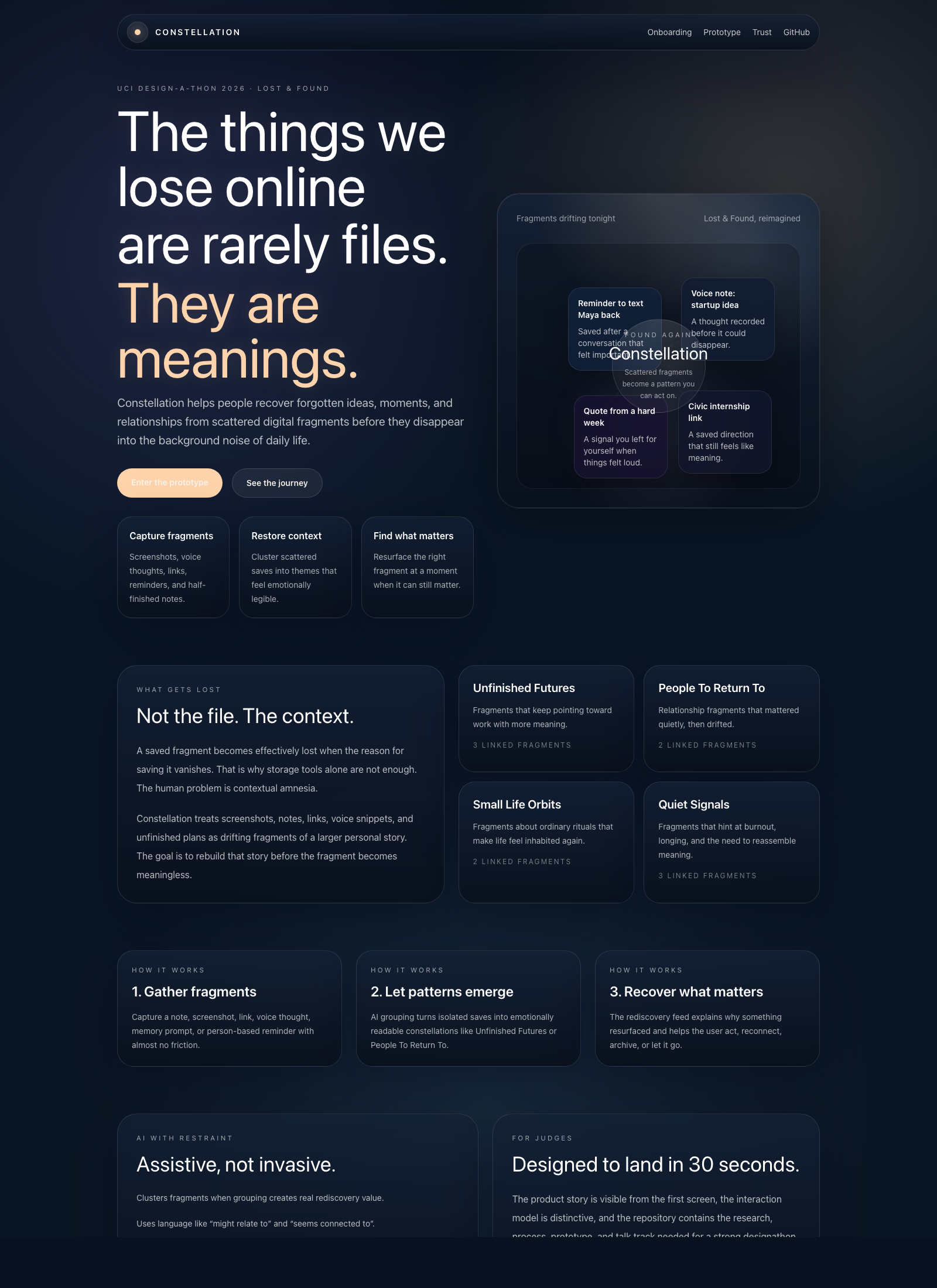
Instead of acting like another notes app or productivity dashboard, Constellation treats saved fragments like stars in a night sky. It helps users:
- capture scattered fragments with very little friction
- group them into meaningful constellations
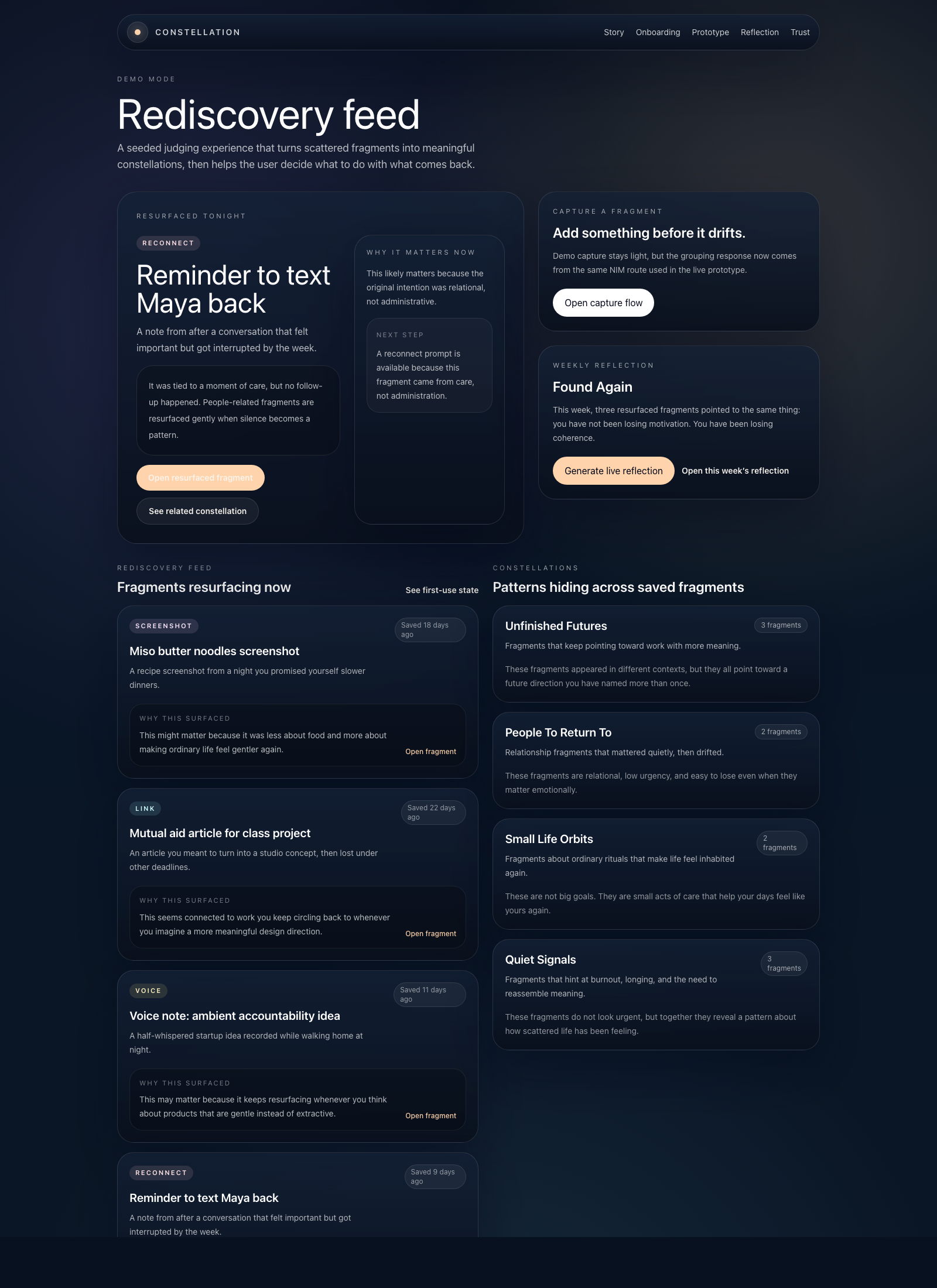
- understand why something resurfaced
- decide whether to act, reconnect, archive, or let go
The result is a product that feels reflective, emotionally intelligent, and calm rather than cluttered or demanding.
How we built it
We designed and built Constellation as a polished web prototype for a live judging demo.
The product was built with:
- Next.js + TypeScript for the prototype
- Tailwind CSS for styling and visual consistency
- Framer Motion for subtle motion and transitions
- Vercel for deployment
- GitHub for version control and repository-based workflow
- Figma for the presentation-ready design artifact
- NVIDIA NIM for assistive AI moments where AI adds real value
For the MVP, we focused on a judging-friendly flow:
- a landing page that makes the Lost & Found theme obvious immediately
- onboarding that frames the emotional problem
- a rediscovery feed with seeded fragments
- a constellation view that shows AI grouping
- context reconstruction and resurfacing explanations
- a gentle reconnect flow
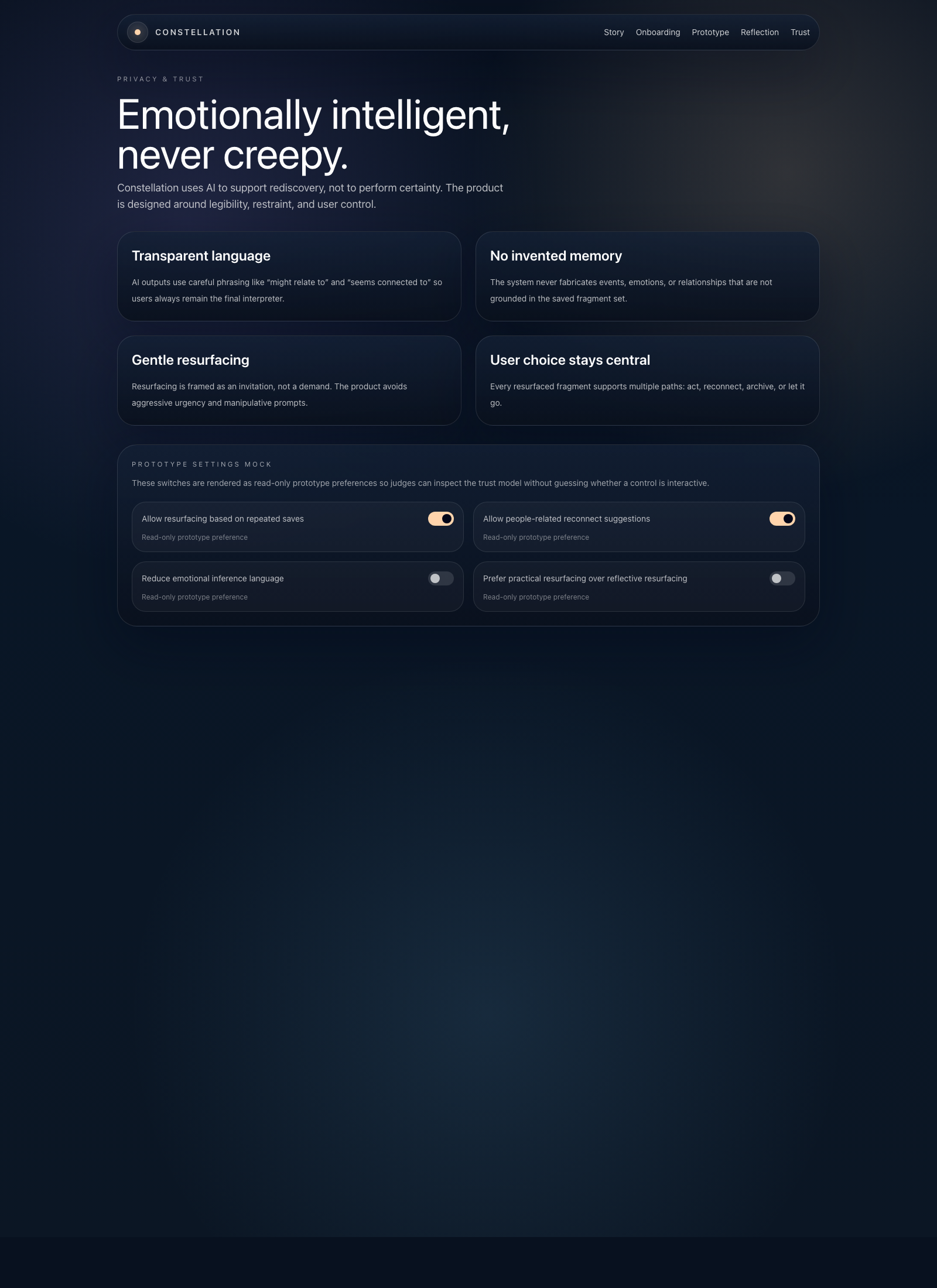
- a privacy and trust page that explains the emotional boundaries of the system
We also built a full designathon-ready repository with a problem statement, solution overview, design process, competitive analysis, personas, JTBD, usability testing plan, synthesis template, pitch script, and judging talk track.
A key principle was honesty in the process: we did not fabricate user research. Instead, we created a rigorous research kit and clearly marked the places where real interview insights and usability findings should be inserted before final judging.
Challenges we ran into
One of the biggest challenges was making the experience feel emotionally meaningful without becoming creepy or over-automated.
Because this is an AI-assisted product, the line between helpful resurfacing and intrusive suggestion matters a lot. We had to be careful with tone, interaction design, and language. That is why the AI in Constellation uses restrained phrasing like might relate to or seems connected to, and why the privacy/trust principles are visible in the product itself.
Another challenge was preserving the visual metaphor. We wanted the constellation concept to feel elegant and premium, not childish, sci-fi noisy, or like a generic AI SaaS interface. That led us to refine the typography, contrast, spacing, and motion so the interface feels calm and intentional in the first few seconds of the demo.
We also ran into practical prototype challenges while preparing the Figma deliverable and deployment flow, especially around getting the public presentation assets clean and submission-ready.
What we learned
We learned that a strong designathon concept is not just about a clever feature. It is about framing the right problem in a way that judges can feel immediately.
We also learned how powerful it is to treat digital clutter as an emotional problem, not just an information architecture problem. People do not merely want better storage. They want help recovering intention, memory, and meaning.
From a product perspective, we learned that the most compelling AI experiences are often the most restrained ones.
What's next for Constellation
Next, we would expand Constellation in three directions:
- real user interviews and usability testing to validate the emotional model
- deeper fragment import flows across notes, screenshots, voice memos, and saved links
- smarter but still careful AI clustering, reflection, and reconnection timing
Long term, we see Constellation becoming a true rediscovery system: not a place to store more, but a space that helps people find what still matters.
Built With
- css
- figma
- framer
- github
- html
- javascript
- motion
- next.js
- nim
- nvidia
- tailwind
- typescript
- vercel

Log in or sign up for Devpost to join the conversation.