-
-
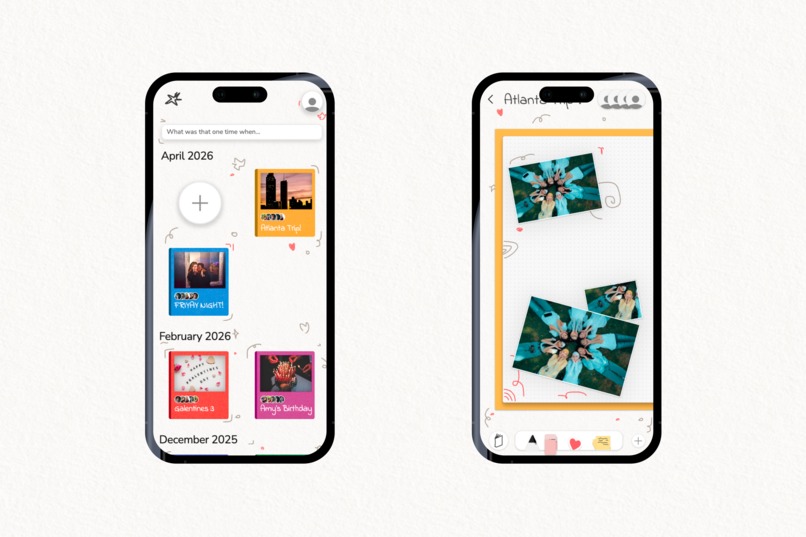
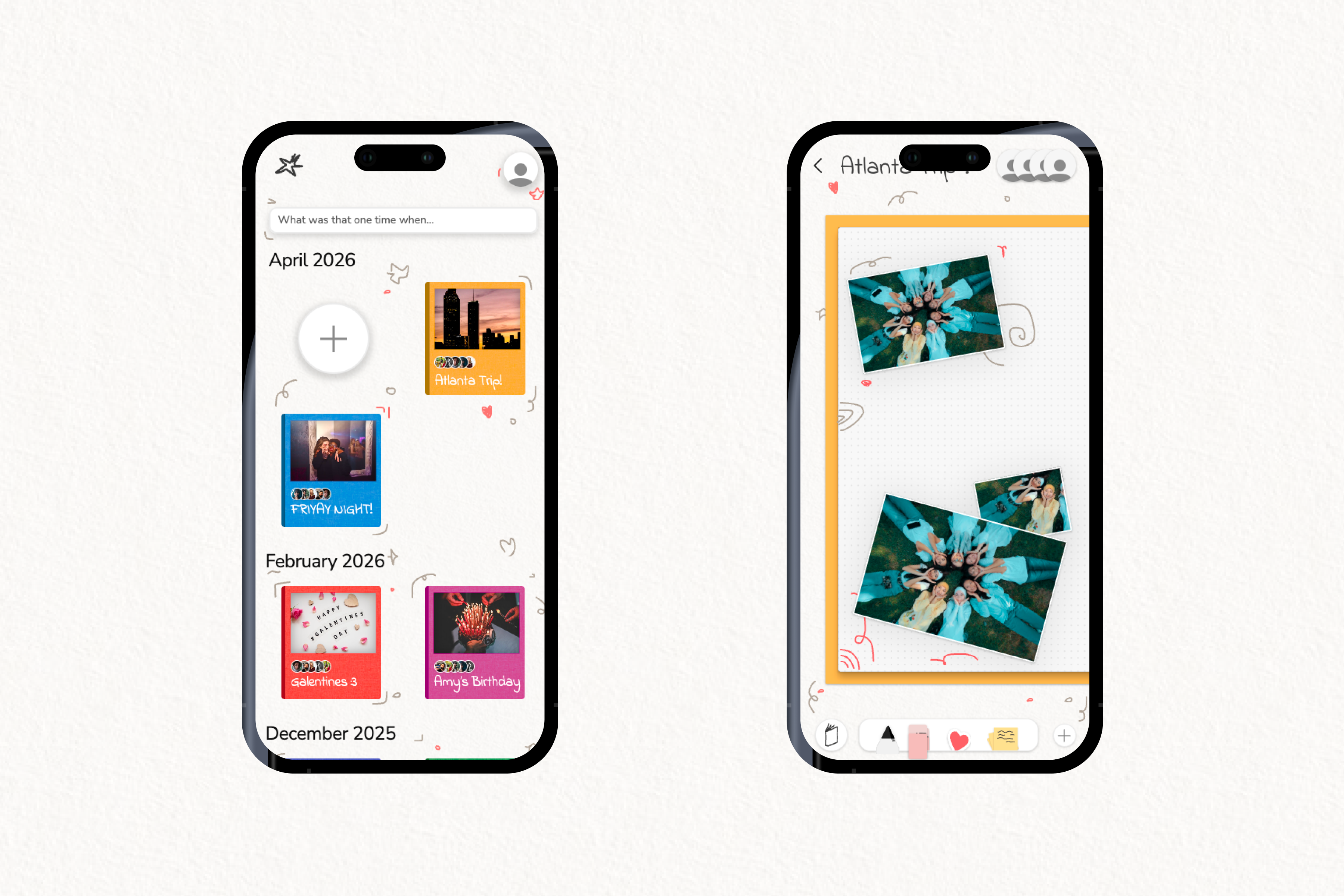
Constellation Screens
What is it?
Photos freeze one moment from one angle, but memories are bigger than that. Constellation is a shared digital scrapbook where friend groups piece together the full story from everyone's perspectives and keep building on it with messy layers of stories, inside jokes, and arguments about what really happened.
The Problem
After any group event, the same thing happens. Everyone takes photos. They get shared over text, saved to camera rolls, maybe posted on Instagram. Within a week they're buried and scattered across apps and chats with no shared home.
But the real problem isn't the logistics. It's what happens later, when those photos resurface. A picture captures a single perfect frame of a moment from a single angle, but the actual memory is so much deeper than that. The conversation that was happening. The joke someone made right before. The thing that went wrong that became the best part of the story. None of that lives in the photo. And everyone who was there saw something different. Your photos captured what you noticed, your friend was looking somewhere else entirely, someone else remembers a moment nobody photographed at all. Each person holds a fragment of the full story that never gets assembled.
Over time, even those fragments fade. The picture becomes all that's left, while the context, the stories, the inside jokes around it quietly disappear because nothing held onto them.
Ask someone what they remember from a night out and they'll almost never describe the moment a photo was taken. They'll tell you about the specific incident that made everyone laugh, or the thing someone said that became a running joke for months. Those are the real memories, and a picture physically cannot capture them.
The photo was never the memory. It was just a catalyst, a trigger that asks your imperfect brain to reconstruct everything around it. And every year, that reconstruction gets a little thinner.
The Experience
Constellation gives friend groups a shared space to build the complete picture of an event together. After a trip, a dinner, a night out, someone creates an album and invites the group. Everyone pools their photos into one place. From there, anyone can add to the album at any time. This can include scribbling notes in the margins, sticking doodles on top of photos, pinning songs to moments, or slapping stickers wherever there's space. The album gets messier and more layered with every revisit. Here's how it works.
- Shared album creation. A user declares a time period for an event and gives Constellation permission to pull all photos from their device within that window. The app surfaces everything from that period and the user picks which specific photos they want to place on the scrapbook. No manual uploading one by one.
- Scrapbook generation. Constellation reads the location and time metadata from each photo to automatically organize them. The event gets divided by days and hours chronologically, then grouped further by location. Photos taken at the same place cluster together as part of the same moment while duplicate photos are automatically filtered out. The app then generates a unique layout for each page, placing photos at natural angles and positions so no two scrapbooks look the same.
- Annotations. Users can doodle anywhere on the page, place sticky notes, add stickers, and pin songs that autoplay when you reach that page. Everything is freeform. There are no designated annotation zones or templates.
- Accumulating layers. Every revisit adds more, reactions to old notes, corrections, new memories that just resurfaced, jokes that only make sense now. New layers stack on top of old ones. The interface is fluid and any element can be freely moved to read what's underneath.
- Multiple perspectives. Each contributor brings their own photos and their own version of events. Every person's additions are visually distinct and the scrapbook holds all perspectives without resolving contradictions. Two conflicting accounts of the same moment sit side by side as part of the full story
Over time, the album becomes more than a record of the original event. Every scribbled note, every correction, every argument about what really happened, those are new shared moments in themselves. The act of remembering together becomes its own memory worth keeping.
Design Philosophy
The name Constellation comes from a simple idea. Every person at an event sees it differently. From different angles, notice different moments, and remember different details. Each perspective is a single star. Incomplete on its own. But bring them all together and the full picture of the event emerges, a constellation that no single person could have seen alone.
Memory is inherently imperfect, it fades, shifts, exaggerates, and contradicts itself. Current photo apps fight this by trying to perfectly preserve moments exactly as they happened. But a moment is messy and chaotic. A single frozen frame is fundamentally the wrong approach. It's simply one piece of a much bigger puzzle. Constellation doesn't try to fix the imperfection of memory. It uses it as fuel.
Photos are incomplete. People don't remember every detail. Rather than treating that as a problem to solve, Constellation treats it as a building block. The gaps in the photo and the gaps in your memory are open space, space for friends to fill with their own additions. Sometimes that's a genuine detail someone else remembers. Sometimes it's an exaggeration. Sometimes it's a complete fabrication that everyone plays along with because it's funnier than what actually happened. It doesn't matter. The point isn't reconstructing the truth, it's giving the group a reason to come back, add to it, and create something new together. The process of scrapbooking is itself the memory being formed.
The hand-drawn, informal visual language ties this together. The messy handwriting, the sticky notes at odd angles, the overlapping layers signal the opposite. This is a space for play, not preservation. The aesthetic gives users permission to be silly, imprecise, and personal without feeling like they're doing it wrong.
And the deeper payoff emerges over time. Every note scribbled in the margins, every correction, every argument about what really happened, those aren't just preserving the original memory. They're creating new ones. The act of revisiting an album together and adding to it is itself a shared experience worth remembering. The imperfection of memory isn't a problem Constellation solves. It's the engine that keeps the memories alive and growing.
Built With
- claude
- figma
- figmamake

Log in or sign up for Devpost to join the conversation.