-
-
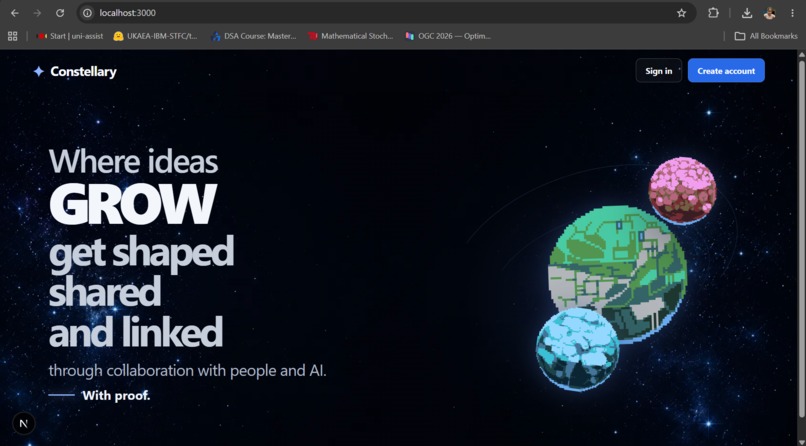
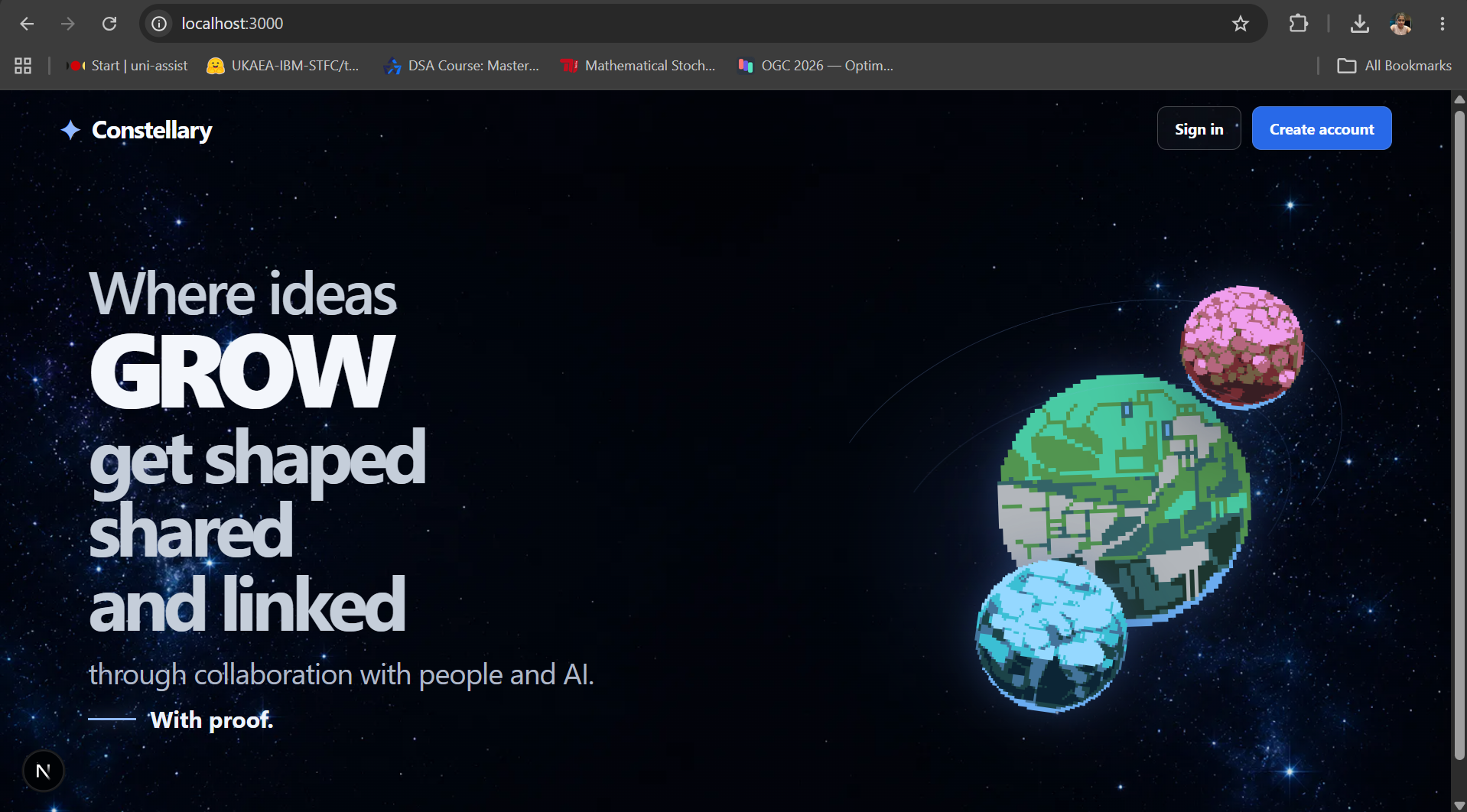
landing page
-
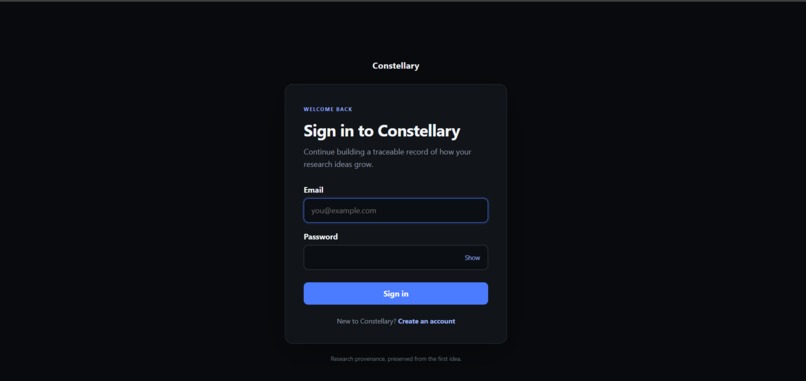
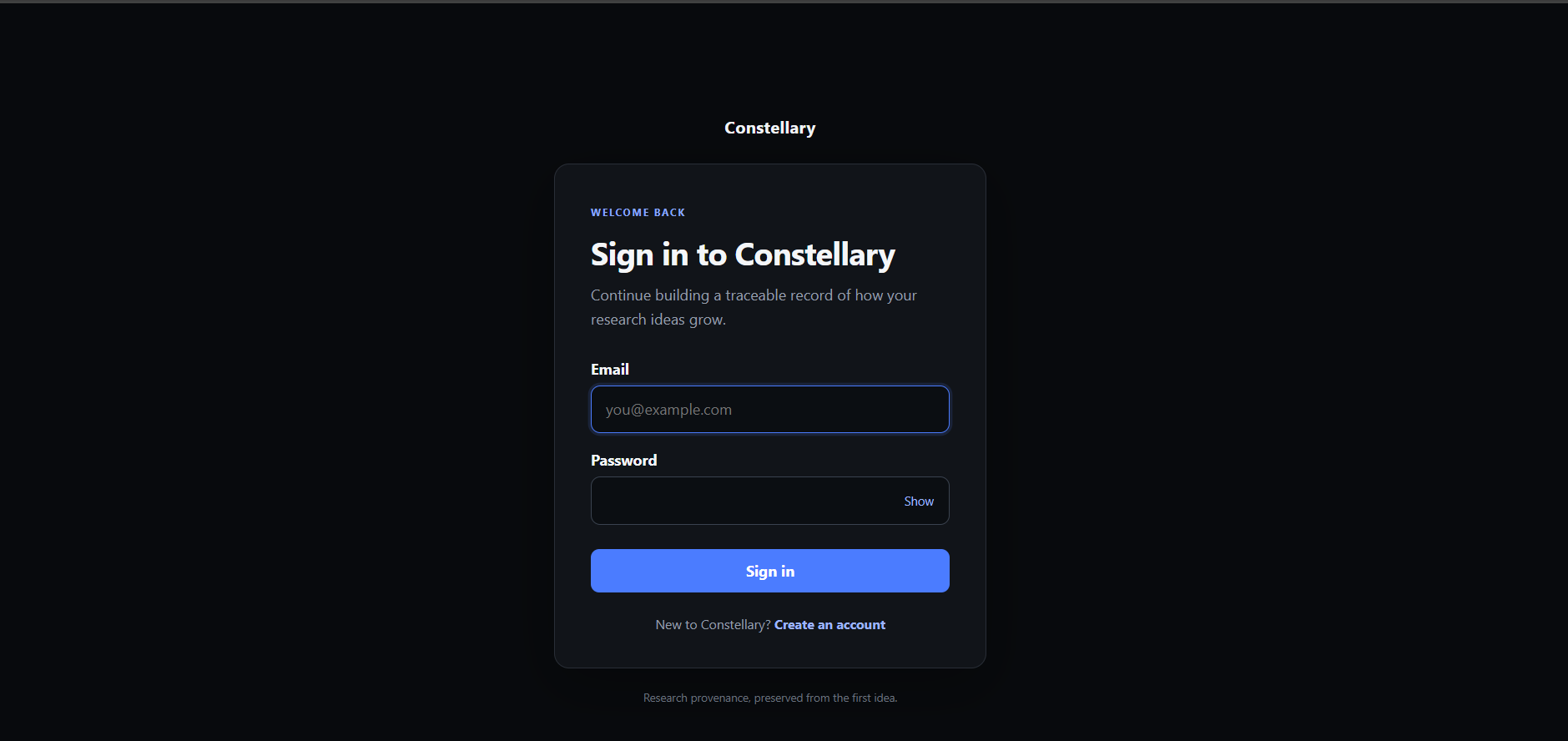
signin
-
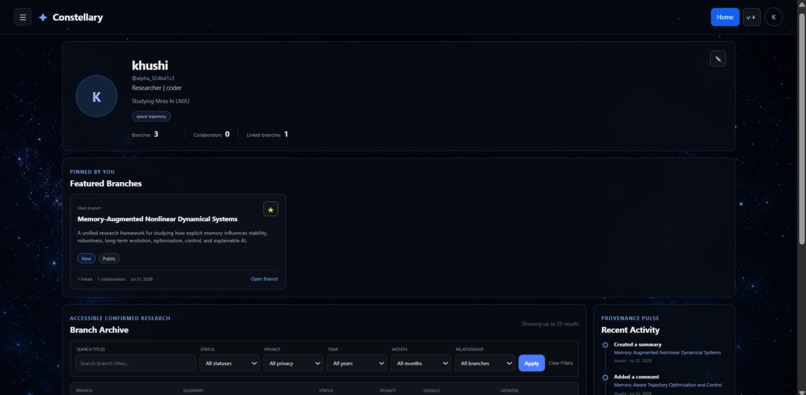
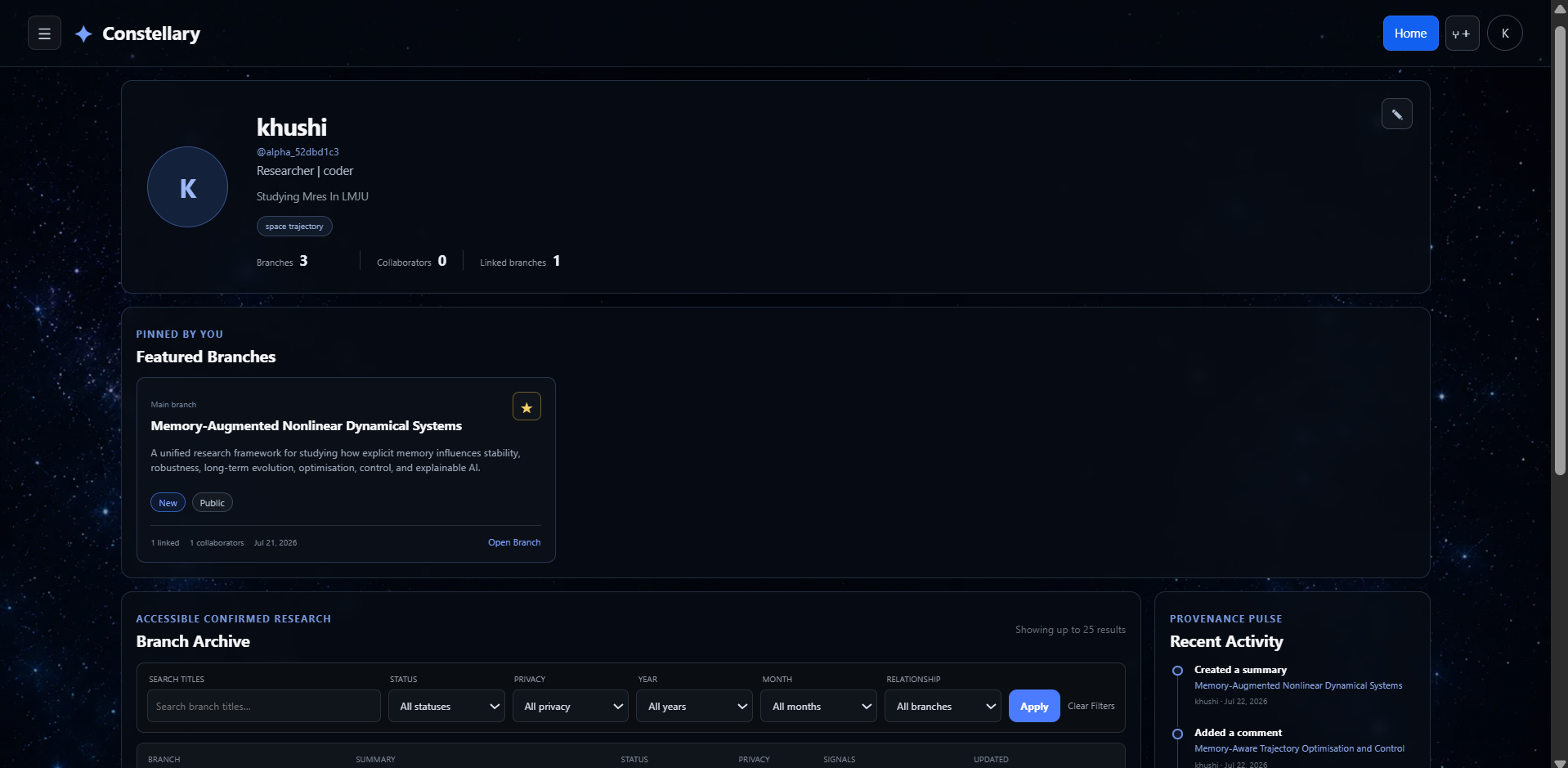
profile view of a user
-
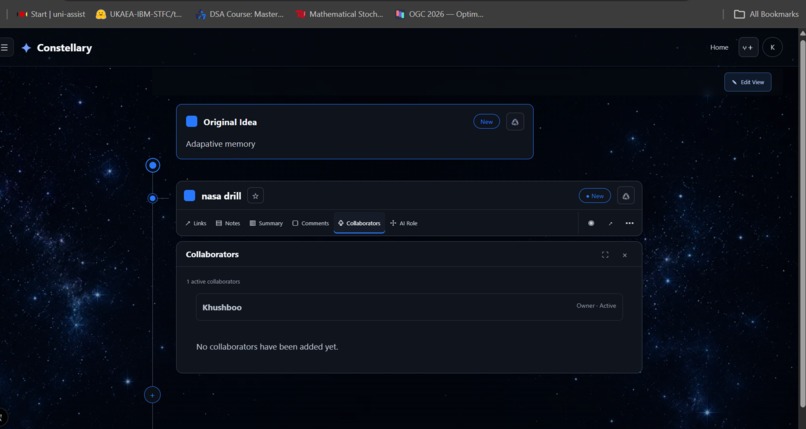
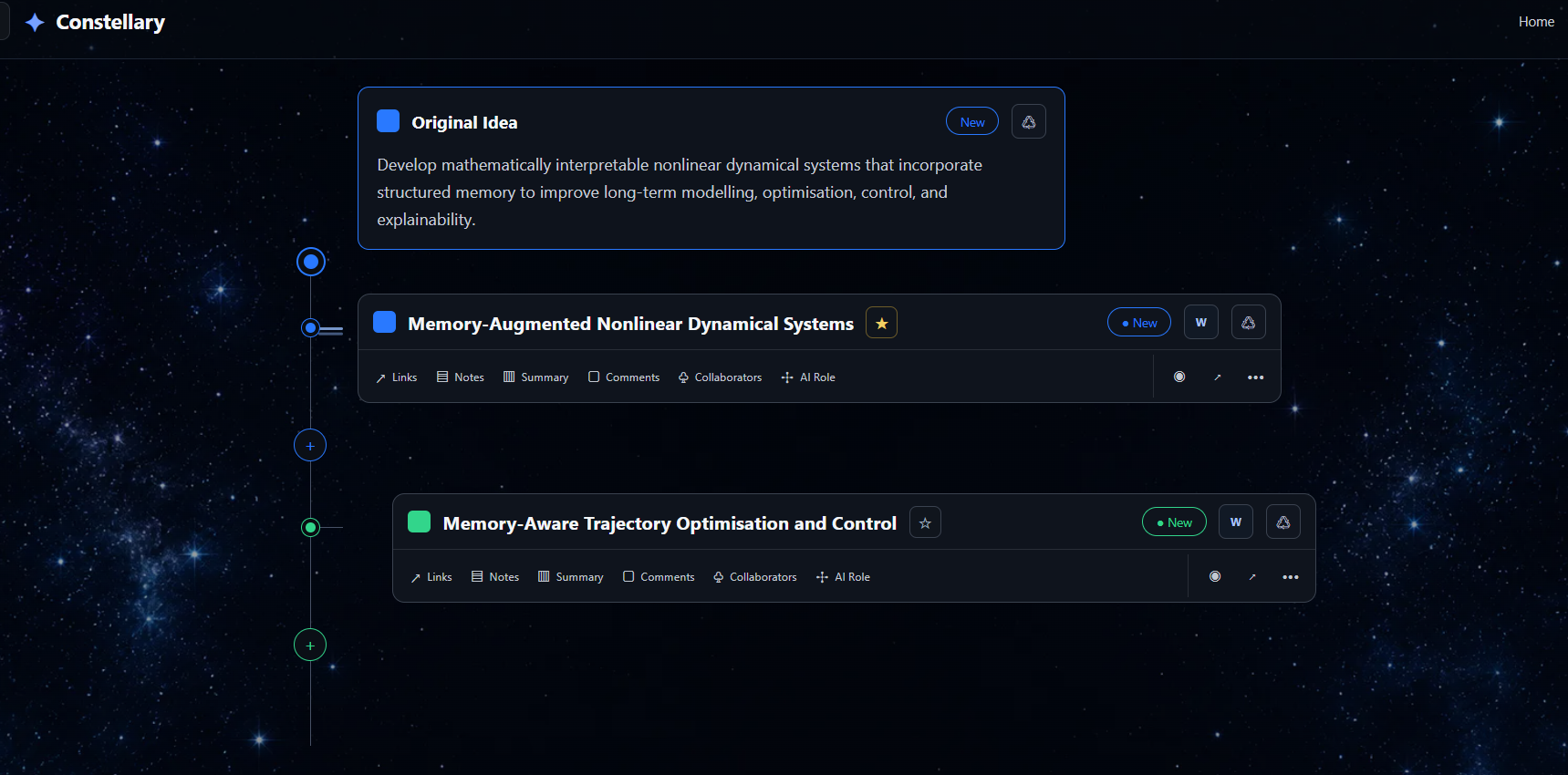
Branch page _view
-
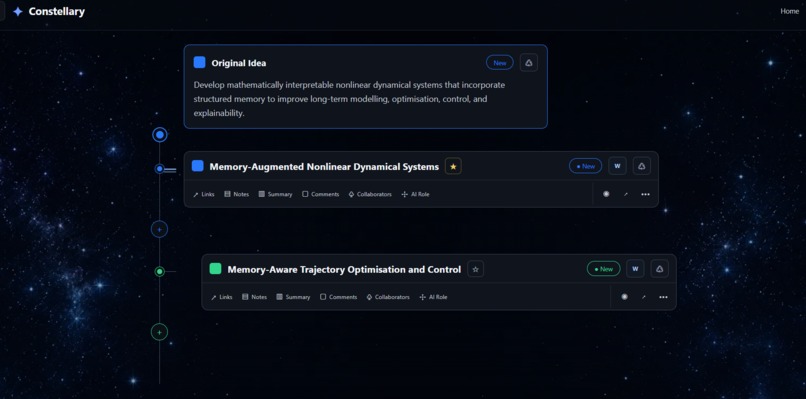
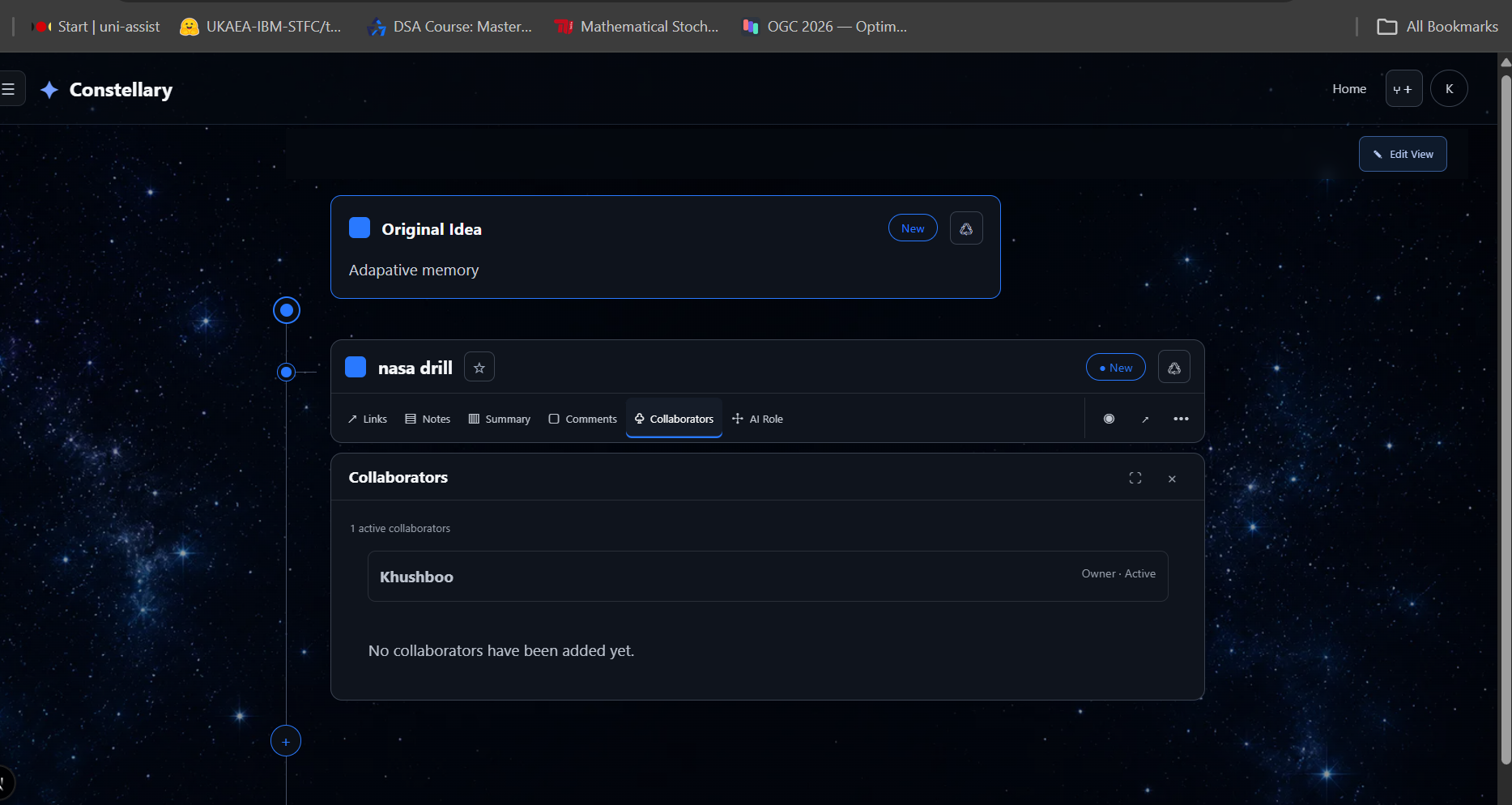
subbranch view
Inspiration
For the past five months, I have been preparing my research profile for PhD opportunities and connecting my ideas with professors worldwide.
GPT and I continuously studied their work, mapped my projects to their research, refined ideas, and searched for stronger directions.
But everything was scattered across documents, AI conversations, code repositories, diagrams, notes, references, and separate projects. The connections existed in my thinking, but there was no shared place where I could clearly show how an idea began, changed, connected to other work, or grew through human and AI contributions.
Existing tools handled separate parts of the journey, so I repeatedly rebuilt the same profile and explained the same connections again.
That is when the problem became personal:
I did not only need a place to store research.
I needed a place where ideas, work, people, and AI collaboration could grow together as one visible research identity.
So GPT, Codex, and I created Constellary—a connected workspace for linking, mapping, sharing, discussing, and growing ideas across their complete journey.
What it does
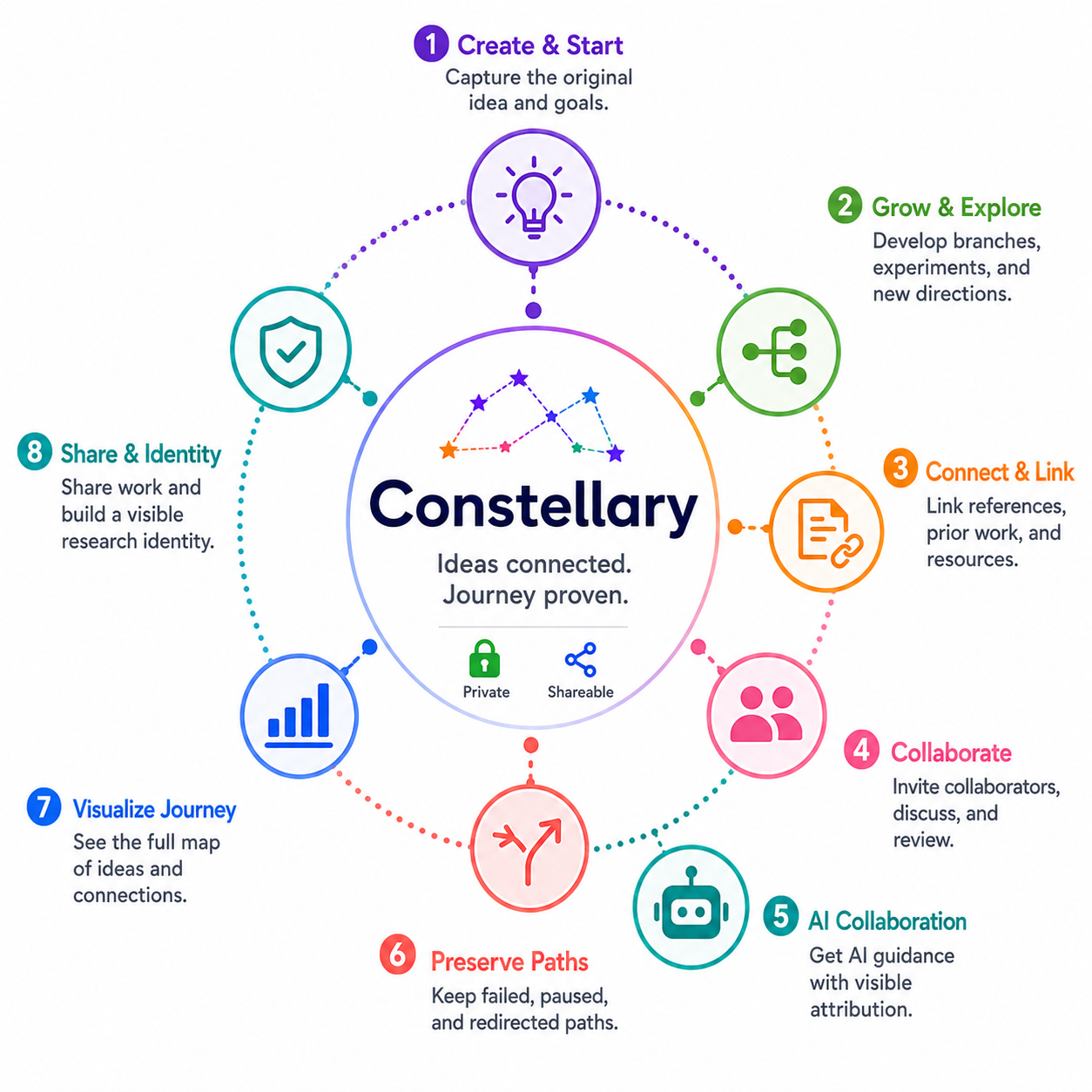
Constellary is the solution to a research journey that has become increasingly scattered across papers, repositories, AI conversations, notes, tools, collaborators, and unfinished directions.
It brings those disconnected parts into one visible system where an idea can begin, branch, connect to previous work, involve people and AI, preserve failed paths, and grow into a complete research identity.
Watch why Constellary is needed and how it solves the problem
Constellary is a provenance-first workspace where people and AI can create, connect, and grow ideas across their full journey.
It helps users start with an original idea, develop it through branches, link references and related work, collaborate through comments and shared contributions, record AI-supported work, preserve failed or redirected paths, and view the entire journey as a visible map.
Instead of showing only the final output, Constellary shows how the work began, how it evolved, who shaped it, and what connects it together.
How we built it
We built Constellary by first defining the product as a provenance-first research workspace, then converting each product decision into focused implementation tasks.
1. Defining the product
We began by deciding what Constellary needed to preserve across a research journey:
- the original idea;
- how it grows into branches and subbranches;
- how related work is linked without changing ancestry;
- how comments, collaborators, files, and notes stay connected to the right branch;
- how failed or redirected paths remain visible;
- and how human and AI contributions stay attributed.
The core rules were:
- a parent branch represents direct research ancestry;
- a linked branch represents reference or influence;
- a changed direction becomes a new subbranch;
- confirmed provenance cannot be silently rewritten;
- permissions belong to the exact branch being shared.
2. Turning the model into product features
From that model, we built the main product experiences:
- root branches, subbranches, and linked research;
- Branch View for readable shared research pages;
- Workspace for focused editing;
- summaries, notes, sources, comments, and collaborators;
- privacy, sharing, archives, and featured branches;
- AI context selection, review, approval, and attribution;
- researcher profiles and visible research identity.
3. GPT-5.6 as a reasoning collaborator
GPT-5.6 helped as a product and architecture collaborator.
It helped us refine:
- how the workflows should behave;
- how permissions and sharing should work;
- how AI boundaries and attribution should be handled;
- and how the product language and interface structure should stay consistent.
4. Codex as the implementation collaborator
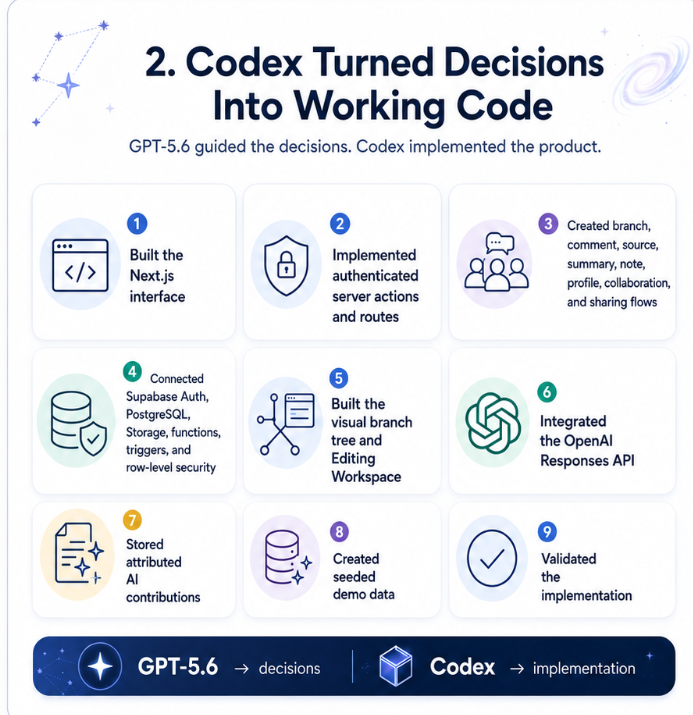
Codex then turned those decisions into working code inside the repository.
It helped implement:
- authentication and researcher profiles;
- branch creation, linked research, and branch viewing;
- the Editing Workspace;
- comments, collaborators, summaries, notes, and sources;
- OpenAI-powered AI flows with review and attribution;
- and testing, validation, and implementation fixes.
Our working loop was:
Product decision → GPT-5.6 refinement → focused Codex task → implementation → automated validation → browser review → correction
### 5. Technical implementation

The application was built with:

- Next.js App Router, React, and TypeScript;
- Supabase Auth, PostgreSQL, Storage, functions, triggers, and Row-Level Security;
- the OpenAI Responses API with GPT-5.6;
- Vitest and pgTAP;
- and Vercel deployment.

The OpenAI integration runs only on the server. Users explicitly choose which branch content is sent as context, and every generated contribution must be reviewed before it can be approved and applied.

### 6. Validation

We continuously validated the product through:

- type checking and linting;
- automated tests;
- database and RLS tests;
- production builds;
- permission checks;
- seeded demo data;
- and manual browser testing with different user roles.

This process allowed us to build Constellary as one connected research workspace while keeping the product decisions, implementation, permissions, and AI contributions aligned.

[Watch how codex solves our problems and build Constellary ](https://youtu.be/W-VDt359nxc)
## Challenges we ran into

The biggest challenge was keeping a deep product model consistent while building quickly.

### Product complexity

Research does not grow like a simple folder structure. We had to support changing directions without losing the original history, while keeping branches, linked work, collaboration, and AI contributions understandable.

### Permissions and real browser behavior

A feature could pass automated checks and still behave incorrectly in the interface.

We ran into issues such as:

- controls appearing in the wrong place,
- expected actions being hidden by capability checks,
- seeded branches behaving differently from owned branches,
- and technically correct changes not matching the intended workflow.

This required both automated validation and repeated browser review.

### Learning to work with Codex

Large, broad instructions often produced changes that were technically valid but incomplete or misplaced.

Codex worked much better when each task included:

- one precise objective,
- the exact user flow,
- rules that must not change,
- visible acceptance criteria,
- and required validation steps.

Our final working loop was:

Inspect
→ define one precise change
→ implement with Codex
→ run checks
→ review in the browser
→ correct the remaining issue

## Accomplishments that we're proud of

We are proud that Constellary became more than a collection of research features. It became one connected system for preserving how ideas grow.

Our main accomplishments were:

- designing a provenance model that keeps original ideas, branches, linked research, failed paths, and contributions connected;
- building a complete workflow from idea creation to collaboration, editing, AI assistance, sharing, and researcher profiles;
- making human and AI contributions separately visible and attributable;
- allowing users to review, approve, reject, and apply AI-generated work instead of inserting it automatically;
- creating permission-safe experiences for owners, collaborators, viewers, private branches, and public research;
- building a visual research tree that makes the journey easier to understand;
- connecting Next.js, Supabase, PostgreSQL, Storage, Row-Level Security, and the OpenAI Responses API into a working deployed application;
- and validating the product through automated tests, database checks, production builds, and real multi-user browser testing.

Most importantly, we are proud that GPT-5.6, Codex, and a human did not work as separate tools. They worked as one development process: the human defined the vision, GPT-5.6 refined the decisions, and Codex helped turn them into a tested product.

> Constellary does not only preserve what was created. It preserves how the work became possible.

## What we learned

This was our first time using Codex deeply as part of a complete product-building workflow.

We learned that:

- Codex performs best with focused tasks, precise rules, and clear acceptance criteria;
- complex products should be divided into smaller connected implementation steps;
- automated checks must be combined with real browser testing;
- permissions and provenance must be designed from the beginning;
- and AI output should remain reviewable, attributable, and controlled by the user.

Most importantly, Codex can accelerate implementation significantly, but the product vision, decisions, and final responsibility must remain human-led.

## What's next for Constellary

Our next goal is to make Constellary a more complete place for turning ideas into real collaborative work.

We plan to add:

- direct GitHub and Codex links for connecting ideas with implementation;
- an interactive canvas for visually designing and developing ideas;
- more built-in research and creation tools;
- smoother branch and subbranch creation;
- clearer icons and navigation across the product;
- and shareable researcher profiles that can be sent directly through email.

The long-term vision is for Constellary to become a connected workspace where ideas can be explored, designed, implemented, shared, and preserved from their first origin to their final outcome.

## Why we chose Education as category

Constellary can fit both **Education** and **Work and Productivity**, but we chose **Education** because its first audience is researchers, students, professors, and academic labs.

It helps them:

- develop ideas through connected branches;
- link prior research and related work;
- organise notes, summaries, code, results, and decisions;
- collaborate with people and AI;
- and share one clear, trustworthy research journey.

Work and productivity is also part of the product, but the primary goal is academic research and learning. Later, Constellary can expand to product teams, engineering, game development, and other professional workflows.

## Project videos

- [Why Constellary is needed](https://youtu.be/iomn6d2tFxM)
- [How GPT-5.6 and Codex helped build it](https://youtu.be/W-VDt359nxc)
- [Complete product demo](https://youtu.be/BZaiwaqXcGA)
Built With
- api
- auth
- codex
- gpt-5.6
- next.js
- openai
- pgtap
- postgresql
- react
- responses
- row-level
- security
- storage
- supabase
- typescript
- vercel
- vitest

Log in or sign up for Devpost to join the conversation.