-
-
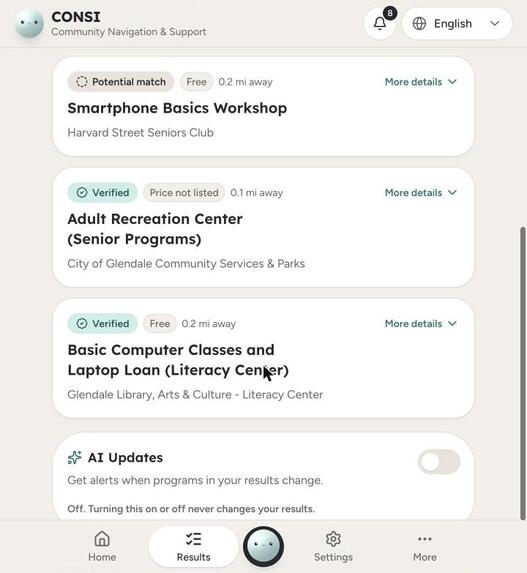
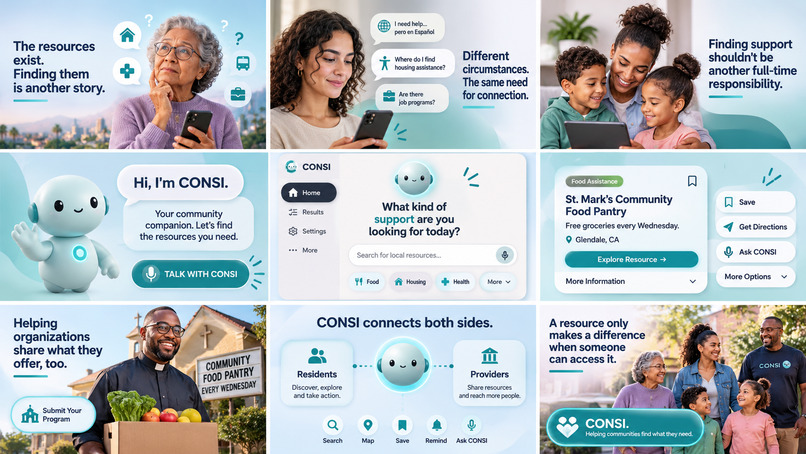
Three real nearby options, each with a trust label, cost and distance
-
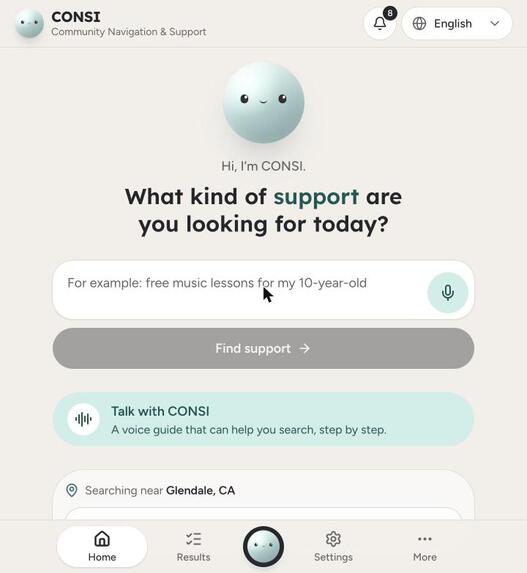
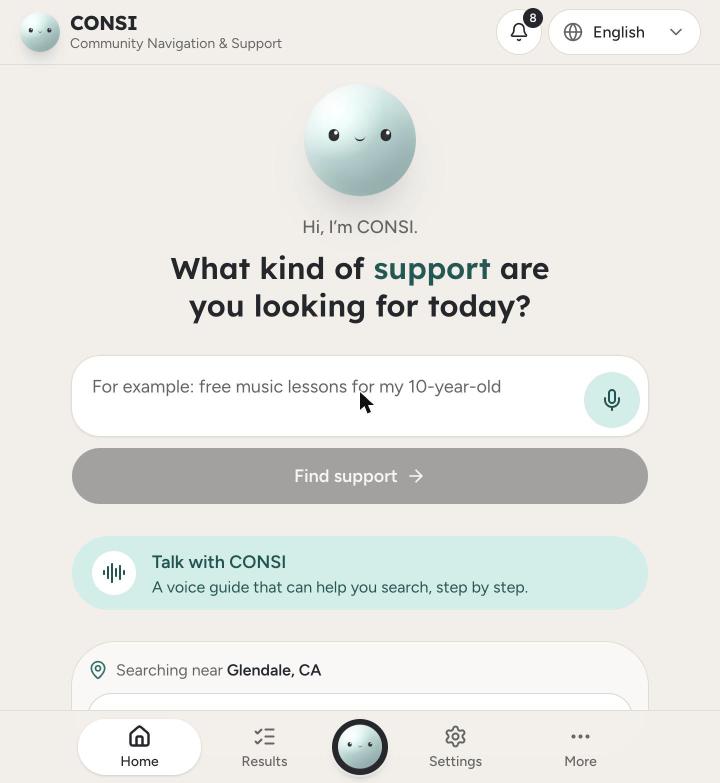
Ask in your own words, in English, Spanish, Armenian or Mandarin
-
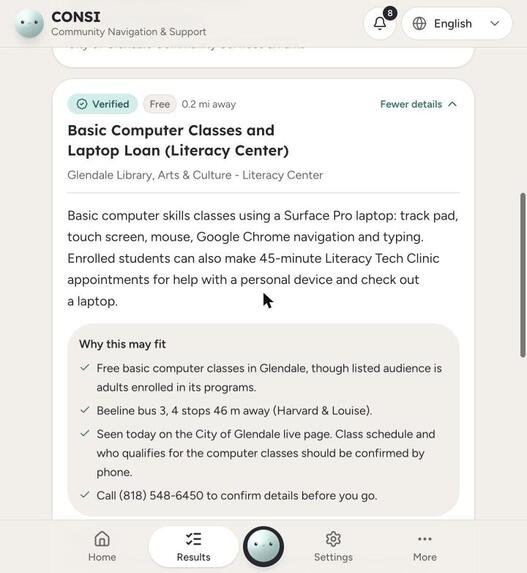
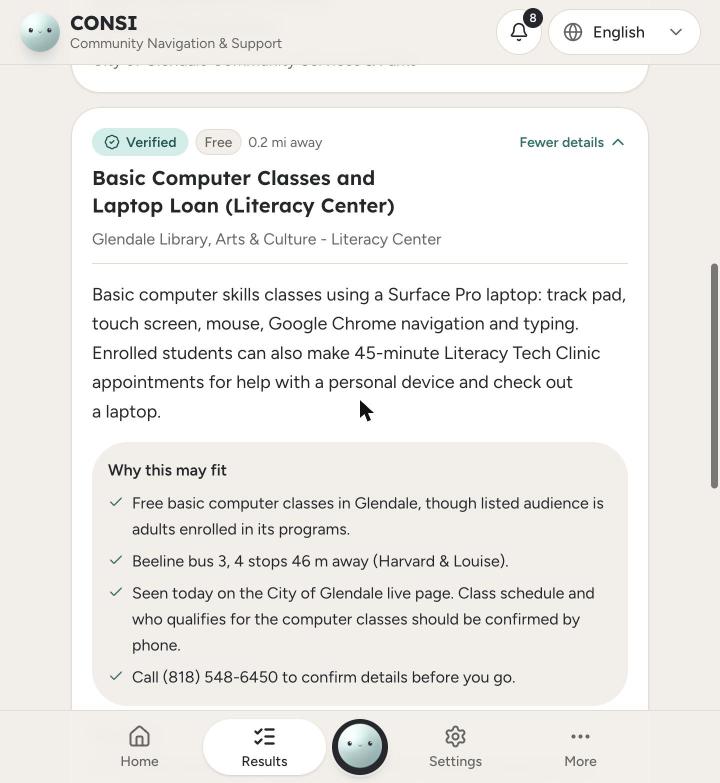
Why it fits: the nearest bus stop, where the information came from, and the next step
-
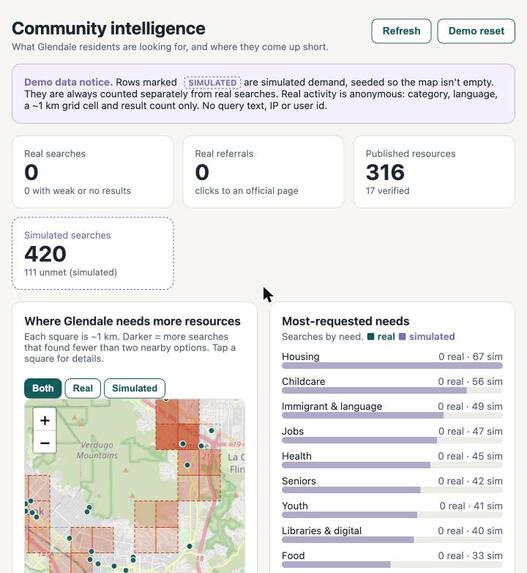
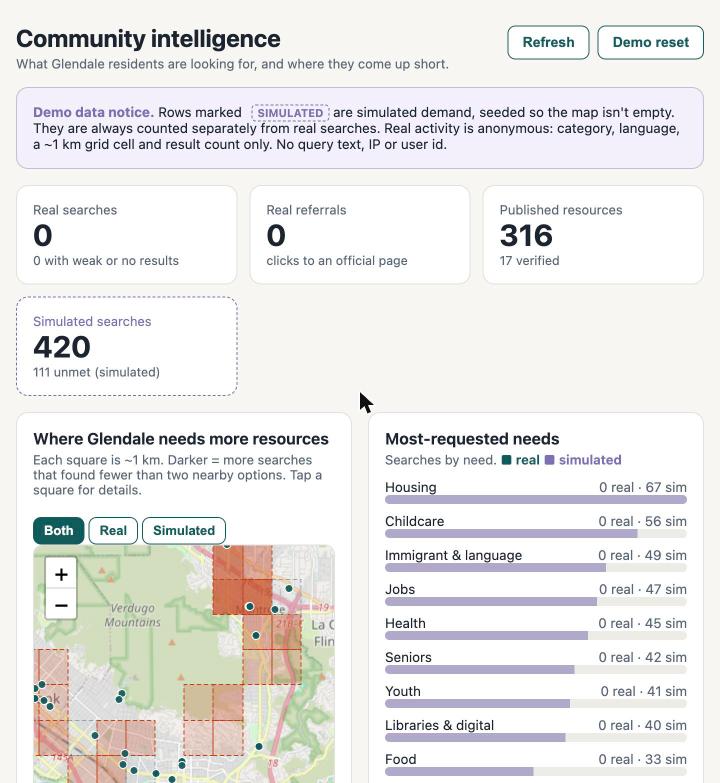
Resource for Organizations City dashboard: most-requested needs and where Glendale needs more resources (simulated demand clearly labeled)
-
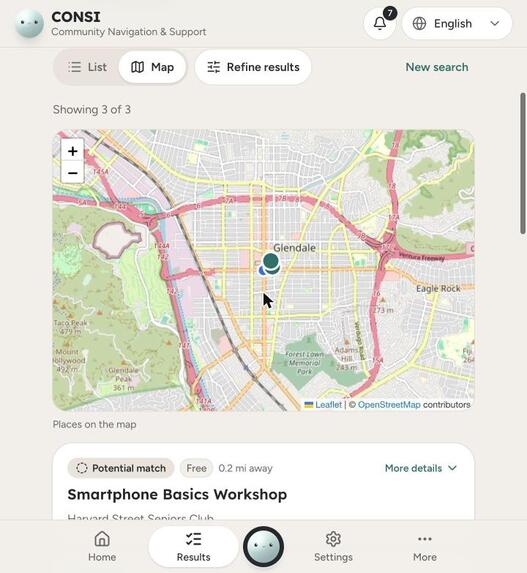
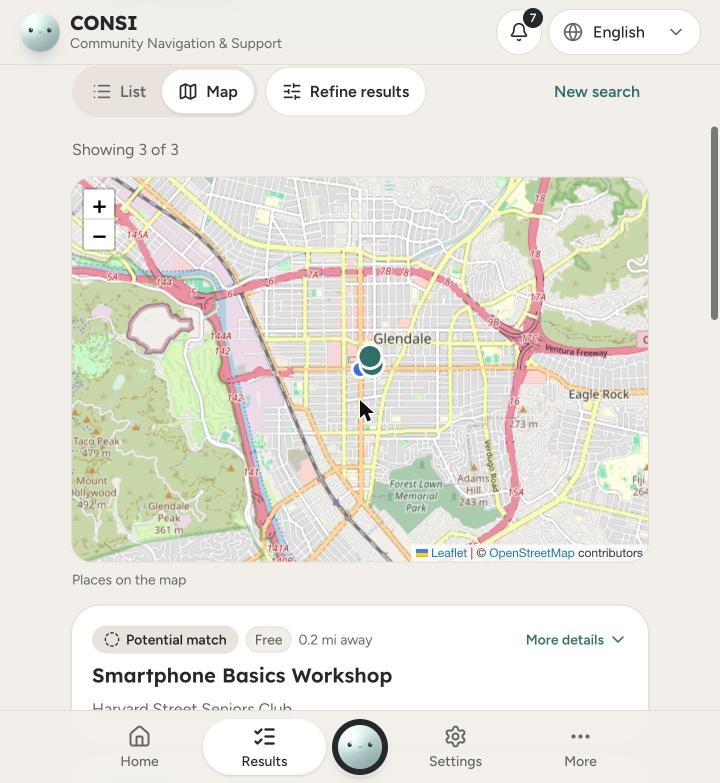
Results on a map of Glendale
-
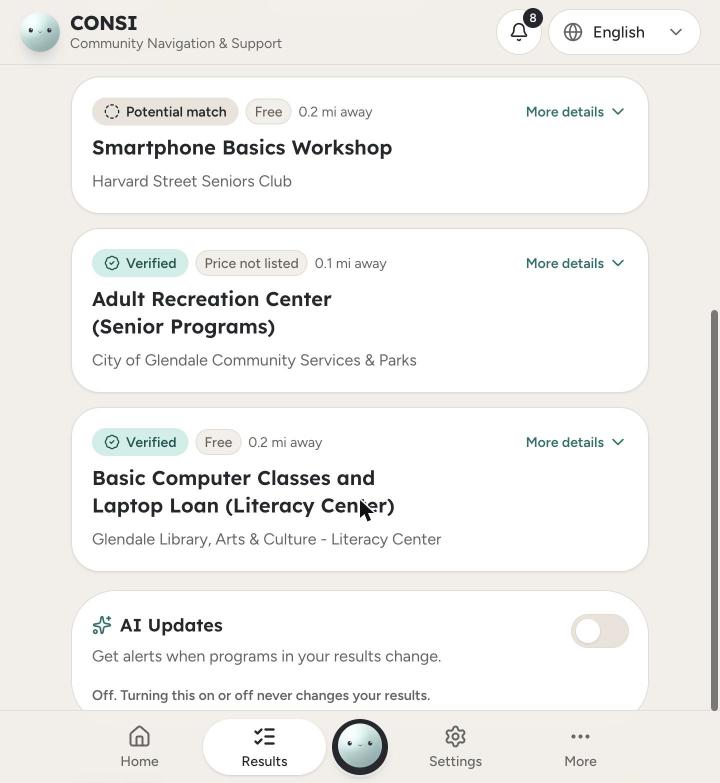
CONSI
Making community resources easier to discover, understand, and access.
An AI-powered community resource discovery and distribution platform.
1. Inspiration
Access to resources shouldn't depend on knowing where to look.
We were inspired by the belief that resources should be discoverable by everyone—not just people who know how to navigate complicated websites, traditional directories, or institutional intake processes.
For people who are less comfortable with technology, neurodivergent individuals, or anyone who experiences information overload, finding support can become an overwhelming process before they even reach the resource itself.
At the same time, many community organizations rely on grassroots outreach, printed flyers, social media posts, and word of mouth to promote their programs. Valuable opportunities can remain difficult to discover simply because their promotional information isn't reaching the right people.
We saw an opportunity to connect these two sides of the problem.
2. What It Does
One place to discover what's already available.
CONSI helps people discover community resources, programs, services, and opportunities through a more approachable, personalized experience.
- Conversational discovery: Users can describe what they need in everyday language instead of navigating complicated categories or knowing the correct search terms.
- Location-based discovery: ZIP-code-based search helps surface relevant resources in a user's community.
- Personalized recommendations: Search context, user preferences, and previous interactions help surface relevant opportunities—including resources users may not have known to ask for.
CONSI also creates a pathway for organizations to make their programs and promotional materials more discoverable to the communities they serve.
3. How We Built It
A designed experience on top of a live engine.
- Interface (Vercel v0, Next.js): Home, Results, Settings and More, with the map inside Results. Results show as compact cards that open on tap, so all three recommendations fit on one screen.
- Real local data: over 300 real resources across Glendale, Burbank, Pasadena and Northeast LA, pulled from City of Glendale GIS (through the organizers' GlendaleGisMcp server), LA County's public GIS, and official agency pages. Each listing carries its source and a trust status: Verified, Potential, Outdated or Unknown.
- AI with guardrails (Anthropic Claude): Claude reads an everyday request, ranks real records and explains why each one fits. It can only return listings that exist in our database; if it is slow or unavailable, search falls back to keyword matching, so a resident always gets an answer.
- Four languages: English, Spanish, Armenian and Mandarin, translated with Claude (not yet reviewed by native speakers).
- Voice (ElevenLabs): the concierge speaks its answers in all four languages, residents can ask out loud (Scribe speech-to-text), and a live voice conversation runs on an ElevenLabs agent in English, Spanish and Mandarin.
- For organizations: paste a flyer, a photo or a URL and CONSI drafts a structured listing, flags missing details, and publishes it, so it appears in residents' results right away.
- For the city: a dashboard shows the most-requested needs, a map of where searches found too little ("where Glendale needs more resources"), and which listings are going stale. Its demand map uses clearly labeled simulated searches.
- Open engine: the same search is exposed as an MCP server, so any AI assistant or city system can use it.
Stack: Next.js, TypeScript, Neon Postgres, Vercel, Anthropic Claude, ElevenLabs.
4. Challenges We Ran Into
Making discovery simpler without oversimplifying the problem.
One of our biggest challenges was balancing the amount of information people need with the amount of information they can comfortably process.
Traditional resource directories often overwhelm users with categories, eligibility requirements, lengthy descriptions, and disconnected application processes.
We also had to consider the fragmented nature of community information. Resources come from government agencies, nonprofits, local providers, community directories, and grassroots promotional materials. Their information isn't always presented consistently or maintained in one place.
Our challenge was to envision a platform that could make this information easier to navigate without sacrificing relevance, accuracy, or the details people need to take action.
5. Accomplishments We're Proud Of
We reimagined what a resource directory could be.
We're proud of establishing a product direction that considers both the person searching for support and the organization trying to reach them.
- A working product, not a mockup: a resident can ask in their own language, get three real nearby options with a trust label, open the one that fits, and call or get directions.
- Honest information: every listing shows its source and how recently it was confirmed, and the AI cannot invent a resource.
- Both sides of the problem: organizations can publish from a flyer in seconds, and the city can see unmet need on a map.
- An inclusive design philosophy: technology literacy, cognitive accessibility and information overload treated as core product concerns.
Most importantly, we established a foundation for thinking about community information as something that should be actively discoverable—not something people should have to struggle to find.
6. What We Learned
Accessibility is more than making an interface easy to use.
We learned that the challenge isn't simply whether information exists. It's whether people can recognize it, understand it, determine whether it's relevant to them, and figure out what to do next.
We also recognized that discovery and distribution are connected problems.
Organizations can create valuable programs and promotional materials, but those materials have limited impact if the intended audience never encounters them.
A successful resource platform needs to consider both sides: how information enters the ecosystem and how people discover and act on it.
7. What's Next for CONSI
From a discovery prototype to a connected community resource network.
Our next steps focus on turning the current foundation into a more functional, connected platform.
1. Verify and expand the data: have local partners confirm listings, add native-speaker review of translations, and extend beyond Glendale.
2. Deeper personalization: saved locations, reminders and notifications.
3. Organization accounts: let providers manage and refresh their own listings over time.
The longer-term vision is to make CONSI a bridge between community needs and community resources—where discovering a program can also mean discovering the flyer, event, application, or next step that makes participation possible.
Closing
The resources already exist. The connection is what's missing.
CONSI is building a more accessible way for people to discover what's available to them—and for organizations to make sure their work reaches the communities it was created to serve.
Find what exists. Access what matters.
Built With
- anthropic-claude
- elevenlabs
- esri
- mcp
- neon
- next.js
- postgresql
- react
- typescript
- vercel
- zod
