Inspiration
Growing up, I saw how environmental decisions can have consequences that don't appear until years later. A failed dam construction in my community eventually caused devastating flooding. That experience made me think about a simple question: what if we could examine the consequences of major decisions before committing to them?
What it does
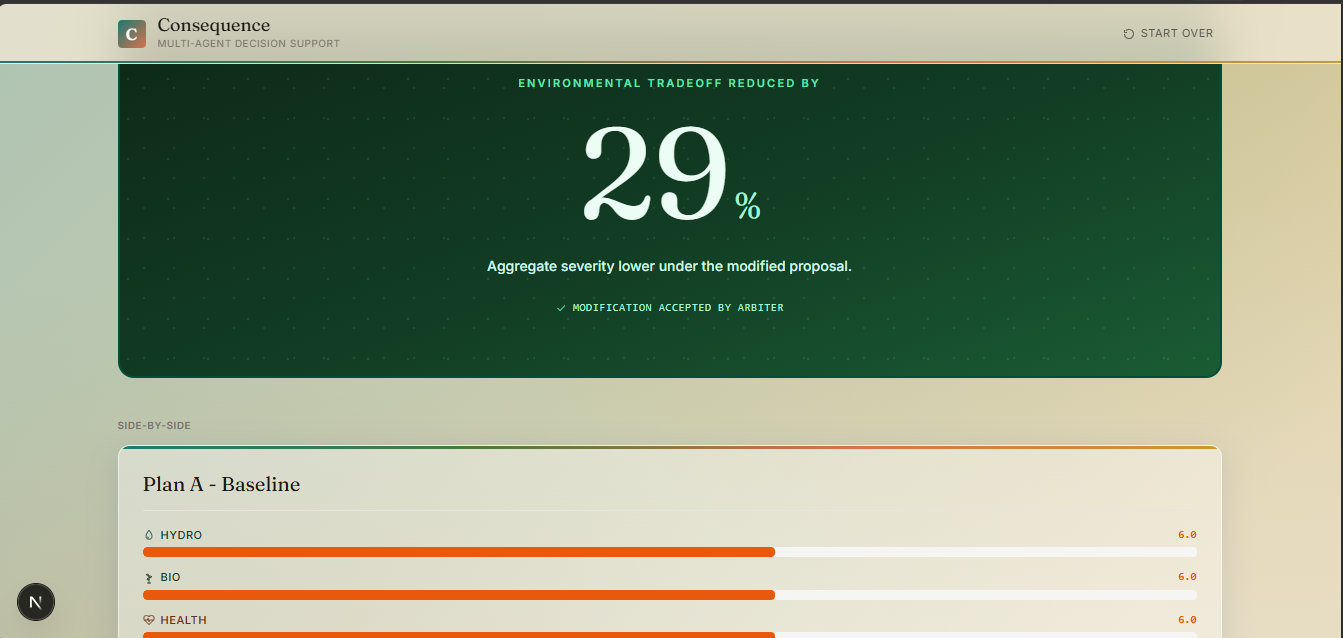
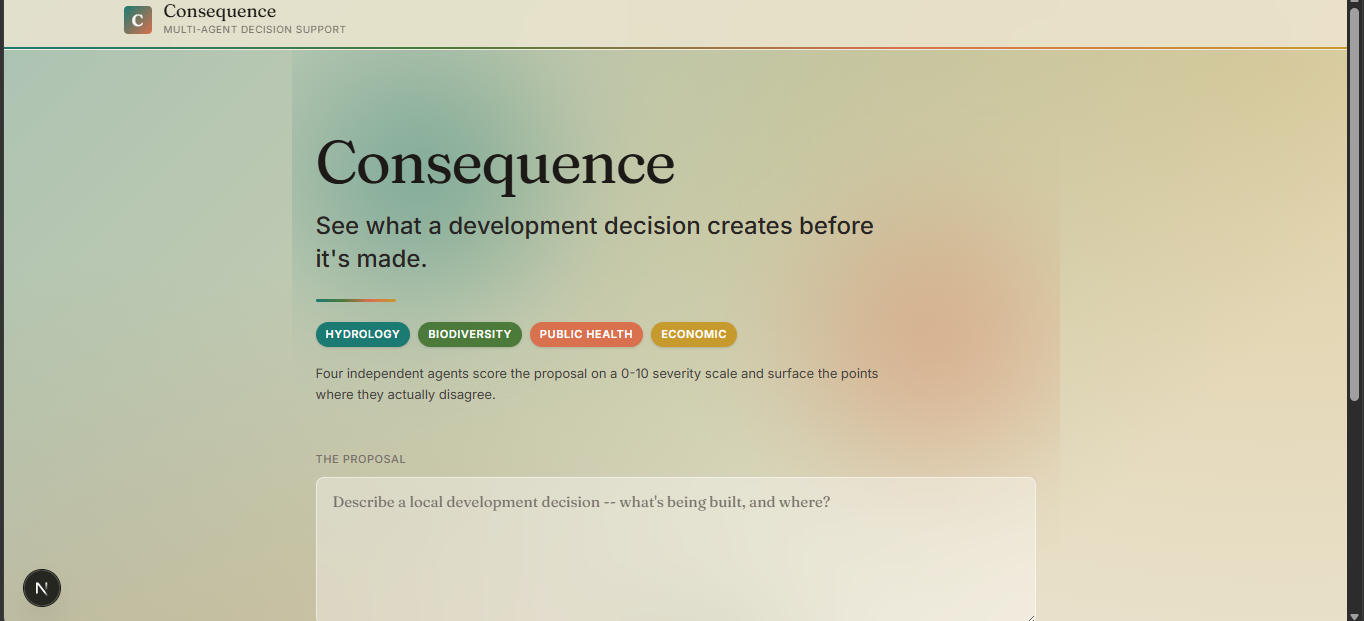
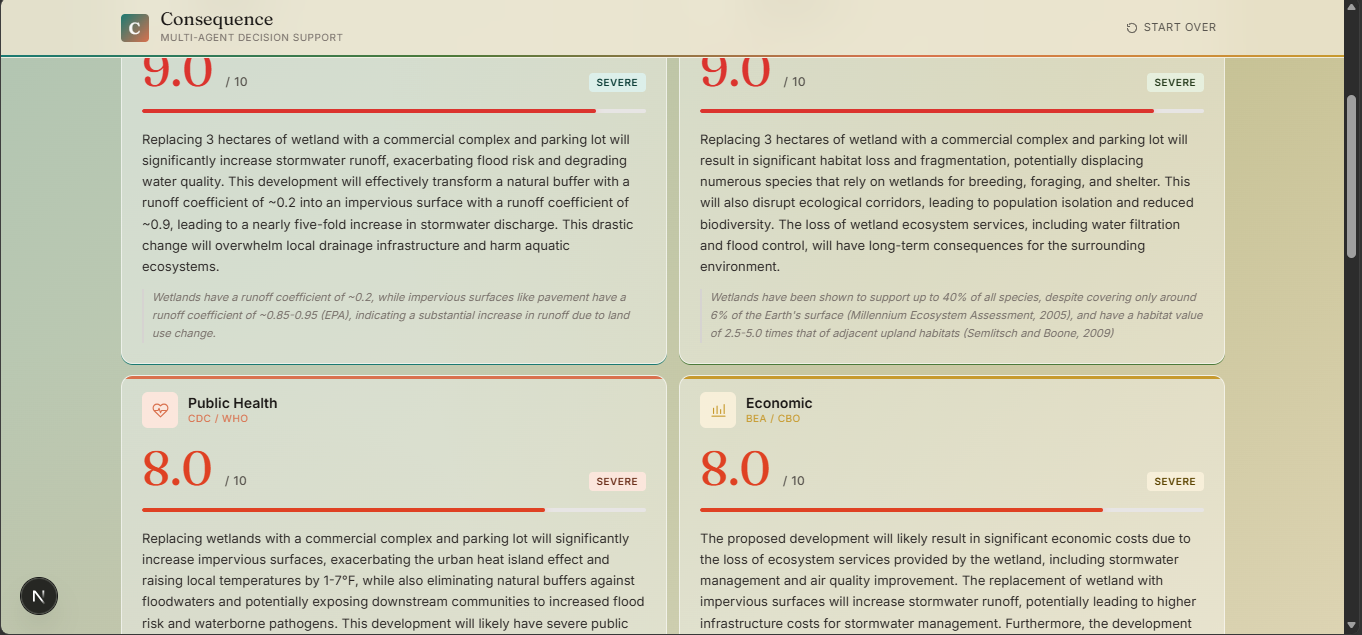
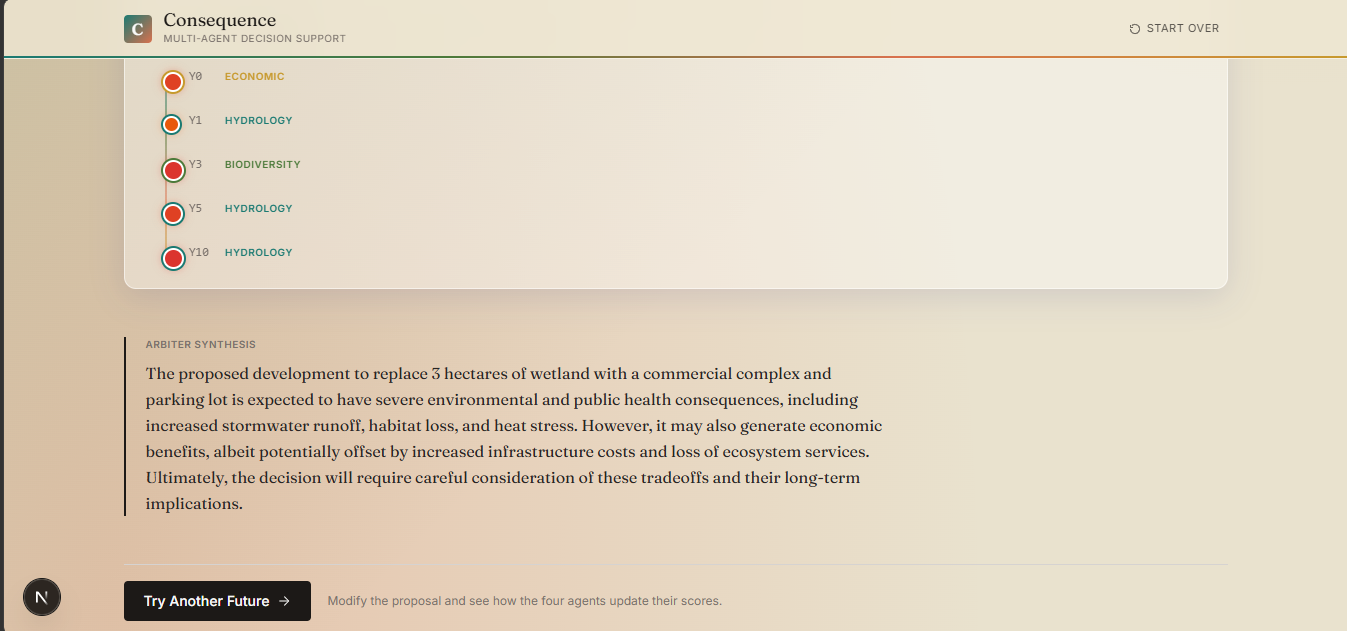
Consequence Engine is a multi-agent AI decision analysis system. It takes a proposed decision and independently evaluates its long-term environmental, social, economic, and practical consequences. The agents debate where tradeoffs exist, an arbiter synthesizes their findings, and users can modify the proposal to compare different futures.
How we built it
We built Consequence Engine as a web application using Next.js, TypeScript, React, and AI-powered analysis. Multiple specialized agents independently score and analyze a proposal, while an arbiter combines their perspectives into a unified assessment. We also built comparison and compromise flows so users can test modifications and see how the projected consequences change.
Challenges we ran into
The hardest part was making multiple AI perspectives work as one coherent system. We had to handle inconsistent model outputs, normalize agent scores, build reliable comparison logic, and create a UI that could communicate complex multi-agent reasoning without overwhelming the user. We also had very limited time to build and validate the full experience.
Accomplishments that we're proud of
We built a working multi-agent decision analysis pipeline from scratch during the hackathon. The system can evaluate proposals, surface disagreements between agents, synthesize their findings, and compare modified versions of the same decision. Most importantly, we turned an abstract idea about long-term consequences into something people can actually interact with.
What we learned
We learned that multi-agent systems are most useful when each agent has a clearly defined responsibility rather than simply asking several models the same question. We also learned that presenting AI reasoning is just as important as generating it: users need to understand where conclusions come from and where uncertainty or disagreement exists.
What's next for Consequence
We want to expand Consequence Engine with stronger environmental datasets, real-world geographic and climate information, uncertainty modeling, historical validation, and domain-specific agents. The long-term goal is to make it a decision-support layer for governments, organizations, planners, and communities evaluating high-impact decisions.
Built With
- api
- css
- groq
- ide
- turbopack
- typescript
- vscode

Log in or sign up for Devpost to join the conversation.