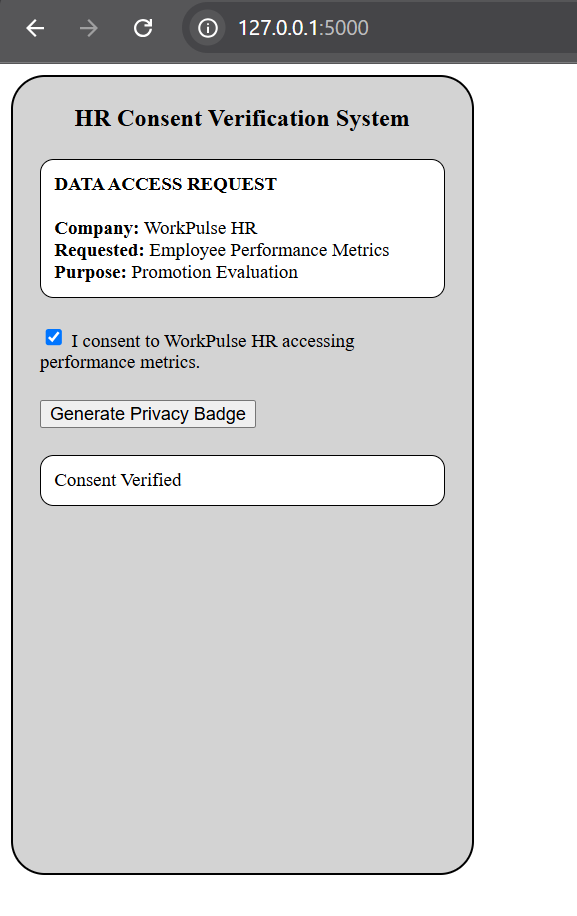
ConsentBadge began as a simple curiosity about how real full‑stack communication works. I wanted to understand how data actually travels between the frontend and backend, instead of just building static interfaces. The idea of turning a user’s consent into an instant badge felt both practical and visually satisfying, so I used it as a way to learn JSON handling, Flask routing, and dynamic UI updates in a real environment.
The project itself is a lightweight consent‑verification tool. When a user checks a box and clicks a button, the frontend immediately shows a “Waiting for backend…” message. JavaScript reads the checkbox value, sends it to Flask using a JSON POST request, waits for the server to process the logic, and then displays a badge returned by the backend. This creates a smooth loop of input → backend → badge, demonstrating how real applications validate user actions in real time.
Building ConsentBadge involved connecting three parts: HTML for the interface, JavaScript for sending and receiving JSON, and Flask for processing the logic. On the frontend, I learned how fetch() works, how to use JSON.stringify() to send data, and how r.json() converts the backend’s response into a usable object. On the backend, I used request.get_json() to read incoming data and jsonify() to send structured responses back. Seeing the badge appear instantly after the backend responded helped me understand how dynamic DOM updates create a responsive user experience.
The biggest challenges came from mixing up JavaScript and Python JSON functions, not knowing which JSON keys to use until the backend was written, and misunderstanding what the r object actually represents in r.json(). I also struggled with DOM updates and figuring out why the UI wasn’t changing. Debugging these issues taught me how important it is to understand the difference between JSON text and actual objects, and how frontend and backend must agree on the exact same key names.
Despite the challenges, I’m proud that ConsentBadge became a complete, functional full‑stack project. It’s small, but it demonstrates real JSON communication, a working Flask route, dynamic UI updates, and a clean user flow. It also gave me confidence in connecting frontend and backend logic without relying on templates or guessing.
Through this project, I learned how to structure POST requests, how JSON is handled differently in JavaScript and Python, how to update the DOM dynamically, and how to debug mismatched keys or broken fetch calls. Most importantly, I learned how full‑stack communication actually works in practice, not just in theory.
Next, I want to expand ConsentBadge by adding more validation rules, creating multiple badge types, adding color‑coded styling, and possibly turning the badge system into a reusable component for other projects. I also want to explore animations, transitions, and more complex backend logic. ConsentBadge is just the starting point, and I’m excited to build on it.

Log in or sign up for Devpost to join the conversation.