-
-

Group Clarity Score
-
Suggested Facilitator Prompts
-
Discussion Insights Dashboard

Inspiration
Many discussions appear to reach agreement quickly.
In meetings, classrooms, and team collaborations, people often nod along with an idea. But agreement in a room does not always mean real alignment.
From classroom discussions to team meetings, we noticed that some participants hesitate to speak, even when they have valuable perspectives. Concerns remain unspoken, quieter voices disappear, and decisions move forward without fully understanding the group.
This invisible dynamic inspired our project.
What if facilitators could sense the hidden signals of disagreement before decisions are made?
The Problem
Group discussions rely heavily on facilitators to read the room.
Experienced facilitators try to detect signals such as hesitation, silence, or uneven participation. However, these cues are subtle and easy to miss while simultaneously managing the conversation itself.
As a result, discussions can produce false consensus — where decisions are made without hearing every perspective.
The challenge is that these signals exist, but they are often invisible.
Our Idea
Consensus Lens is a speculative AR tool that reveals hidden dynamics within group discussions.
Using future sensing technologies, the system detects subtle conversational patterns such as hesitation, participation confidence, and psychological safety.
Instead of interrupting the conversation, Consensus Lens visualizes these signals through lightweight AR overlays, helping facilitators notice moments where voices may be missing.
The goal is not to control conversations, but to support more honest and balanced discussions.
How It Works
During a discussion, Consensus Lens continuously analyzes conversational signals and interaction patterns.
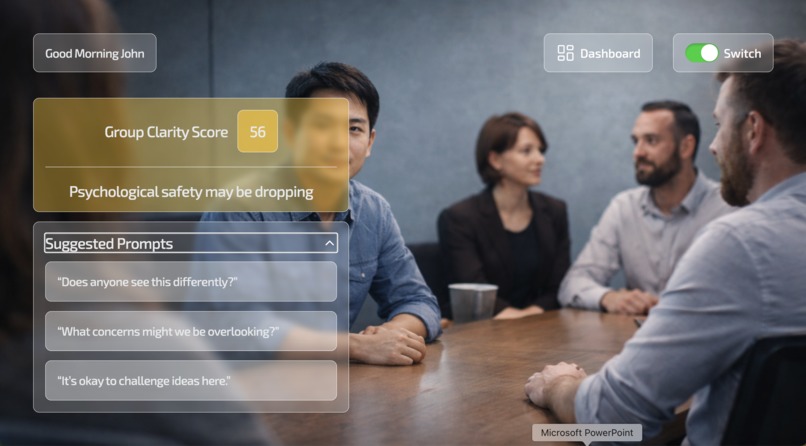
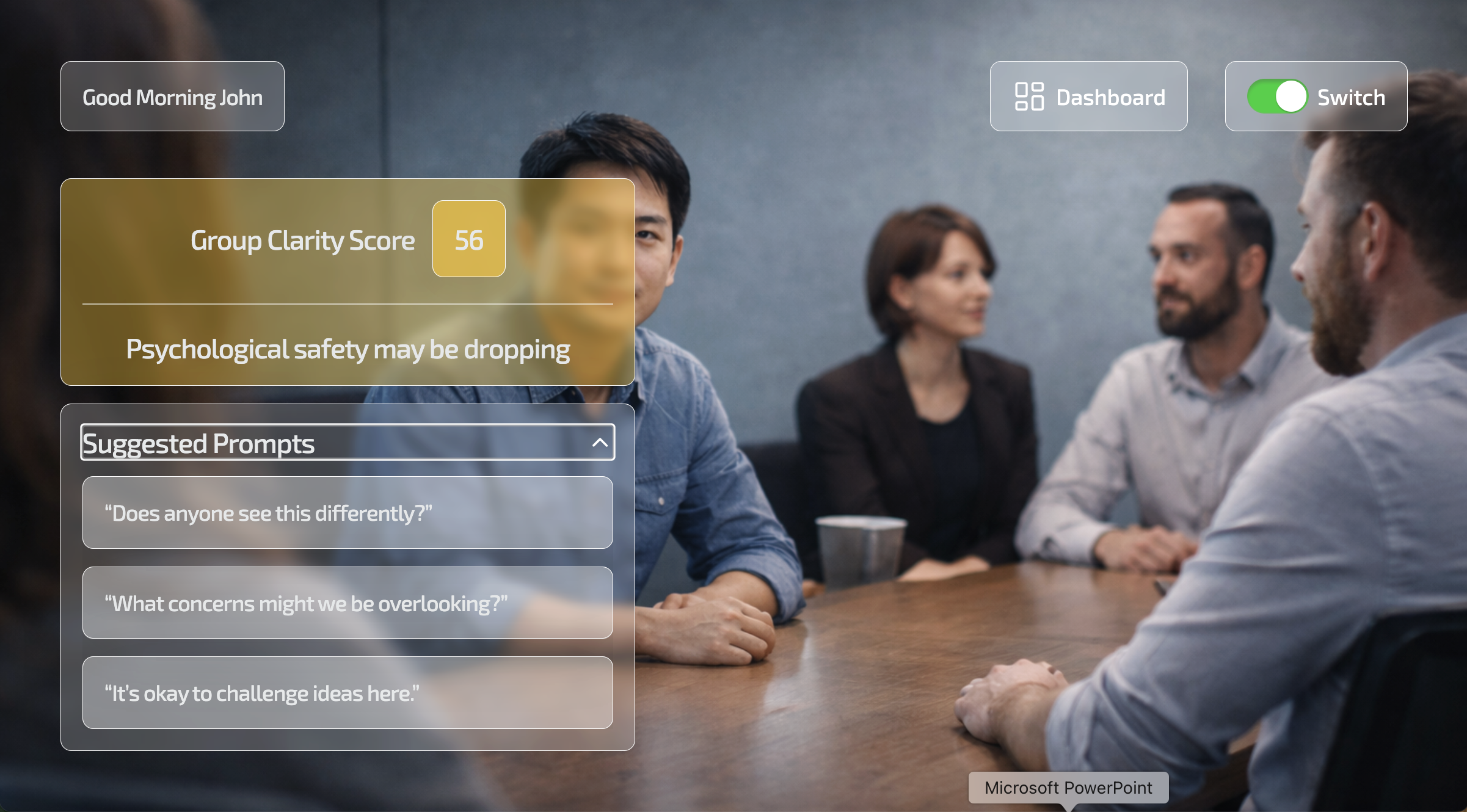
The facilitator sees a simple Group Clarity Score summarizing how aligned the discussion currently is.
When subtle signals appear — such as declining participation confidence or hidden ideas — the interface gently surfaces these moments.
The system may suggest neutral prompts such as:
"Does anyone see this differently?"
These prompts help facilitators invite quieter voices without disrupting the flow of discussion.
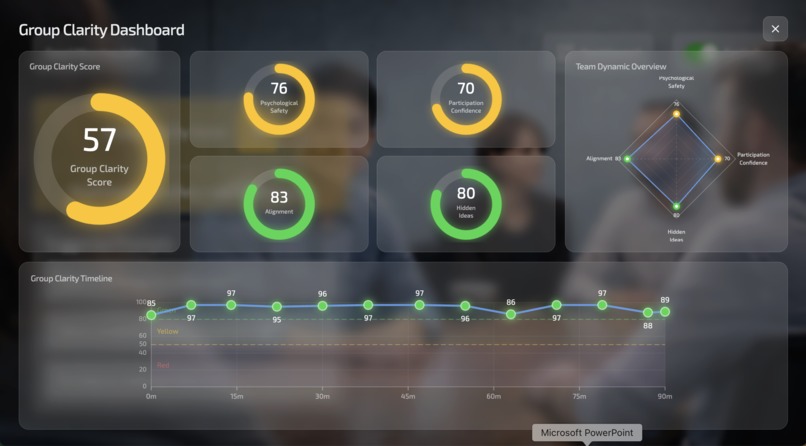
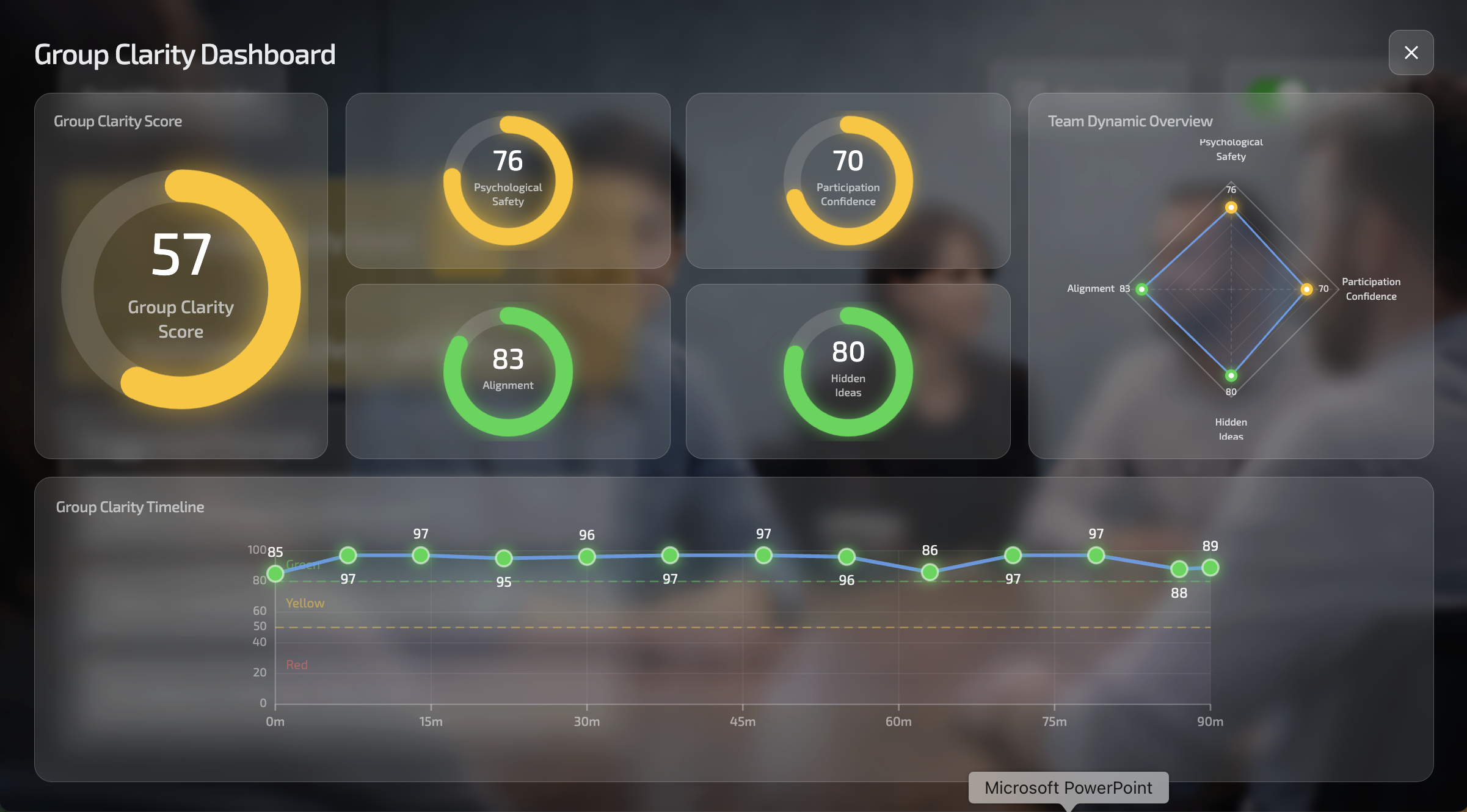
After the meeting, facilitators can explore deeper insights through a discussion dashboard, revealing patterns such as participation balance, psychological safety, and hidden idea signals over time.
Design Considerations
Because facilitators already focus heavily on managing discussions, the interface was designed to remain minimal and glanceable.
Key principles guiding the design include:
- Glanceable Information – Signals must be readable within seconds.
- Minimal Cognitive Load – Only essential signals appear during discussions.
- Consistent Visual Signals – Colors and indicators remain consistent across the interface.
- Comfortable Social Interaction – Information around participants remains subtle to avoid making people feel observed or judged.
These design decisions ensure that the tool supports facilitators without distracting from the human conversation itself. Consensus Lens explores how emerging sensing technologies could help people better understand the invisible dynamics of collaboration.
Built With
- capcut
- elevenlabs
- figma
- figmamake


Log in or sign up for Devpost to join the conversation.