-
-
Logo
-
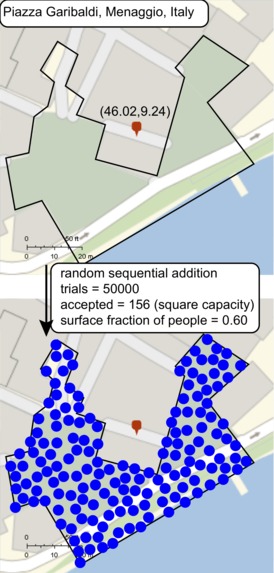
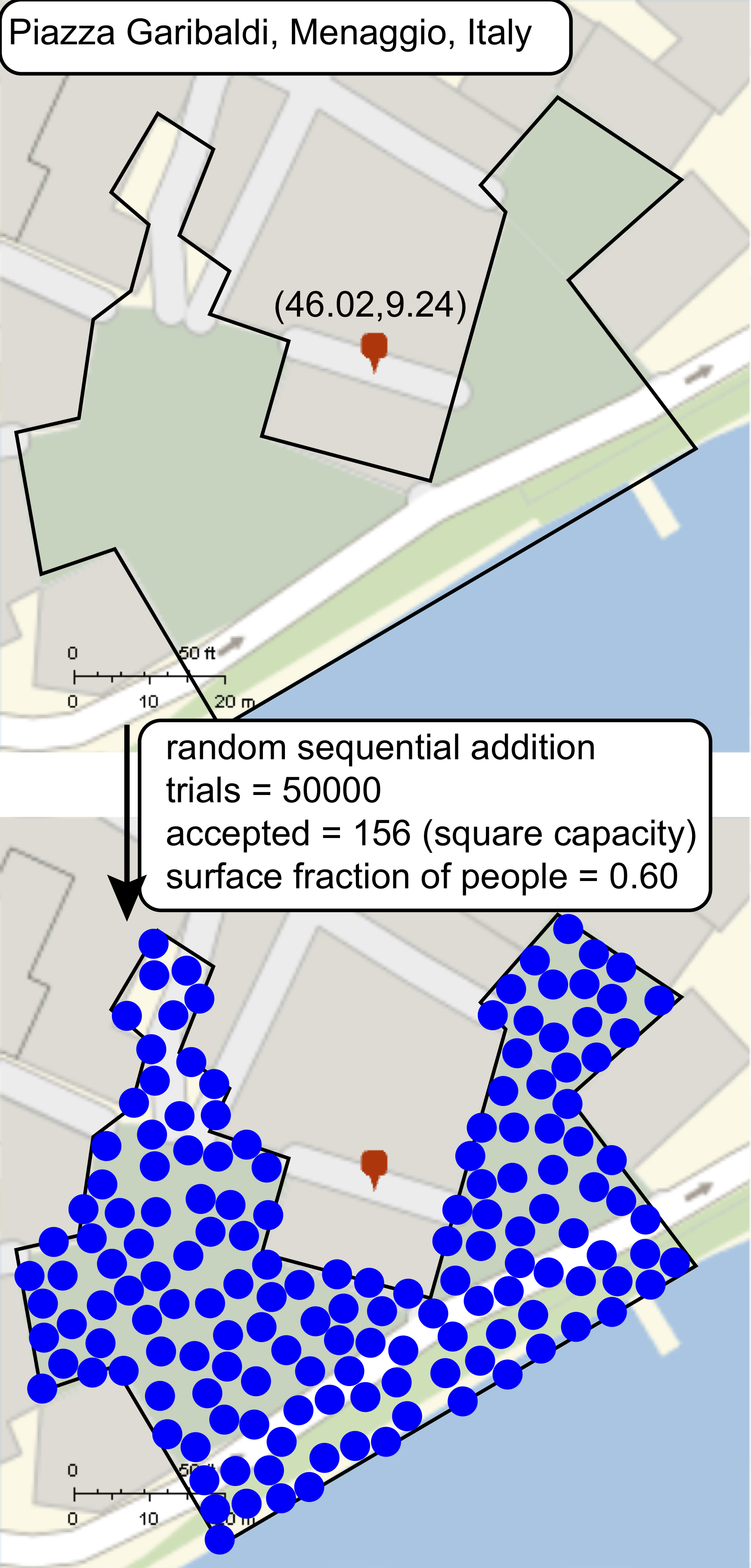
The app works for strangely shaped squares as well, such as this plaza in Italy.
-
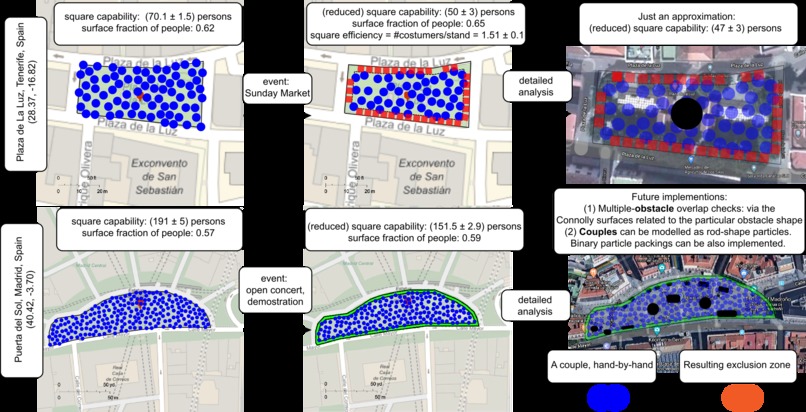
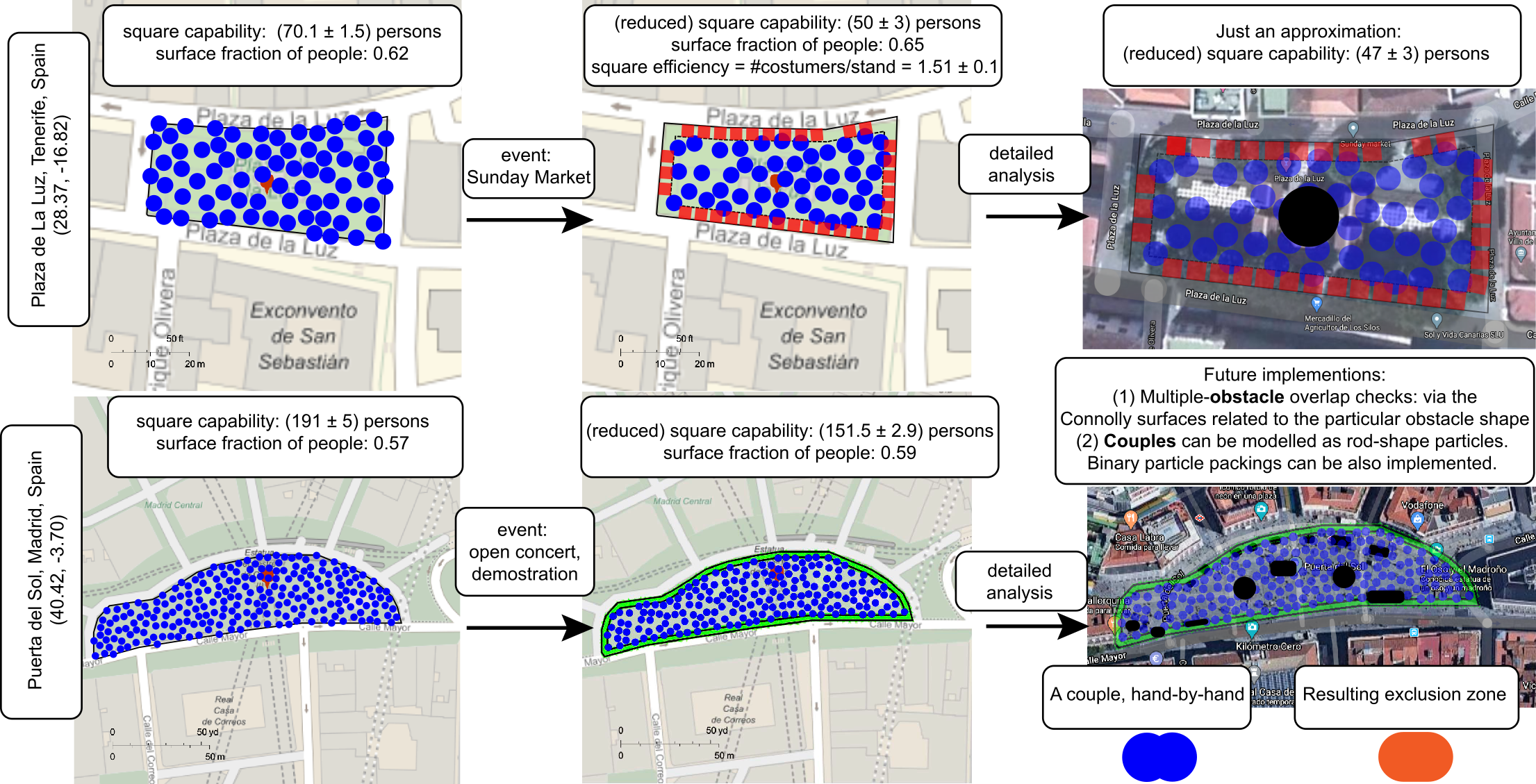
We account for the presence of barriers placed at the perimeter of the space, as well as obstacles in the space itself.
-
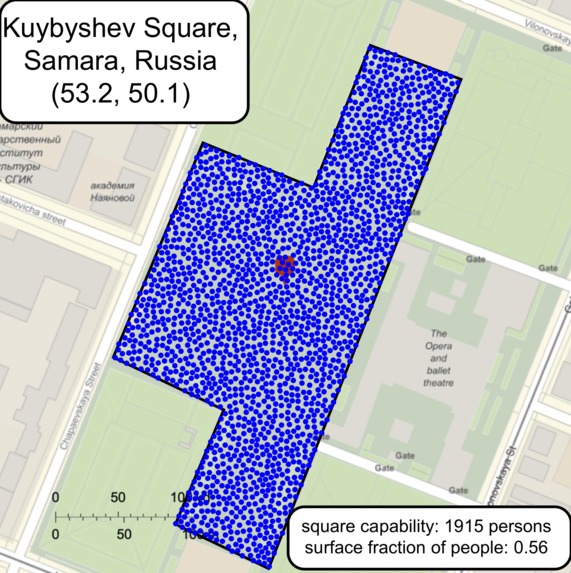
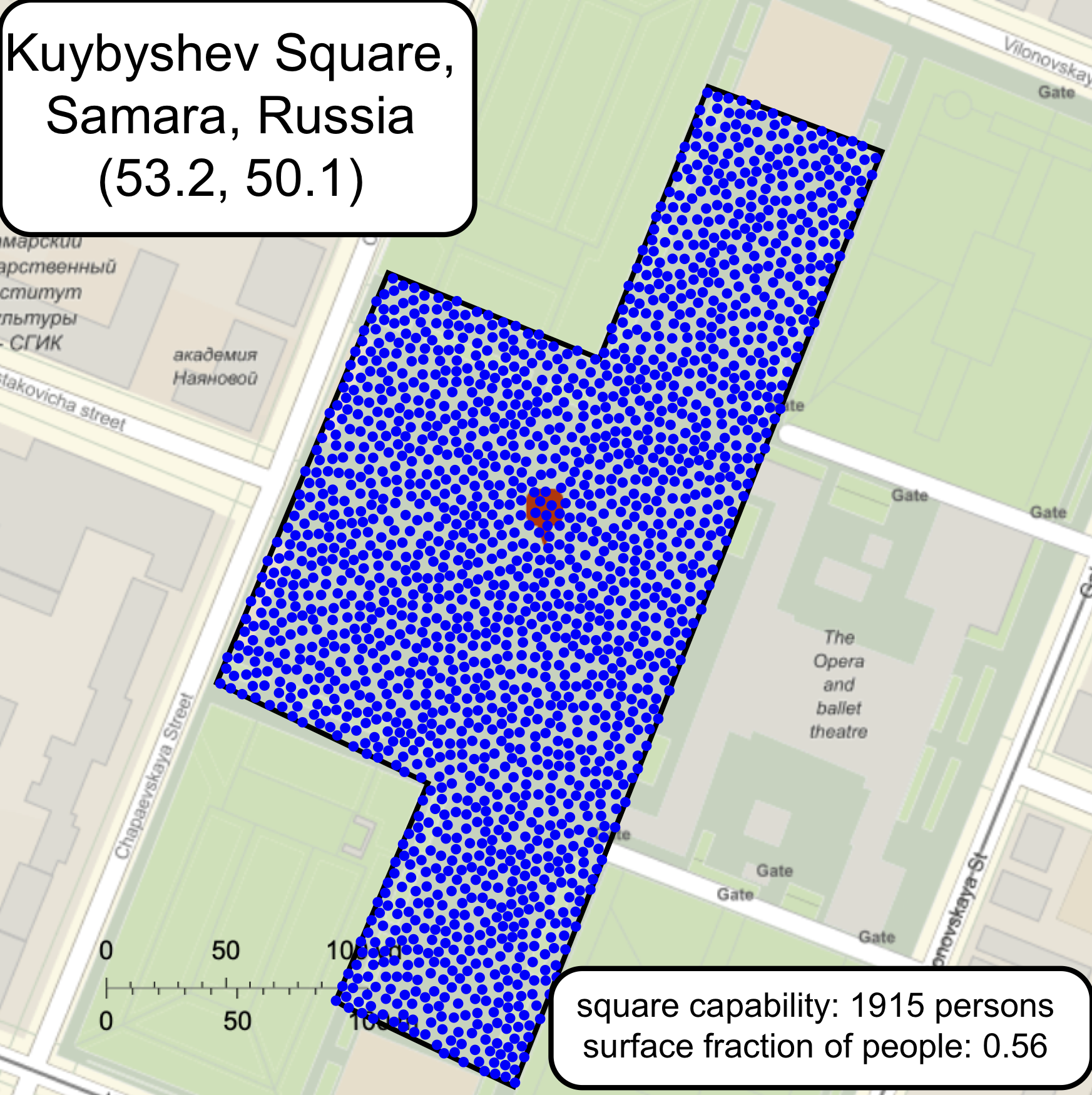
The largest square in Europe! This takes approx 20 seconds to be generated, but it's a lot of people! All 2m apart at minimum.
What inspired us
In the "new" normality we are going to live in for the foreseeable future, we are in dire need of getting back our public spaces from COVID. We want to repopulate our plazas, start organising again events and gatherings, and attend to markets and fairs. In essence, we need to get back to public spaces for the immeasurable social value they represent. But... we need to do it in a safe, regulated manner. We need to respect social distancing.
As physicists, we asked yourself: can we build something that can provide a solid, reliable estimate of a public space capacity, when taking into account social distancing measures? Can we build it fast? And would people be interested in it? And one hour later, we started this project: ConquerYourSpace!
What it does
ConquerYourSpace is a web-app that estimates the number of people that can fit into a public space. It's very simple:
- Look for your space of interest (a square, a park) in the map
- Draw the perimeter of the space
- Add obstacles and/or barriers on the perimeter
- Set the MINIMUM social distance you'd like to be observed
- Press the button and enjoy!
ConquerYourSpace will estimate the number of people that can fit in the space, using a physics concept known as Random Packing. It accounts for the "stochastic" nature of people, so it truly is one of the best way to provide a guideline for crowd control!
How we built it
One of us pitched the idea to a number of local artisans. They have been severely affected by COVID in their business, and they absolutely loved it -- they truly saw it as the way to get back to their foot as fast as possible, and start organising again local markets and events to launch their business again. So, we first prototyped the physics model behind the idea. Then, using Wolfram Mathematica, we started applying it to squares and parks around the world. We have an arXiv preprint based on this: check it out! https://arxiv.org/abs/2005.07038
Then we started thinking about how to make it accessible to everyone. So, we signed in for the hackathon, assembled a ragtag team of developers and students and, with the help of the artisans in the team, who provided feedback and ideas, we built our prototype app. We used Python in the backend, Javascript, Node.js and CSS in the frontend, and we deployed it as a React app on the cloud.
Challenges we ran into
One of the first thinks you'll notice is... The app only works for Europe so far :( The reason is essentially time -- we tested it extensively on European squares and parks but when we tried outside Europe we found out our geo-localization method was not appropriate. However, changing it was, unfortunately, challenging. Something we definitely did not expect. We are very sorry for it!
Another challenge we faced is calculation speed. There is a lot of number crunching behind it. While we could implement the physical model relatively painlessly, making it so that the calculation would be "almost" real time for a user of the app has been very challenging. Luckily, we managed to solve that at the end!
Finally, it was relatively hard to agree on the "best" user interface. While the concept is simple, we could not satisfactorily find a way to present the app to the user with all the functionality, but in the simplest way possible. Shall we allow the user to draw the plaza shape? Shall we use predefined polygons? How should we design the buttons and such? These challenges were absent when we prototyped the physical model, but took us a lot of time when developing the app.
Accomplishments that we're proud of
We are really proud of the feedback we have received so far. While we were kind of expecting praising from artisans and public event organisers, what we loved was people reaching us to implement it for indoor spaces as well, such as offices and university laboratories. This made us realise that this idea could really make an impact across all societal levels for regaining working and social normality during the "new" normality, not only in the public but also in the private.
We also showed the app to professors and academics. What we did not expect is that they all backed us! Yes, implementation is simplistic and yes, a lot could be added. But they all loved how far a simple physical idea could be translated to tackle a societal issue such as this. We are very proud of their feedback.
We are also really proud of what we achieved as a team in, essentially, a weekend. We "clicked" so well and engaged so much, that we achieved what we thought it would require us more than a week. And we loved the experience, so much that we plan to keep working on it as a possible start up!
What we learned
We learnt a lot from all the other team members, all with different backgrounds. We learnt from the model developers that everything can start from a simple idea. We learnt from the backend developers that robustness and speed of the implementation are of utmost importance, no matter how solid the theory behind it is. We learnt from the frontend developers that a beautiful interface makes the difference between an app which is impossible to use and an app you can have fun using. And we learnt from our artisan "stakeholders" that none of this matters if they cannot use it! Overall, we really learnt a lot about project development, from beginning to end. This was a very inspiring and precious lesson for all the people in the team.
What's next for ConquerYourSpace
We plan to add a lot of things in the near future. To start with, we would like to expand this idea to be used in indoor spaces as well; this is our top priority. Then, we plan to add the option of specifying "escape" routes. We would also like to add the option of simulating the presence of couples, alongside individuals. Finally, we would like to start implementing a simple simulation of crowd dynamics to make it more realistic. All in all, these are our initial bullet points, but in essence we are really thinking to "scale" it up. However, the first step in absolute is that... the app should be used by as many people as possible. This will provide us the feedback and the suggestions for implementations and improvements, as well as the momentum to get this project to fly. We hope this is going to happen in the next immediate weeks, and we are really looking forward to it!

Log in or sign up for Devpost to join the conversation.