-
SOM
Inspiration
Sooner or later, hardware is going to stop functioning. Failures are unexpected, costly, and affect everyone negatively. One way to minimize the repercussions of a hardware failure is to predict under what circumstances it is going to fail. An issue that arises in predicting failure is the fact that it might be very difficult to find a correlation between the values for which it might fail, especially in this challenge, which has readings from 107 sensors, several of which have 10 readings as a histogram. Seeing patterns with such a huge dataset is not humanely possible.
What it does
This is where Artificial Neural Networks (ANNs) step in. With sophisticated algorithms developed by mathematicians and scientists over several years, we can use ANNs to find patterns among large amount of data and predict things that aren’t possible to otherwise. Our team developed an ANN model to predict if, given the sensor values, the fault is going to be down-hole or surface.
How I built it
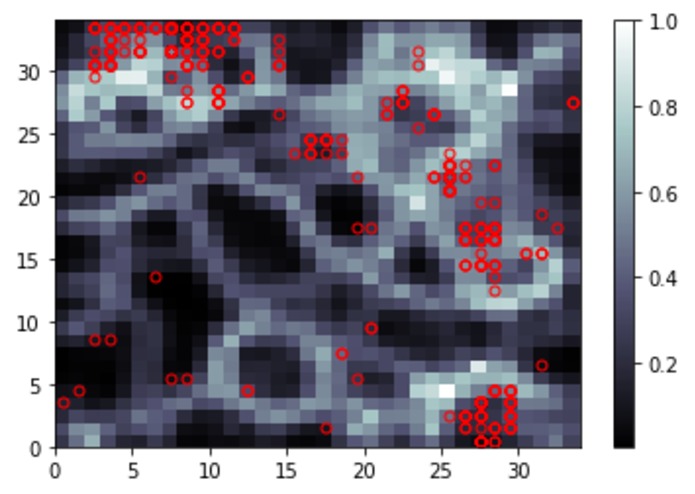
There are several models of neural network that are available free of use for public domain. We decided to use Keras with TensorFlow for backend because that was what our team had experience with, and it is popular for a reason—it is straightforward to implement in Python. We tuned some hyperparameters—we tuned the learning rate to a reasonably low value because the prediction rate was very high. We left the other hyperparameters to their usual values and saved the trained model. We also used SOM (miniSOM) to group the parameters together.
Challenges I ran into
Running the application since none of us had front end experience
Accomplishments that I'm proud of
- Tuning hyperparameters to get a very high accuracy
- Building an SOM that accurately groups together data
What I learned
-> Don't leave front end till the end -> Distribute work more evenly -> Get to know your teammates
What's next for ConocoPhilips Challenge
Better application
Built With
- keras
- minisom
- python
- scikit-learn

Log in or sign up for Devpost to join the conversation.