🚀 SyncOS — Project Story
🌟 Inspiration
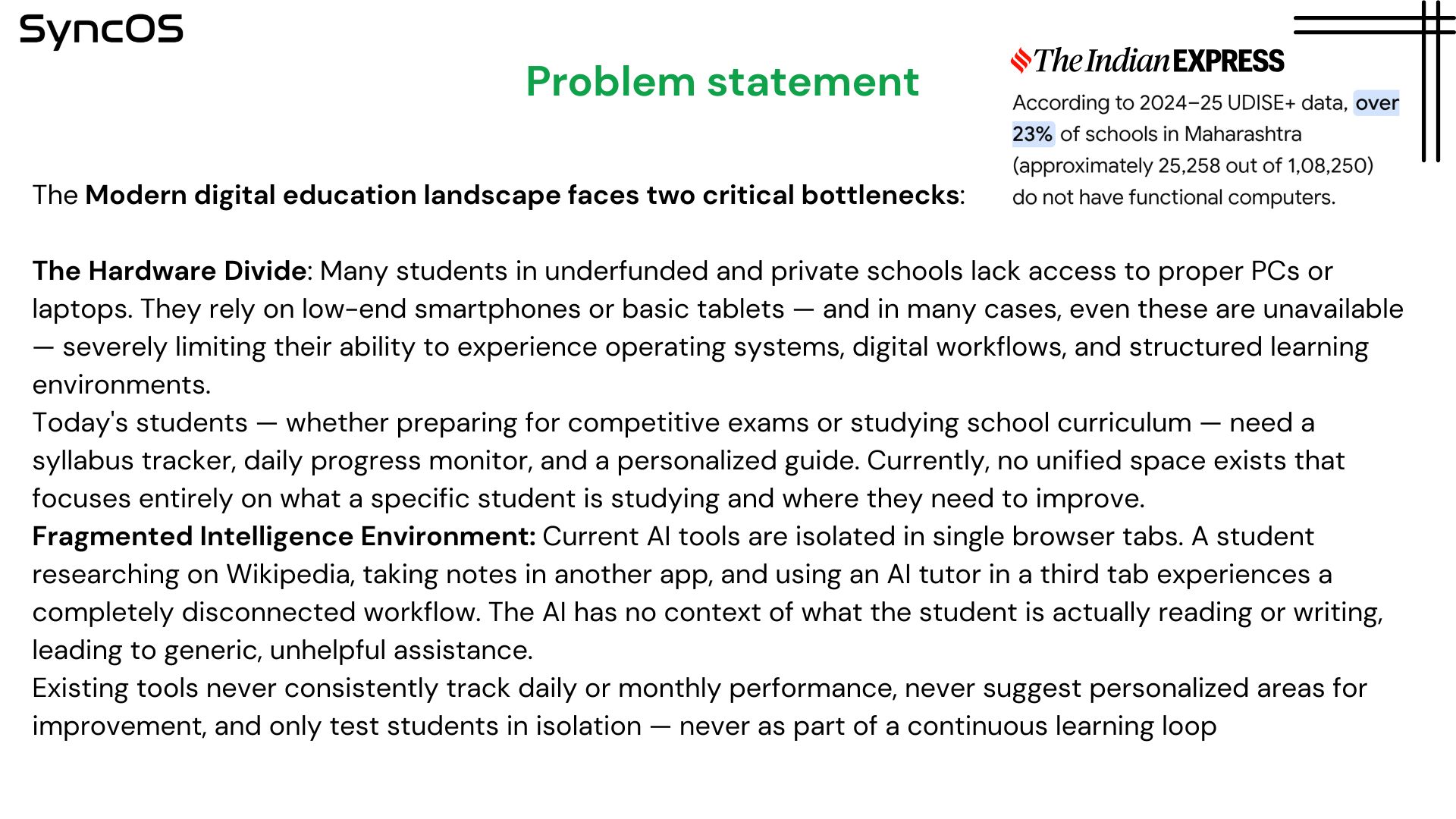
SyncOS was inspired by a real and visible gap in modern education —
many students lack access to proper computers, yet digital learning tools are becoming essential.
In many schools and homes:
- Students rely only on low-end smartphones
- Computer labs often remain unused or outdated
- Learning tools are scattered across multiple disconnected apps
This fragmentation forces students to constantly switch between tools for:
- reading
- writing notes
- solving doubts
- practicing questions
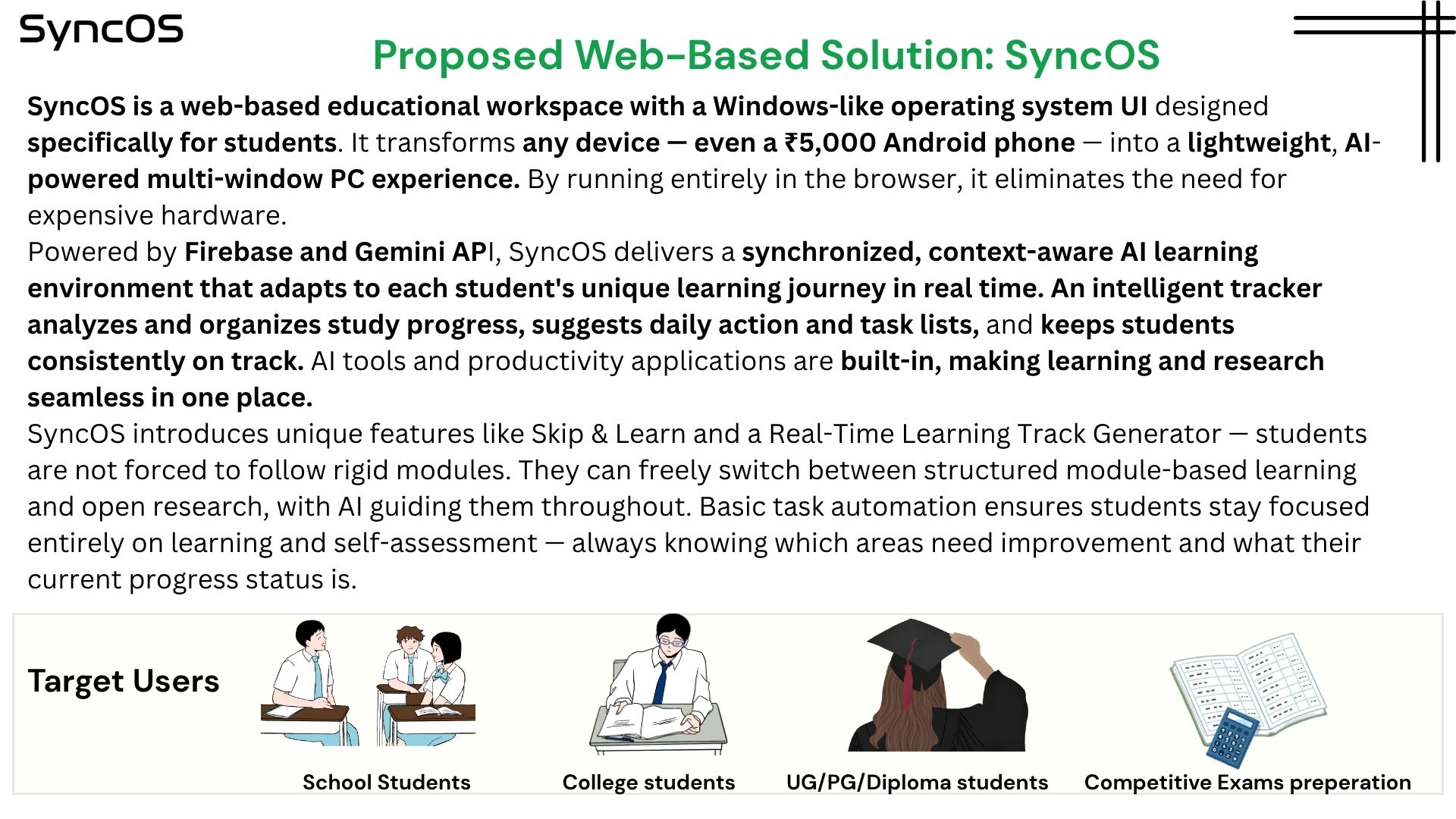
We wanted to design a single unified learning workspace that behaves like a computer but runs entirely inside a browser.
✨ Our core vision:
Make powerful digital learning accessible on any device — even basic smartphones.
🧠 What it does
SyncOS is a conceptual web-based learning workspace designed to simulate a desktop-like learning environment inside a browser.
The proposed system enables students to:
✔️ Access a desktop-style workspace from any device
✔️ Open multiple learning tools simultaneously
✔️ Use an AI assistant for summaries and explanations
✔️ Generate quizzes and learning modules
✔️ Track learning progress and weak areas
✔️ Continue learning from different devices
🔄 Conceptual Learning Workflow
The system is designed to create a continuous learning loop, not isolated study sessions. Learn >> Track >> Analyze >> Improve >> Test >> Adapt
📌 Current Stage
At present, SyncOS exists as a structured concept and system design, including:
- 🧩 System architecture diagrams
- 🖥️ Desktop-style UI layouts
- 🔄 Workflow interaction planning
- 📚 Learning module logic concepts
This stage focuses on validating feasibility before implementation.
🛠️ How we built it
At this phase, our work focused on design thinking, architecture planning, and interface prototyping.
We developed:
🎨 UI Design Concepts
- Desktop-style learning workspace layouts
- Multi-window interaction models
- Structured navigation workflows
🧱 System Architecture Design
- Data flow diagrams
- Component interaction mapping
- Logical module connections
🔍 Workflow Planning
- Learning module structures
- Interaction between tools
- AI-assisted workflow concepts
Our goal during this phase was to:
Validate the practicality of a unified learning workspace before building full functionality.
⚡ Challenges we ran into
1️⃣ Designing a Realistic System Architecture
Planning how multiple components interact was complex.
We had to carefully design:
- Data flow structure
- Module relationships
- Communication pathways
Ensuring scalability while keeping the system understandable was a key challenge.
2️⃣ Balancing Features with Simplicity
Initially, many features were proposed.
However, we realized that too many features can reduce usability.
We refined the system to prioritize:
- Core learning tools
- Essential intelligent features
- Scalable architecture
3️⃣ Understanding Real Student Needs
We explored real-world problems such as:
- Device limitations
- Learning workflow inefficiencies
- Lack of structured progress tracking
This helped us transform a broad idea into a focused and practical concept.
🏆 Accomplishments that we're proud of
✨ Designed a clear and scalable architecture
✨ Created a unified learning workspace concept
✨ Developed structured feature workflows
✨ Identified real-world educational challenges
✨ Built a strong conceptual foundation
Most importantly:
We transformed a simple idea into a structured system blueprint ready for development.
📚 What we learned
Working on SyncOS strengthened our understanding of system-level design and planning.
🧩 System Thinking
We learned how to:
- Break complex systems into smaller modules
- Define structured workflows
- Design scalable solutions
🎯 Problem-Oriented Design
Instead of adding random features, we focused on solving meaningful problems:
- Accessibility limitations
- Fragmented learning tools
- Lack of structured study tracking
🔁 Iterative Improvement
We learned that strong designs evolve through:
- Revisions
- Simplification
- Continuous refinement
🔮 What's next for SyncOS
SyncOS is currently in the design and planning stage, and the next phase focuses on moving toward implementation.
🚧 Short-Term Goals
- Develop initial working interface prototypes
- Implement core workspace interactions
- Test multi-window learning behavior
- Begin basic AI-assisted learning tools
📈 Medium-Term Goals
- Expand learning module generation
- Introduce progress tracking visualization
- Design cross-device workflow logic
- Improve system efficiency
🌍 Long-Term Vision
Our long-term vision is to build:
✔️ A fully functional browser-based learning workspace
✔️ Accessible on any device
✔️ Scalable for schools and institutions
✔️ Capable of supporting personalized learning environments
🎯 Final Vision Statement
SyncOS aims to become a universal digital learning workspace that reduces dependency on expensive hardware and improves accessibility for students everywhere.
Built With
- cloud
- css3
- firebase
- firestore
- google-cloud
- html5
- react
- react-native
- web3


Log in or sign up for Devpost to join the conversation.