-
Game
Inspiration
The classic Connect4 game has been a favorite for generations, challenging players to think strategically and anticipate their opponent's moves. The idea of creating an AI agent that could learn and master this game through reinforcement learning was a fascinating challenge. This project aims to explore how machine learning can be applied to traditional board games, pushing the boundaries of AI capabilities in strategic decision-making.
What it does
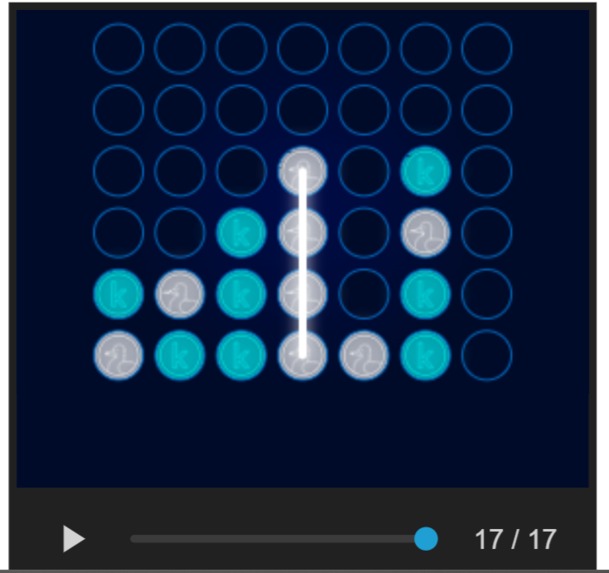
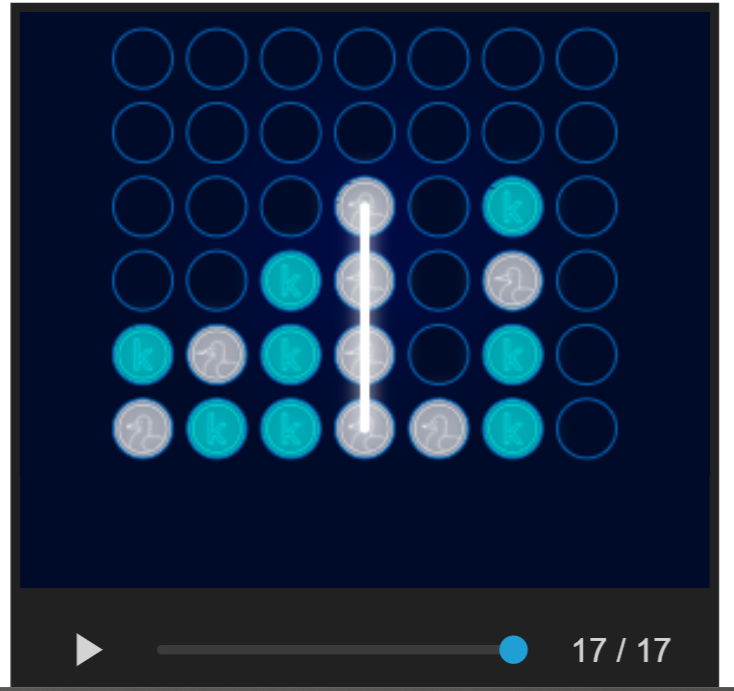
This project implements a Connect4 game where two players take turns dropping their coins into a 7x6 grid. The first player to align four of their coins in a row, whether horizontally, vertically, or diagonally, wins the game. The AI agent, trained using reinforcement learning, plays against an opponent and learns to improve its gameplay over time by maximizing its cumulative reward based on a set of predefined rules.
How we built it
The game was built using the following steps:
Environment Setup: - The ConnectFourGym class was created to define the game environment compatible with OpenAI Gym. - The environment handles the game board's initialization, the agent's actions, and the reward system. Reward System: The agent receives rewards based on its actions:
- +1: If the agent wins the game.
- -10: If the agent makes an invalid move.
- -1: If the agent fails to prevent the opponent from winning in the next move.
- 1/42: For a neutral move that doesn't result in immediate winning or losing. Neural Network Architecture: A convolutional neural network (CNN) was designed to process the game board and predict the probabilities of selecting each column. The PPO (Proximal Policy Optimization) algorithm was used for training the agent, optimizing the neural network's weights to maximize the agent's cumulative reward. Training: The agent was trained using Stable-Baselines3, a popular reinforcement learning library. During training, the agent played numerous games, adjusting its strategy based on the rewards received after each move.
What we learned
Throughout this project, we gained valuable insights into reinforcement learning and its application in game development. Some of the key takeaways include:
- Reward Engineering: Designing an effective reward system is crucial for guiding the learning process of the AI agent. Small changes in rewards can significantly impact the agent's behavior.
- Neural Network Design: Understanding how to structure a neural network to handle specific types of input, such as a game board, was essential for achieving good performance.
- Reinforcement Learning Algorithms: Exploring the PPO algorithm and understanding how actor-critic networks function provided deeper insights into advanced reinforcement learning techniques.
What's next for Connect4 Game
Future iterations could involve training the agent with more advanced reinforcement learning algorithms or fine-tuning the existing model for better performance. Introduce more sophisticated opponent strategies, making the game more challenging and providing the agent with diverse learning experiences.

Log in or sign up for Devpost to join the conversation.