-
-
A few words about CONNECT YOUR CITY App
-
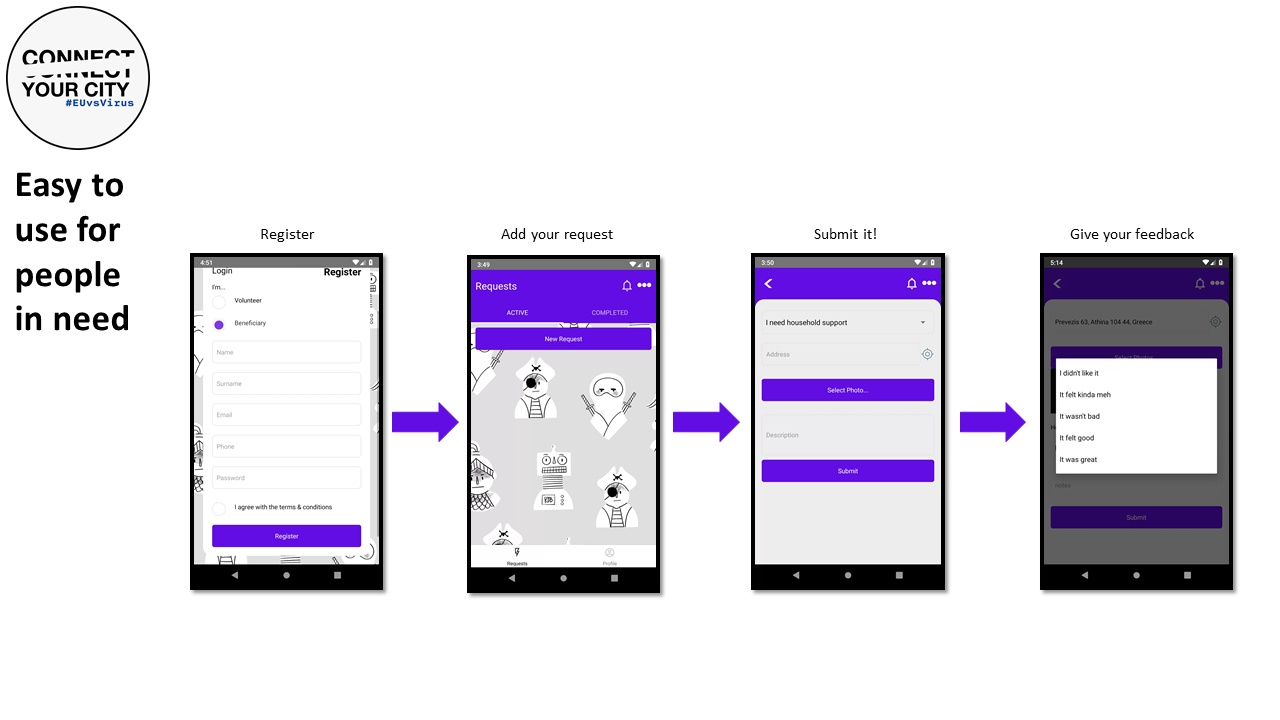
Easy to use for people in need
-
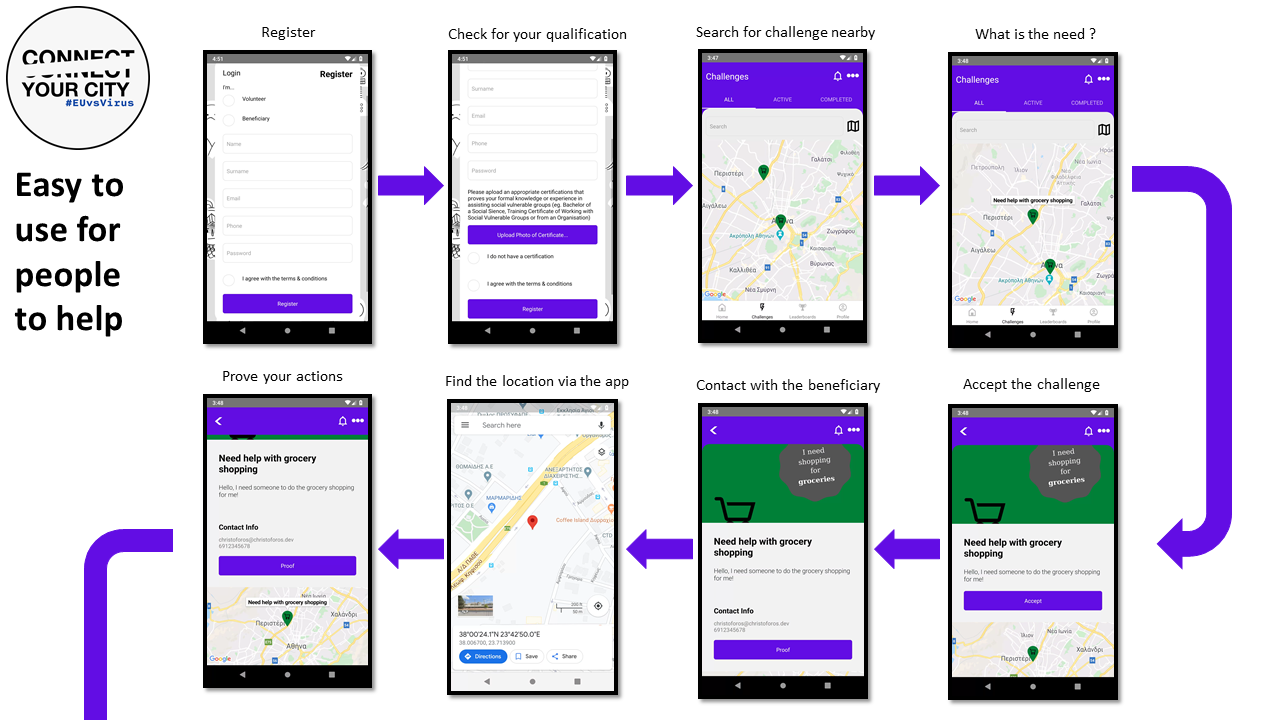
Easy to use for people to help
-
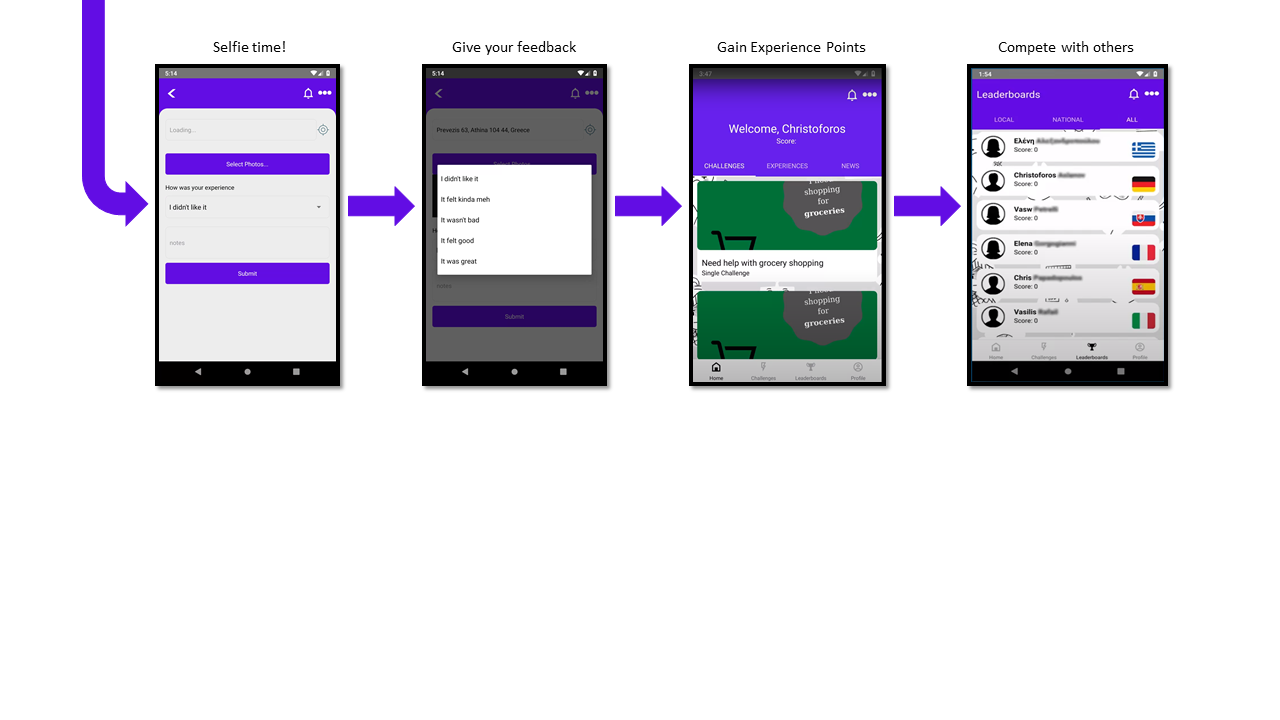
Easy to use for people to help2
Inspiration
During the COVID-19 period, CONNECT YOUR CITY youth Center, actively provides social support in Greece to vulnerable social groups and people in need. While working with these groups, we came to the realization that the existing social support services in Greece are not adequate to instantly cover the basic needs that these people request and the minimal coverage they offer is quite meager. Within the social reality caused by COVID-19, we developed an application through which the procedure of helping vulnerable people at home becomes faster and more convenient through the utilization of the civil society as a tool of social support during crises.
This application has already started to develop but initially, its aim was to motivate volunteers to be more active and helpful for the community, training them in soft skills such as communication and teamwork and promoting active citizenship. Hackathon gave us the chance to modify the application and link it with the problem we addressed earlier so that registered volunteers provide direct support to those that are facing difficulties during the quarantine period. What we did is that we kept the youth characteristic of the application through a gamification process (XP points, awards), and at the same time, we created a tool that bridges volunteers with vulnerable social groups. Now the challenges are addressed to social groups hindered by the quarantine.
For the above reasons, we got inspired to modify the application and its content to create a tool for providing technical and psychosocial support to vulnerable social groups.
The importance of developing such an application is highly visible. There are over 45.000.000 elder people living alone during the COVID-19 and about 25-50% of Europe's population belongs in a vulnerable social group and therefore is at risk while being outside. CONNECT YOUR CITY aims in the activation of the voluntary resources in every neighborhood of Europe to help local people in need. The methodology of the application is also expected to have a great impact on young people, due to the element of gamification (complete a challenge and earn rewards), leading to a more appealing and fun aspect of volunteering for older and younger adults alike.
Sources: https://ec.europa.eu/eurostat/cache/infographs/elderly/index.html https://ec.europa.eu/eurostat/statistics-explained/pdfscache/29306.pdf
What it does
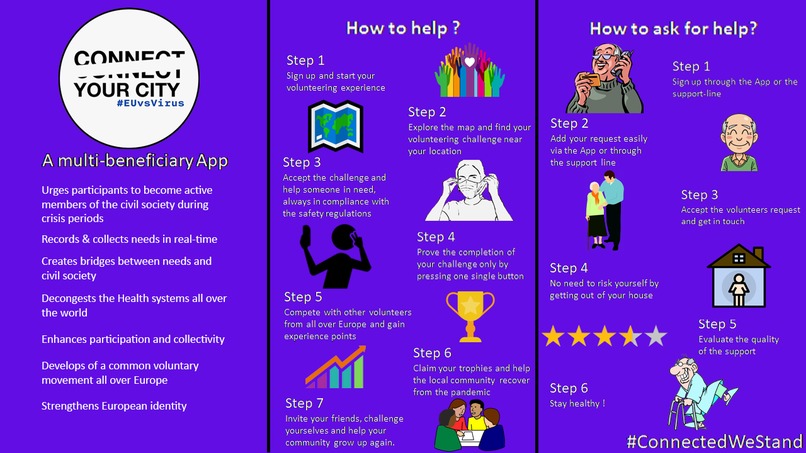
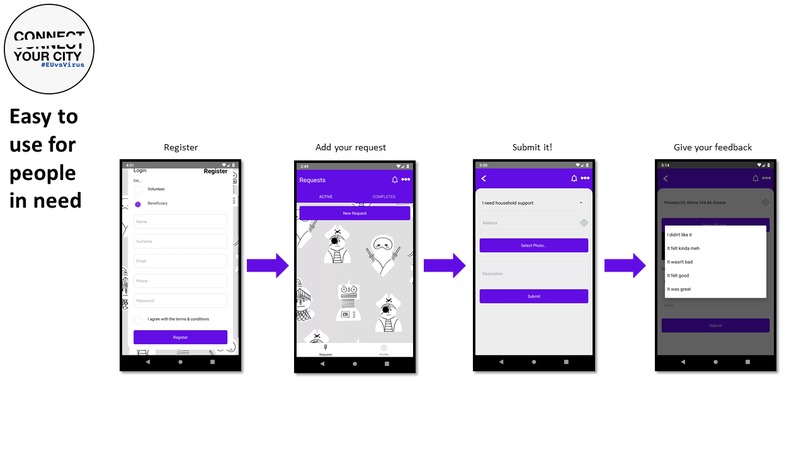
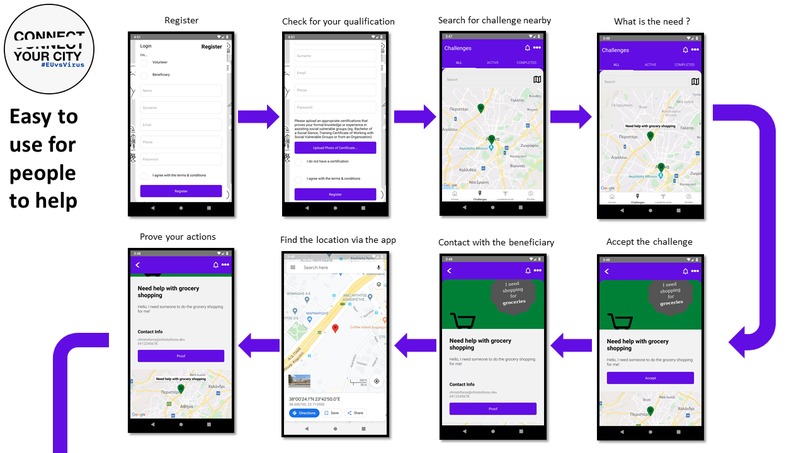
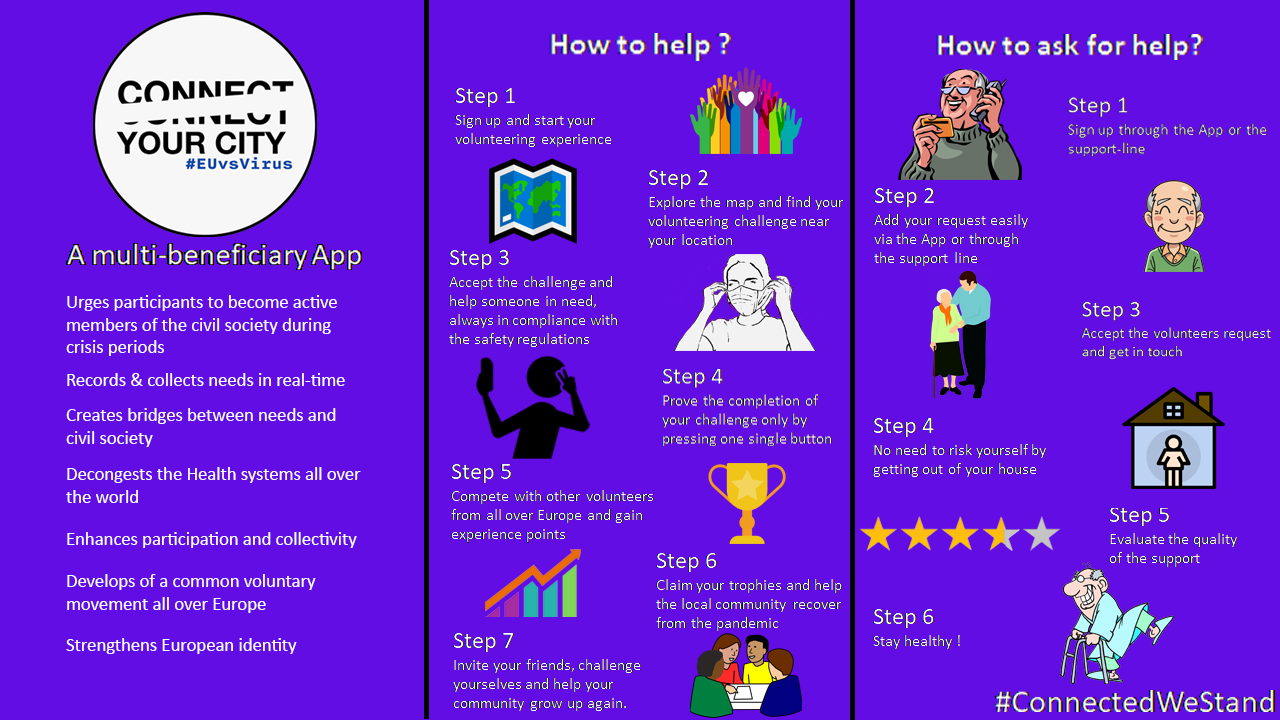
CONNECT YOUR CITY is an application that links the needs of vulnerable social groups with the active citizens who are willing to offer their skills and services through the pandemic and young people who also want to help but they don't know how/where, aiming at making the civil society the first line of social assistance during COVID-19 times and forward. Both volunteers and beneficiaries can sign up in the application using different forms. Beneficiaries who are not familiar or unable to use a cellphone can also submit their requests by calling the Support-Line οf CONNECT YOUR CITY or be submitted directly by the Social Service of the Municipality on behalf of the beneficiary. When a beneficiary submits an anonymous request through the application, it will show its location on the map and it will pop-up as a notification on the phones of nearby volunteers so that they can accept it.
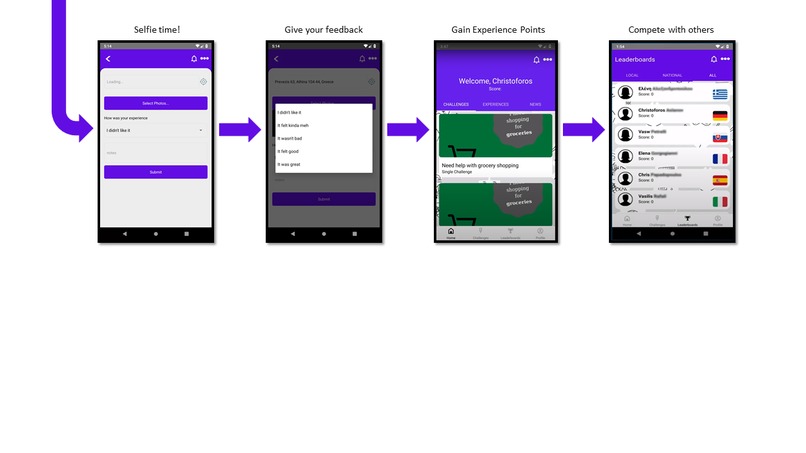
When a volunteer accepts a request, it has a time limit of 24 hours to fulfill it. When the request has been fulfilled, both volunteers and beneficiaries can submit comments for each other.
Volunteers get points when they complete requests and with the gathering of points, they get awards from collaborating businesses of the municipality. Τhe awards can include discounts on products or services for the top players, or they can also give out selected prizes to the top 3-5 players. This creates a circle of benefits for all the involved people and stakeholders. Citizens who want to offer support can do it via the organized process of the application and local businesses also contribute to the resolution of the humanitarian crisis caused by the COVID-19 while at the same time they establish marketing value through the gifts and awards donated to the top volunteers.
How we built it
To build the application, as well as the video accompanying it, developers with different knowledge and experiences joined their forces to make the project a reality. For the purposes of Hackathon, we made 2 versions of the app, one focusing more on its visual representation and the other one showcasing its functionalities. We will highlight and submit the version that points out its functional aspect, where the visual-focused application is made as a proposal for the future design of it. Even though we will submit one of the prototypes, we highly value our extensive teamwork and we invite you to also view the visual-based application prototype here: https://connect-your-city-euvsvirus.bubbleapps.io/version-test?debug_mode=true
Firstly, we used Bubble to make a version of the application that shows how it will look, meaning how the requests will be shown on map, how the login and sign up environment will be, etc. Along with bubble, we used nodejs express, mysql and react-native for the visual version of the app and we experimented with how colors can change to make it more pleasant as an application overall.
The final version of the application that was made to test its functionality, submitting the requests and accepting them, collecting the data from the registered volunteers and beneficiaries, etc.. For this version, we used js, nodejs, express and mysql to build the backend of the application and for the application itself, we utilized js, typescript, react-native and realm.
Finally. for its graphic representation and the video representing it, we used photoshop to cover all of our graphic needs for the presentation of the application. In order to create the Youtube video, we used Davinci Resolve to give a visual example of what is our project about.
Challenges we ran into
Our team had IT, skilled members, with incompatible knowledge on programming and as such, we thought of creating 2 versions of the application, one focusing on its operational aspect and one showcasing its visual aspects to see how it should look when it is finalized.
We are also still having some peril regarding GDPR issues, mainly because of the confirmation of a challenge one must also upload a photo with the beneficiary to prove his task. For the legal issues we have already contacted a legal expert and we will include a paragraph concerning the GDPR compliance in the final version. Because it can be risky to trust volunteers to run such challenges and having contact with people in need, we thought of making necessary in the registry of volunteers to include a form where it is mandatory to submit a license that proves that someone has the required knowledge to interact with vulnerable social groups (ex. a university/college degree, training qualification etc.). We have already predicted the fact that the volunteers need training, but we could not include it in the context of the competition. For those not having the required diploma, we will include a list with all the local organisations that provide such training, which also links the volunteers with organisations.
Another controversial issue we ran into was the usability of the application by the target groups. Socially vulnerable people include elders or people with some sort of an intellectual or physical disadvantage that makes them unfamiliar or even totally unavailable to handle a phone. As such, we will also include the options for the beneficiaries to submit their request either by sending an SMS or calling a support line.
Accomplishments that we're proud of
This was our first experience with Hackathon and we can surely say that, regardless of the outcome of the competition, we are very proud that we managed to pull off so much work in just a few days. This was an extraordinary experience that brought the team together and made us more efficient project managers. Another important accomplishment we achieved is that we have estimated the operational costs regarding the application which is approximately 60.000€ for a country like Greece. This amount covers the salary of the workforce required for the project, which includes 25 people. The group will consist of professionals from various educational backgrounds (social workers, technicians, developers, designers,etc.) which will:
-handle the maintenance of the application
-upload challenges and resolving technical issues and keeping the application updated
-review and monitor the submitted challenges
-contact and communicate with the beneficiaries through the phone line
-keep in touch with the municipalities for referencing beneficiaries in great need
-contact the organizations and provide the appropriate trainings
Τhis idea is proven to be cost-effective. Its basis's about volunteering that it can rapidly evolve into a service that greatly decongestants the Health System of each involved country, being a factor in its future development and prosperity.
What we learned
This Hackathon was a great chance to hone our IT skills. The short period of a given time and the need to combine our different expertise gave us a greater overview of how different programming languages work and also what other tools are available to build an application. Every member of the team took a step forward in software development and gained technical knowledge that will be proven useful in the development of the application after the Hackathon ends. Besides all the important technical knowledge we gained, we learned how to cooperate more effectively with each other. All the work that had to be done online significantly improved our communication skills and the short period of time that we had made us more efficient at working through stress to deal with tasks in time. We realized how important it is to have a variety of people in a team so that each of them can bring his expertise and skills on the table and have a more holistic approach to a project, bearing better results. Most importantly, we had lots of fun during the competition and we enjoyed the process of Hackathon. This first taste we got from this event made us hungry to participate in future Hackathons.
What's next for CONNECT YOUR CITY App.
The submitted application presents how the application will look like when it's finished. When the application is stable enough, we plan to do test runs with municipalities in Greece that we are collaborating with, we will begin then to approach other municipalities in Europe. From our experience with the European Project, we have developed a vast and reliable network of collaborating youth centers that are aware of our idea of the application and they have expressed their will to support our cause. Hopefully, our European partners can help us to connect with their local stakeholders to start running the application in their countries as well.
Meanwhile, we are also planning to search for European funds to make the project sustainable and even embark on a working team for each municipality. After the resolution of the quarantine measure for the whole population, the application will continue to function as a social support tool of the municipalities. Humanitarian aid is still needed after the quarantine for the disadvantaged social groups and for the general public as well.
CONNECT YOUR CITY app will remain as a tool for managing volunteers in difficult situations, including also natural disasters such as fires, floods etc. As mentioned, the application aims at connecting all municipalities from all European countries with a call to action for their volunteers, improving the quality of life of citizens in need, and promoting a European, fun aspect of volunteering.
You can try out the prototype application in the bellow link. Any comments and feedback are always helpful!
Built With
- bubble
- davinci-resolve
- javascript
- mysql
- nodejs-express
- photoshop
- photoshop-js
- react-native
- realm
- typescript








Log in or sign up for Devpost to join the conversation.