Inspiration
We noticed a critical gap in health tracking: apps tell you WHAT you're doing (steps, sleep, exercise) but never explain WHY it matters for YOUR mental health. Generic advice like "walk 10,000 steps" doesn't help when you don't know if it actually makes YOU feel better. We wanted to build something that connects physical activity to mental wellness and reveals personalized patterns based on YOUR data—not population averages. Plus, we knew that motivation is hard when you're going it alone, so we built in social features to keep users accountable.
What it does
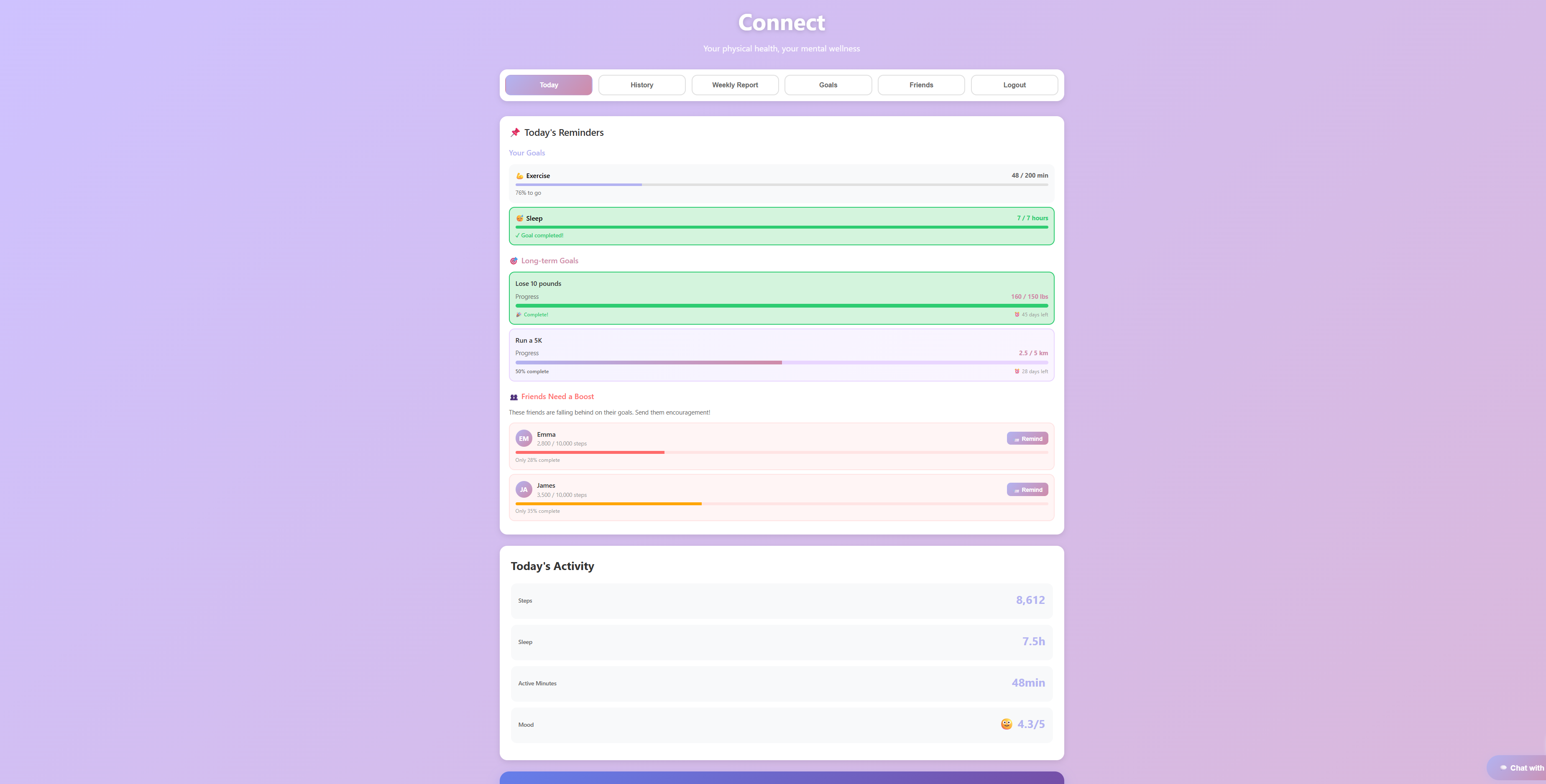
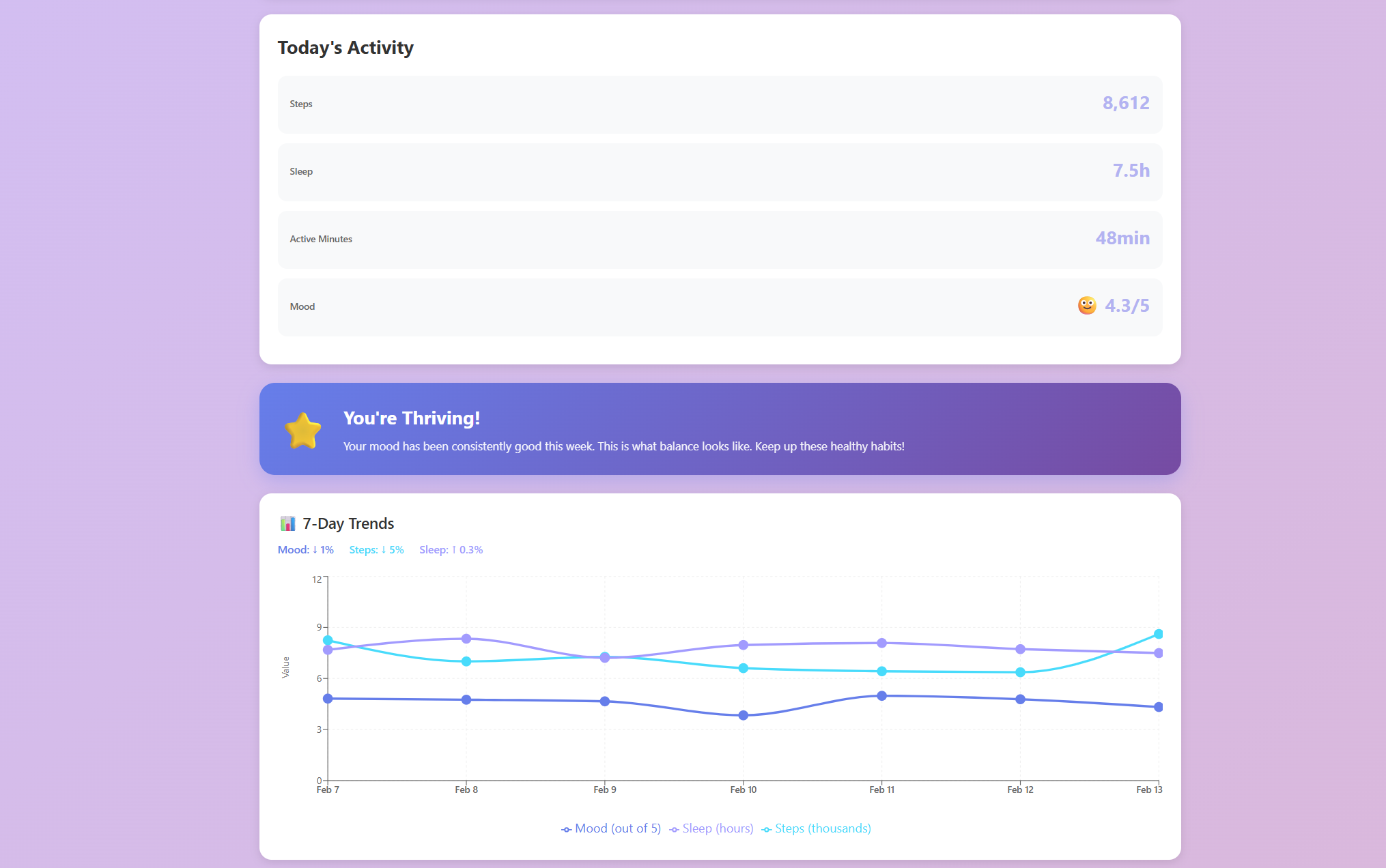
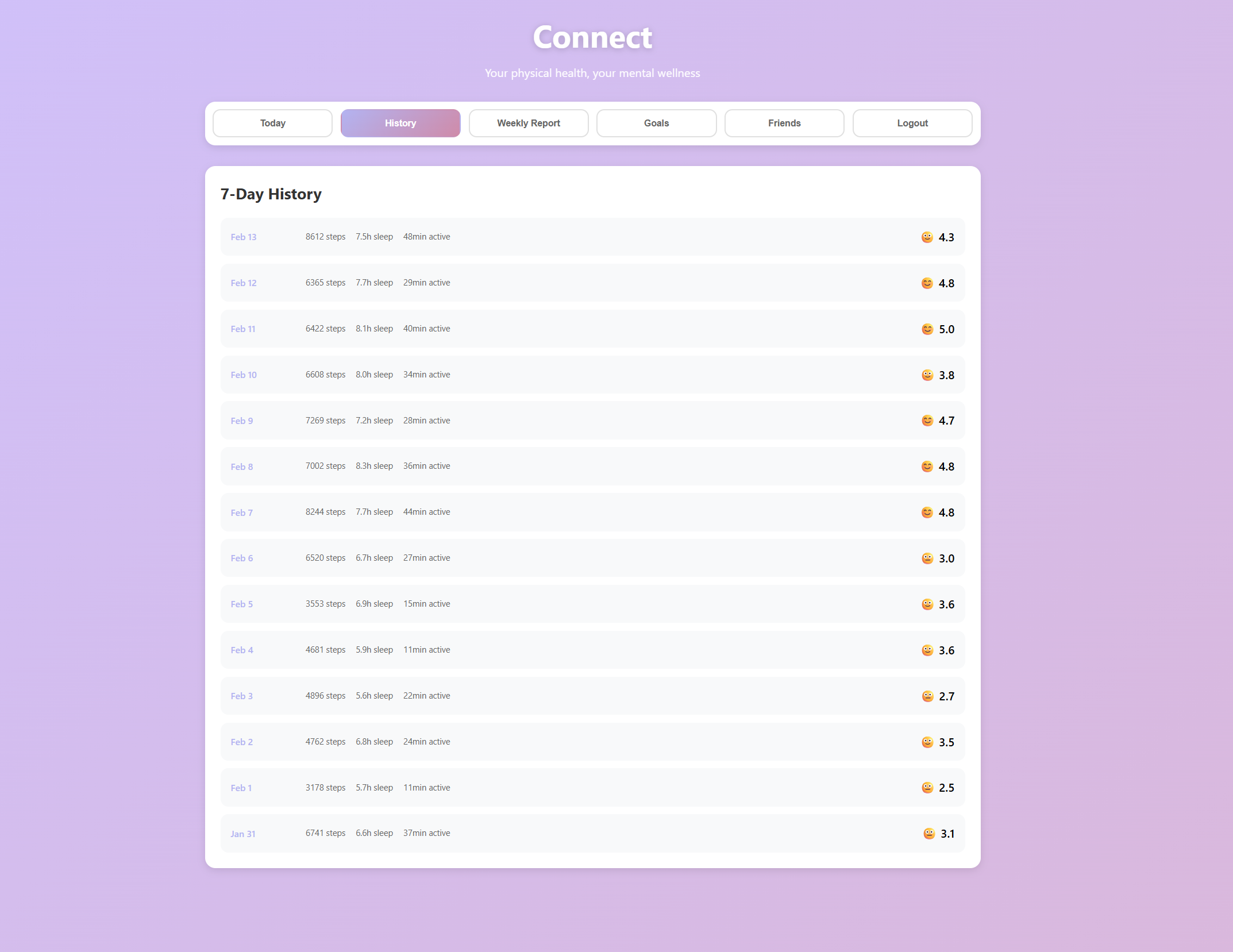
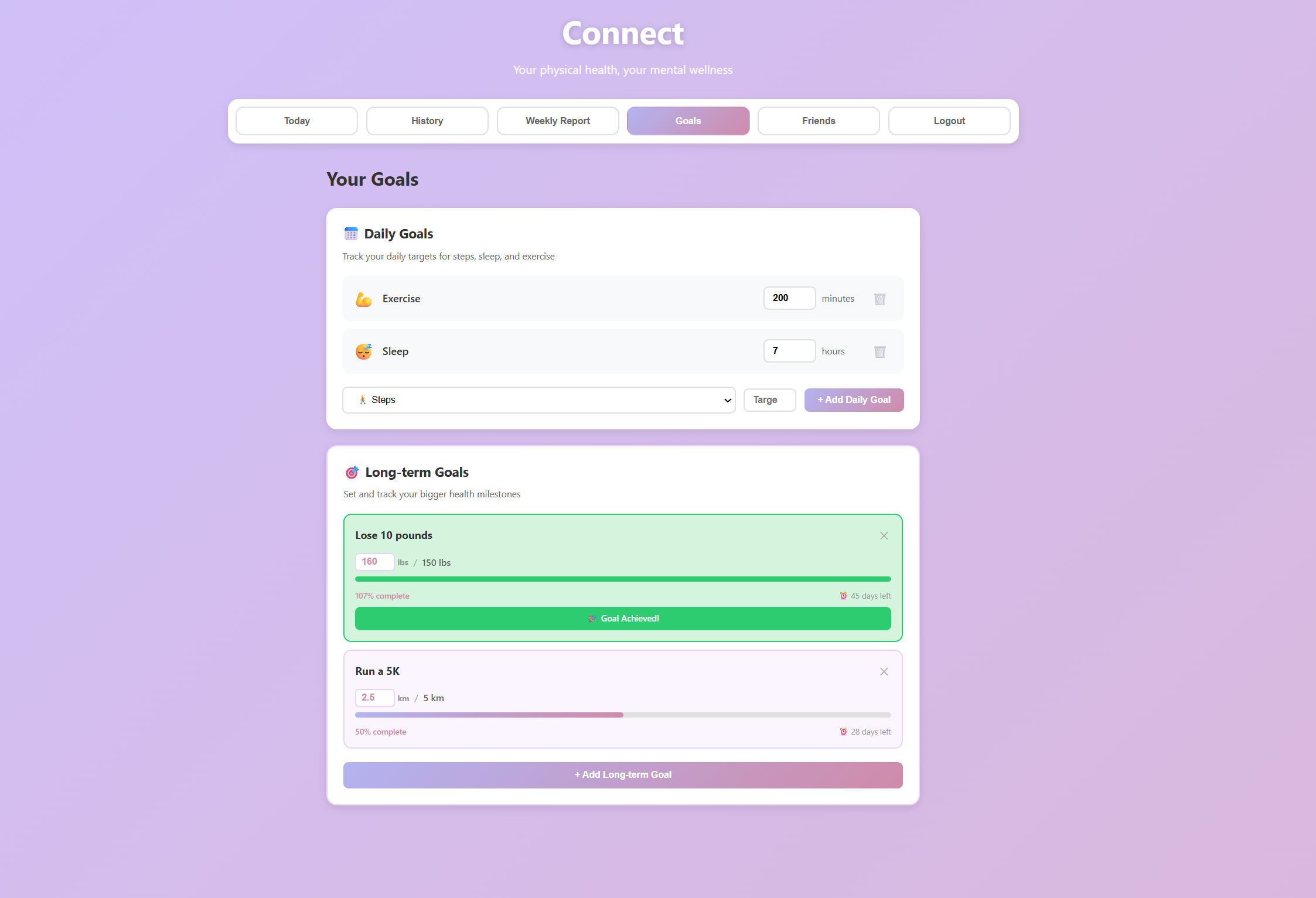
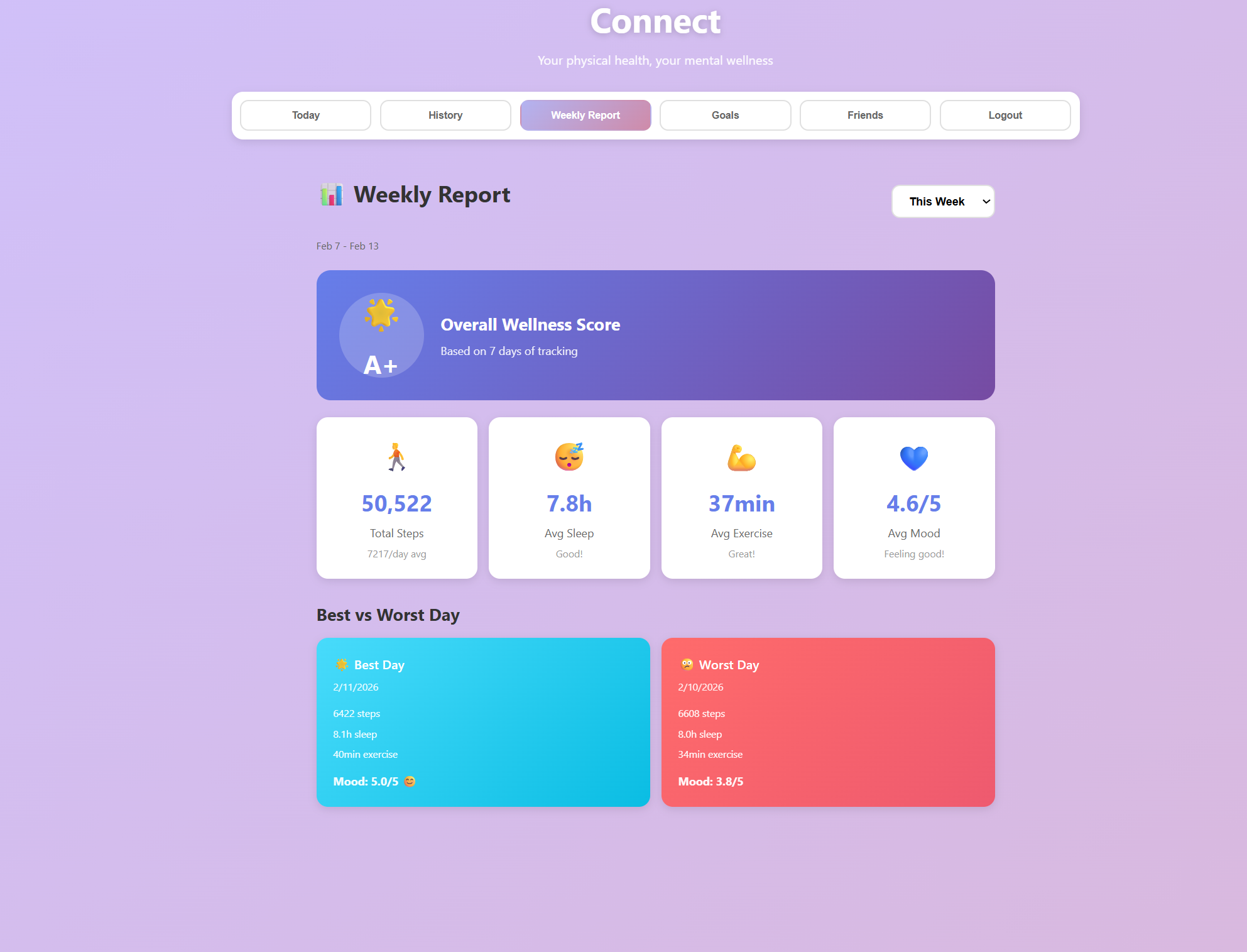
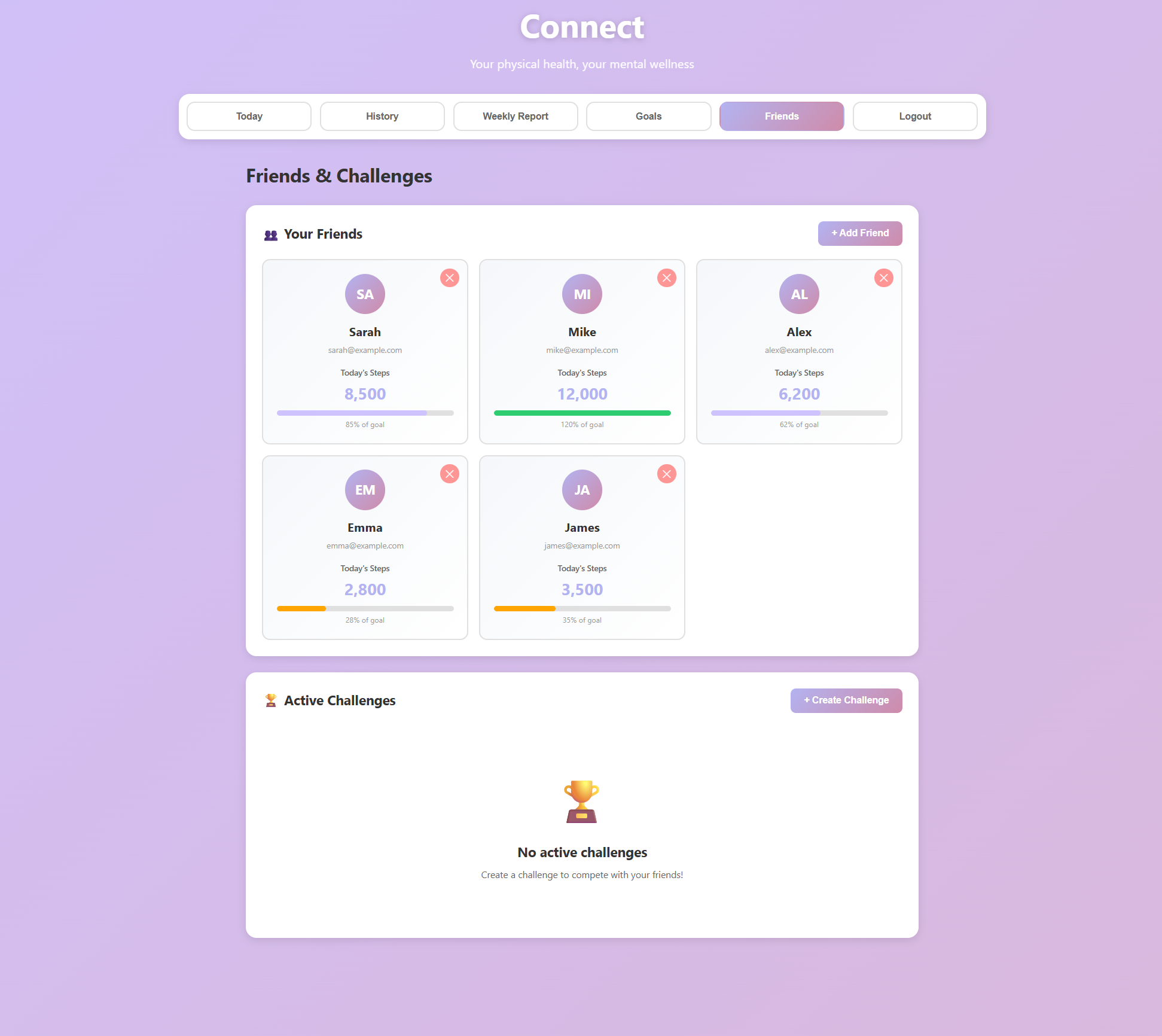
Connect tracks your activity (steps, sleep, exercise) and mood in one place, then analyzes your data to find YOUR unique patterns. It shows exactly how your habits impact your mental health—like discovering you feel 30% better on days with 7+ hours of sleep, or that high-step days consistently boost your mood. The personalized chatbot answers questions like "Why is my mood low?" with specific insights from your history. Visual trend graphs show correlations between activity and mood over time, making patterns immediately obvious. Social features let you compete in challenges with friends, track leaderboards, and send motivational reminders when someone's falling behind. You can set both daily goals for steps, sleep, and exercise, plus long-term milestones like losing weight or running a 5K. The smart dashboard puts everything in one view—your progress, active challenges, and friends who need encouragement.
How we built it
We built Connect entirely in React.js with custom components and a cohesive purple/pink design theme using custom CSS. For data storage, we used the browser's LocalStorage API to keep everything privacy-first with no backend required. We created custom analytics algorithms that segment data by activity thresholds—comparing high-step days to low-step days and calculating mood differences to find meaningful correlations. For visualization, we integrated Recharts to create interactive graphs that make patterns jump out visually. Our development process was iterative: we started with core tracking functionality, added pattern analysis capabilities, then layered in social features. Each component was designed to solve a specific user problem we identified along the way.
Challenges we ran into
The biggest challenge we ran into was the initial plan was to integrate apple's health's data into an app and while apple provided an API key known as Apple Healthkit this API was only available to ios devices and none of us had a mac so we had to scrap this idea. We then looked over to android and they provided a way to retreive user health data without an API key however this was only available on android studio. While this wasn't a big issue the biggest issue encountered was the fact that none of us had android devices so running an emulator through the Android Studio was our only choice and unfortunately the emulator consumed too much of our CPU and we had to ditch that idea as well settling to just input health data through the backend for demo purposes.
Accomplishments that we're proud of
We built a complete health analytics platform from scratch with a clean, intuitive user interface that makes complex data accessible. We created meaningful personalization without requiring expensive ML infrastructure or servers—proving that smart analysis of individual baselines can be just as effective. Our context-aware chatbot provides genuinely useful insights based on individual data patterns, not generic one-size-fits-all advice. The social features we implemented feel natural and motivating through friendly competition rather than forced gamification. We made complex health data immediately understandable through visual trend graphs that reveal patterns at a glance. Most importantly, we shipped a fully functional app that solves a real problem people face every day—understanding what actually makes them feel better.
What we learned
Data visualization is incredibly powerful—seeing trends graphically makes patterns immediately obvious that would be completely invisible in raw numbers. We learned that personalization doesn't always require machine learning—smart analysis of individual baselines and thresholds can be just as effective for many use cases, and it's faster and more explainable to users. User experience truly makes or breaks health apps—clean design and intuitive navigation make complex features feel simple, and if users can't easily understand their data, they won't act on it no matter how sophisticated the analysis. Finally, iteration beats trying to build everything perfectly from the start—building feature-by-feature and testing as we went led to a more cohesive, thoughtful product.
What's next for Connect
The next step is to get access to more IOS devices or a better CPU so we can take advantage of Apple's and Androids tools so we can link user health data to our app allowing for a fully opperational app that users that use on a daily basis to improve their overall welbeing
Built With
- css3
- html5
- javascript
- localstorage
- npm
- react
- recharts

Log in or sign up for Devpost to join the conversation.