Inspiration
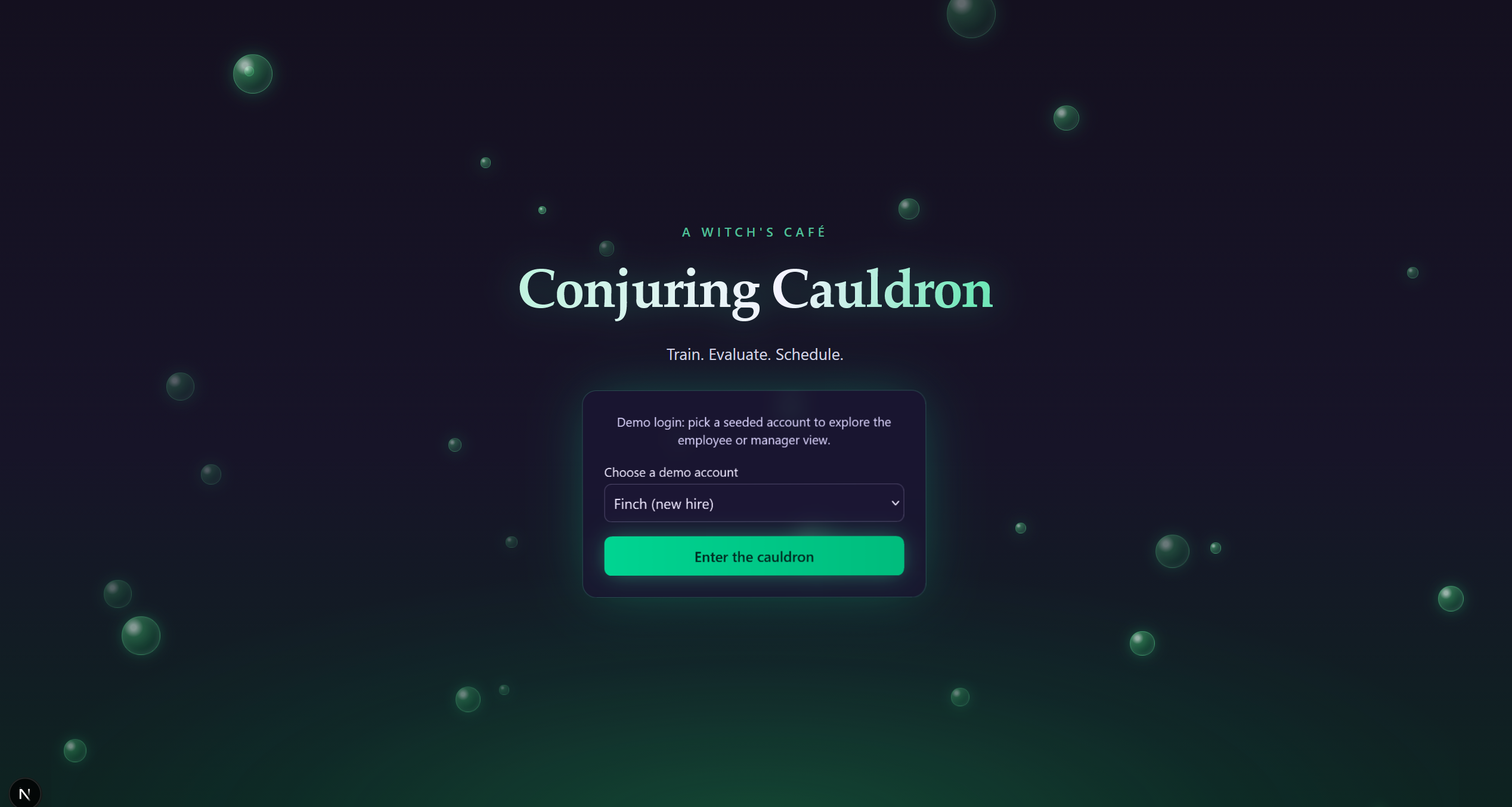
We all agreed that working and getting paid is great. But the onboarding process can be so tedious and sometimes ineffective because of how much information they have you read or watch in one sitting. Our boredom and need for stimulation was the inspiration for Conjuring Cauldron, a gothic fantasy themed app that saves time training, evaluating and scheduling workers. It gives employees ongoing education through interactive tasks, and gives managers less to worry about when it comes to performance in the kitchen or on the floor.
What it does
It makes training interactive, evaluation simple and scheduling less time consuming. Employees can start learning as soon as they start onboarding, and each part connects to the others like an onboarding ecosystem. Our demo restaurant is a witch-themed cafe called Conjuring Cauldron.
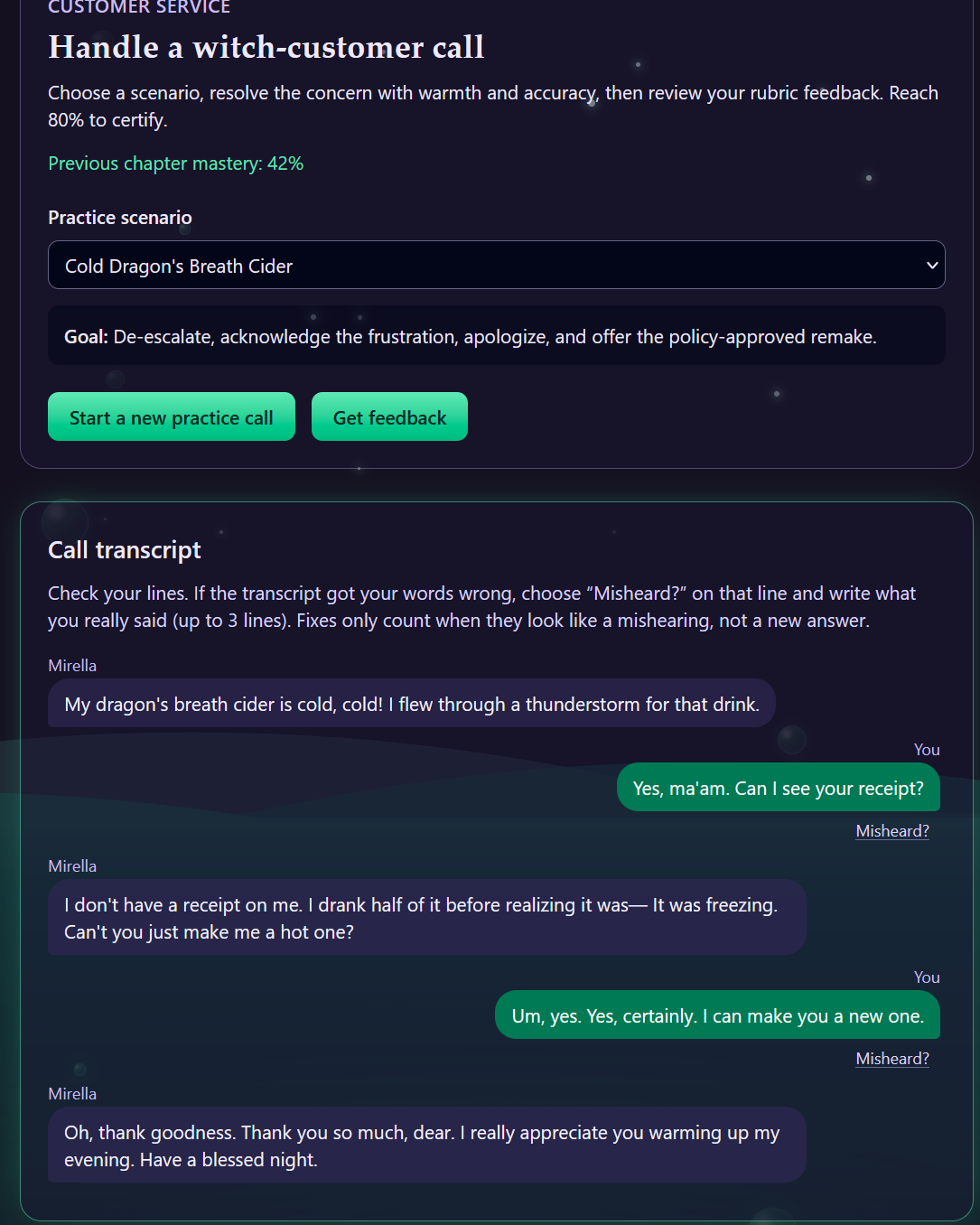
Training. New hires learn three skills: making food, making drinks, and handling customers. For food and drinks they study a recipe, then build it from memory by dragging ingredients into a cauldron or onto a plate against the clock, and an AI trainer judges accuracy and speed. One perfect recipe is not enough: a station certifies only after three different recipes pass at 80%. For customer service they hold a live voice call with an upset AI witch customer, with a live transcript on screen, and their words are graded on warmth, empathy, problem solving and tone. If the speech recognition misheard them, they can flag the line and say what they really said. A fix is accepted only if it looks like a mishearing, not a rewritten answer, and managers can see every fix reported.
Evaluation. Every result feeds a report for each employee: what they are good at, what is holding them back, and what they can start doing right now. It is computed from real results, and an AI trainer then writes a short friendly summary from those facts. Skills fade without practice, but working shifts counts as practice. Employees who work a lot, across several stations, build experience that slows the fade and spares them constant retests, while people who work few shifts need to train more.
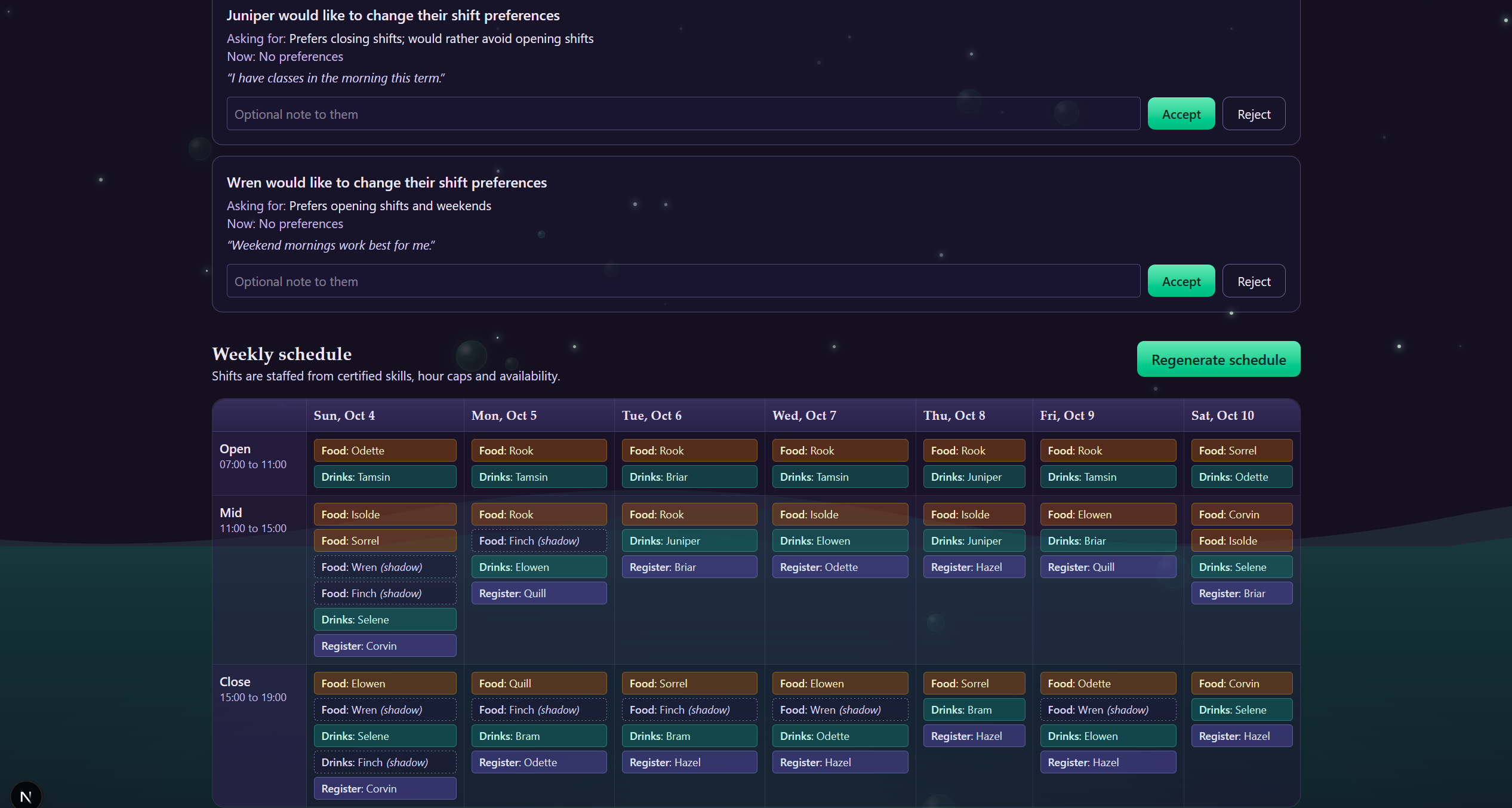
Scheduling. Managers get a weekly schedule built from certified skills, availability and hour limits, with trainees always shadowing a certified teammate. Employees can ask for the shifts and days they prefer, through a form or by chatting with the assistant. Managers accept or reject each request, and the scheduler leans toward approved preferences without ever breaking a hard rule or leaving a slot empty. When someone calls off, the system ranks who can legally cover and why, and the manager approves with one click. A schedule assistant explains any decision and proposes changes, but only the manager can apply them.
How we built it
Conjuring Cauldron is a Next.js and TypeScript app with a SQLite database. Google Gemini powers the recipe judge, the call grading, the evaluation summaries, the employee assistant and the manager's schedule assistant. The recipe builder uses dnd-kit. The customer service call runs live through Vapi with a custom witch voice designed in ElevenLabs, and Vapi sends the finished transcript back to our app through a tunnel.
The most important design choice was keeping the AI inside guardrails. The schedule comes from a deterministic engine that enforces every hard rule (availability, hour limits, certification, shadow pairing), and the AI can only explain it or propose changes that the same rules re-check before anything is saved. Recipe scores are computed from the build log first, and Gemini can only move them slightly. Transcript corrections are checked by a plain similarity rule, not by the AI. If Gemini is slow or down, everything falls back to the computed result.
Two of us built it, each pairing with an AI coding agent, using branches, pull requests and automated checks, including 200 randomized stress tests of the scheduler.
Challenges we ran into
We ran into challenges during our ideation process. Making AI dependable enough for a live demo was the biggest technical challenge. Gemini sometimes hung or returned overload errors, so we added time limits, retries and fallbacks everywhere. Testing with realistic data caught a grader that marked everyone down on "greeting" because customers speak first, a transcript with the customer and trainee swapped, and a loophole where one perfect recipe certified a whole station. Speech recognition could also silently cost people points, which led to the mishearing report, and we had to stop it being used to rewrite a bad answer. The live call depends on a tunnel whose address changes on every restart, so a missing transcript turned out to be a network problem, and we wrote a runbook for it. Finally, building fast with AI coding agents meant slowing down to review, test and merge carefully.
Accomplishments that we're proud of
- The whole loop works: a new hire trains, gets certified and shows up on the schedule, and the schedule reacts when skills change, preferences are approved or someone calls off.
- A real spoken conversation with an AI witch customer, with a live transcript and a fair way to dispute a mishearing.
- A schedule the AI can never break: any suggested change is re-checked by the rules before it is saved.
- Skills that behave like real life: they fade without practice, working counts as practice, and experienced staff do not retrain constantly.
- An evaluation report grounded in real results, and fallbacks so everything keeps working when the AI does not.
- A demo clock that skips ahead three days to show skills fading, retests appearing and the schedule adjusting.
What we learned
Keep the AI in a supporting role. It is excellent at explaining, judging and chatting, but the rules that must never be broken belong in plain code that can be tested. AI graders need real data and careful wording, and any way to dispute a score needs guardrails against gaming it. Speed matters as much as accuracy in a live product. And with AI coding agents, process (branches, reviews, tests) is what keeps fast work trustworthy.
What's next for Conjuring Cauldron
- More call scenarios, with customer service certification requiring several of them, like food and drinks.
- Training built from a restaurant's own recipe book and policies.
- Real sign-in, multiple locations, and text or email notifications for shift offers.
- More scheduling rules (breaks, overtime, minors) and shift swaps between employees.
- Manager analytics linking training to performance, plus fairness and transparency views.
Built With
- cloudflare
- css
- dnd-kit
- drizzle-orm
- elevenlabs
- google-ai
- google-gemini
- html
- next.js
- node.js
- react
- sqlite
- tailwind-css
- typescript
- vapi

Log in or sign up for Devpost to join the conversation.