Inspiration
In VR you can go almost anywhere, as long as someone has already built it. Every world you visit was modelled, textured, lit and scripted by a team, often over months. We wanted the opposite: say any place out loud, such as a lantern-lit city at dusk, a desert oasis or Silverstone under floodlights, and stand inside it a few seconds later.
A place on its own is pretty for a minute and then empty. What makes a place memorable is something to do there: someone to meet, something to find, a reason to walk to the next hill. So Conjure doesn't stop at building the world. It turns every world into a small, cozy story game, written for that world, that you play seated with your hands and your voice. The tone is always gentle: think Studio Ghibli or a bedtime story, with no danger and no villains, just wonder.
What it does
A typical session takes under ten minutes:
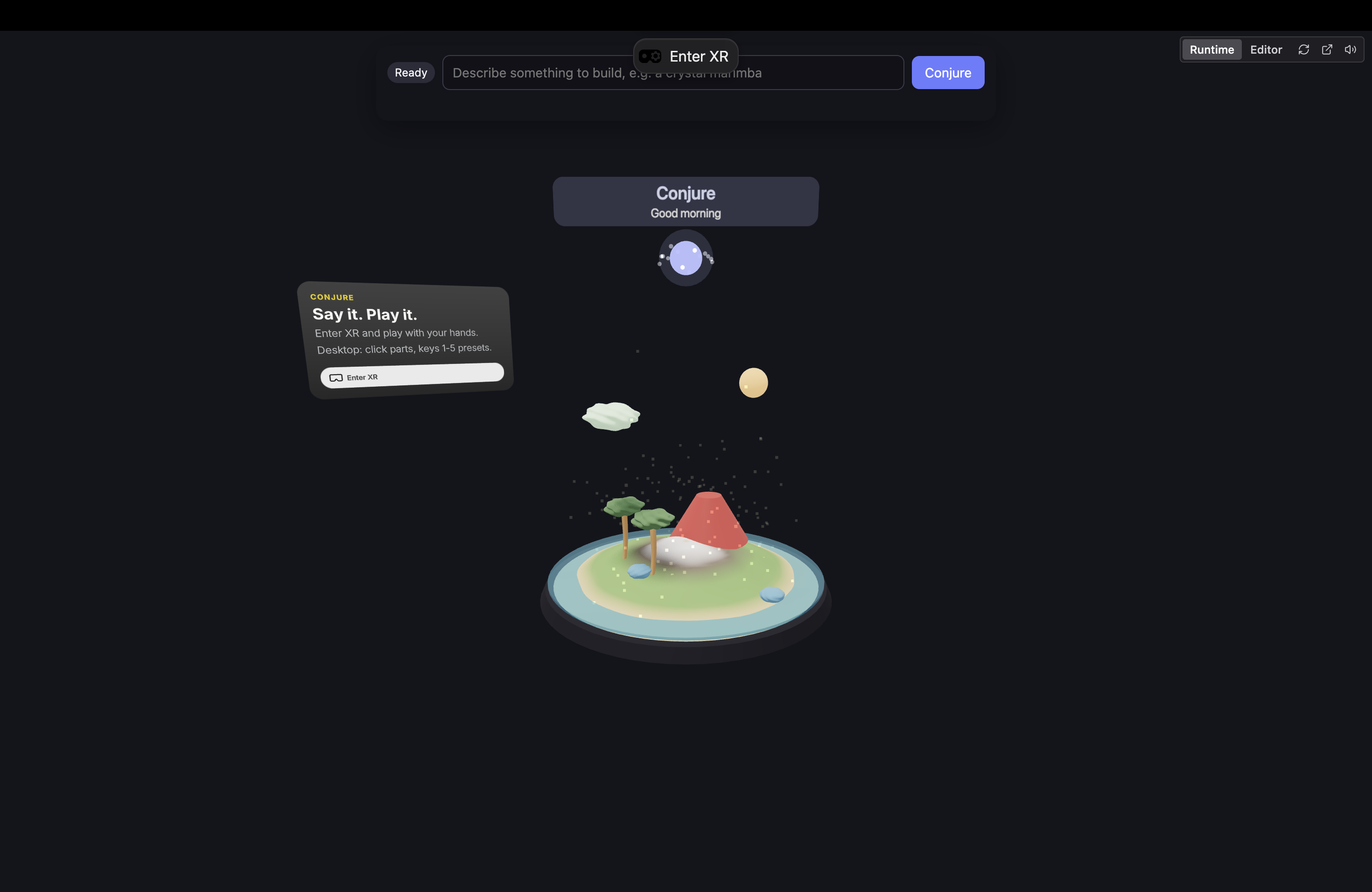
- Say a world. Pinch your left hand with the palm toward your face (or hold Space on desktop) and speak: "A cozy lantern festival in a snowy mountain village at night." You can also type it, or tap one of the idea chips on the start screen.
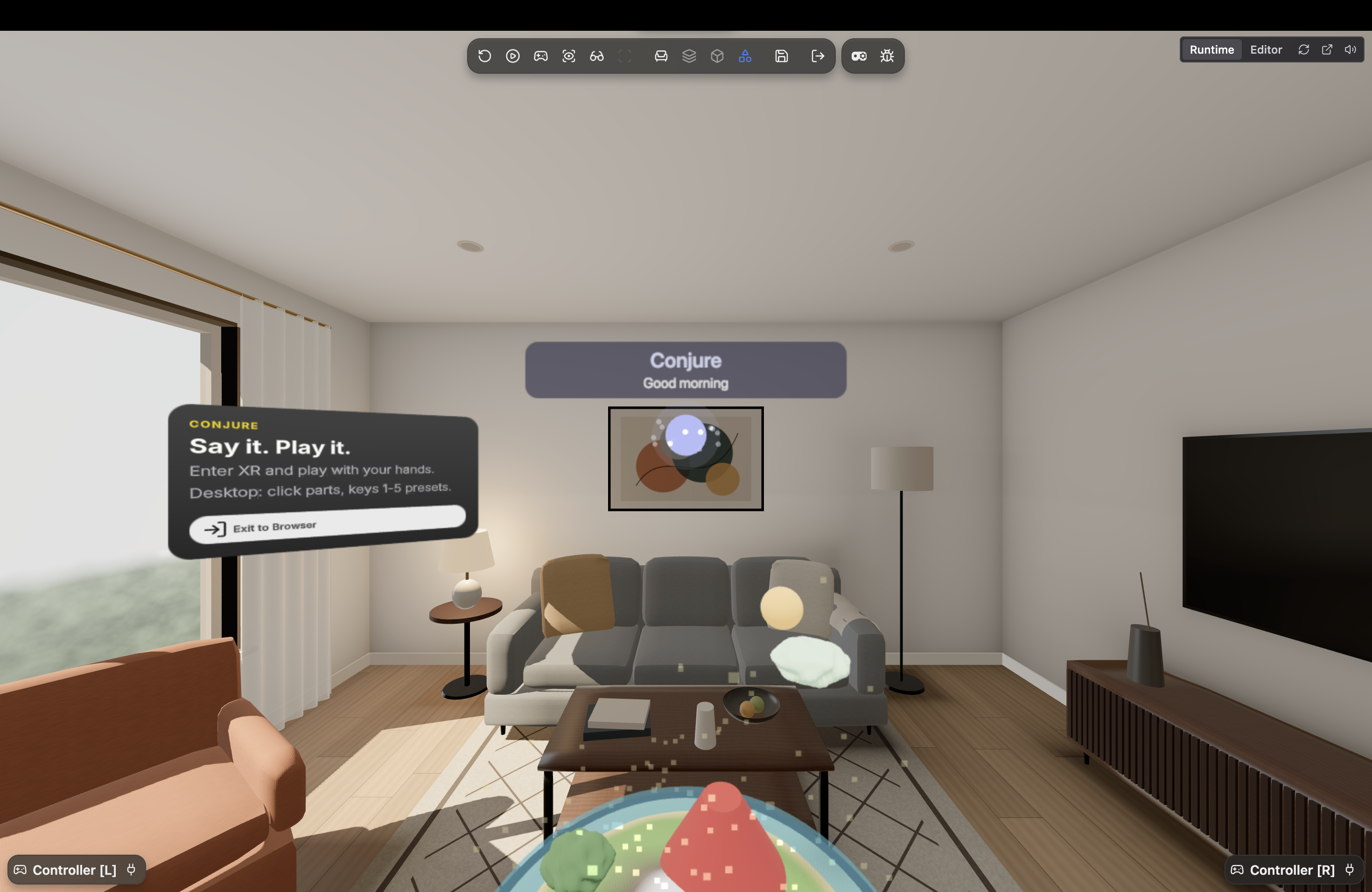
- Watch it build. A team of AI agents plans the place, and the world assembles in front of you as a tabletop miniature, biggest things first: the mountain, then cottages, frosted pines, lanterns and villagers. Turn your left palm up and the miniature floats onto your hand.
- Step inside. Pinch with both hands and pull apart: the miniature grows forty times to life size around you, and you are standing in the snowy lane.
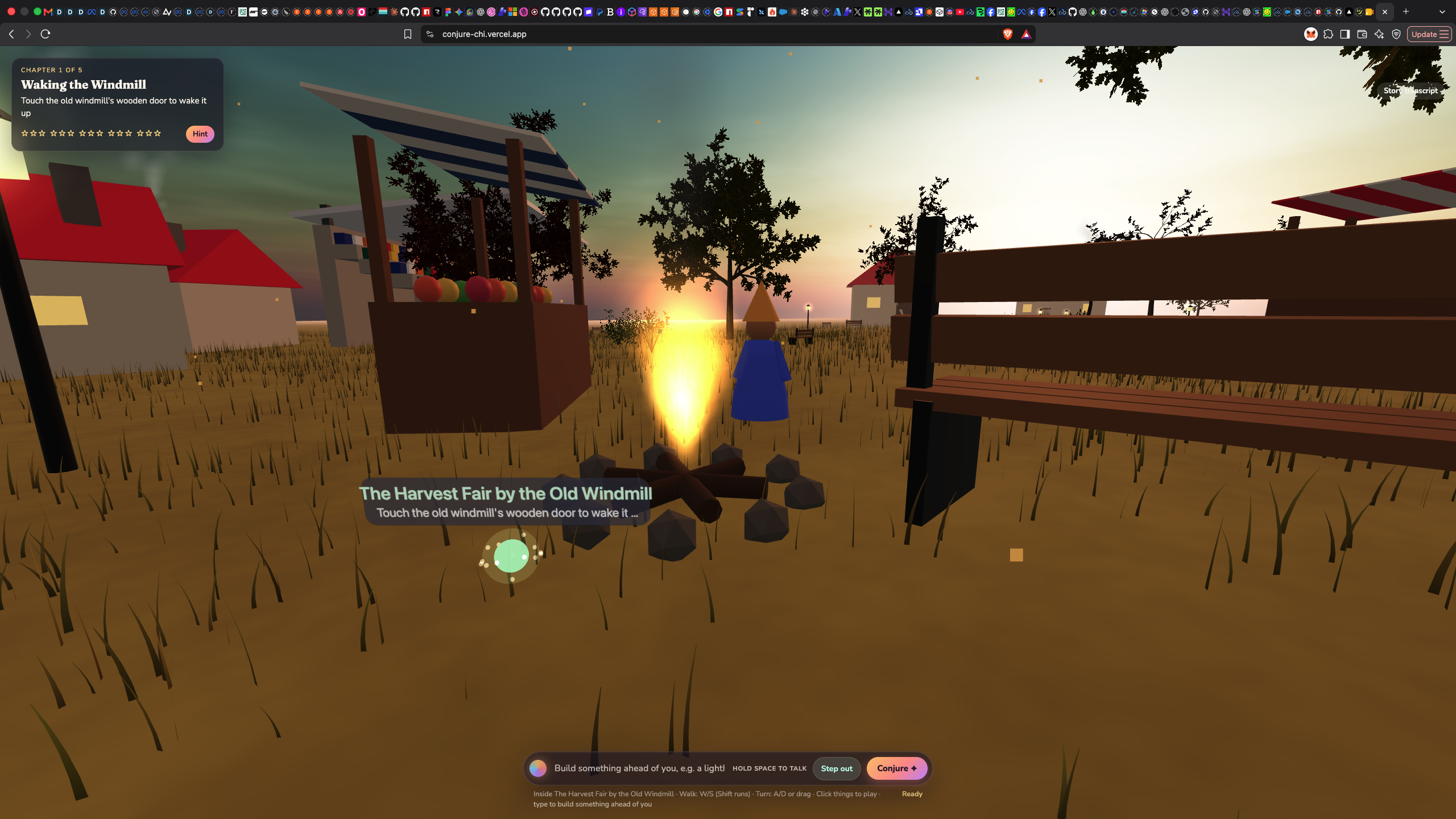
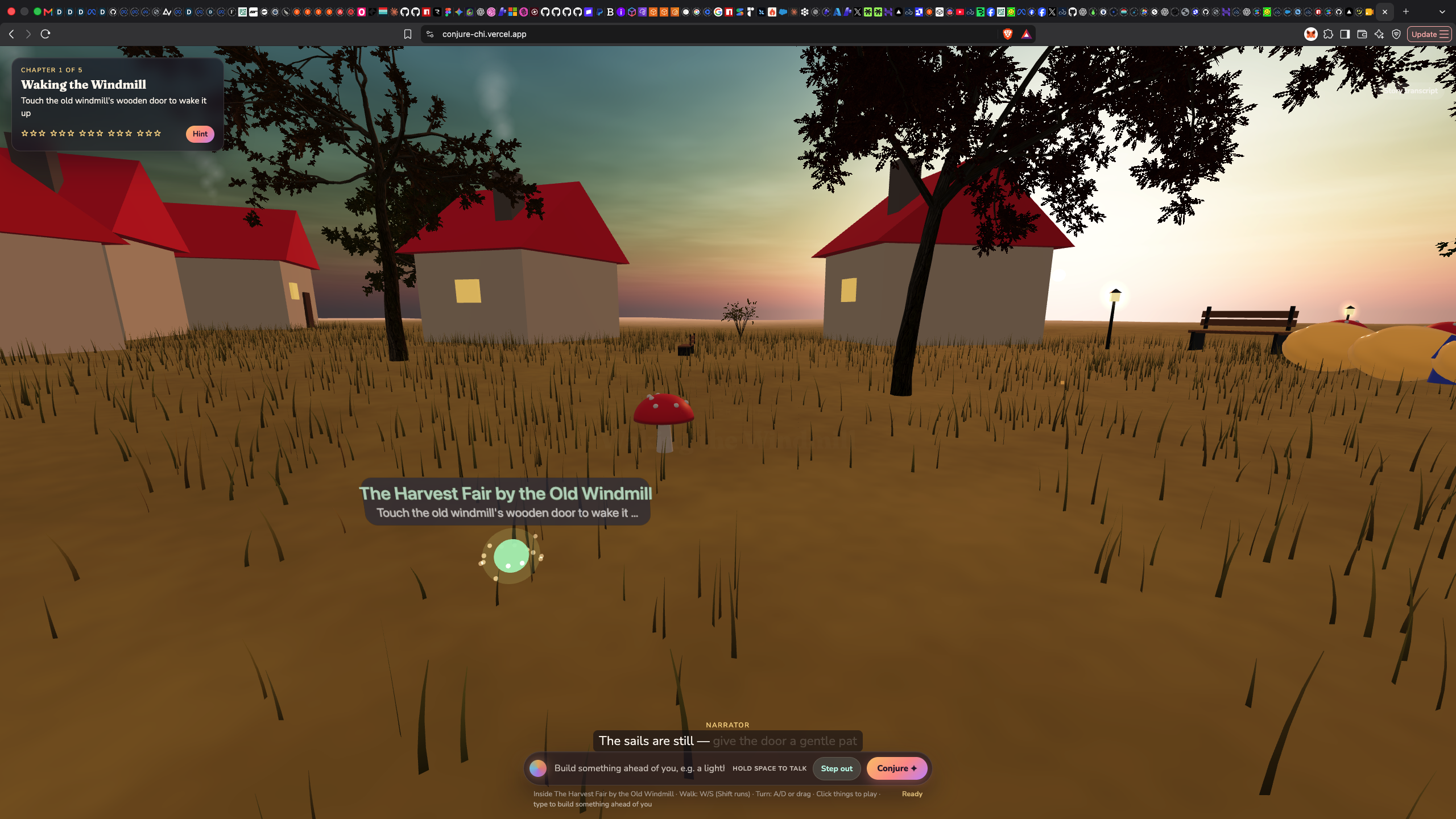
- Explore an endless world. Walk in any direction and the land keeps going. New hills, streets and forests stream in around you, and AI agents design new areas as you approach them. Every object can be touched and has its own sound and reaction: a volcano erupts, a windmill spins faster, a fountain sprays, a villager hops and hums.
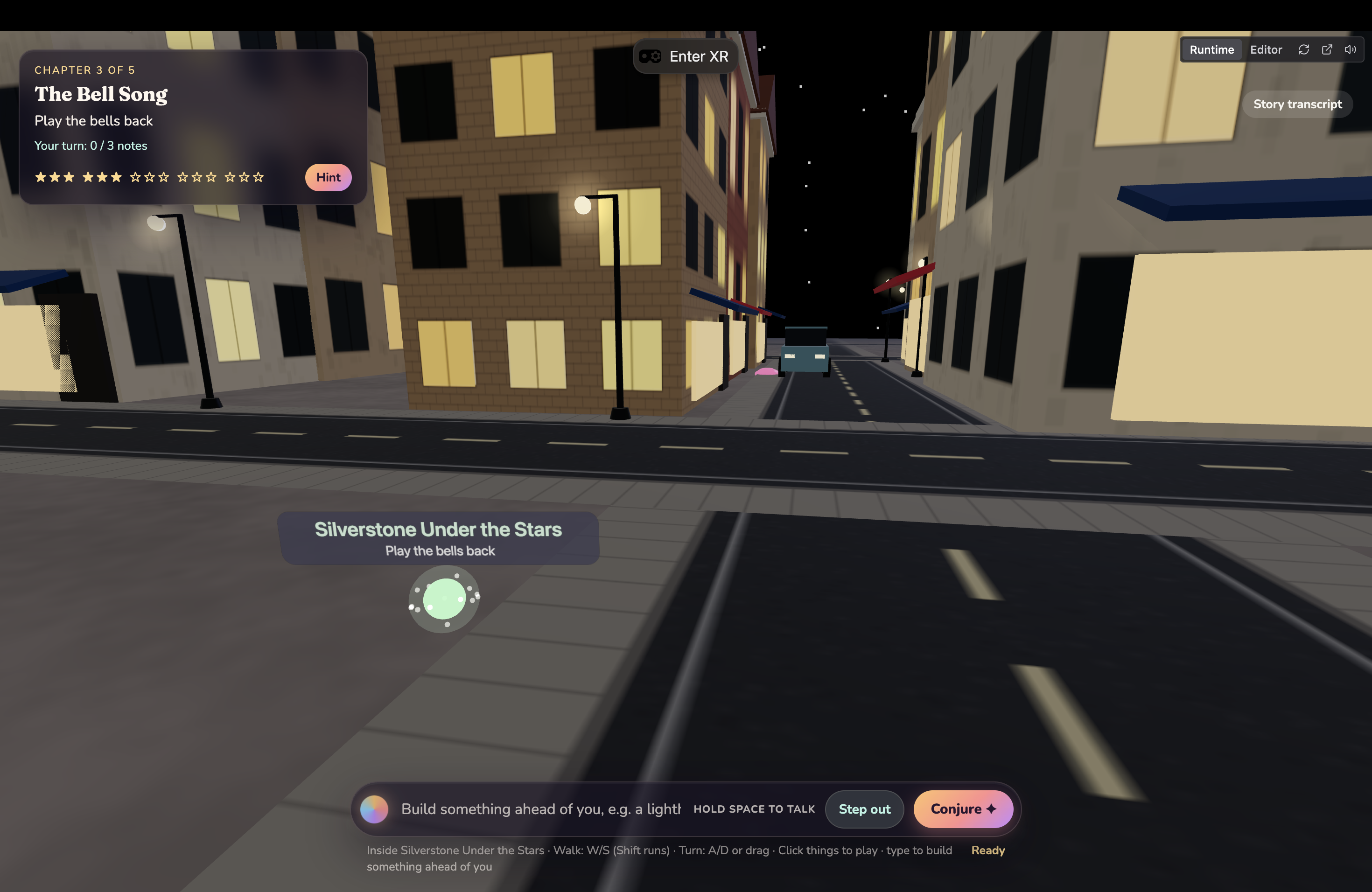
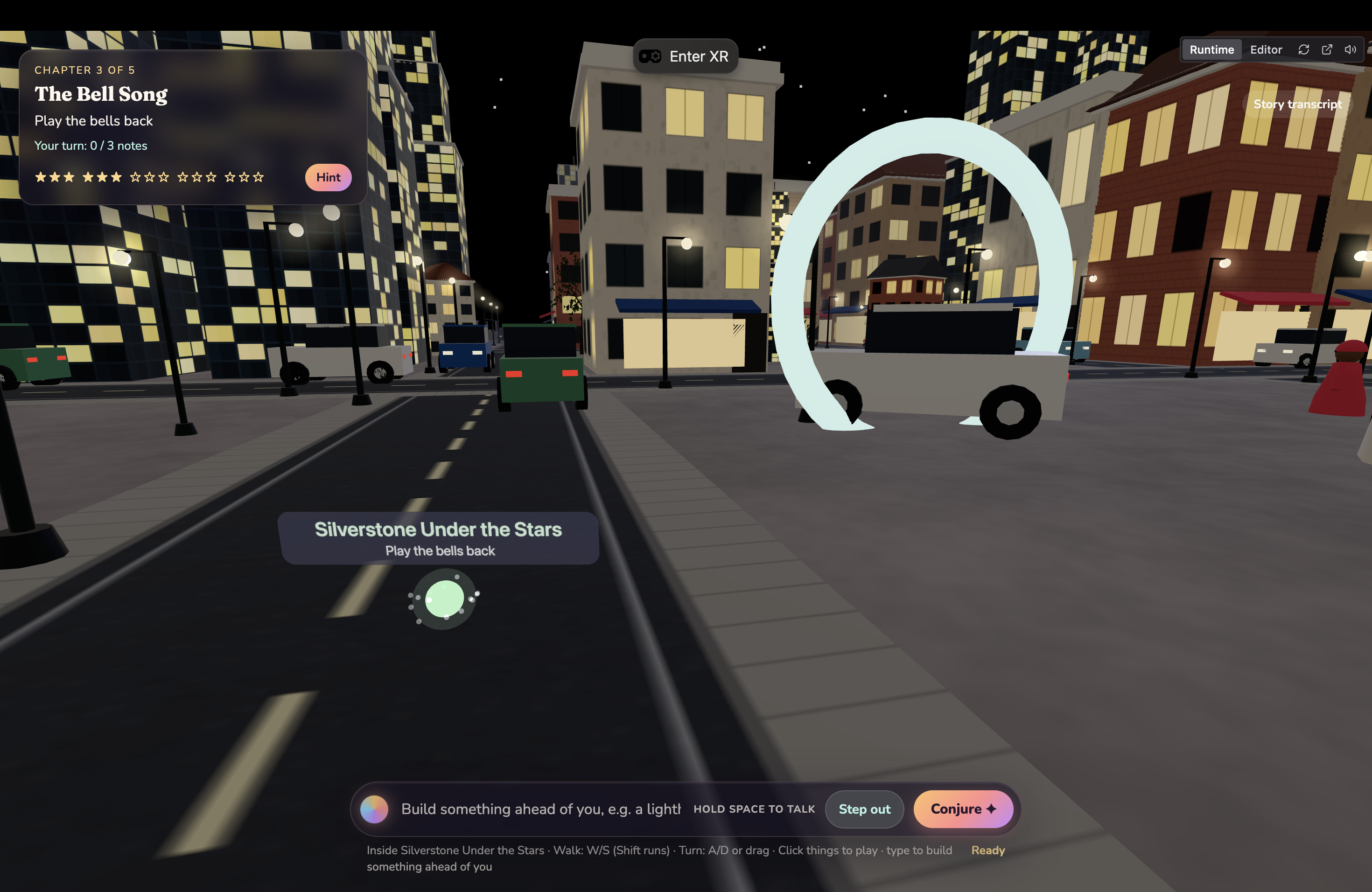
- Play its story. A warm narrator introduces a five-chapter quest written for this world, with a quest card, subtitles, a guiding wisp and hints. Chapters mix different little games, and a choice near the end changes how the story finishes. You earn up to three stars per chapter.
- Keep creating from inside. Say "create a boat" or "put a hot-air balloon over there" and it is built in front of you. Say "make it night" and the sky changes.
Worlds that feel like the wish
Each world gets a biome (city, desert, snow, autumn, tropical, forest, village, fantasy or meadow). The biome sets the ground colours, grass, sky haze and the things that fill the endless land, so a desert has dunes, cacti and tents, autumn has maple trees and warm haze, and fantasy has crystals and giant mushrooms.
- Cities are laid out like real ones: streets with sidewalks and centre lines along every block, brick and plaster buildings and glass towers facing the street with lit windows and shop awnings, pocket parks, fountain plazas and markets in the middle of blocks, street lamps and parked cars.
- Racing wishes ("Silverstone", "Formula 1", "grand prix", "speedway") get a real race track looping around the world: asphalt with red-and-white kerbs, a chequered start line, a start-lights gantry, cars on the grid, grandstands with a cheering crowd, pit garages, floodlights and tyre walls. You land on the grid looking down the start straight.
- Real places are built from their signature features rather than as a generic town.
Chapters that are different every time
The story engine has seven kinds of chapter, and every world uses three different ones in the middle of its story:
| Chapter | What you do |
|---|---|
| Wake | Touch something to bring it to life |
| Talk | Touch a character; they answer in their own voice |
| Collect | Gather 3 to 4 items scattered around a new place |
| Melody | Listen to a tune on bells, then play it back |
| Gates | Pass through glowing gates in order (on a race track, they go round the lap) |
| Seek | Hide and seek: a shy friend hides three times and teases you each time |
| Choose | Pick one of two options; your choice changes the ending |
Names, items, characters and places all come from the wish: in the Silverstone world the marshal sends you looking for lost wheel nuts in the pit lane; in the snowy village, Lantern Keeper Yumi asks you to wake the festival bells.
Voice for everything
Every hand action has a spoken alternative, so the whole experience can be played by voice:
| Say | What happens |
|---|---|
| "A snowy village…" | Builds a new world |
| "Make it night", "add more trees" | Edits the world |
| "Take me to the fountain" | Glides you there and turns you to face it |
| "Walk forward", "keep walking", "stop", "turn around" | Moves you |
| "Where next?" | Takes you to where the story continues |
| "Hint", "say that again" | Helps with the story |
| "The lantern one" | Makes a story choice |
| "Step inside", "step out" | Changes scale |
Hands-first design
Conjure is fully playable with bare hands, seated, with everything within arm's reach. Controllers work too, but are never required.
| Gesture | What it does |
|---|---|
| Tap with a fingertip | Plays any object's sound and reaction; completes story goals |
| Pinch at a distance | Selects objects out of reach |
| Pinch the air and drag | Pulls the world toward you (moves you without standing up) |
| Two-hand pinch | Rotates and resizes the tabletop world |
| Pull hands apart past about 2.5× | Steps inside at life size |
| Bring hands together | Steps back out to the table |
| Left palm up | Holds the miniature world on your hand |
| Left pinch, palm toward your face | Push-to-talk |
How we built it
Conjure has two halves: a WebXR app that runs in the Meta Quest browser, and an agent server. They share one set of schemas, so the headset and the server validate exactly the same data.
On the headset: WebXR with Meta's Immersive Web SDK
- IWSDK (Immersive Web SDK) on three.js with its entity-component system, hand tracking (fingertip touch, pinch, palm pose) and the IWSDK emulator for desktop testing.
- Moving the world, not the user. Instead of moving a camera rig, the whole world hangs from one anchor. Each frame it is posed as
$$\mathbf{p}_{world} = \mathbf{P} + R_y(\theta) \cdot s \cdot \mathbf{p}_{local}$$
- So walking, turning, scaling the miniature to life size (\( s = 40 \): one world unit becomes 40 m) and voice travel are all smooth, eased changes of \( (\mathbf{P}, \theta, s) \). The world follows the ground under your head, so you walk over hills, and solid objects gently push you around them.
- An endless streamed world. The ground is split into 25 m chunks that load in rings around you. Each chunk scatters the world's own props deterministically (walk away and come back, and the same trees stand in the same places), and AI-designed areas are requested for land you haven't seen yet, with a rate limit as a cost guard.
- Procedural 3D assets, built on the device. There are no model downloads: more than 40 asset types are built in code. Trees come from ez-tree (open source), and the rest are ours: buildings and glass towers with canvas-painted facades whose lit windows glow at dusk, cars and Formula 1-style race cars, grandstands with a crowd, floodlights, a start-lights gantry that counts down, volcanoes with lava and smoke, windmills, fountains, lighthouses with turning beams, and more. Each asset knows its default sound and reaction.
- Rendering. A physically based sky with day, dusk and night, stars, instanced grass swaying in the wind, a ground shader with detail noise, fog tinted by the biome, and ACES tone mapping.
- The story runner plays each chapter: it places its own goals, collectibles, bells, gates and hiders so a chapter never depends on the AI remembering to include them, guides you with a chiming wisp, offers an automatic hint after 50 seconds, counts stars, and builds the next chapter's place while you play the current one.
- Sound and UI. Spatial audio for every object, an ambient soundscape (wind, waves, birds, crickets, footsteps), a narrator with subtitles that reveal word by word, a quest card, a story transcript, chapter title cards and an end screen; in the headset, captions and the quest line float in front of you.
On the server: a LangGraph.js agent team
A hybrid of Meta Muse Spark and Gemini, each used where it is strongest, with every agent able to fall back to the other model:
| Agent | Job | Model |
|---|---|---|
| Router | Decides: new world, edit, or a single object | Gemini Flash |
| World Planner | Writes a scene plan: objects, counts, sizes, spatial relations ("around the well", "trackside"), biome, track, light, and the story | Gemini Flash |
| Editor | Changes an existing world in place ("make it night") | Gemini Flash |
| Designer + Researcher | Builds single objects and instruments, after looking up what the real thing looks like | Gemini Flash |
| Area Designer | Designs new areas and story places as you explore | Gemini Flash |
| Story Director | Writes or repairs a five-chapter story for any world | Gemini Flash |
| Repairer | Fixes invalid parts until the creation validates | Meta Muse Spark |
| Critic | Looks at a snapshot of the creation and refines it once | Meta Muse Spark |
| Listener | Turns a voice clip into a transcript and a command | Gemini (audio input) |
| Narrator voice | Speaks the story with a storyteller voice and character voices | Gemini text-to-speech |
Results stream back to the headset as server-sent events, so the world assembles piece by piece while the agents are still working.
A Holodeck-style layout solver
The key design choice: the AI never writes coordinates. It describes the scene in words and relations, and a deterministic solver decides exactly where everything goes. The solver:
- sizes every object from its real-world height (a cottage is about 6 m, a pine about 11 m, a person 1.75 m);
- places objects by relation (center, near, around, in a row, scattered, by the shore, on the water, in the sky, trackside, on the track) with rejection sampling, so nothing overlaps;
- keeps things on dry land, off roads and off the race track, and turns buildings to face the street;
- sends big landmarks like mountains and volcanoes to the horizon so they never swallow the village;
- keeps a clear line of sight from where you land to the heart of the world, so the first thing you see is the place, not the back of a house.
Voice pipeline
The Quest browser has no built-in speech recognition or speech synthesis, so both run on the server. The headset records push-to-talk audio as 16 kHz mono and ends the clip itself after a short silence. One Gemini call hears the clip and returns both what you said and what you meant, as a structured command. Short control phrases like "stop" or "turn around" are also matched by a small on-device grammar, so they never depend on the model's interpretation. Travel by voice is an eased glide of about 10 m/s, never longer than 3.5 seconds, which is comfortable when seated.
Quality
82 automated tests cover the layout solver, biomes, city blocks, race tracks, story repair, chapter variety and voice commands, and we ran scripted headless playthroughs of whole stories in the browser to check that every chapter can be finished.
Challenges we ran into
- "Every world looks the same." Early worlds were all green islands: even "a city" came out as the same place with different props. Adding biomes, a real city-block generator and race tracks made a city feel like a city and Silverstone feel like a circuit.
- Stories that silently failed. Models often returned a story with one empty or null line, which failed validation, so every world quietly fell back to the same template. A lenient repair step that fills gaps instead of rejecting the whole story, plus stricter writing rules (three different kinds of middle chapter, names taken from the wish), fixed it.
- Chapters that wouldn't move on. Touching a goal while the narrator was still speaking was ignored, and a late line could overwrite a newer chapter. Goals now count at any time, cut the narration short, and a flow token stops stale lines from changing state.
- Making every chapter always playable. The engine places its own goal pieces in every chapter, so the story never depends on the AI remembering to include them. We also had to let you walk through gates instead of bumping into them.
- No speech on the Quest browser. Without built-in recognition or synthesis, we built server-side listening and narration, with caching so replaying a story costs nothing.
- Comfortable seated locomotion. Pulling the world by hand, eased voice glides, smooth turns and ground following, all without large physical movement.
- A Gemini API quirk. Only one system message is allowed, and it must come first. This caused a 90-second routing hang until we merged our instructions into a single leading system message and added fast paths and timeouts.
Accomplishments that we're proud of
- One sentence becomes a life-size, endless, touchable world in seconds, with a story written for it.
- The same engine produces a snowy lantern festival, a night-time Formula 1 circuit and a downtown city block that each feel like themselves.
- The whole experience works with bare hands, and every action also works by voice.
What we learned
Let the AI decide what and where, in words, and let deterministic code decide exactly where and how it looks. That split is what makes AI-generated worlds feel both surprising and solid. The same idea applies to the story: the AI writes the narrative, and the engine guarantees that every chapter can be played.
What's next
- Conversations with characters: talk back and forth with the people who live in your world.
- AI-designed objects for anything outside the asset catalogue, assembled from parts.
- Shared worlds: conjure a place together with friends and play its story side by side.
- Saving worlds to revisit, and sharing them by link.
- Mixed reality: a passthrough mode with the miniature world on your real table.
Built With
- ez-tree
- gemini
- gemini-tts
- immersive-web-sdk
- langchain
- langgraph
- meta-muse-spark
- meta-quest
- node.js
- procedural-generation
- three.js
- typescript
- vercel
- vite
- web-audio-api
- webxr


