-
-
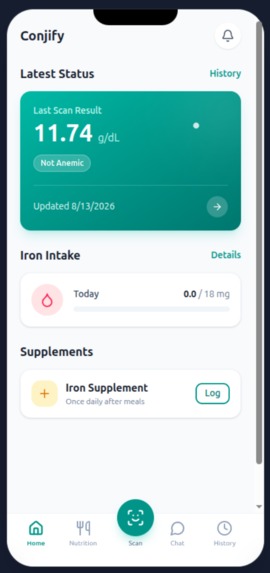
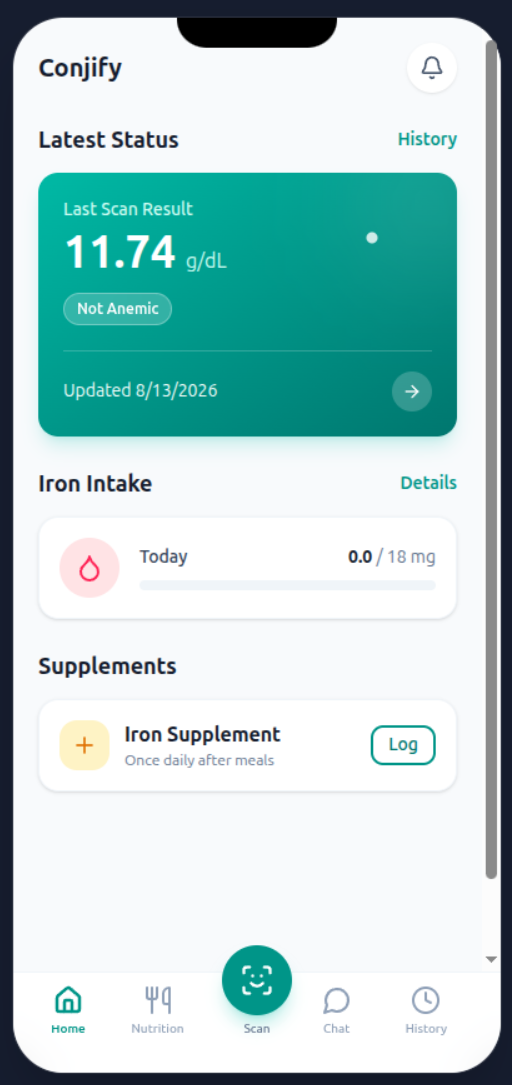
Conjify homepage
-
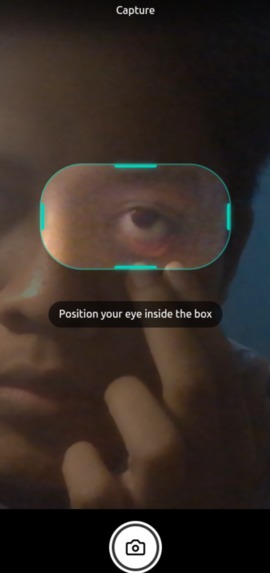
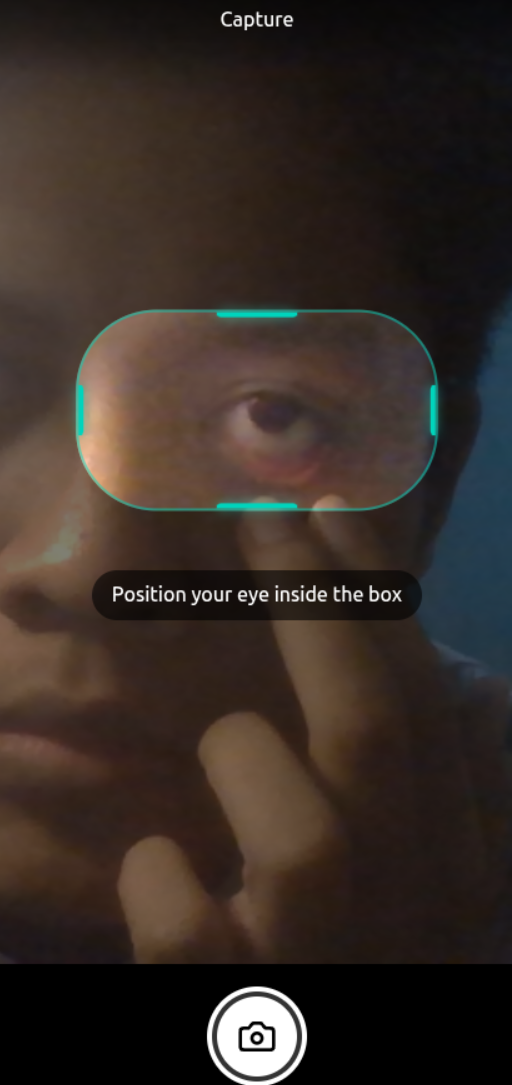
Scanning Conjungtiva
-
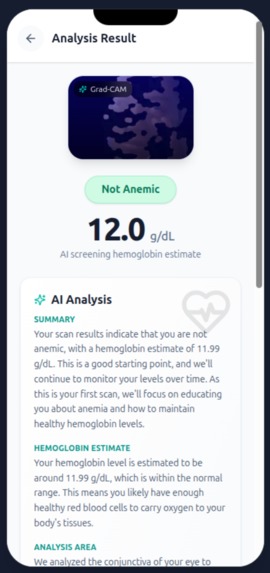
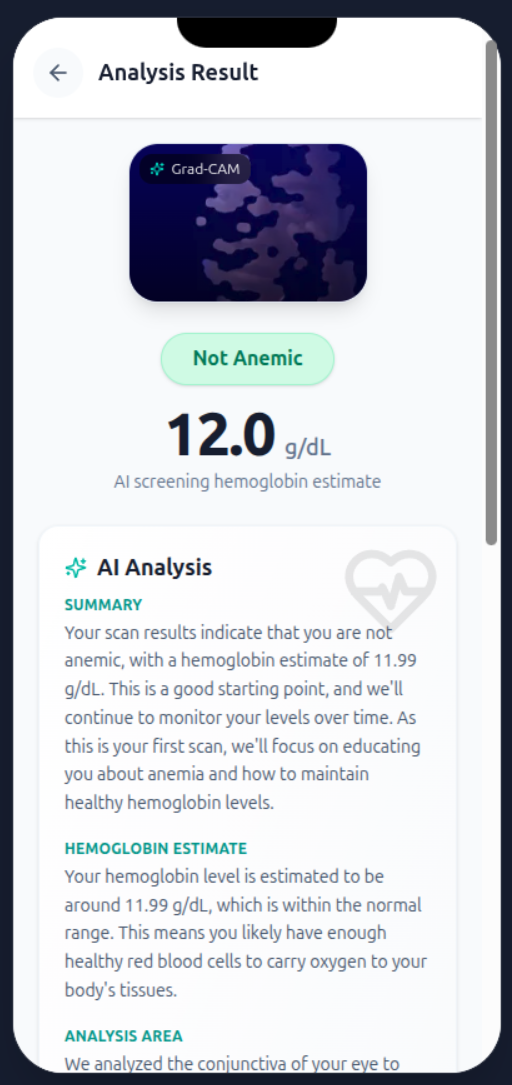
Scan & AI Summary Results
-
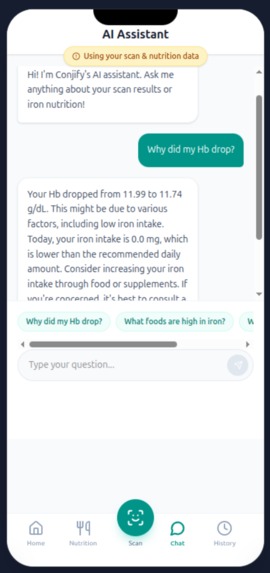
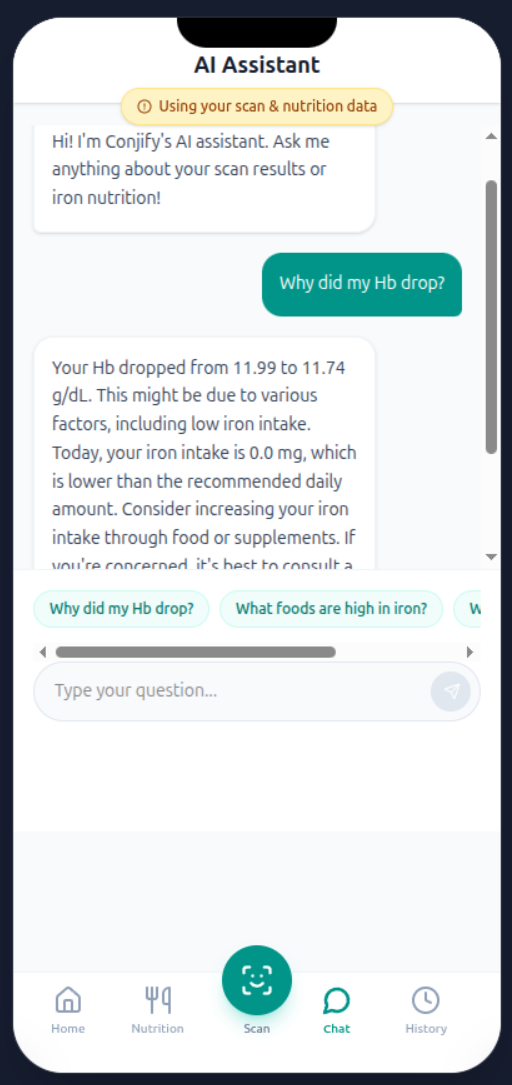
RAG Chatbot
-
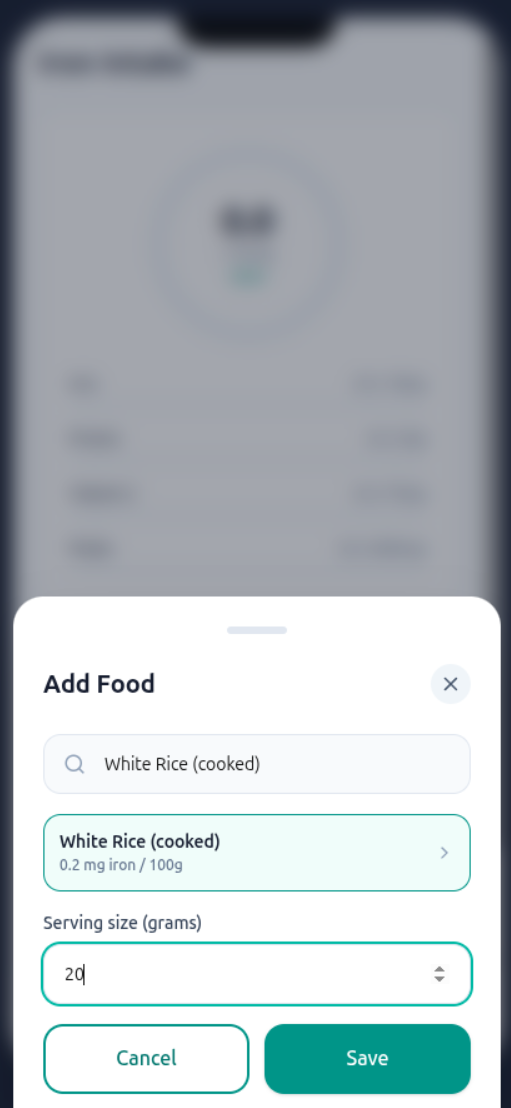
Nutrition Tracking (Iron)
The Idea
Anemia is one of the world's major public health challenges, affecting nearly 2 billion people globally in 2021. In Indonesia, anemia also remains a significant concern, with the 2023 Indonesian Health Survey reporting a prevalence of 15.5% among adolescents aged 15–24 years, above the World Health Organization's 10% threshold for a public health problem. Anemia can affect cognitive and motor function, productivity, and maternal and child health, making early detection important.
However, conventional anemia screening still commonly depends on measuring hemoglobin through laboratory testing. This can require specialized equipment, trained healthcare workers, and access to healthcare facilities, creating barriers for people in areas with limited resources or limited healthcare access.
At the same time, pallor of the palpebral conjunctiva, the inner surface of the lower eyelid, has long been recognized as a visual indicator associated with anemia. Because this characteristic can be captured through a camera, we saw an opportunity to combine it with modern computer vision. The increasing availability of smartphones and internet access in Indonesia further motivated us to explore a screening approach that could be accessed through a device people already carry.
This led to the idea behind Conjify:
Can a smartphone camera become a simple first step toward more accessible anemia screening?
Conjify was built to explore that question. Rather than creating only a binary image classifier, we wanted to build a complete user-facing system that could analyze a conjunctival image, estimate hemoglobin, explain what the model is looking at, and communicate the result in language that ordinary users can understand.
That is why Conjify combines computer vision, explainable AI, and a Large Language Model into one platform. The goal is not to replace doctors or laboratory testing, but to make an initial screening experience more accessible, understandable, and actionable for the public.
How It Works
A user opens Conjify on a smartphone and captures an image of their lower eyelid through the browser camera.
The image is then sent to the AI inference pipeline, where a Dual-Head EfficientNet-B0 simultaneously performs two tasks:
- Anemia classification, predicting whether the visual characteristics are associated with anemia.
- Hemoglobin regression, estimating the user's hemoglobin level.
The shared EfficientNet-B0 backbone extracts visual features, which are then processed by separate classification and regression heads.
Conjify then applies Grad-CAM to identify regions of the image that contributed to the model's prediction. The classification result, estimated Hb, and Grad-CAM statistics are provided as structured context to an LLM, which converts these technical outputs into an Indonesian-language explanation designed for everyday users.
The user can then review previous screening results, monitor estimated Hb trends, track nutritional intake, and interact with a contextual health chatbot.
Main Features
AI Anemia Screening Users can capture a conjunctival image using their smartphone and receive an AI-assisted screening result.
Dual-Head AI Model Instead of only performing binary classification, the model simultaneously predicts anemia status and estimates hemoglobin concentration.
Explainable AI with Grad-CAM Grad-CAM highlights image regions that contribute to the model's prediction, providing a visual explanation of the computer vision output.
LLM-Powered Indonesian Interpretation The system transforms model predictions and explainability information into an understandable, contextual Indonesian-language explanation.
Screening History & Hb Trends Users can review previous screening results and monitor estimated hemoglobin trends.
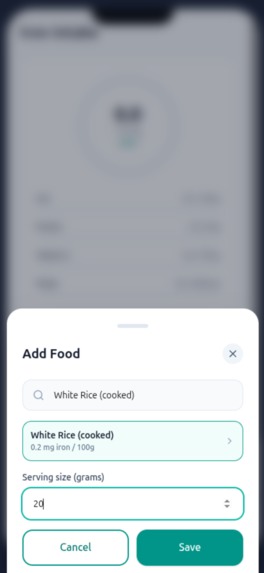
Nutrition Tracker Conjify includes a food tracker based on Indonesian food composition data, including tracking of iron, protein, vitamin C, and folate.
Context-Aware Health Chatbot The chatbot can interact with the user's available screening and nutrition context, turning Conjify from a single-use classifier into a broader health-monitoring experience.
Technology Stack
Frontend
- React 18
- TypeScript
- Vite
- Tailwind CSS
AI & Machine Learning
- Python
- PyTorch
- EfficientNet-B0
- Multi-task learning
- Grad-CAM
- Computer Vision
Generative AI
- Llama 3.3 70B
- Groq API
Inference & Deployment
- Hugging Face Spaces
- Gradio
- Netlify
Client-Side Storage
- Browser
localStorage
The application uses a mobile-first architecture. Image inference is handled through the Hugging Face inference service, while user screening history and nutrition records are stored locally in the browser rather than in a centralized health database.
GitHub: https://github.com/galihkjaya/conjify
Intended Audience
Conjify is designed primarily for members of the general public who want an accessible first step toward anemia screening using a smartphone.
It is particularly motivated by users who may face barriers to conventional screening, including limited access to healthcare facilities or laboratory testing. The platform is designed to communicate results in a way that does not require medical or machine learning expertise.
Conjify is an AI-assisted screening tool, not a diagnostic system. Its results are intended to support awareness and encourage appropriate follow-up, rather than replace laboratory testing or professional medical evaluation.
Built With
- gradio
- groq
- huggingface
- netlify
- pytorch
- react
- typescript

Log in or sign up for Devpost to join the conversation.