-
-
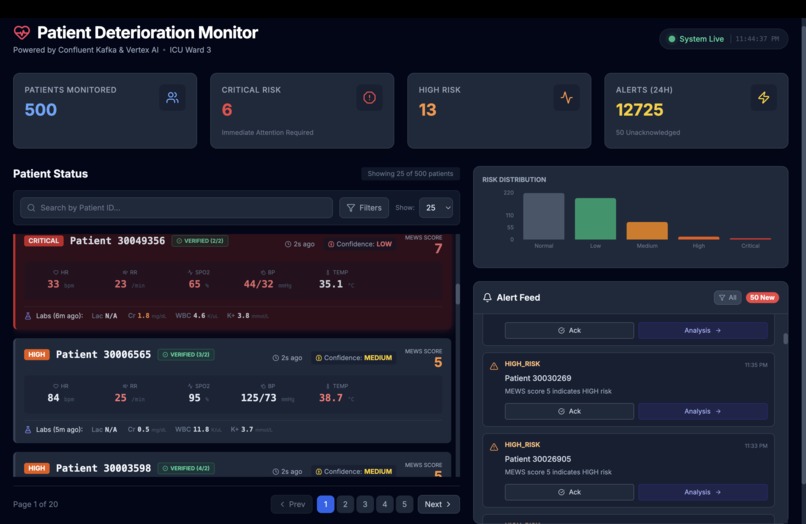
Dashboard
-
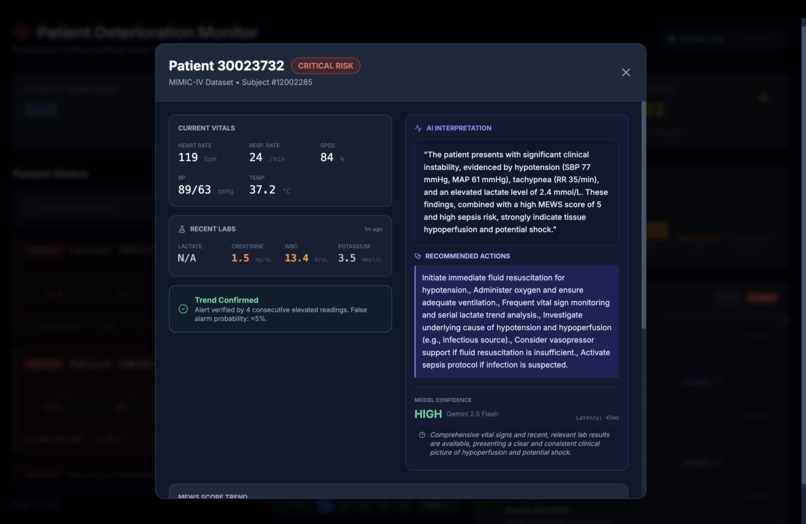
Patient Detail with AI Assessment


Inspiration
84% of in-hospital cardiac arrests show documented warning signs within 8 hours of the event; yet traditional intermittent monitoring often misses this critical window. We wanted to transform this 8-hour warning window into actionable clinical intelligence using real-time streaming.
What it does
A real-time clinical decision support system that predicts patient deterioration using streaming vital signs and laboratory data. Clinicians get a priority pool of high-risk patients filtered by risk level and AI confidence, with Gemini-powered assessments that explain why each patient is flagged, reducing alert fatigue while maintaining sensitivity.
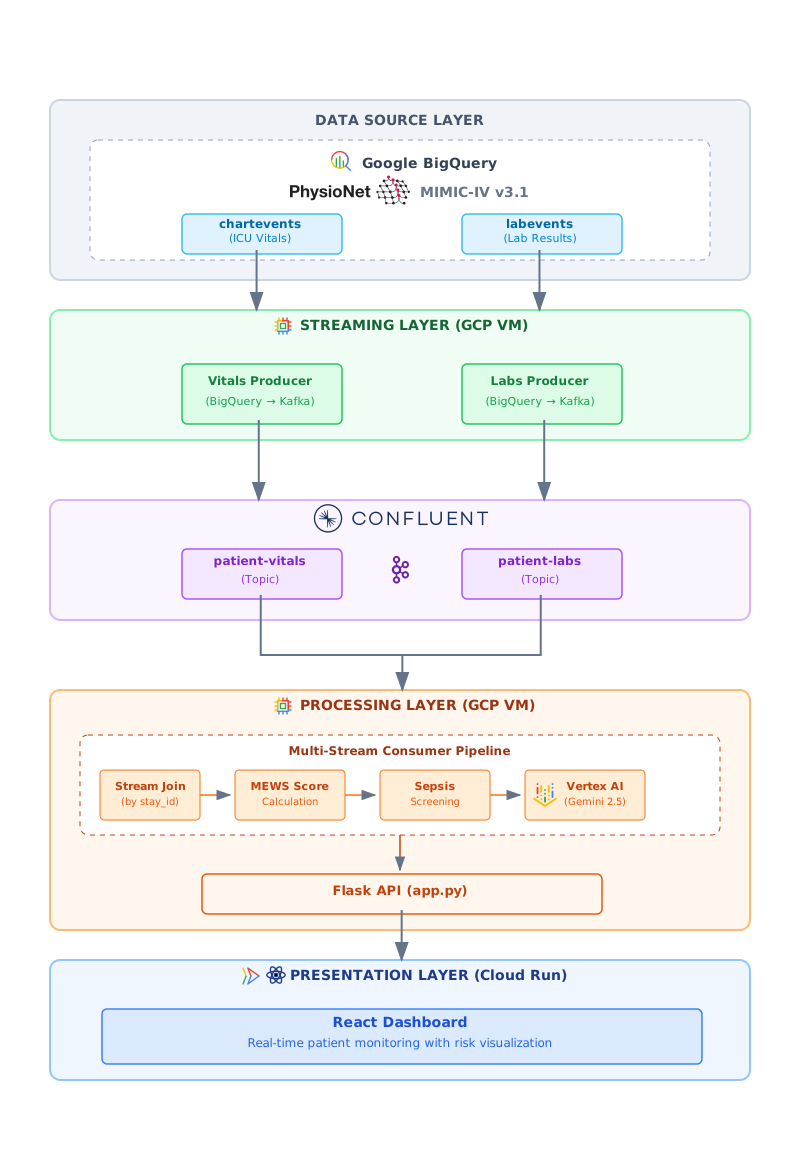
Architecture
How we built it
- BigQuery hosts MIMIC-IV data, enabling SQL-based extraction of vitals and labs for 500 ICU patients
- Confluent Kafka ingests vital signs and lab results in real-time, joined by patient stay ID
- Automated MEWS scoring calculates risk on every incoming data point
- Vertex AI Gemini 2.5 Flash provides zero-shot clinical reasoning with confidence-aware assessments
- React dashboard with risk filtering, trend charts, and real-time alert feed
- Cloud Run + GCE for deployment on Google Cloud
Challenges we ran into
- Stream joining: Synchronizing vitals (continuous) with labs (intermittent) required temporal windowing with a 4-hour staleness threshold
- Alert fatigue: Traditional early warning scores have PPV as low as 4-7%. We implemented trend-based confirmation requiring 2+ consecutive elevated readings
- AI confidence calibration: Teaching Gemini to express appropriate uncertainty when vital signs are incomplete or labs are stale
Accomplishments that we're proud of
- End-to-end streaming pipeline processing 266K vital records and 25K lab results in real-time
- Clinically validated MEWS scoring with SpO2 integration
- Confidence-aware AI that explains its reasoning, not just the risk score
- Filtering system that turns 500 patients into a focused priority pool
What we learned
- Zero-shot LLMs can provide clinically useful interpretations without training data
- The real value isn't just prediction, but reducing cognitive load for clinicians
- Streaming architecture enables intervention during the "Golden Hour" that batch processing misses
What's next
- MIMIC-CXR integration: Chest X-ray analysis for respiratory deterioration
- Nursing notes: Unstructured text analysis for subtle clinical cues
- Federated learning: Multi-hospital deployment without sharing patient data

Log in or sign up for Devpost to join the conversation.