-
-
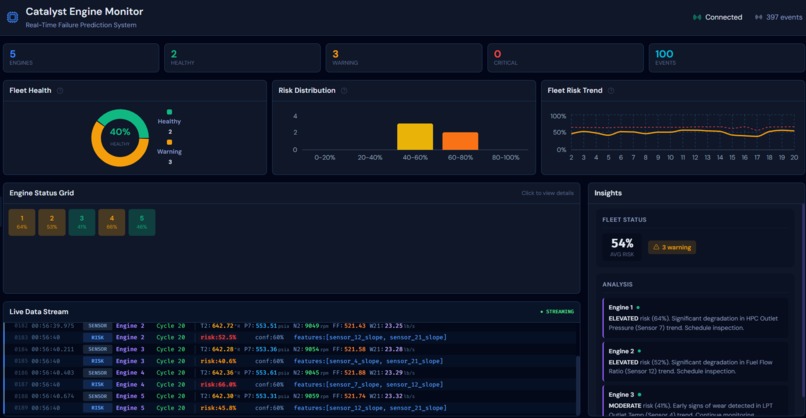
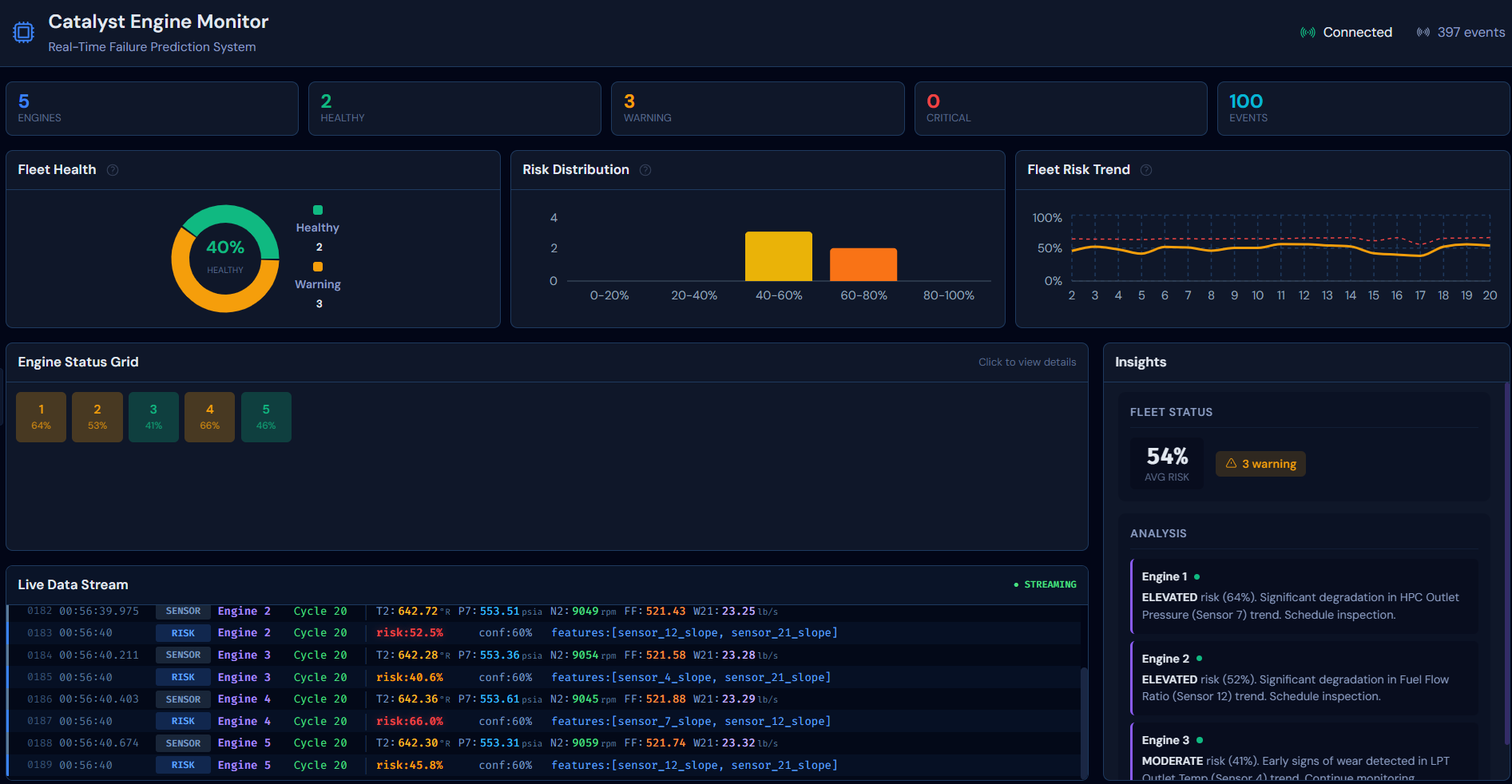
Main (Fleet) Dashboard
-
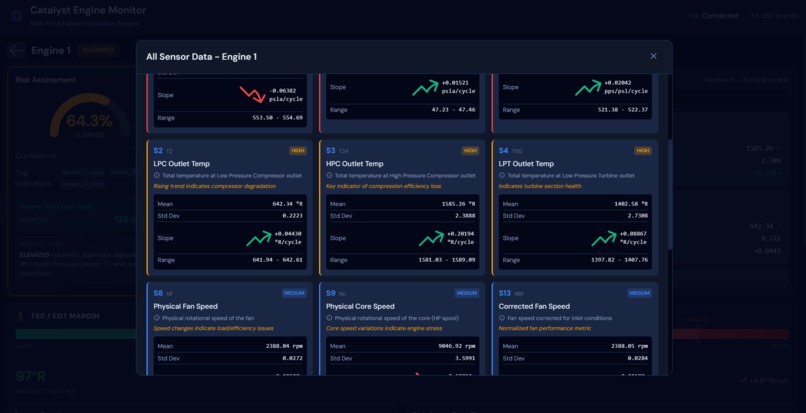
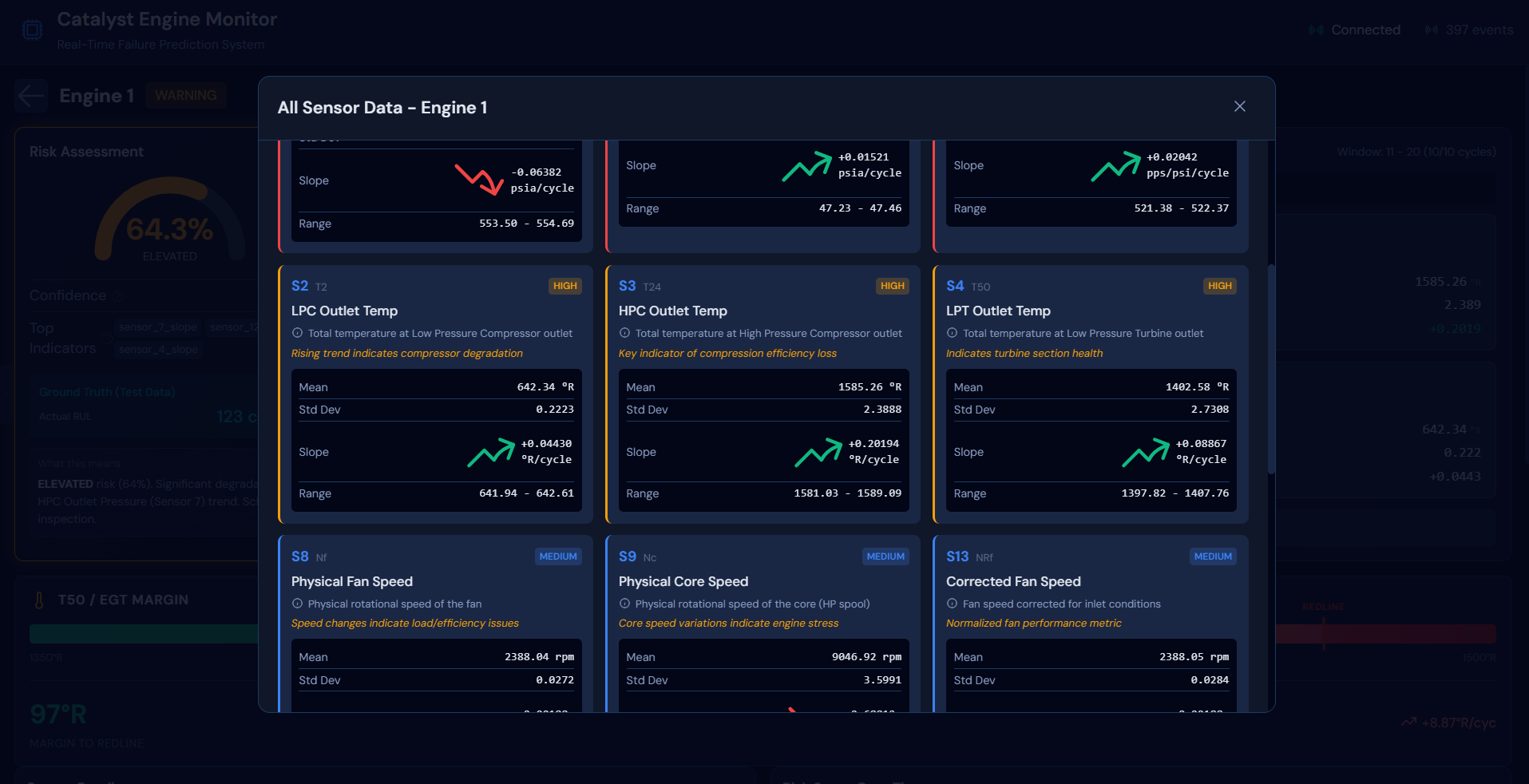
Engine Dashboard 3 (All Sensor Data)
-
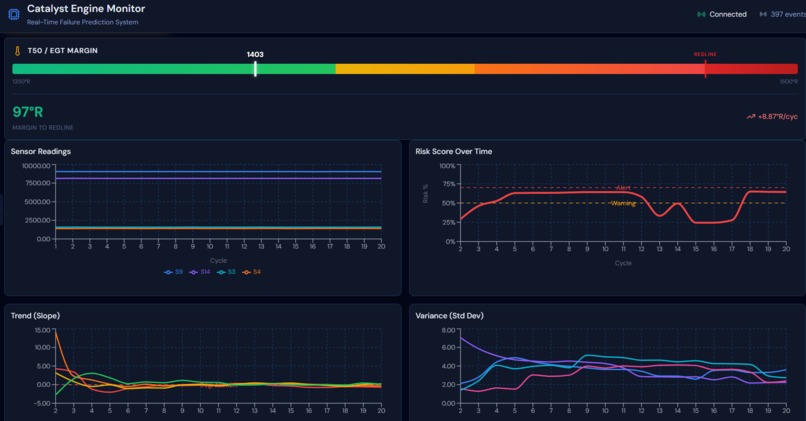
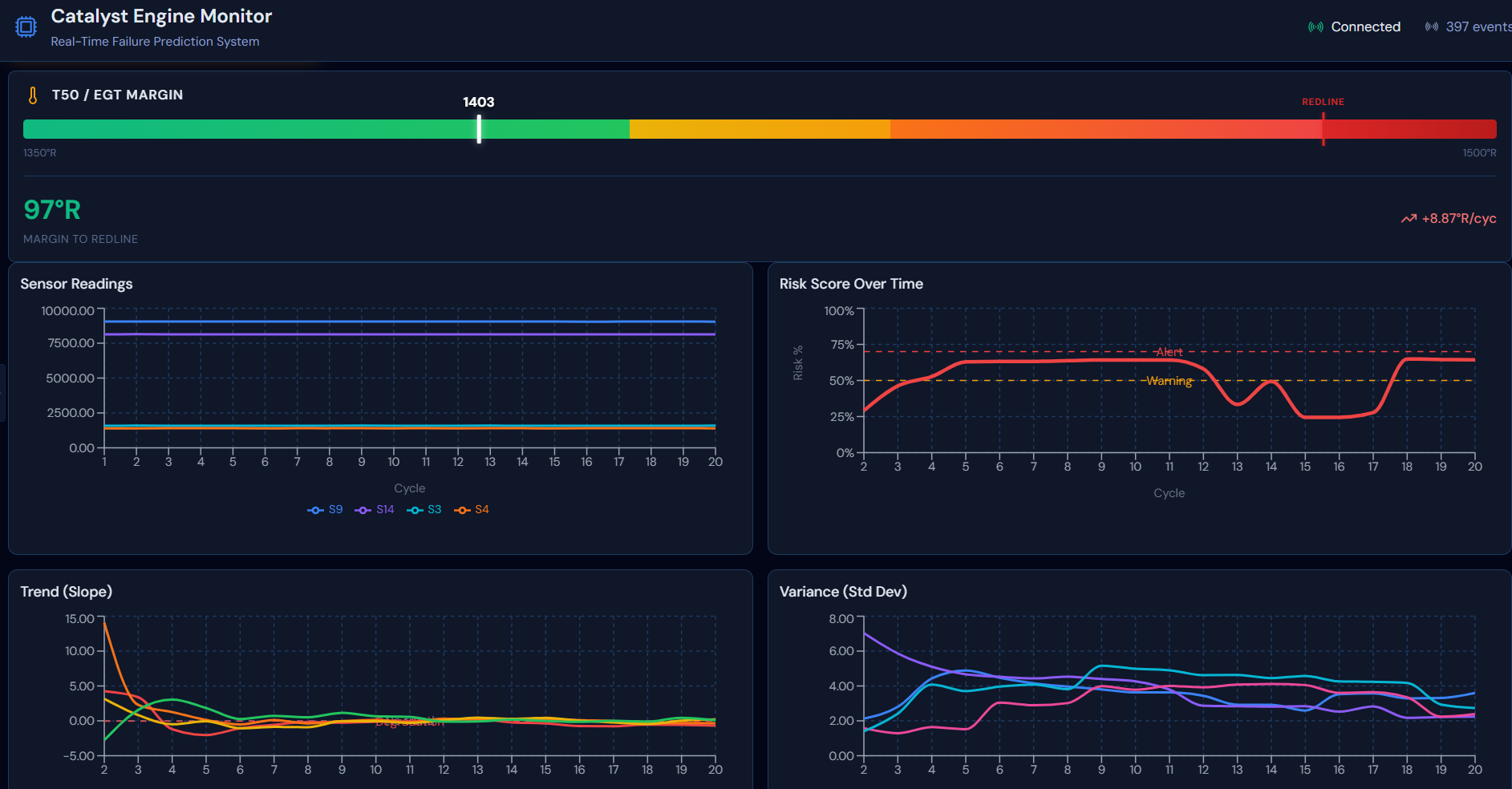
Engine Dashboard 2
-
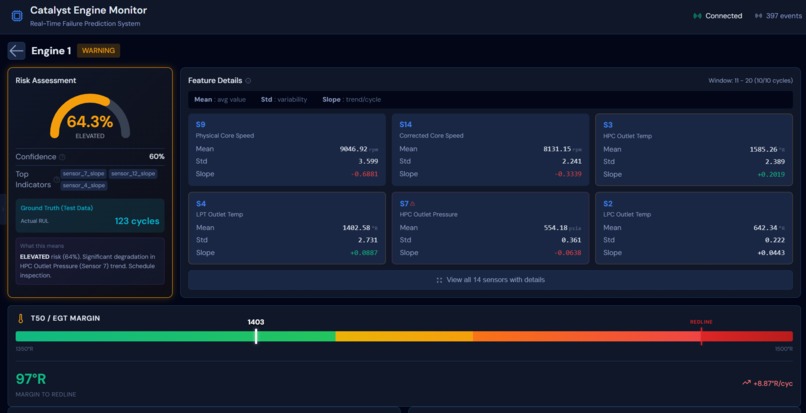
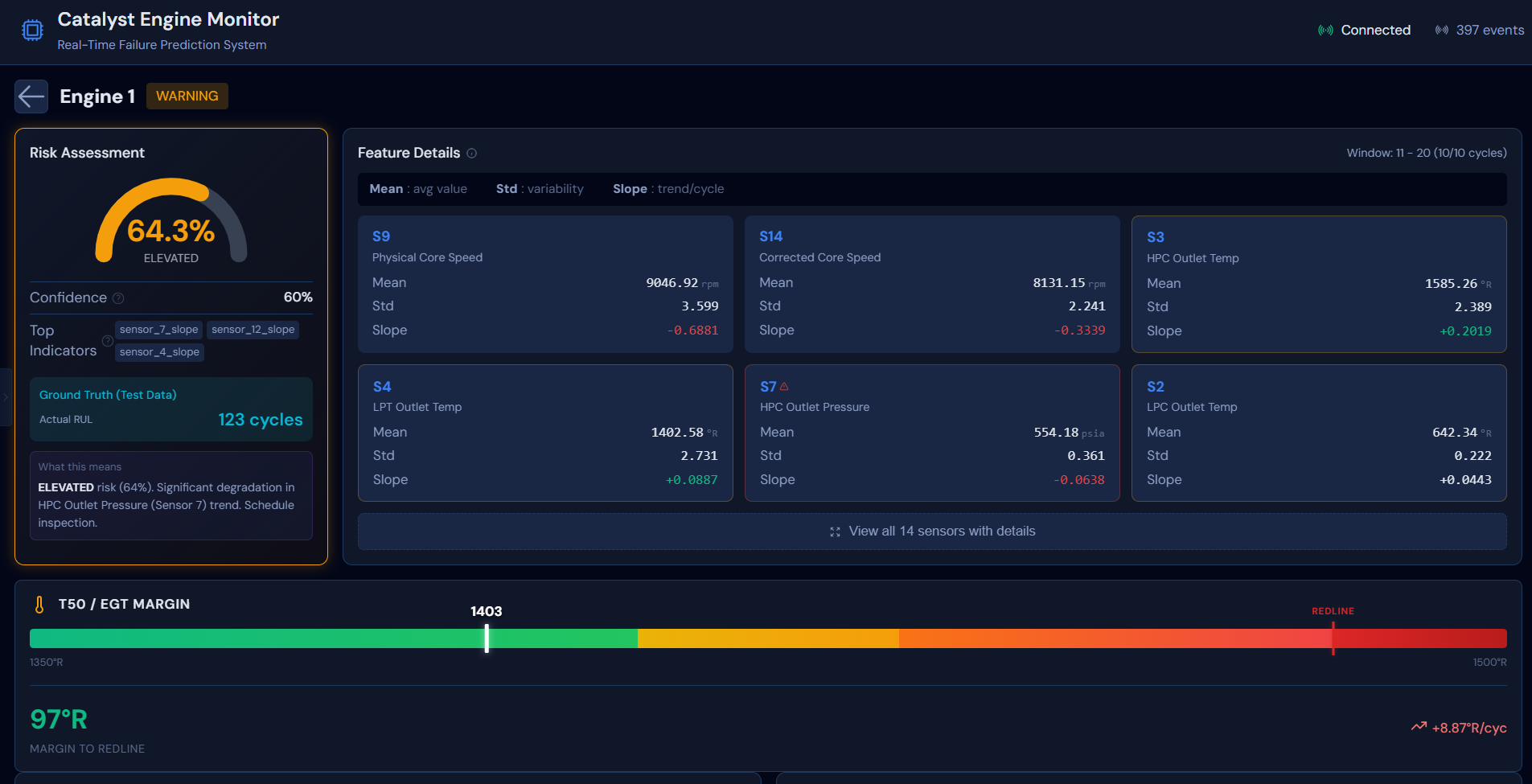
Engine Dashboard 1
Inspiration
Unplanned engine failures cost the aviation industry over $150 billion annually. Current maintenance approaches are reactive—fix it when it breaks. With modern sensors generating thousands of data points, we saw an opportunity to flip this model: predict failure risk in real-time and intervene proactively.
What it does
Catalyst is a real-time predictive maintenance system for turbofan engines:
- Streams sensor data — 21 sensors measuring temperature, pressure, and speed flow through Confluent Kafka
- Computes features — Rolling statistics detect degradation patterns in real-time
- Predicts risk — LSTM neural network scores failure risk from 0-100%
- Enables intervention — Operators can simulate maintenance actions and see cycles saved
- Explains alerts — Gemini AI generates natural language explanations
How we built it
Streaming Layer:
- Confluent Cloud with 3 Kafka topics (sensor-events, feature-events, risk-events)
- WebSocket server for real-time dashboard updates
ML Pipeline:
- LSTM neural network trained on NASA C-MAPSS FD001 dataset (100 engines, 21 sensors)
- Multi-task learning: predicts both risk score and remaining useful life
- Physics-informed features: rolling variance, trend slopes, cross-sensor correlations
Cloud Infrastructure:
- Google Cloud Run for serverless backend
- Vertex AI for ML model serving with auto-scaling
- Gemini 2.0 Flash for AI-powered alert explanations
Frontend:
- React 18 with real-time WebSocket updates
- Recharts for live sensor visualization
- Fleet and single-engine views with maintenance simulation
Challenges we ran into
- Progressive windowing: Features need to work from cycle 2, not just after a full 30-cycle window
- Multi-sensor fusion: Combining 14 useful sensors into meaningful health indicators
- Real-time constraints: Keeping prediction latency under 100ms while computing rolling stats
- Intervention modeling: Simulating how maintenance actions affect degradation trajectories
Accomplishments we're proud of
- 94% failure detection rate with 25-cycle average lead time
- End-to-end streaming pipeline from sensor to dashboard in under 200ms
- Maintenance simulation that shows tangible cycles saved
- Clean architecture with clear separation between streaming, ML, and presentation layers
What we learned
- Confluent Kafka's exactly-once semantics are crucial for ML predictions
- Google Cloud Run handles WebSocket connections surprisingly well
- Physics-informed features (variance, slopes) often outperform raw sensor values
- Real-time ML is more about feature engineering than model complexity
What's next for Catalyst
- Multi-engine correlation: Detect fleet-wide issues affecting multiple engines
- Feedback loop: Track actual failures vs predictions to retrain models
- Mobile alerts: Push notifications for critical risk thresholds
- Schema Registry: Enforce data contracts across the streaming pipeline
Built With
- c-mapss
- confluent
- gemini
- google-cloud
- nasa
- python
- pytorch
- react
- vertex
- websockets


Log in or sign up for Devpost to join the conversation.