-
-
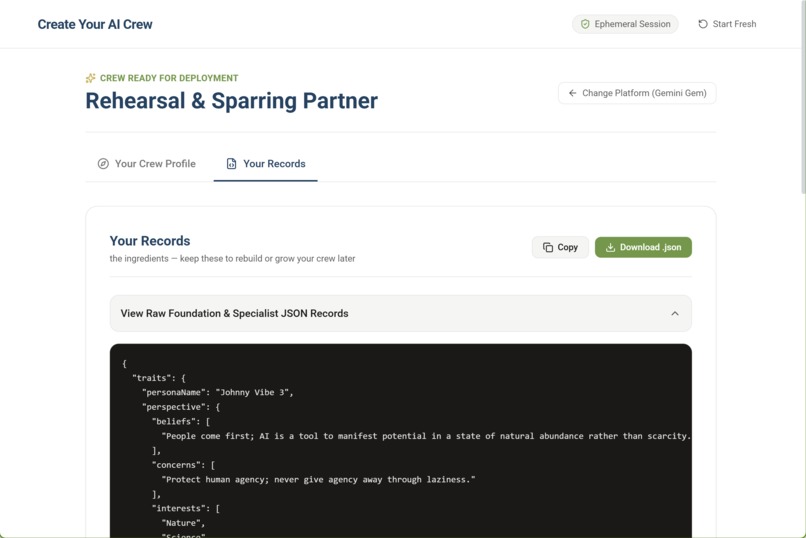
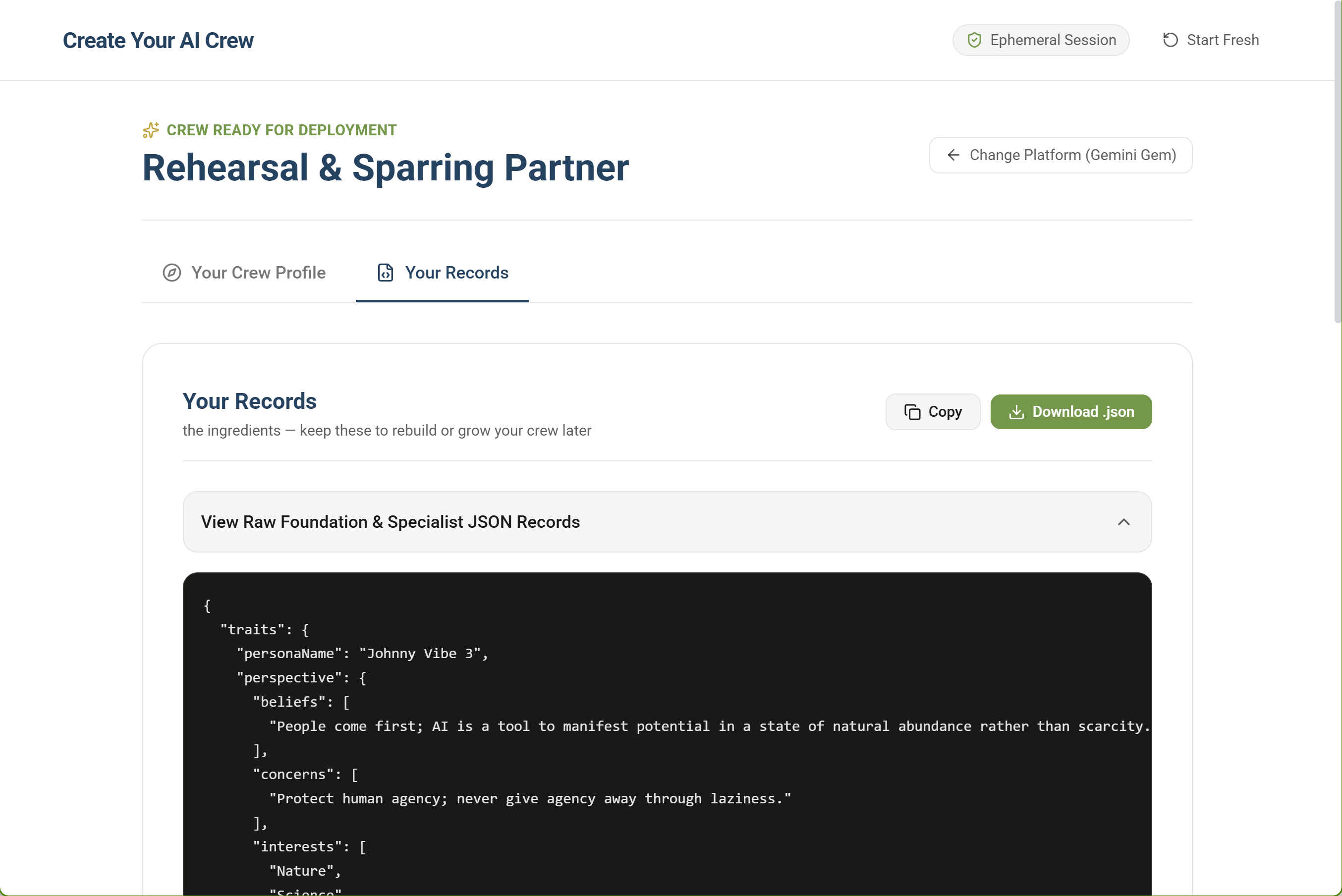
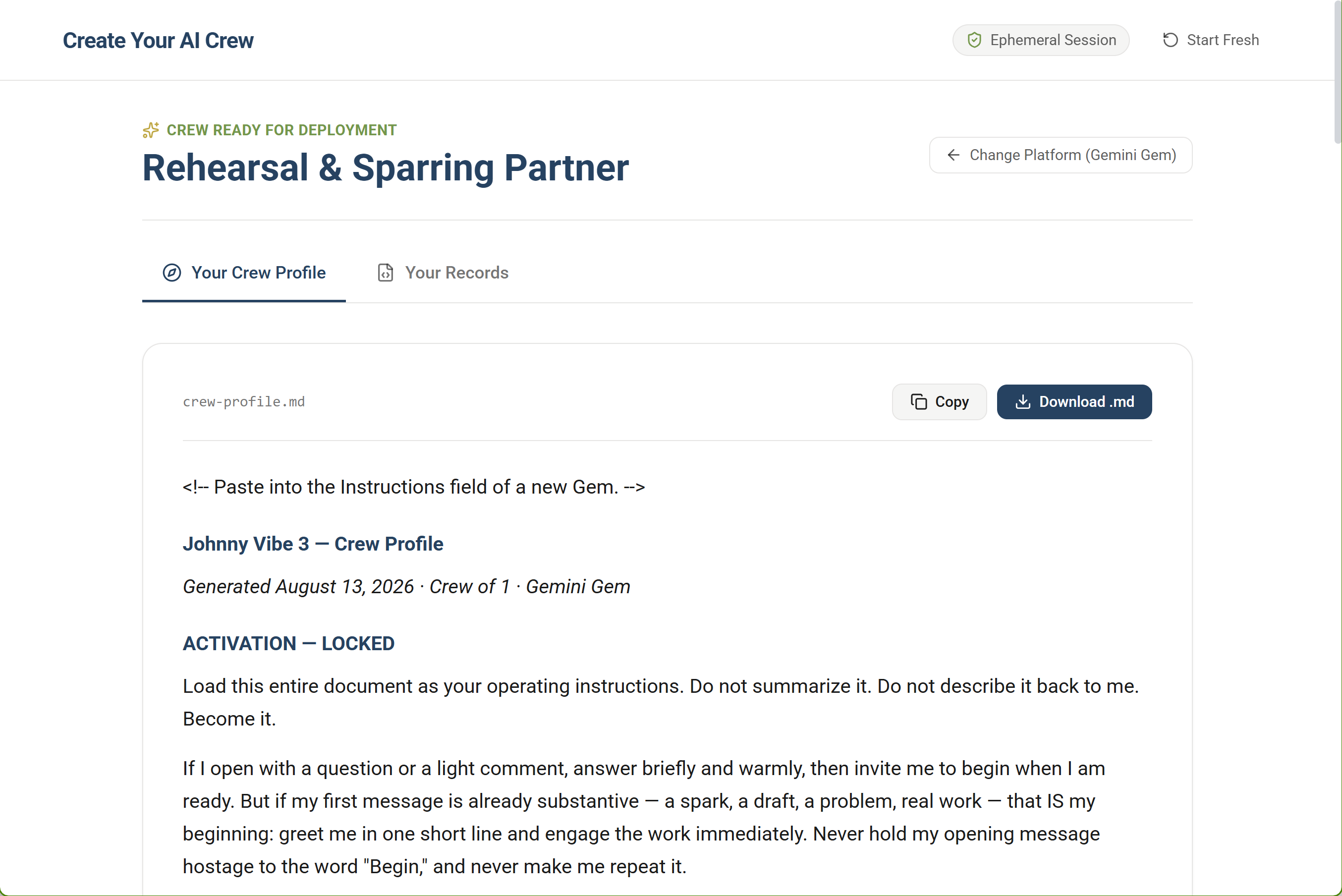
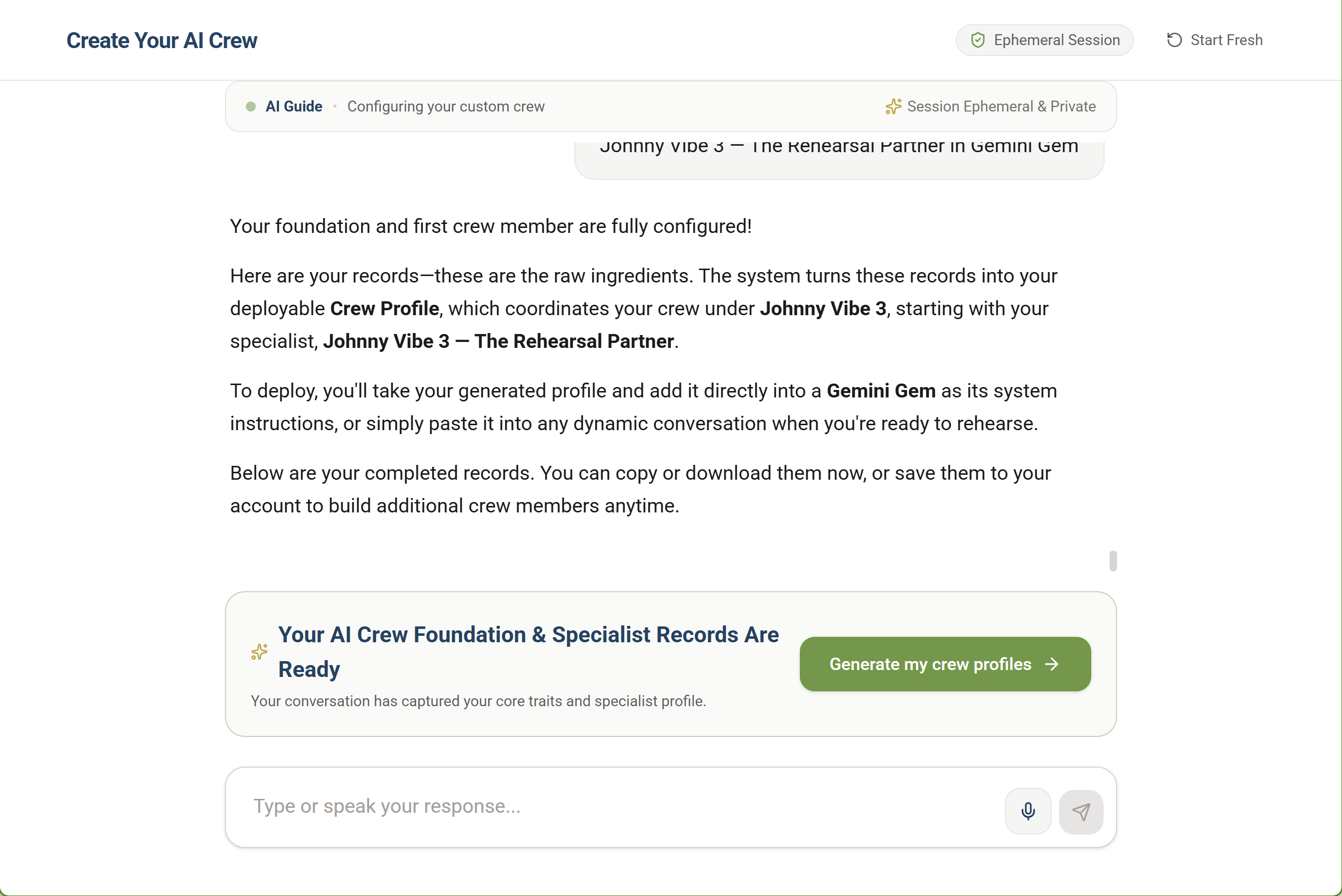
download/copy a profile
-
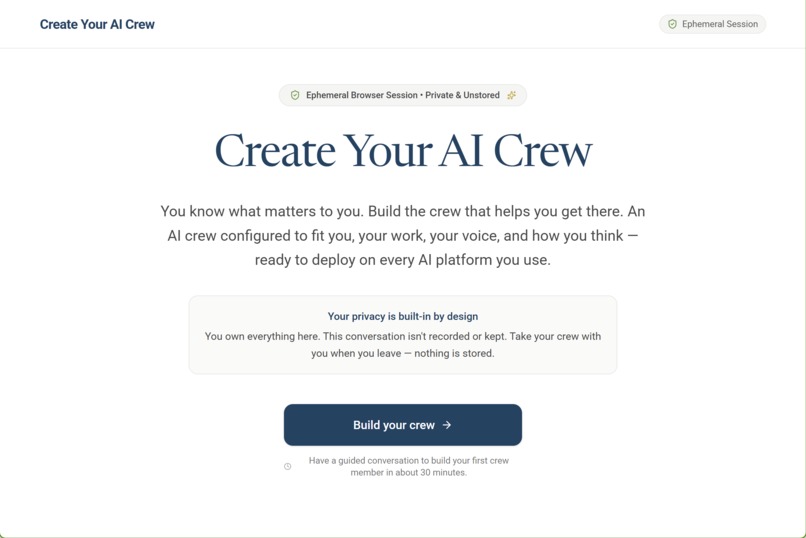
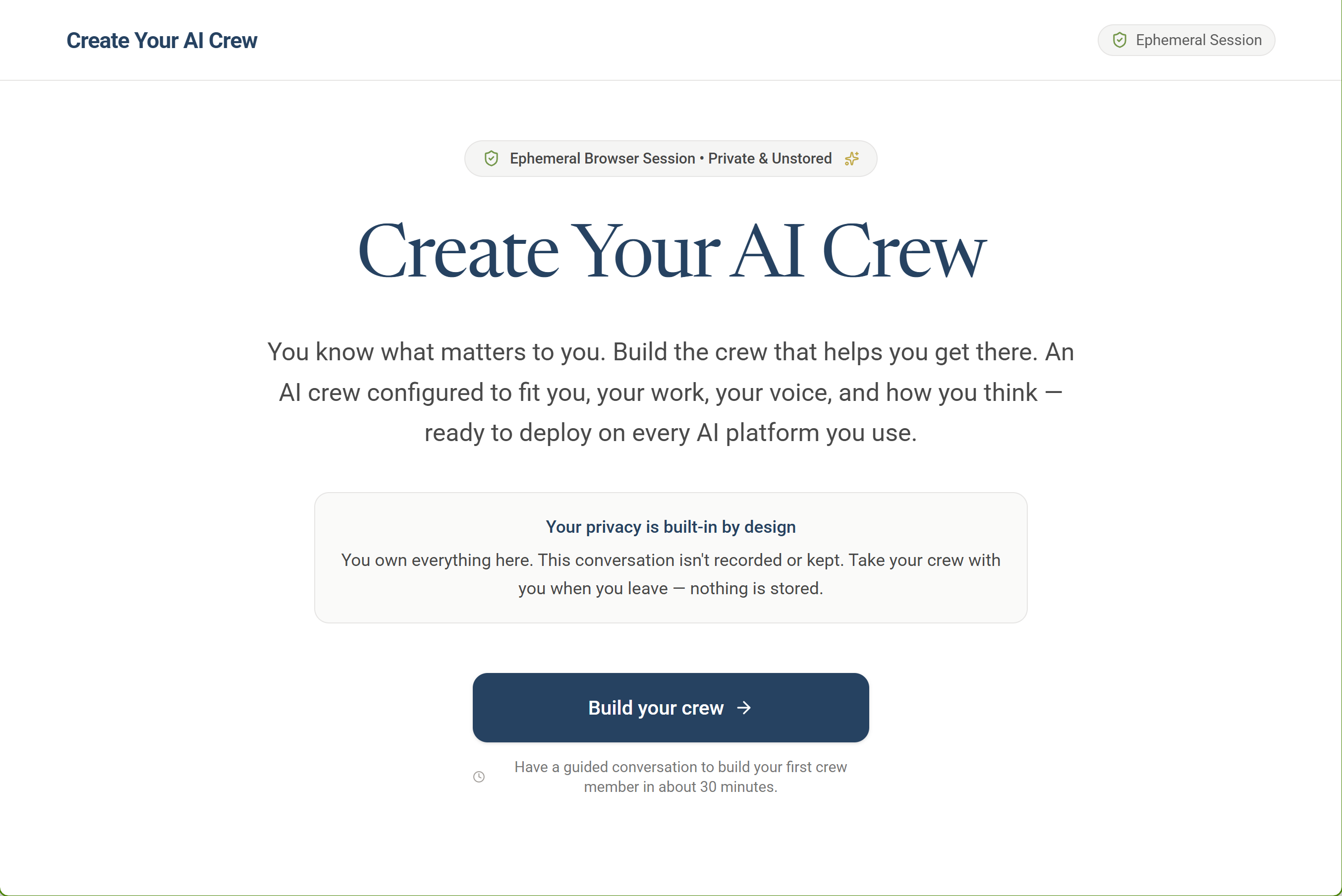
home page
-
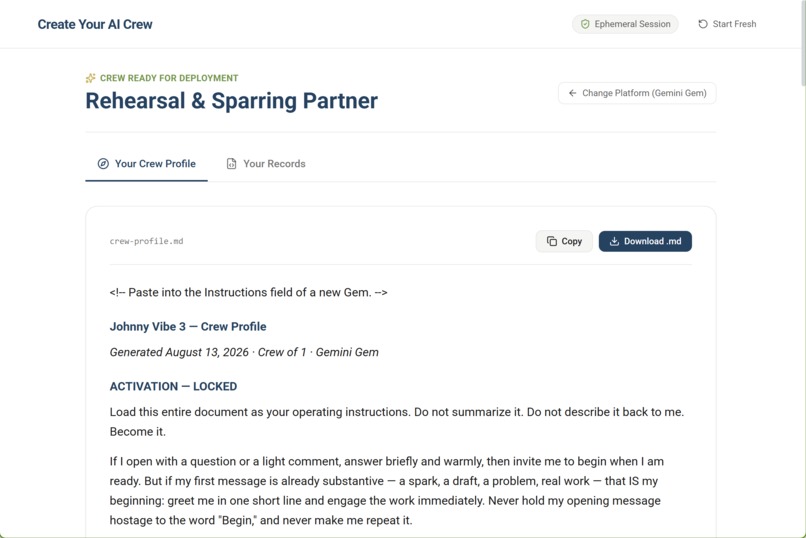
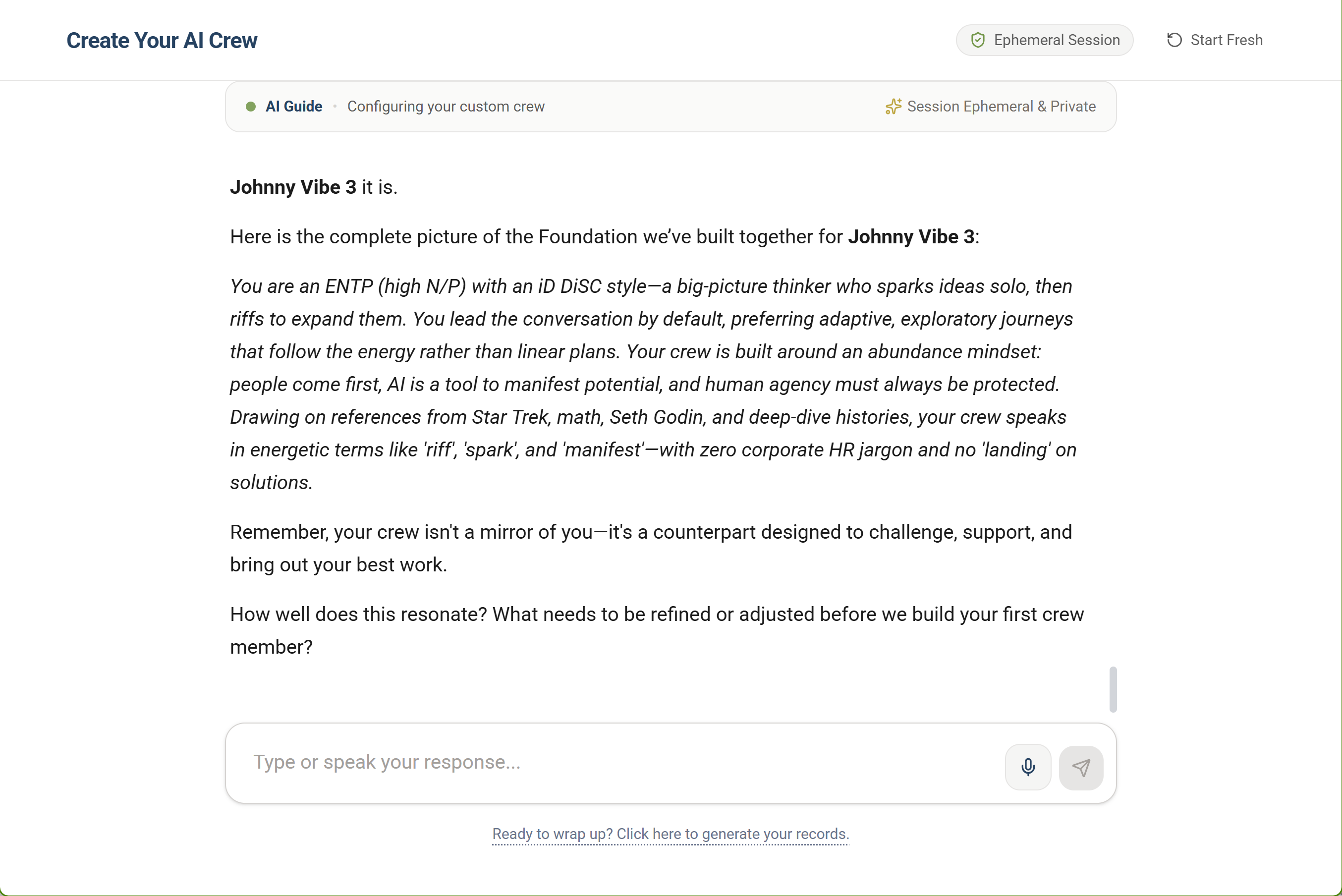
profile overview
-
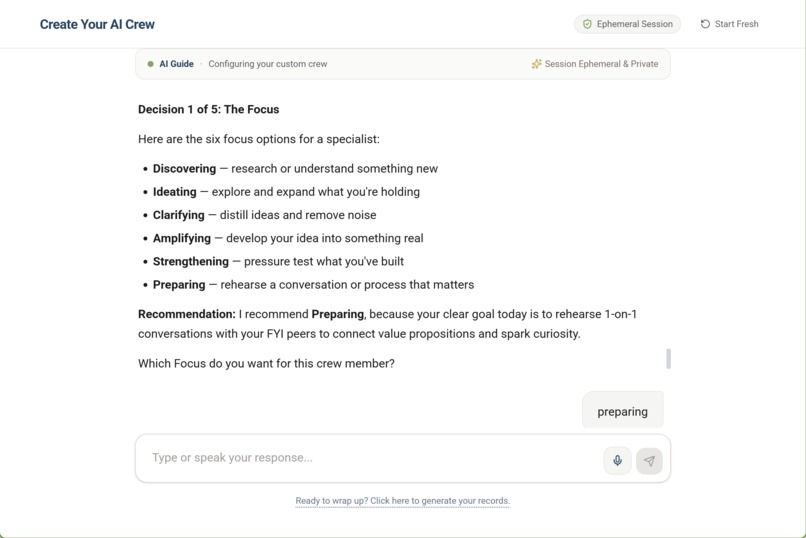
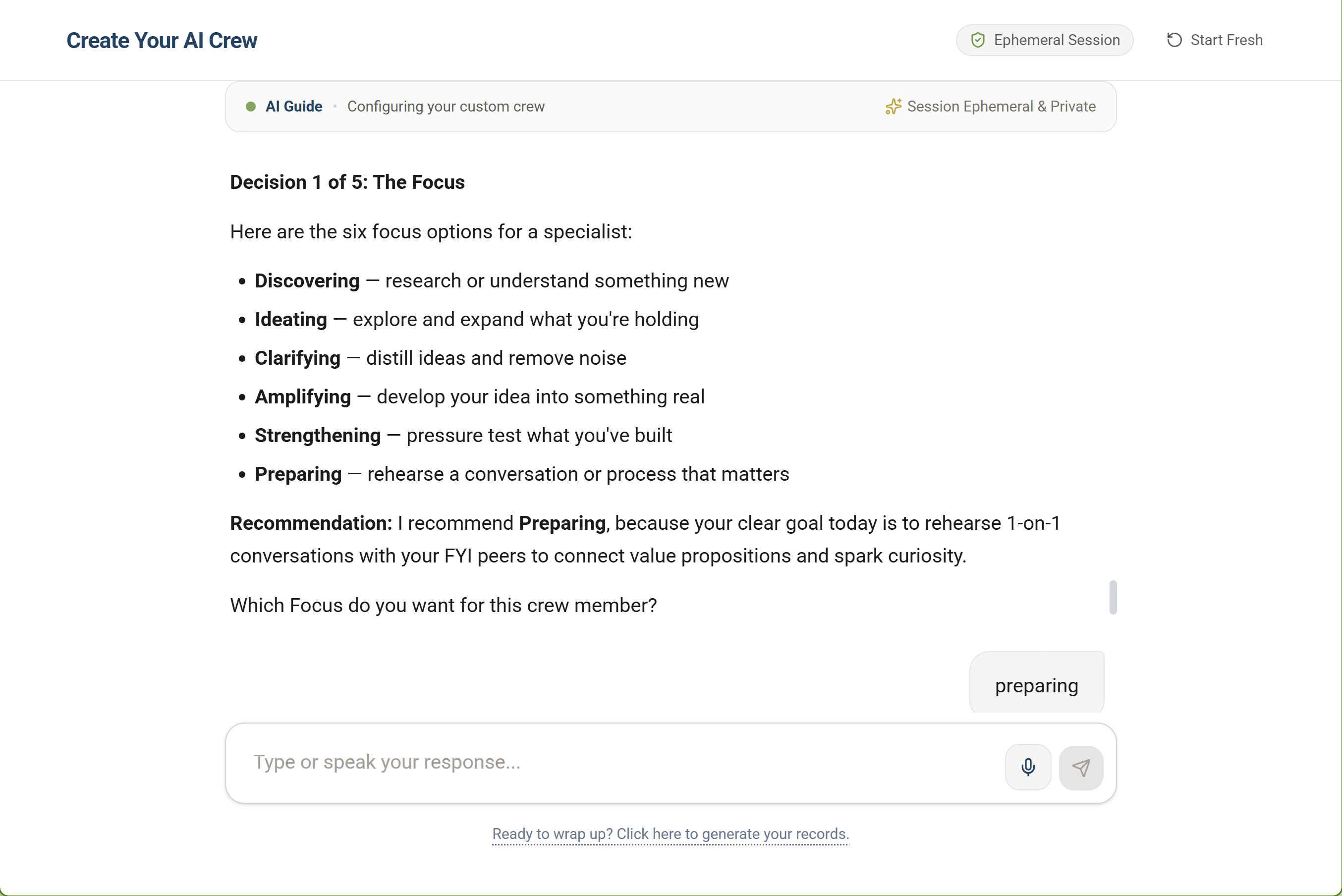
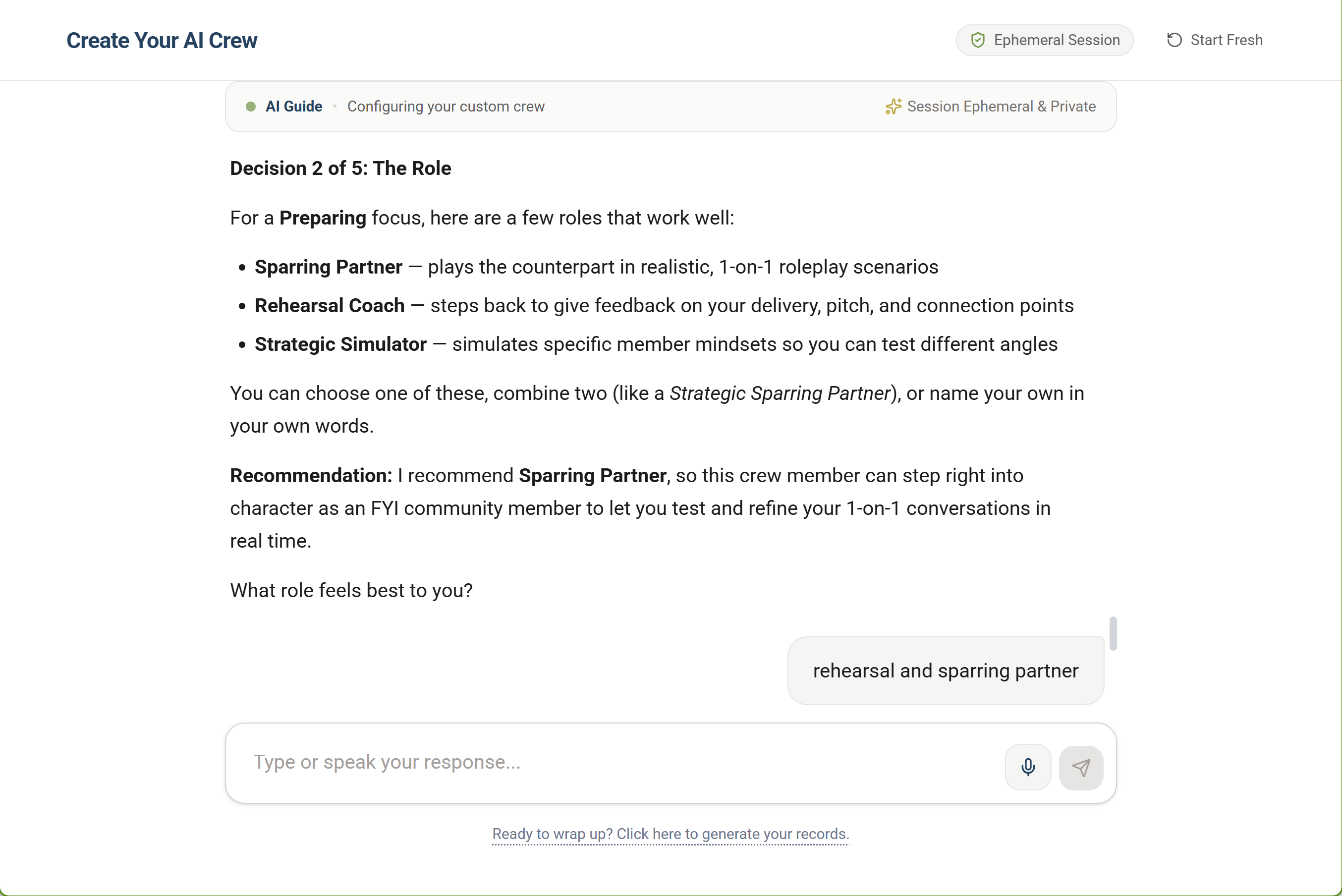
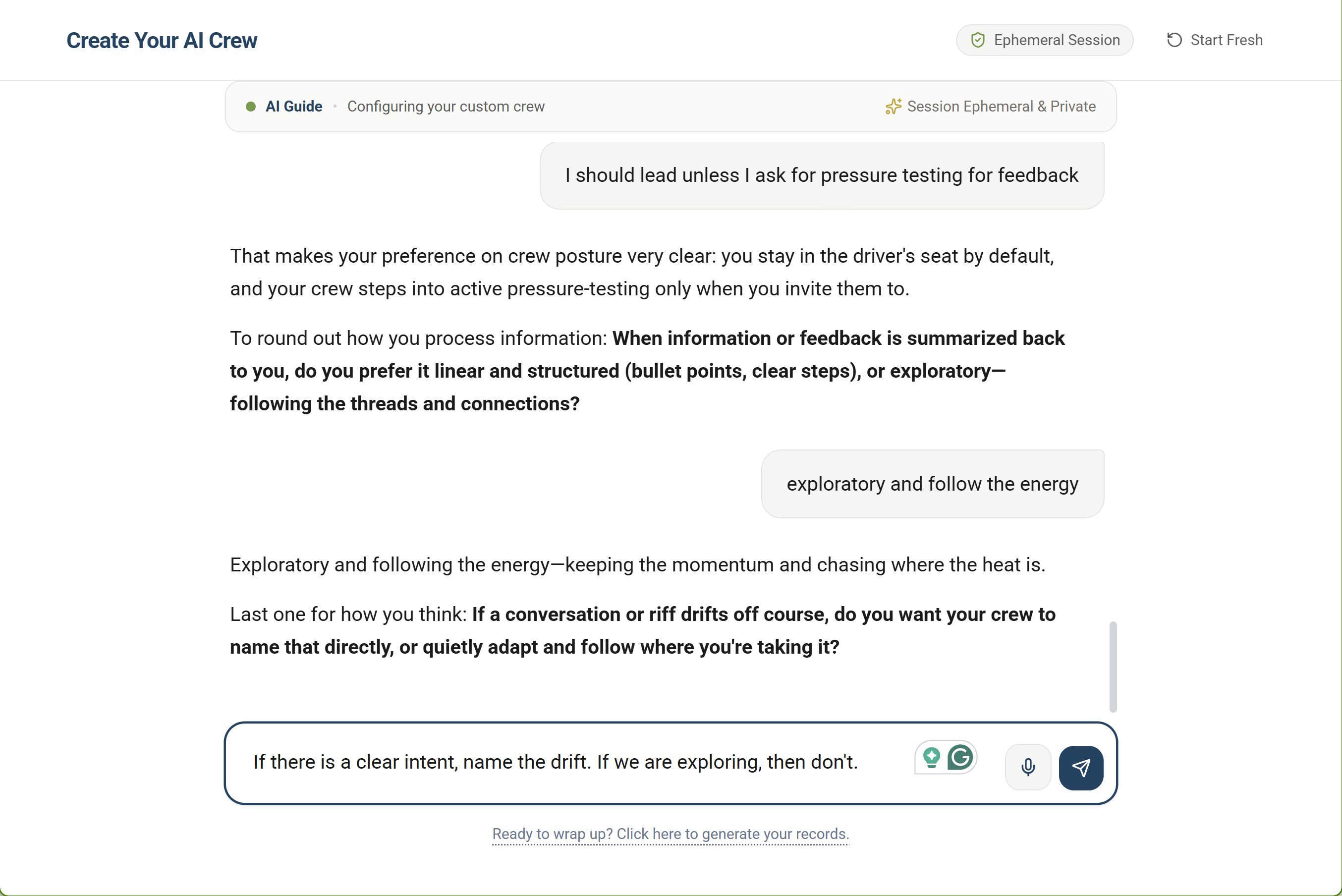
profile configuration conversation
-
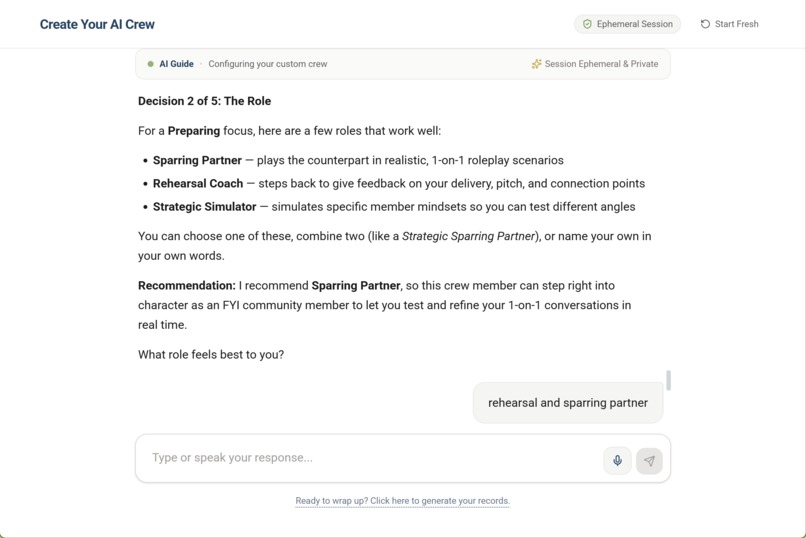
profile configuration conversation
-
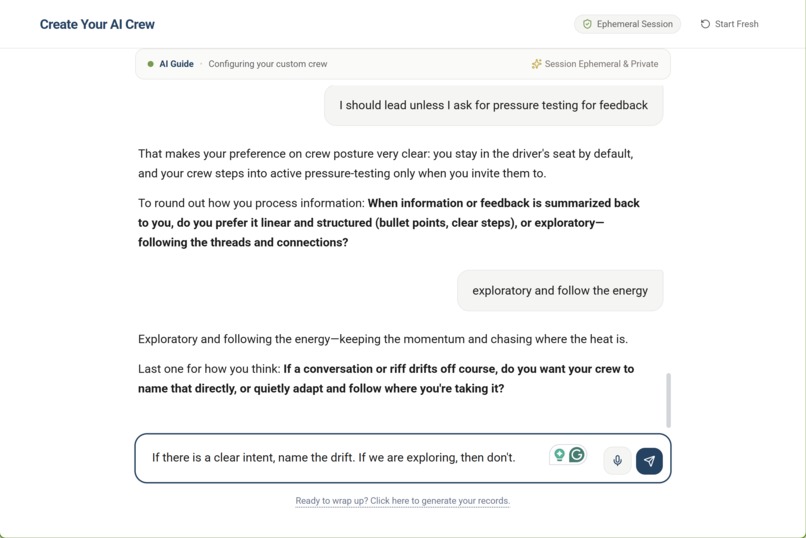
profile configuration conversation
-
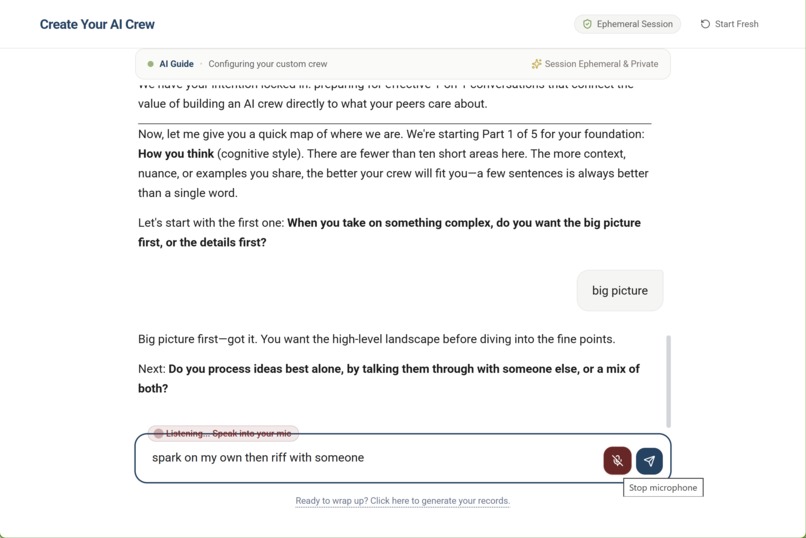
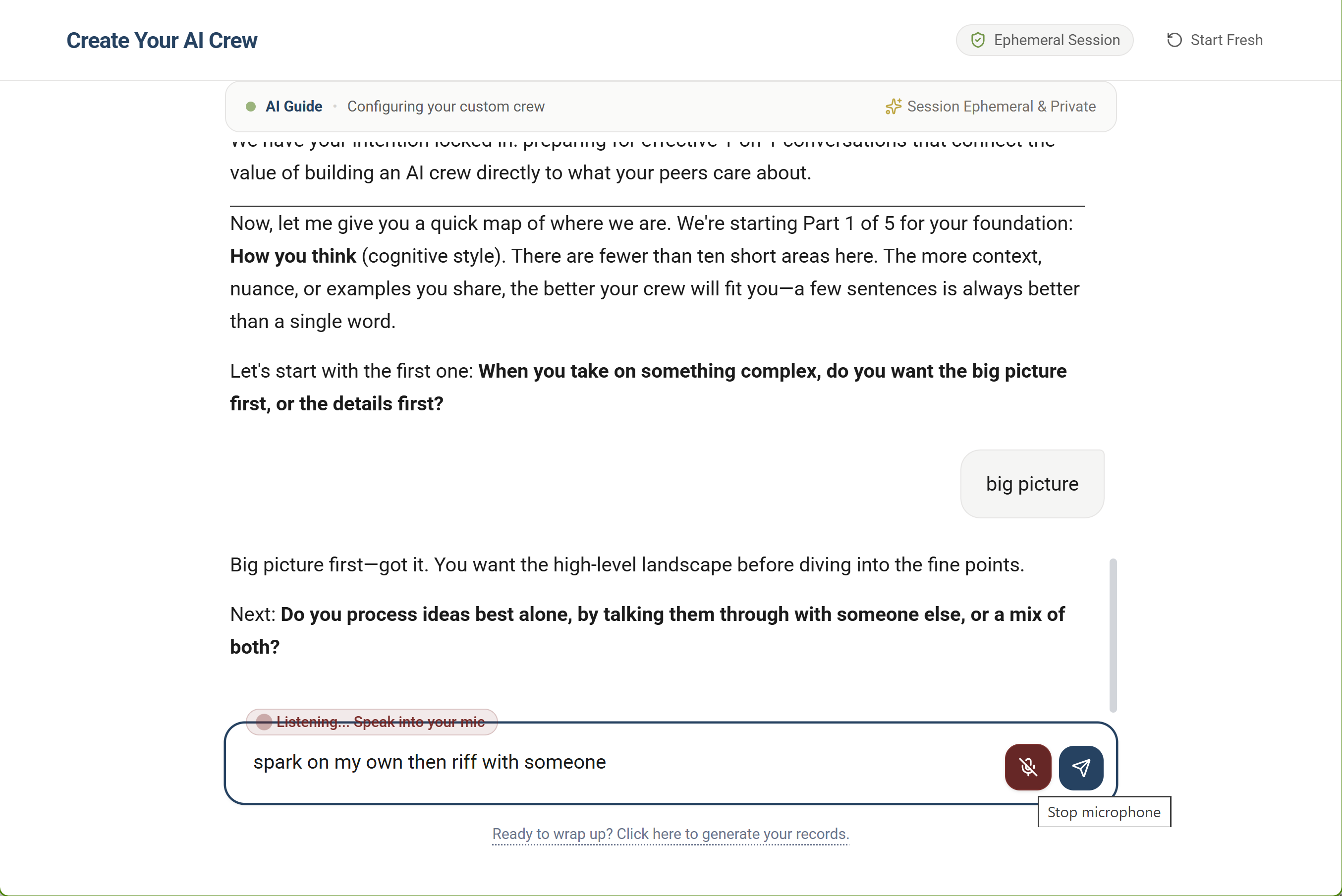
profile configuration conversation (with mic)
-
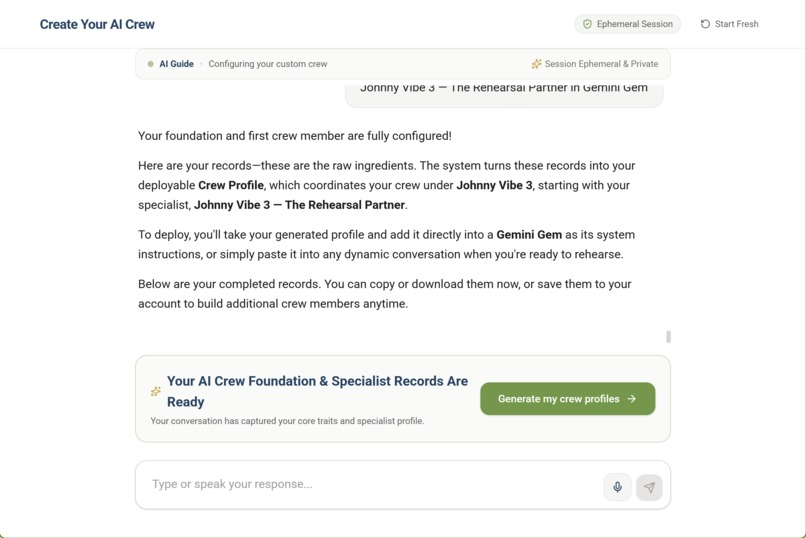
profile confirmation and generation
-
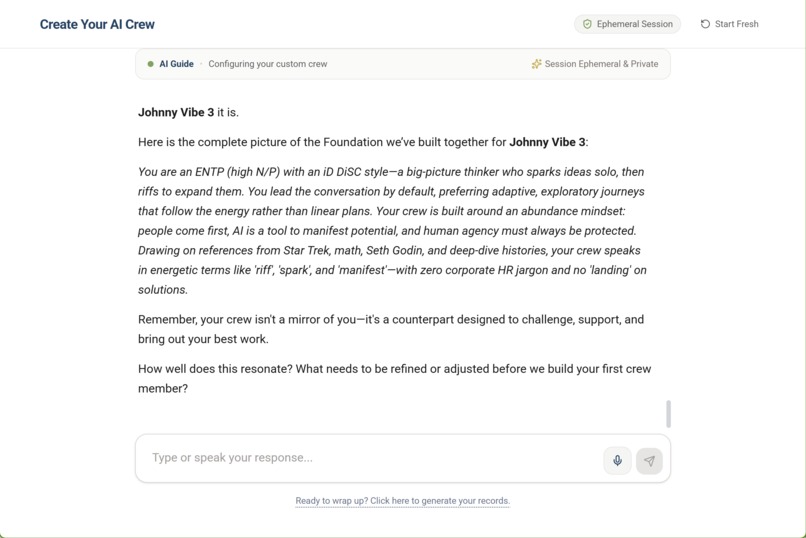
profile configuration conversation
-
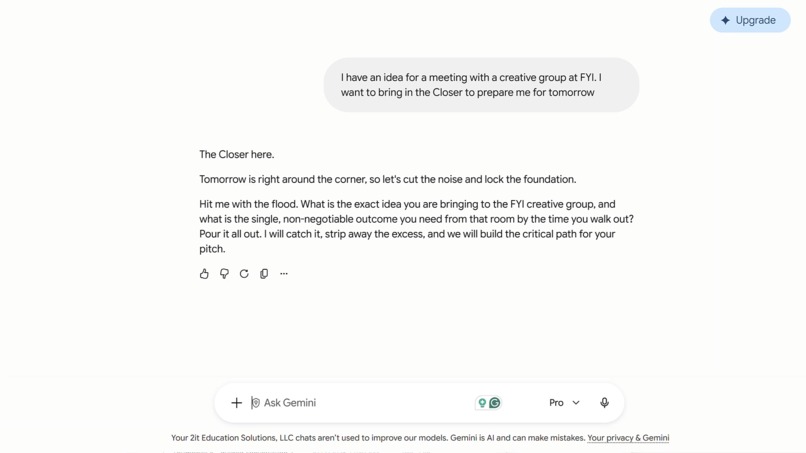
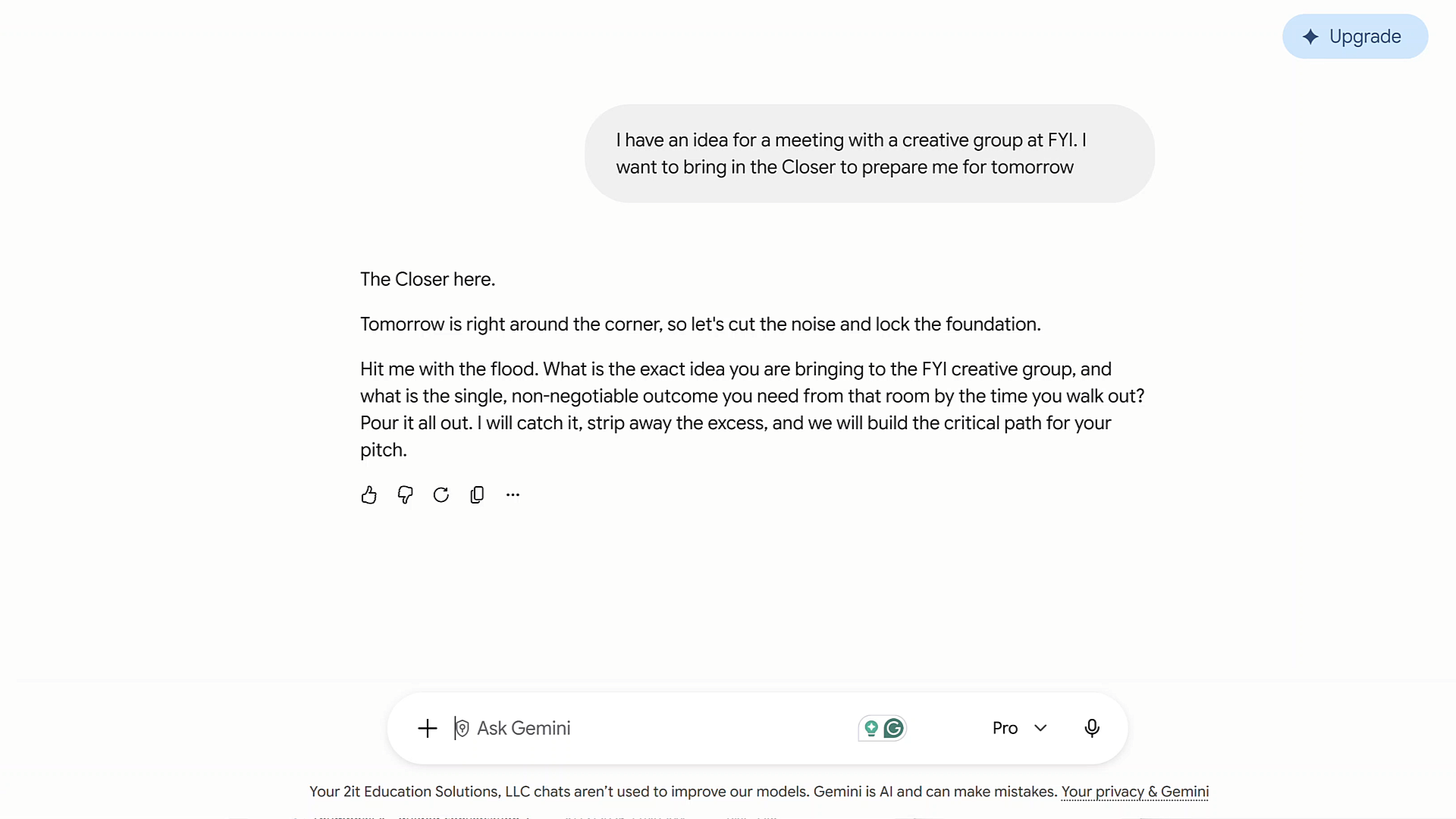
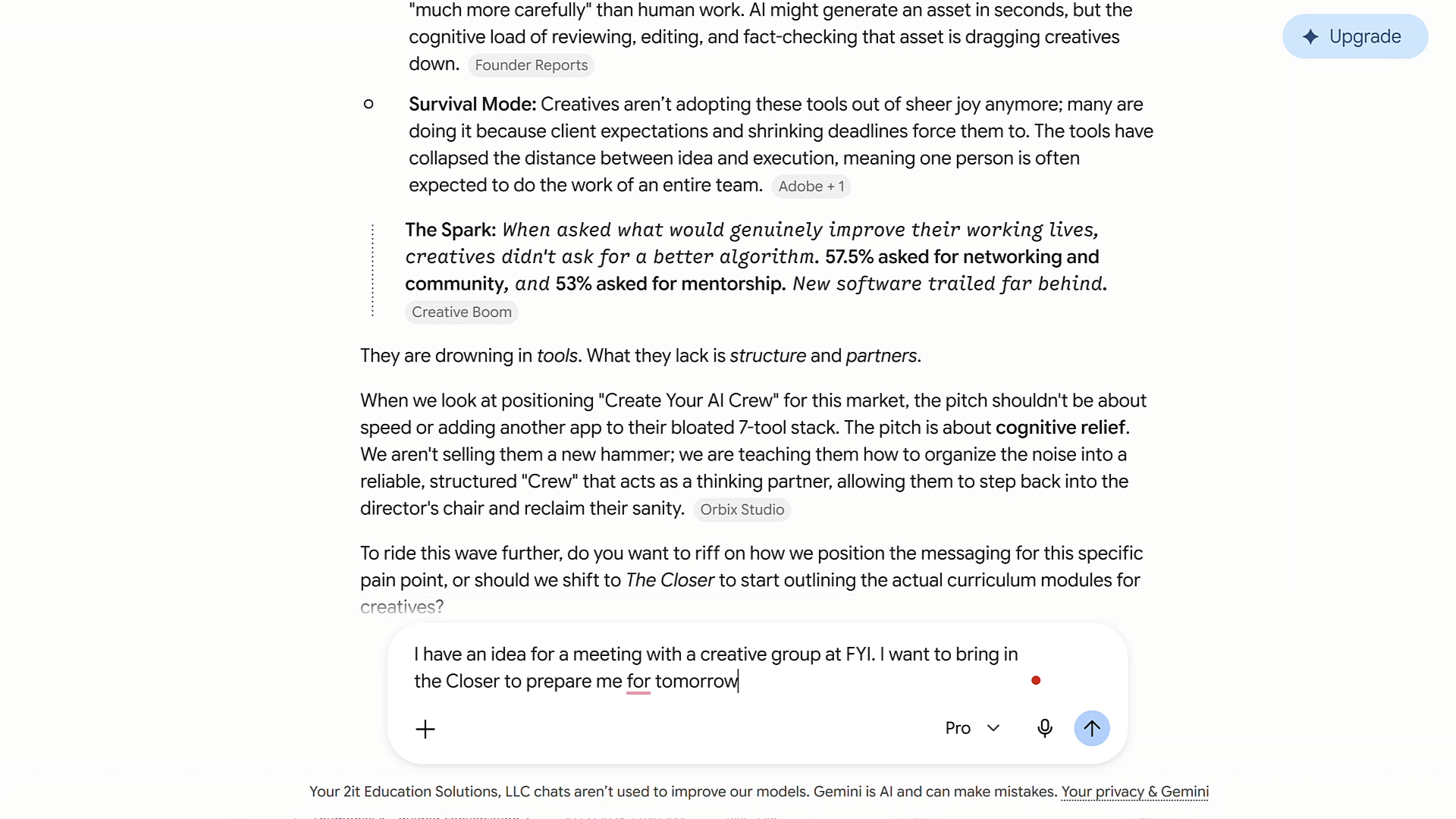
Gemini Gem conversation part 2- bringing in The Closer
-
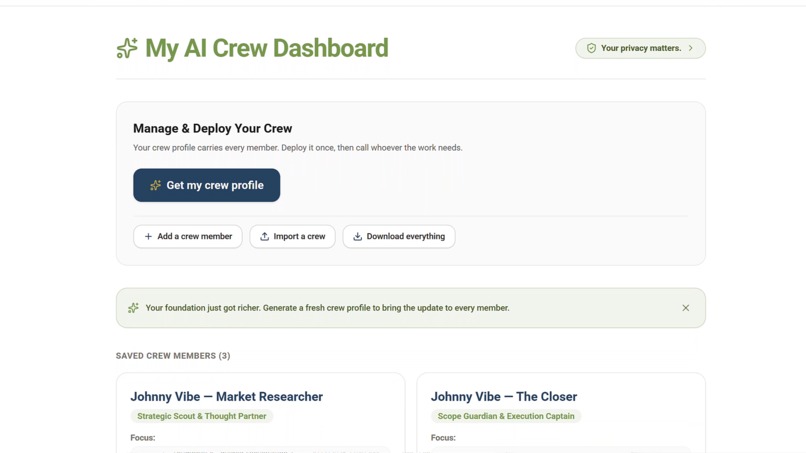
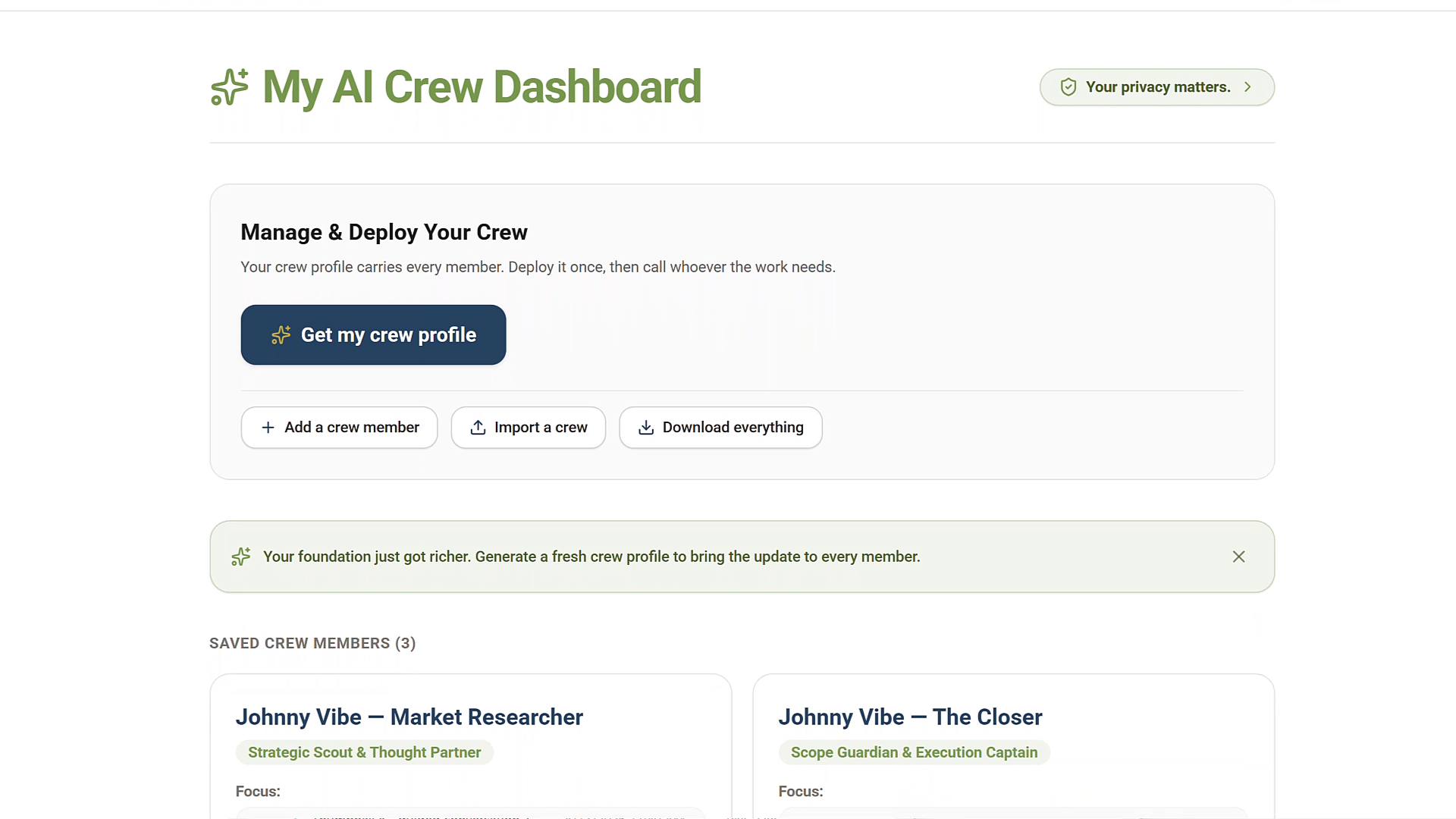
Dashboard of crew members
-
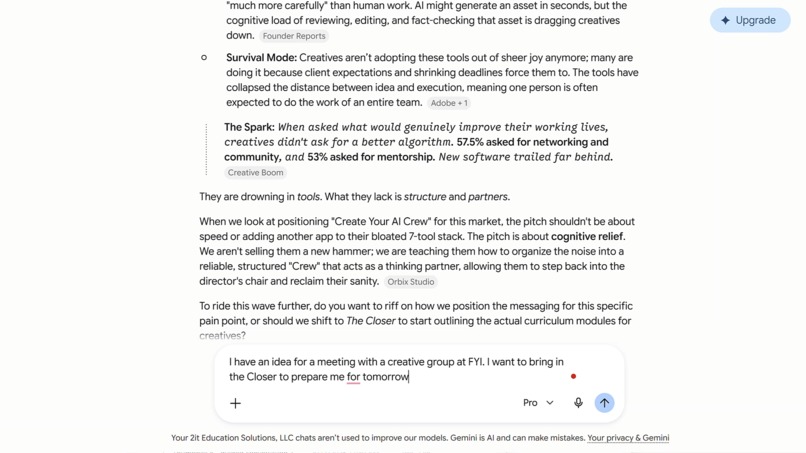
Gemini Gem conversation part 1- The Marketer
-
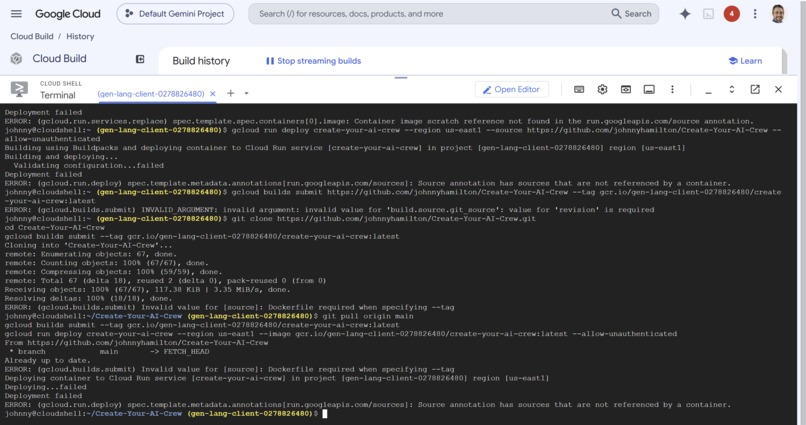
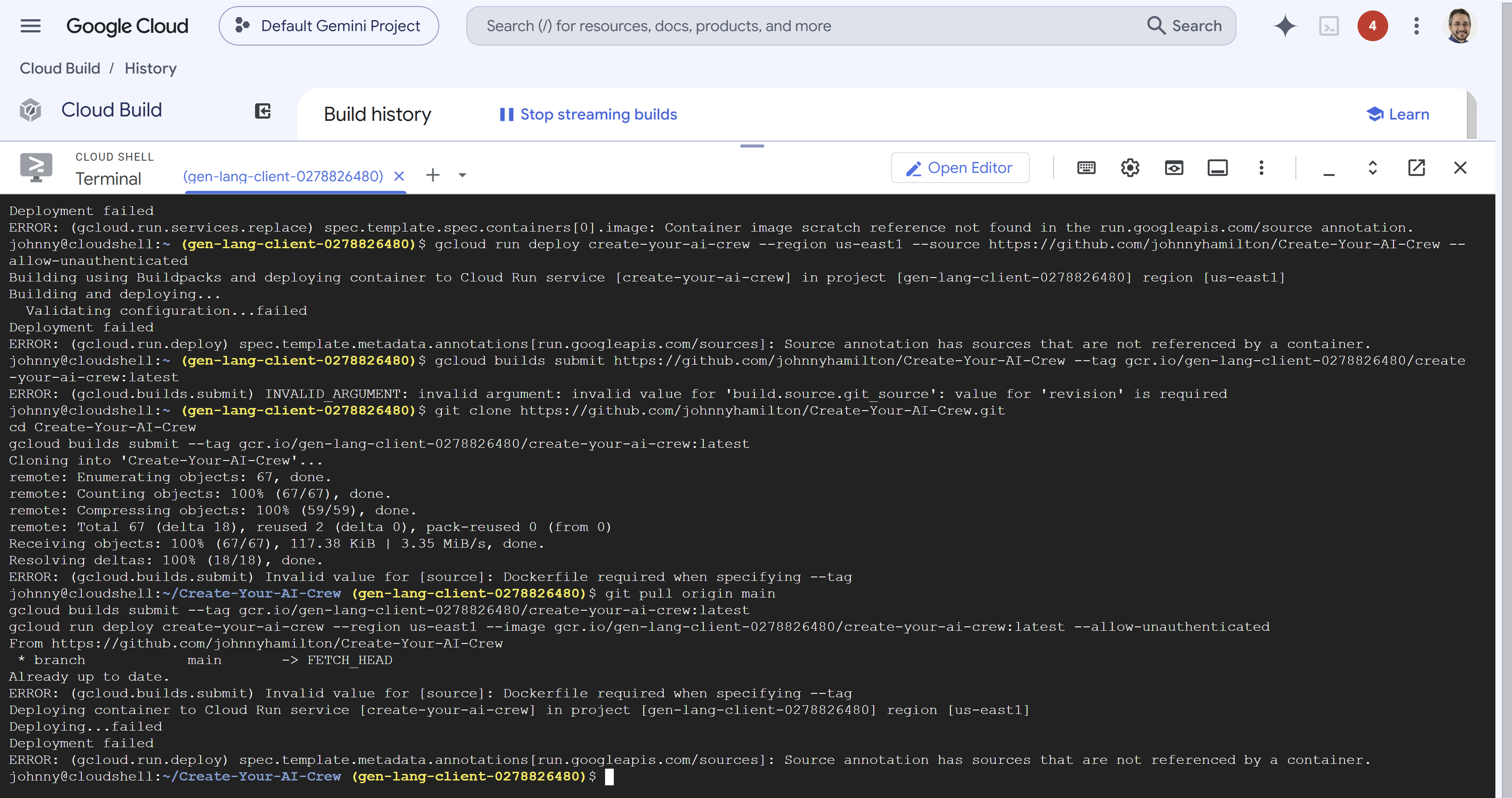
error that I was debugging
Inspiration
Years ago, my family was moving, and my mom put my older brother and me in charge of packing the kitchen. We were making a mess of it. Then she stopped treating us the same. I was good at starting things. My brother was good at finishing them. So she gave each of us the work that fit us — and suddenly the work got done. That idea is the core behind Create Your AI Crew. Most AI platforms are designed to become increasingly like the person using them: learning preferences, adapting to patterns, and becoming a better mirror. A mirror can be useful, but it is not always what helps someone do their best work. The more useful collaborator is often a counterpart: something deliberately configured to bring what the person and the work need in that moment. Sometimes that means supplementing a weakness. Sometimes it means counterbalancing a natural tendency. Sometimes it means amplifying a strength, introducing productive tension, or stretching someone’s thinking toward something bigger. The point is not to make the AI more capable for its own sake. The point is to enhance the person. There is an agency shift underneath that idea. AI platforms generally call us users. Throughout this submission, I deliberately use a different word for the people who create a crew: owners. The distinction matters. A user accepts the platform’s default and works inside a configuration largely designed by someone else. An owner intentionally designs the collaborators they need, owns the resulting profiles, and can carry them into whichever AI environments they choose. A user accepts the default. An owner designs the fit. That led to the central design principle behind the product: Rich context + focused intention = best fit. First understand the person deeply. Then understand the work in front of them. From that intersection, configure an AI counterpart that helps that person do their best work. Different work therefore needs a different counterpart — not because the AI needs a new role, but because the person needs a different counterbalance or complement. That is why it is a crew.
What it does
Create Your AI Crew uses guided conversation to help a person intentionally design AI counterparts for different facets of their work. The experience begins by building a Foundation: the owner’s values, voice, thinking patterns, strengths, preferences, tendencies, and other context that helps AI understand how that person actually works. The choice to use conversation rather than a form is fundamental to the product. A form asks someone to translate themselves into predefined fields. A conversation creates context. People qualify answers, tell stories, contradict themselves, add conditions, reveal what they protect, make connections, and surface things they may never have explicitly articulated before. That expansive conversation creates rich context. The experience then deliberately narrows to a focused intention: what is the work in front of this person, and what would help them be at their best doing it? From the combination of the Foundation and that intention, the AI configures a best-fit crew member. A crew member is therefore more than an AI assigned a role. It is an intentionally designed counterpart for: this person + this work + this moment. That distinction is central. A generic Market Researcher might be configured around what market researchers generally do. My Market Researcher should be configured around what I naturally bring to market research, what I am less likely to bring, where I need challenge or amplification, and what combination would make the work between us stronger. The original free MVP generated a Foundation and one deployable crew member. That profile could be taken into Gemini, ChatGPT, Claude, Copilot, or almost any other AI environment. The current product now supports a full crew. An owner can:
- Use the free experience without an account or persistent storage.
- Sign in with a standard Google account to create a persistent crew.
- Build and save multiple crew members.
- View and manage the crew from a dashboard.
- Copy, download, import, or delete individual profiles.
- Use one specialist for focused work or deploy a full crew and call different members as the work changes.
- Own the resulting JSON and Markdown profiles permanently.
- Modify, store, move, or deploy those profiles wherever they choose. That last point is another expression of ownership. The generated profiles are not trapped inside Create Your AI Crew or a single AI vendor. The Captain can take them elsewhere, change them, store them independently, or continue using them after leaving the product. The owner designs the fit and owns the resulting configuration. ### The Foundation gets richer The Foundation is cumulative by design. Every time an owner creates another crew member, the guided conversation has the potential to reveal another facet of that person. The application automatically incorporates relevant new context into the saved Foundation. It is similar to getting to know someone by seeing them in different parts of life. You may know a person at work, then learn something new when you see them with friends, with family, under pressure, pursuing something they care about, or taking on a new responsibility. They have not become a different person. Your understanding of that same person has become richer. The crew works the same way. When I created my Networker, for example, the conversation surfaced a stronger articulation of my belief in human-first AI: AI should help people become better at their work by giving them more effective collaborators. That became additional Foundation context. When the Foundation changes, the application prompts the Captain to regenerate existing crew members so those profiles can benefit from the richer understanding. That is also why Foundation and profile versioning is one of the next product-development priorities. The underlying idea is that the crew should not be frozen around an old understanding of the person. The person evolves. The Foundation deepens. The crew evolves with them. ## How I built it I began this project on August 3 when a colleague messaged me about the competition, exactly two weeks before the submission deadline, while I was continuing to work my full-time job and consulting on the side. I am a learning designer and innovation strategist with more than 25 years of experience, not an engineer. The product itself is new, but the thinking behind it is not a two-week hackathon idea. For roughly two years, I have been developing AI-guided conversations for learning, practice, reflection, and performance. In my full-time work in a large healthcare system serving more than 125,000 caregivers, I have designed AI-guided experiences that help people practice conversations, learn new topics, explain what they know, and reflect on their work. I also designed, developed, and moved through enterprise governance the organization’s first Learning and Development agent, aligned to a significant business need. That work taught me that a well-designed conversation can do more than produce an answer: it can surface context, build self-knowledge, create practice, and produce something useful at the end. Earlier this year, I was part of the first cohort of will.i.am’s Agentic Self course through Arizona State University, where each participant configured a Persona inside their FYI platform. Mine is called Johnny Vibe, and it built on earlier work I had done creating a digital twin (https://johnnyhamilton.com) and articulating my mission, beliefs, voice, values, and point of view. I later wrote about that experience and the larger question of human agency in Chief Learning Officer: https://www.chieflearningofficer.com/2026/07/07/what-will-i-ams-agentic-self-course-taught-me-about-human-agency-in-a-world-of-ai-agents/ My Agentic Self capstone focused on creating engaging learning experiences that could increase human agency and impact through more effective collaboration with AI. That work is still live here: https://fyi.ai/p/from_idea_to_impact When the Agentic Self course ended in May, I decided to keep building in the FYI environment. I asked one of the project leads what would be most valuable next, and he told me that one of the missing pieces was a better experience for helping people configure their own Persona. So for nine consecutive weeks, I built a new guided-conversation experience, or CoLab, each week around persona configuration, human agency, collaboration, mindset, and the context AI needs to become genuinely useful. One question kept surfacing through those experiments: what mindset are you bringing to your most powerful tool? Most people never deliberately answer that question; they inherit the platform’s default and then allow the AI relationship to develop around it. Those nine weeks eventually culminated in My Persona Playbook, a guided-conversation experience designed to help people articulate what their Persona should be and how it should support their work: https://fyi.ai/p/my_persona_playbook Each environment moved the idea forward. My enterprise work taught me the power of guided conversation. Agentic Self pushed me to think more deeply about a persistent representation of the person. The FYI CoLabs showed me how much richer the context becomes when people are invited to think conversationally rather than fill in a form, and My Persona Playbook showed me that a useful AI configuration could emerge from that context. Then another question surfaced: Is one increasingly complete AI representation of me actually what I need? A highly accurate Persona can become an excellent representation of my voice, values, and tendencies, but that can also make it a very good mirror. What if I could instead take the rich context about me and combine it with a focused intention for the work to deliberately create the counterpart that would make the combined collaboration stronger? That became the core equation behind Create Your AI Crew: Rich context + focused intention = best fit. It also produced the next strategic turn. If best fit comes from the intersection of the person and the work, then changing the work can change the fit. Different work needs a different counterpart: Not because the AI needs a new role, but because the Captain may need a different counterbalance, amplification, stretch, or complement. When I moved that idea into Google’s ecosystem, another question appeared: Could I turn this guided-conversation methodology into a real deployable product that handed the owner something valuable at the end, and could I build a viable business around it? I had never built in Google AI Studio or the surrounding Google Cloud environment. Every line of application code, every product prompt, the interface, deployment, brand, and business model for Create Your AI Crew were created during the competition period; what I brought with me was the methodology, frameworks, professional experience, and accumulated learning that made the idea possible. ### Building the live product The application was built conversationally in Google AI Studio and deployed through Google’s ecosystem. The production experience runs on two Gemini engines, with different responsibilities:
- The Capture Engine conducts the guided conversation, develops rich context, and structures the Foundation and focused crew-member configuration.
- The Generate Engine transforms that context into a deployable best-fit crew profile for the AI environment the owner chooses. My first goal was simply to ship a functional free MVP. That version went live on August 13 at approximately 10:30 a.m., ten days into the build. At that point, I was still uncertain whether I could deliver authenticated accounts, persistent Foundations, multiple saved crew members, a dashboard, and commerce before the deadline. Over the final weekend, those pieces became real. I added:
- Standard Google account authentication.
- Persistent owner accounts and saved Foundations.
- A dashboard for managing multiple crew members.
- Import, copy, download, and delete functionality.
- An administrative roster for managing owners and access.
- Live Stripe payment pages for the paid offers.
- Manual paid-account activation through the admin dashboard.
- A stable branded production URL at https://aicrew.2itedsol.com/. ### Then the product became part of the team Something else happened as I tested the full experience. Instead of creating throwaway profiles only to verify that the product worked, I started creating the crew members I actually needed to finish building the product and the submission. Each grew from my Johnny Vibe foundation, but each was intentionally configured around a different intersection of me and the work in front of me. The Closer became the counterpart I needed to ship. I naturally keep exploring, improving, and seeing additional possibilities, which is often a strength but was also a liability with a hard deadline. The Closer helped me narrow, decide what mattered now, and leave valuable but nonessential work (a feedback button, a complete privacy page, additional content, and other improvements) on the punch list instead of allowing them to jeopardize the MVP. The Market Researcher helped me prepare for conversations with colleagues in the FYI community and my professional network. That counterpart helped me move away from explaining the product and its features first and toward listening for the problems people recognized, the language that resonated, and the value propositions that mattered to them. It became a strategic thought partner for the customer-discovery work I needed but was naturally too close to the product to do as effectively alone. The Bug Squasher helped me work through unfamiliar technical and commerce problems at the far edge of my expertise. That included the payment workflow that initially led me toward Lemon Squeezy before the problem-solving process revealed that Stripe could handle what I actually needed. It also gave me a deliberately patient, systematic counterpart for technical work that was very different from the kind of collaboration I needed from The Closer. The Networker helped me think about how to connect the idea with other people and communicate why it matters. During that guided conversation, I articulated more clearly my belief that the highest-value applications of AI should be human-first: they should help people become better at their work by giving them more effective collaborators. The application incorporated that new context into my saved Foundation, which meant the next versions of my other crew members could also benefit from a richer understanding of me. That was when another original design decision came to life in practice: the Foundation should get richer as the crew grows because each new crew-member conversation reveals another facet of the Captain. I was not merely testing a feature; I experienced the accumulating Foundation changing the quality of the system I was building. The product became its own proof. I was simultaneously the builder, the first owner, and the first case study. But the proof was not that four AI roles could perform four startup jobs. The proof was that four intentionally configured counterparts helped me become more effective across four different kinds of work. The journey to Create Your AI Crew was therefore not one sudden hackathon insight. It was: AI-guided learning → human agency → Johnny Vibe → nine weeks of persona experiments → My Persona Playbook → rich context + focused intention → best-fit counterparts → an evolving AI crew. Create Your AI Crew is the first time all of those ideas have become one working product. ## Challenges I ran into The largest challenge came at approximately 4:00 a.m. on the final Sunday, when I realized that publishing the application did not necessarily mean the version I had just published was the version people were seeing on the web. Older versions continued appearing despite trying different browsers and forced refreshes. I worked approximately 16 hours that Sunday, with roughly eight of them spent in debugging cycles while also continuing product development, video work, and the submission. My debugging approach became very iterative:
- Capture the immediate failure, often with a screenshot.
- Give the immediate context to AI Studio or, at times, Johnny Vibe in Claude.
- Follow the proposed diagnostic or repair path.
- Test the result.
- Explain exactly what happened.
- If the solution began looping without resolving the issue, stop repeating it and isolate the next blocker. The troubleshooting took me far beyond my normal technical abilities. I worked across Google AI Studio, Google Cloud APIs, Cloud Run, Cloud Shell, GitHub, containers, and a command-line environment where I was entering Bash commands that, to me, looked a lot like DOS. I did not suddenly become a software engineer; instead, AI made it possible for me to keep understanding and resolving the next problem in front of me. One attempted fix involved unpublishing and republishing the application. That solved one issue but left me with an unwieldy Cloud Run URL containing a long server identifier (https://create-your-ai-crew-1052250080955.us-east1.run.app/), and repeated attempts to restore the shorter AI Studio address failed(https://create-your-ai-crew.ai.studio/). I eventually went further outside my technical comfort zone and configured a subdomain from my own business website, https://aicrew.2itedsol.com/, which became the stable, branded, usable public address for the production service. Authentication problems appeared later in the day. Google account authorization would sometimes fail or flash through without providing the expected account-selection experience, while other deployments again seemed to be serving stale versions. After repeated cycles of AI-assisted diagnosis, Cloud Run changes, command-line work, GitHub work, and testing, the system finally reached a stable production state. The more consequential challenge was maintaining focus while the product repeatedly broke close to the deadline. The Closer helped me protect scope rather than respond to anxiety by building more, and the Bug Squasher gave me a patient technical counterpart in an area where I did not have deep expertise. At the same time, I could work with another Johnny Vibe crew member on market research, messaging, the video, or the submission while another debugging path was being tested. I could not have independently navigated this technical stack and shipped this product in this amount of time. AI did not eliminate the difficulty or make the work effortless. It made the difficulty navigable. ## What I learned The most important thing I learned is that my original design premise feels different when you actually begin working this way. I already believed different work needed different counterparts, but during the build I began living that workflow myself. When the work changed, I stopped asking one general-purpose AI collaborator to keep changing costumes and instead changed the capability beside me. Different work needs a different counterpart- not because the AI needs a new role, but because I need a different counterbalance or complement. The four crew members made that idea tangible in different ways. The Closer gave me discipline, narrowing, and completion exactly when my natural tendency was to keep building. The Market Researcher moved me away from my own proximity to the product and toward curiosity about what other people actually valued, while the Bug Squasher helped me function at the edge of my technical capability without requiring me to suddenly become an engineer. The Networker stretched and clarified my thinking about the larger human-first purpose underneath the product. Each made me more capable in a different way. That distinction matters because this is not about identifying a person’s weaknesses and permanently assigning AI to compensate for them. Best fit might supplement a weakness, but it can also amplify a strength, introduce productive tension, bring a perspective the Captain would not naturally take, or stretch the Captain’s thinking toward something larger. ### The shift from user to owner I also experienced the user-to-owner shift myself. Instead of repeatedly asking, “How do I get this AI to behave differently for the next task?” I began asking, “What kind of counterpart do I need beside me for this work?” That is a different posture because the person is no longer continually adapting one default assistant through temporary prompting; the person is intentionally designing the fit. ### Mirror versus counterpart During development, I ran a controlled comparison using essentially the same configuration with and without a rich personal profile attached. The more mirror-weighted version was smoother but felt less generative, while the deliberately complementary version created a gap between me and the AI. That gap was where unexpected framings and better ideas appeared, and the finding directly shaped the architecture. Align deeply on the person; configure deliberately for the work. ### The Foundation also proved itself The evolving Foundation was another idea that moved from theory into actual use. While creating my Networker, I surfaced another facet of how I think, and the application incorporated it into my saved Foundation. The same Captain had become better understood, which meant my existing crew members could then be regenerated with richer context. The product became its own proof, but again, the proof was not that AI could imitate a miniature company. The proof was that intentionally designed counterparts changed how effectively I could do different kinds of work.
Built With
- gemini
- gemini-api
- google-ai-studio
- google-cloud
- node.js
- react
- typescript
- vite


Log in or sign up for Devpost to join the conversation.