-
-
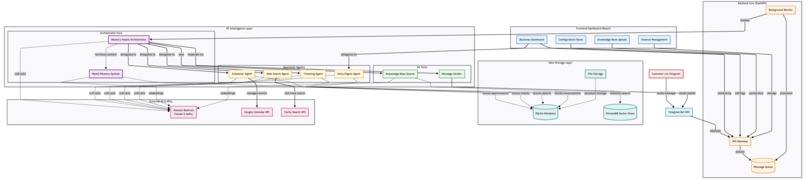
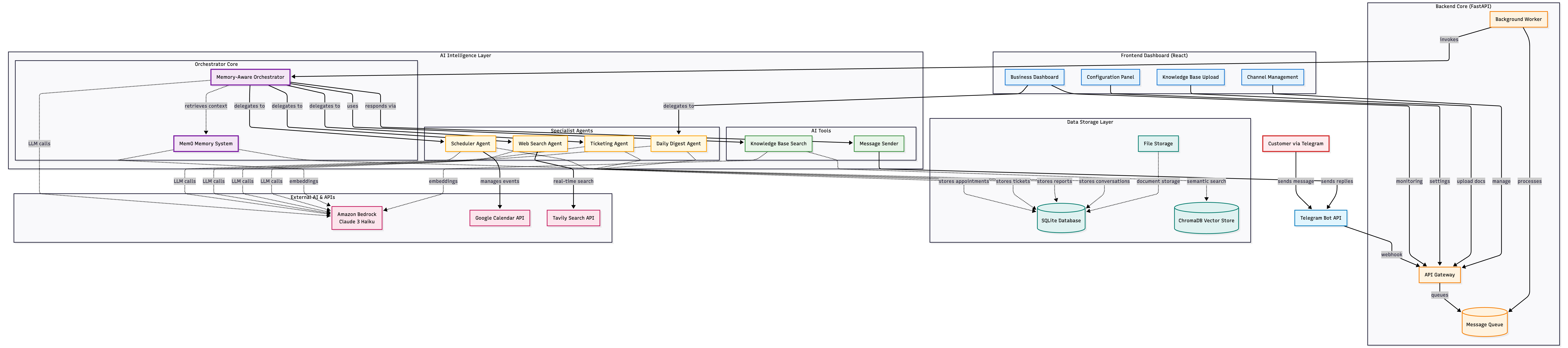
https://www.mermaidchart.com/d/843fba11-979d-4de7-8416-16acb6126795
Inspiration
We noticed that most chatbots fail to understand customer intent beyond preset responses. When users phrase questions differently, support breaks. Staff then manually check documents, calendars, and tickets — wasting time and reducing efficiency. We wanted to build an intelligent, configurable AI system that any business could set up in minutes to automate support, scheduling, and insights seamlessly.
What it does
SuperConfig allows businesses and individuals to launch their own AI Business Agent in under 3 minutes. The agent manages multi-channel conversations (starting with Telegram), schedules meetings, handles support tickets, retrieves data from company documents using RAG, and provides real-time summaries. It acts as a personalized, intelligent assistant that’s always available, context-aware, and brand-aligned.
How we built it
We designed SuperConfig as a multi-agent architecture powered by FastAPI and React. The orchestrator agent coordinates specialist agents for scheduling, ticketing, and web search. We used Amazon Bedrock with Claude 3 Haiku for language processing, ChromaDB for semantic search, and Mem0 for persistent memory. The system integrates with Telegram for chat, Google Calendar for scheduling, and a business dashboard for monitoring. All processes run asynchronously to ensure high performance and reliability.
Challenges we ran into
We faced issues ensuring the system maintained consistent memory across long conversations, integrating multiple APIs smoothly, and managing asynchronous message queues without dropped data. Designing modular agents that cooperated effectively required careful coordination logic. Another challenge was balancing model speed and cost while maintaining high response accuracy.
Accomplishments that we're proud of
We built a fully functional AI support platform that can be deployed in under 3 minutes, requiring no code. It integrates chat, scheduling, ticketing, and analytics seamlessly. The architecture supports multiple channels and persistent conversation context. We also achieved real-time document retrieval and daily business insights within a single unified dashboard.
What we learned
We learned that effective context handling and modular design are crucial in multi-agent systems. Asynchronous task processing significantly improves reliability under high message loads. We also gained experience working with LLM orchestration, vector databases, and memory systems, and learned how to design AI workflows that align with real business operations.
What's next for SuperConfig
Next, we plan to expand to WhatsApp and Web Chat integrations, add sentiment detection for intelligent escalation, and support multimodal input (voice and image). We’ll also introduce predictive analytics, enterprise integrations like Salesforce and HubSpot, and white-label deployment so any company can host its own AI support platform.

Log in or sign up for Devpost to join the conversation.