-
-
Thumbnail
-
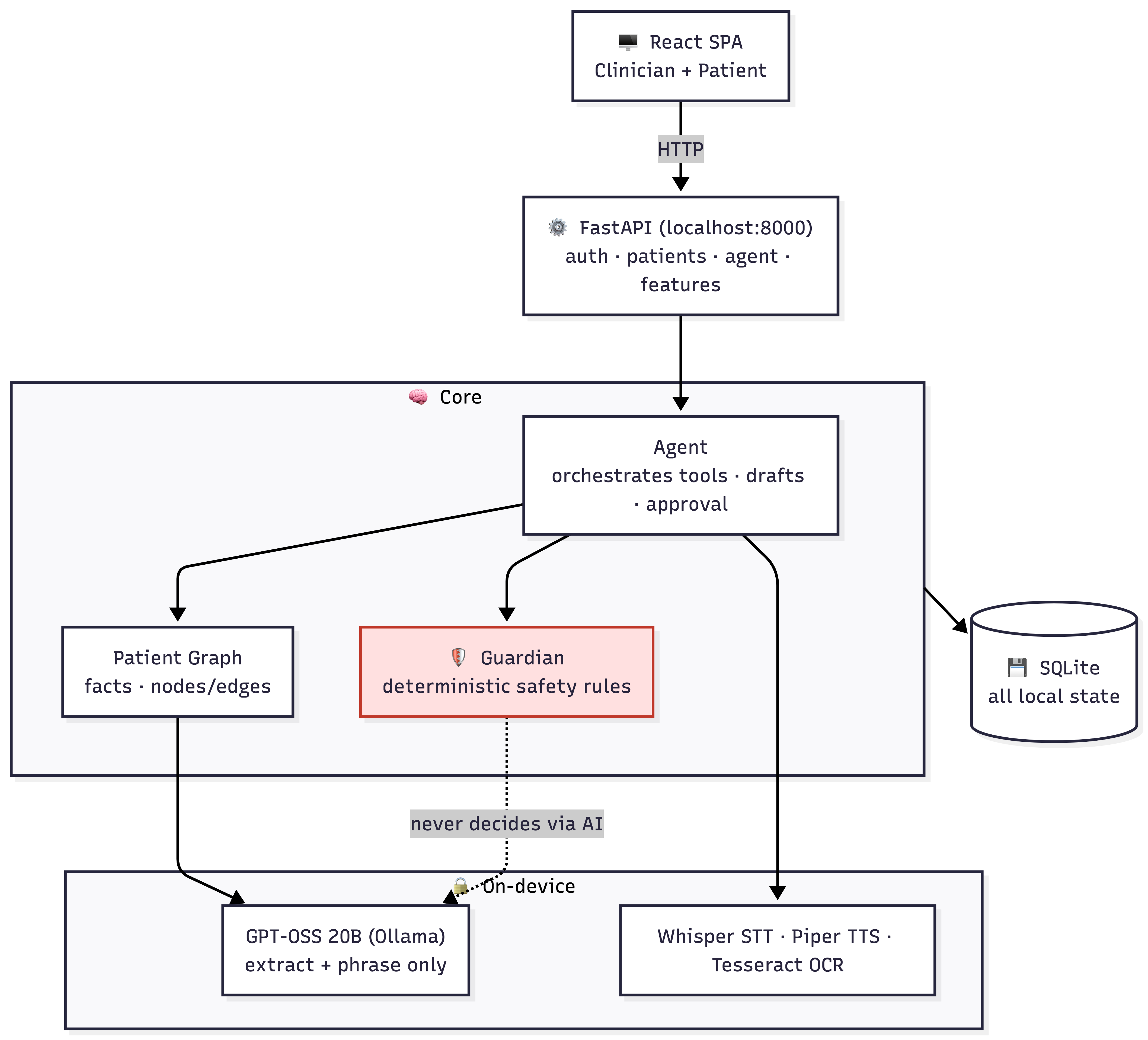
Architecture Diagram
-
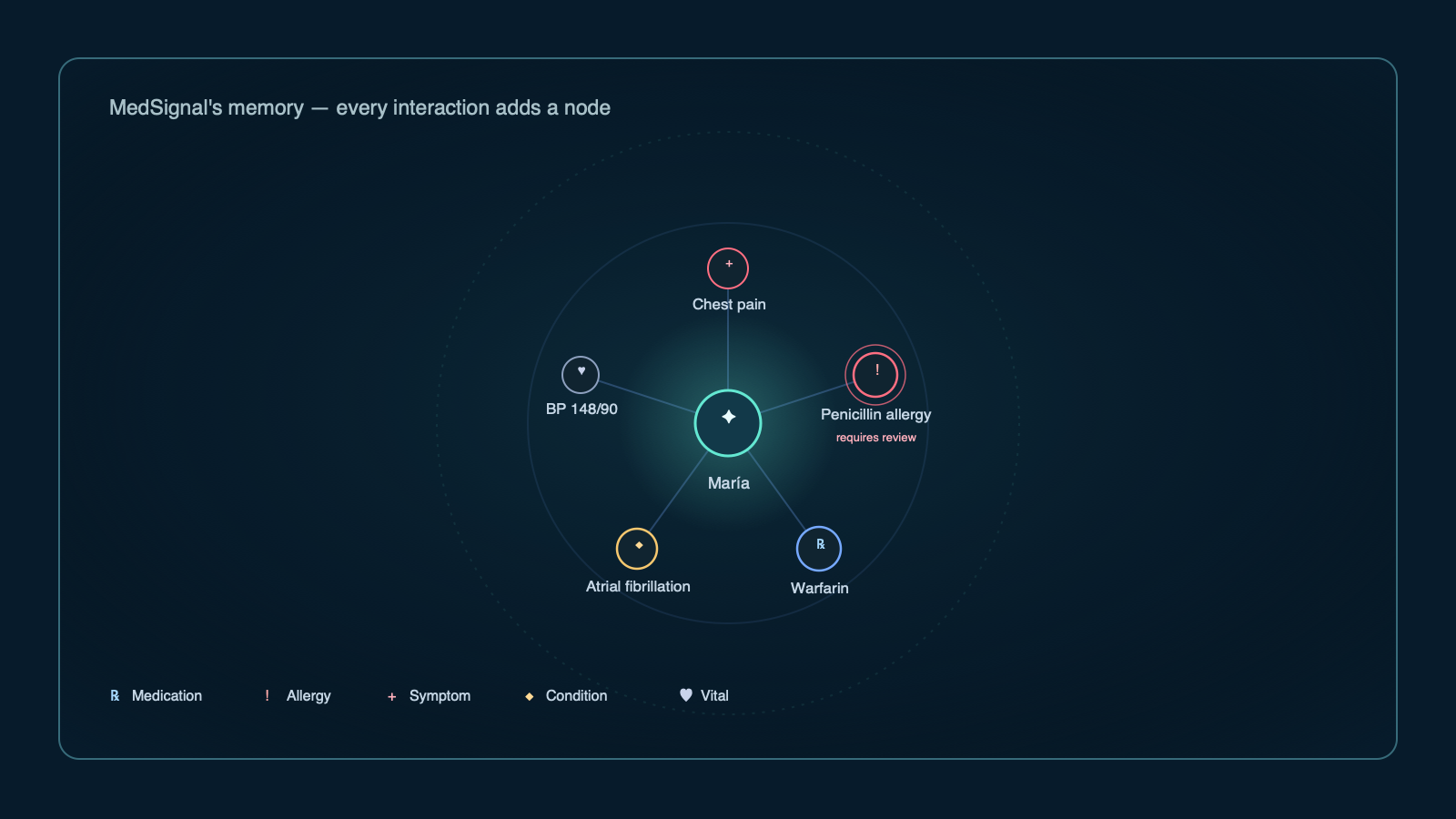
Knowledge Graph
-
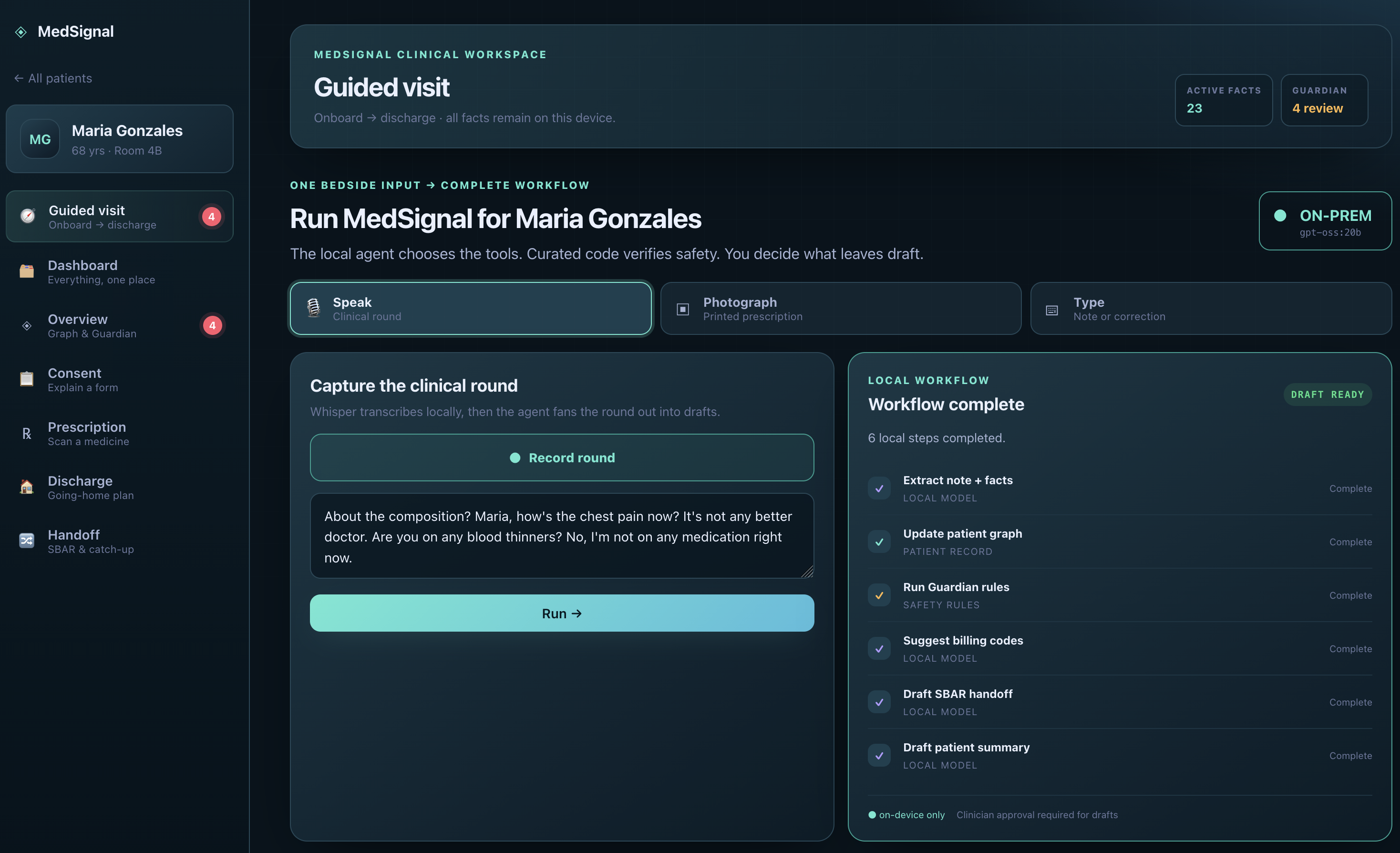
Dashboard
MedSignal connects the patient story before a missed connection becomes harm. MedSignal is a local-first clinical intelligence assistant for hospital teams. It turns fragmented bedside signals into one evidence-linked, clinician-reviewable patient story.
MedSignal is Work & Productivity for clinical teams because it removes the hidden work of care: piecing together a patient’s story across notes, conversations, images, and orders. It turns that fragmented context into one reviewable signal, so clinicians spend their attention on decisions—not on searching. The clinician remains the final decision-maker.
Inspiration
One in ten patients are subject to medical mistakes causing them harm and about half of that harm is preventable. But the problem is rarely that nobody cared or nobody knew enough.
The problem is that the patient story is fractured.
An allergy buried in a note from months ago. A medication that exists only in a exists only in a prescription photograph. A patient says something important during rounds but that critical detail that vanishes when shift changes happen. When three different clinicians are looking at patient's stories through forgotten conversations, scattered notes and memories, the gap in the story becomes dangerous.
We built MedSignal around one belief: The information is often already there. It just needs to come together before the next decision.
Privacy was not just a setting, it is the core of the product.
A prescription photo is not “just an image.” It can contain a name, a diagnosis, a dose, and a moment in someone’s life that should not leave the hospital simply to become useful.
A bedside conversation is not “just audio.” It can contain fear, uncertainty, family context, and the details that change care.
We believe intelligence should move to the patient data - not the patient data to the intelligence. That is why MedSignal runs locally. The patient story stays inside the care environment.
Built with GPT-5.6 and Codex
We used GPT-5.6 in Codex as a specification-driven development (SDD) collaborator: turning product ideas into explicit workflows, building them, and validating the result.
- From specs to product decisions: Codex helped translate the bedside flow of capture → evidence → safety checks → clinician approval into acceptance criteria and screen/API behavior. We chose a local-first design, source-linked facts, and clinician-controlled approvals as non-negotiable product boundaries.
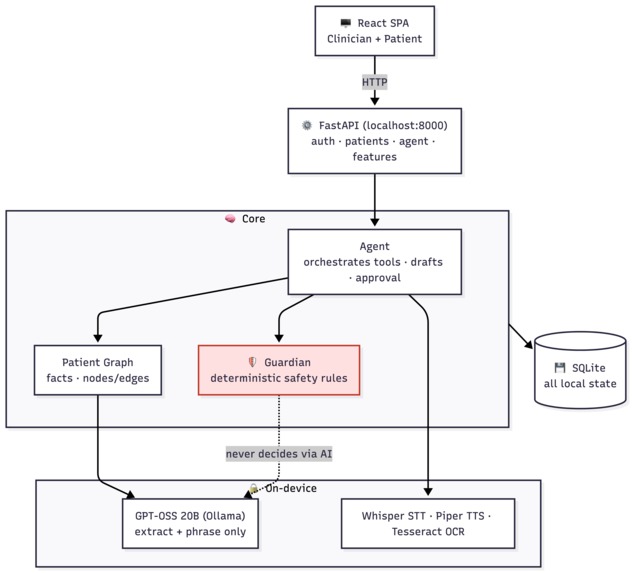
- Engineering the workflow: Codex accelerated the React and FastAPI implementation, local agent tool orchestration, SQLite-backed patient graph, OCR/transcription integration, and reviewable draft bundles.
- Safety and quality: Codex helped implement deterministic Guardian rules, audit-linked corrections, and repeatable tests for medication risks, contradictions, routing, and billing-code validation. We deliberately kept safety decisions in deterministic code rather than the model.
- Design and iteration: Codex supported UI refinement, debugging, and documentation, including the local architecture and judge walkthrough, so the technical design remained understandable and testable.
We made the final product, engineering, and design decisions. GPT-5.6 and Codex were used during development only, not in the runtime patient-care workflow. At runtime, MedSignal uses local gpt-oss:20b, deterministic code, and clinician review.
What MedSignal Does
MedSignal follows one patient from intake to handoff. It automates the entire work around the patient story - so clinicians can focus on the patient.
It captures the encounter
A clinician can speak, type an update, or capture a prescription image.
- Faster-whisper transcribes speech locally.
- Tesseract OCR reads prescription and document images locally, and the image is improved by validating it, fixing the orientation, converting to grayscale, improving contrast and deskewing it.
- Local gpt-oss:20b converts the extracted text into proposed, source-linked facts and reviewable drafts.
The word proposed matters. A model can help organize information. It does not get the final say.
It connects the story
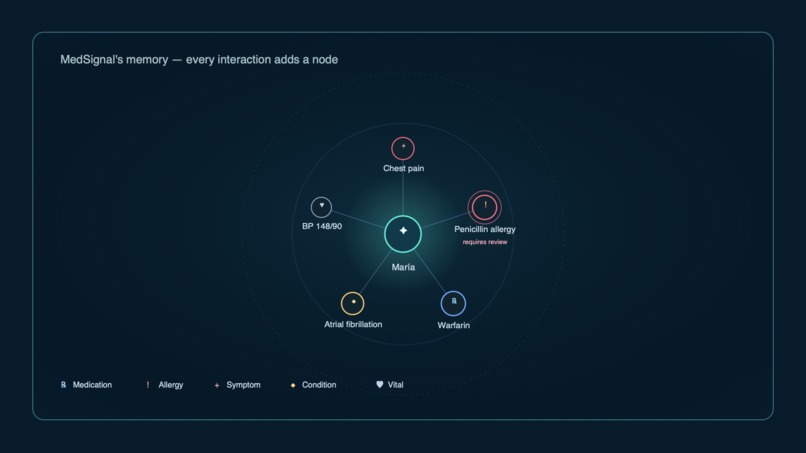
MedSignal keeps consent forms, discharge papers, prescriptions, medication labels, all in one evidence-linked knowledge graph. A prescription is no longer lost in handwriting you do not understand, key decisions are no longer lost in conversations - all of it becomes part of the same patient context. And they carry their source with them. Where did this fact come from? An old note? A conversation today? A photograph? That link is always there.
That context follows the patient across review, handoff, safety checks, and patient explanation.
It runs a bounded agentic workflow
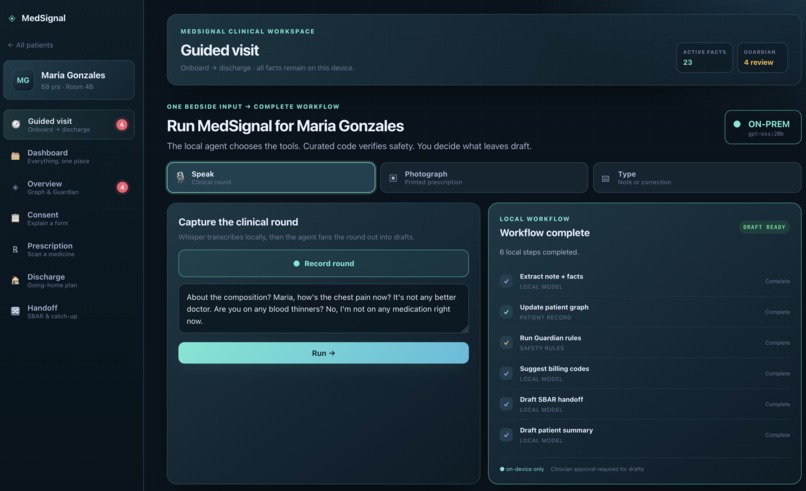
MedSignal is not just another chatbot generating a summary in a box. Its local agent uses gpt-oss:20b to orchestrate a workflow with approved tools: read the patient context, process a transcript or OCR result, structure stated facts, update the graph, trigger deterministic checks, and prepare a final dashboard for the clinician to review.
The model connects all pieces and renders them, it does not make any sensitive decisions. MedSignal shows the tool trace, semantic inputs, and outcome summaries so the workflow is visible and reviewable to anyone looking, that too without persisting or exposing any private reasoning. Like we said, security is the key!
It surfaces what needs attention and catches what gets missed
Guardian is MedSignal’s deterministic safety layer. It evaluates any new information using explicit Python rules and a curated knowledge base.
It can surface:
- A patient statement that contradicts the active record Example: Maria says she is not taking blood thinners while warfarin is recorded.
- A potential medication interaction Example: ketorolac appears in a prescription and is checked against warfarin and contradiction is found.
- A potential allergy conflict
- An overdue/missed follow-up order
Guardian doesn't invent problems or contradictions. If a rule applies, it fires. If it doesn't, it doesn't.
And every decision requires clinician review, we want to make sure that there is nothing up for a chances when it comes to something as sensitive as medical visits!
It preserves history when plans change
Care plans change. History should not disappear. If a clinician learns that a repeat EKG was already completed, MedSignal records an audit-linked correction. It preserves the original order, links the correction, and waits for clinician approval before changing the plan. No silent rewrites.
Help the next clinician actually catch up
MedSignal creates different source-linked handoff views. Catch Me Up is concise, for someone joining the case mid-shift. SBAR is the traditional format: Situation, Background, Assessment, Recommendation.
The goal is straightforward. The next clinician shouldn't have to spend the beginning of a shift hunting for context. The story is already there. They can focus on what to do next.
It helps patients understand
MedSignal can explain consent and care updates in plain language and in the patient’s preferred language. It helps patients understand what changed, what comes next, and why, without pretending to replace the care team.
If a medication photo gets checked against recorded allergies, if nothing bad shows up, MedSignal doesn't tell the patient it's safe. It tells them to double-check with their clinician or pharmacist. We don't overstep that boundary!
Privacy and safety by design
At runtime, MedSignal keeps the patient story local:
- Local transcription with faster-whisper
- Local OCR with Tesseract
- Local gpt-oss:20b inference through Ollama
- Local SQLite storage
- Local deterministic Guardian rules No cloud model is required to process patient context.
Privacy is not separate from safety. If clinicians cannot trust where data goes, they cannot trust the tool at the bedside. Patients should never have to trade confidentiality for clarity.
MedSignal makes local operation visible, not hidden in an architecture diagram - because in healthcare, trust has to be something you can see.
Evaluation Results
The default runtime model is gpt-oss:20b, a 20.9 billion parameter model using MXFP4 quantization with a 13 GB footprint, served locally through Ollama.
We ran three standardized synthetic clinical prompts with a warm model, 4,096-token context, and 512-token output limit:
| Metric | Result |
|---|---|
| Mean input tokens | 102.3 |
| Mean output tokens | 405.3 |
| Mean total time | 4.99 seconds |
| Model load time | 203 ms |
| Prompt processing time | 109 ms |
| Output generation time | 4.67 seconds |
| Output speed | 86.77 tokens/sec |
| Input speed | 941.61 tokens/sec |
Guardian deterministic safety checks passed 9 out of 9 cases with precision 1.0 and recall 1.0. Zero false positives and zero false negatives.
These measurements use synthetic data and demonstrate prototype performance only. They do not establish clinical validation, real-world accuracy, or production readiness.
Challenges we ran into
The biggest challenge was turning fragmented clinical information into useful, connected patient context without letting AI make clinical decisions. Technical challenges included running a 20B local model with usable latency, reliably converting speech and prescription images into structured facts, grounding every output in source-linked evidence, and keeping the workflow fully local with SQLite, Ollama, Whisper, and Tesseract.
We addressed this with clear boundaries:
- GPT-OSS organizes stated facts and drafts clinician-reviewable language.
- Deterministic Guardian rules identify medication risks, contradictions, and incomplete follow-ups.
- Clinicians review the evidence and approve meaningful actions.
This keeps patient data local while ensuring clinical judgment remains with the care team
What we are proud of
We did not build “AI for healthcare” as a vague promise.
We built a working, local workflow that shows:
- What information was captured
- Where each fact came from
- Which tool the agent used
- What Guardian checked
- What requires clinician review
- What changed in the record
- What the patient can understand
MedSignal makes intelligence visible, evidence traceable, and clinicians the final decision-makers.
Track
Work & Productivity
MedSignal is Work & Productivity for clinical teams because it automates the invisible work around care, right from intake and consent to documentation, safety review, patient explanation, and handoff. It turns notes, conversations, images, and orders into one reviewable workflow, so clinicians spend less time reconstructing the story and more time making the next decision. The system prepares the work; the clinician owns the decision.
Primary Codex session IDs:
- 019f85cc-ba22-7a63-8dac-56cb8775600c
- 019f82ca-2865-7832-bbe6-25323479bd10
- 019f8236-f8fe-7582-a58b-d77232b87488


Log in or sign up for Devpost to join the conversation.