-
-
Website
Inspiration
Farmers make important decisions every day based on weather: when to work in the field, when heat may become stressful, whether recent rainfall has changed conditions, and when crops may need closer monitoring.
But environmental data is often presented as raw numbers, charts, or sensor readings that are difficult to translate into action.
I built Conduit FarmGuard to bridge that gap.
The idea is simple: take environmental data and turn it into understandable agricultural insights that can help farmers and communities respond to changing weather conditions.
FarmGuard aligns primarily with:
- SDG 2: Zero Hunger, by supporting more informed agricultural decision-making.
- SDG 13: Climate Action, by helping users understand and respond to changing environmental conditions.
What it does
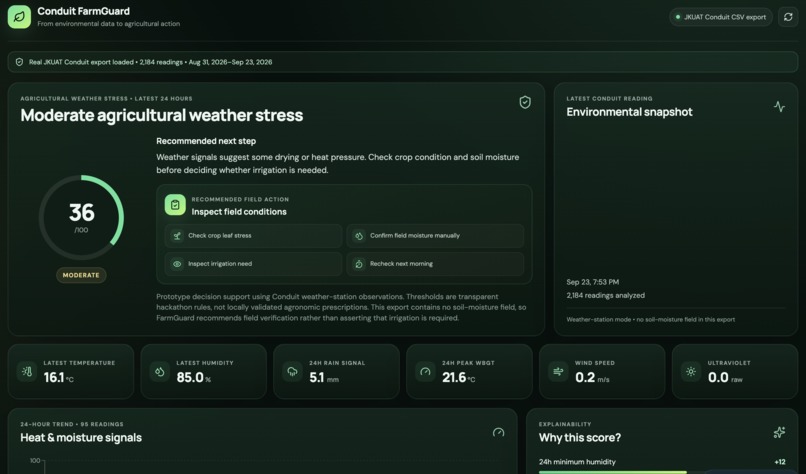
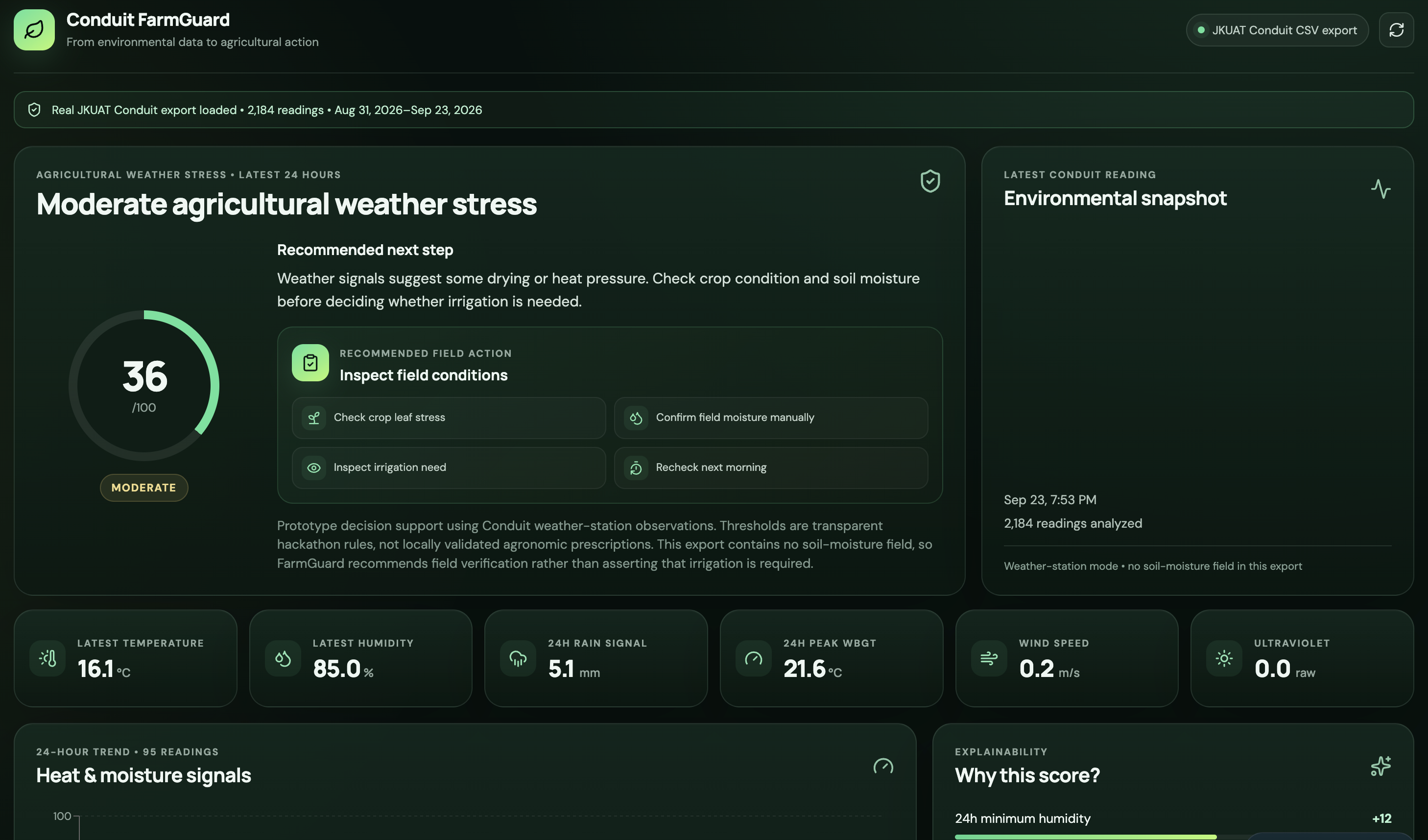
Conduit FarmGuard is a digital agricultural weather intelligence dashboard.
It analyzes weather data such as temperature, humidity, rainfall, wind, heat index, and related environmental signals and converts them into an explainable Agricultural Weather Stress Score.
Instead of asking users to interpret raw sensor values, the dashboard highlights:
- Current agricultural weather stress
- Recent environmental conditions
- Temperature and humidity patterns
- Rainfall behavior
- Wind conditions
- Heat-related pressure
- Recommended field actions
The goal is to answer a more useful question than simply “What is the weather?”
What does this weather mean for someone working in agriculture?
The current dataset contains 2,184 environmental observations across 22 sensor fields collected between September 1 and September 23, 2026.
SDG Impact
Climate variability creates additional uncertainty for agriculture.
FarmGuard is designed as a decision-support layer between environmental data and the person who needs to act on it.
For example, if temperature rises while humidity and rainfall patterns suggest increasingly dry conditions, FarmGuard can flag agricultural weather stress and recommend checking local field and soil conditions.
Importantly, the system also communicates the limits of its data.
The dataset does not contain soil-moisture readings, so FarmGuard does not claim that irrigation is required. Instead, it identifies weather conditions that may justify further field verification.
This makes the recommendations more transparent and responsible.
How I built it
I built FarmGuard as a full-stack web application using:
- React
- Vite
- Python
- FastAPI
- Pandas
- JavaScript
- HTML and CSS
- Environmental sensor data
The Python backend processes the weather dataset and derives indicators from multiple environmental variables.
FastAPI exposes the processed information to the frontend.
The React dashboard then turns those calculations into visual summaries, timelines, stress indicators, and practical field recommendations.
Challenges
One of the biggest challenges was creating useful recommendations without claiming more than the data could support.
Agricultural decisions can depend on many variables, and the available dataset does not include every possible measurement.
For example, without soil-moisture data, it would be misleading to automatically tell a farmer to irrigate.
Instead, I designed FarmGuard around explainable recommendations that distinguish between what the data shows and what still needs to be verified in the field.
I also worked through challenges involving data cleaning, frontend and backend integration, API communication, CORS configuration, and translating a large environmental dataset into a dashboard that remains easy to understand.
What I learned
The biggest thing I learned is that impact does not come from displaying more data.
It comes from making data understandable and actionable.
Building FarmGuard pushed me to think beyond analytics and consider the person using the product: what they need to know, what the data can reliably tell them, and how uncertainty should be communicated.
I also learned how closely climate data, product design, and responsible decision-support can work together.
What's next
FarmGuard could eventually incorporate:
- Soil-moisture sensors
- Crop-specific stress thresholds
- Weather forecasts
- Multiple farms and geographic locations
- Historical comparisons
- Crop-specific recommendations
- Mobile alerts for high-risk weather conditions
- Local-language interfaces
The long-term goal is to make environmental intelligence easier to access and act on, particularly for agricultural communities facing increasingly unpredictable weather.
FarmGuard is not meant to replace farmers' knowledge.
It is meant to give that knowledge another useful signal.

Log in or sign up for Devpost to join the conversation.