-
-
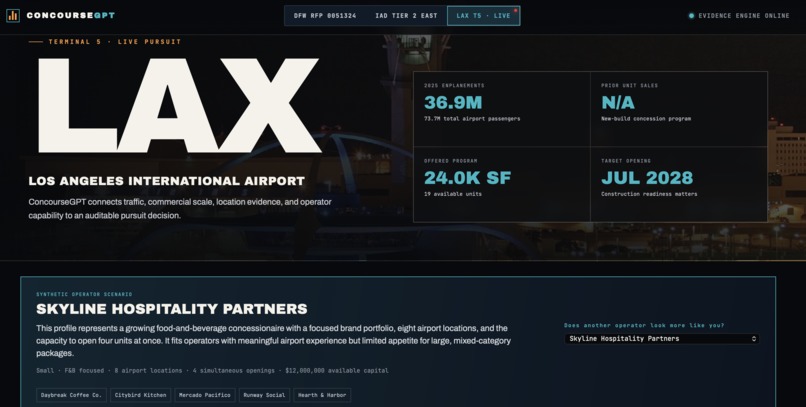
Operator-specific opportunity ranking
-
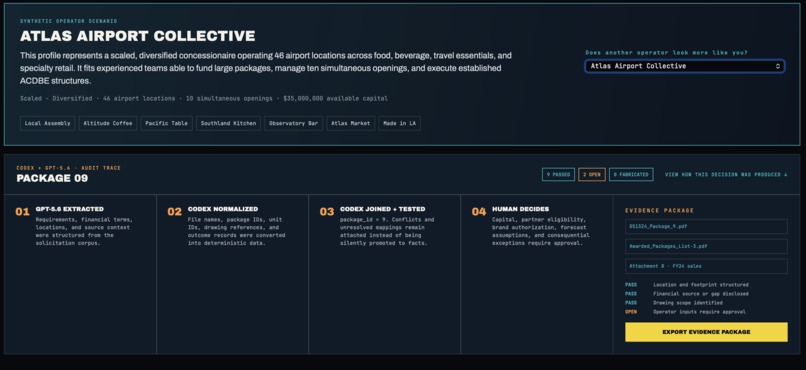
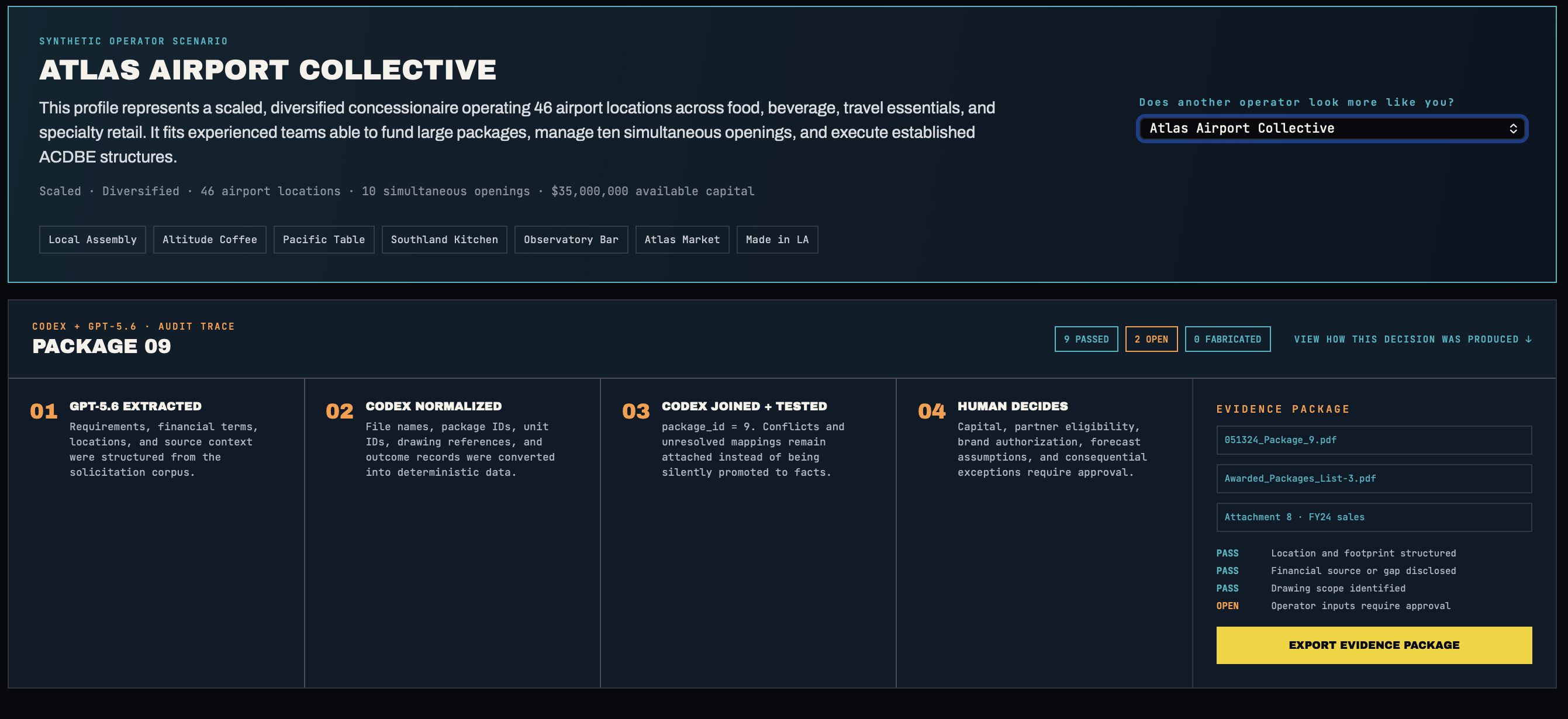
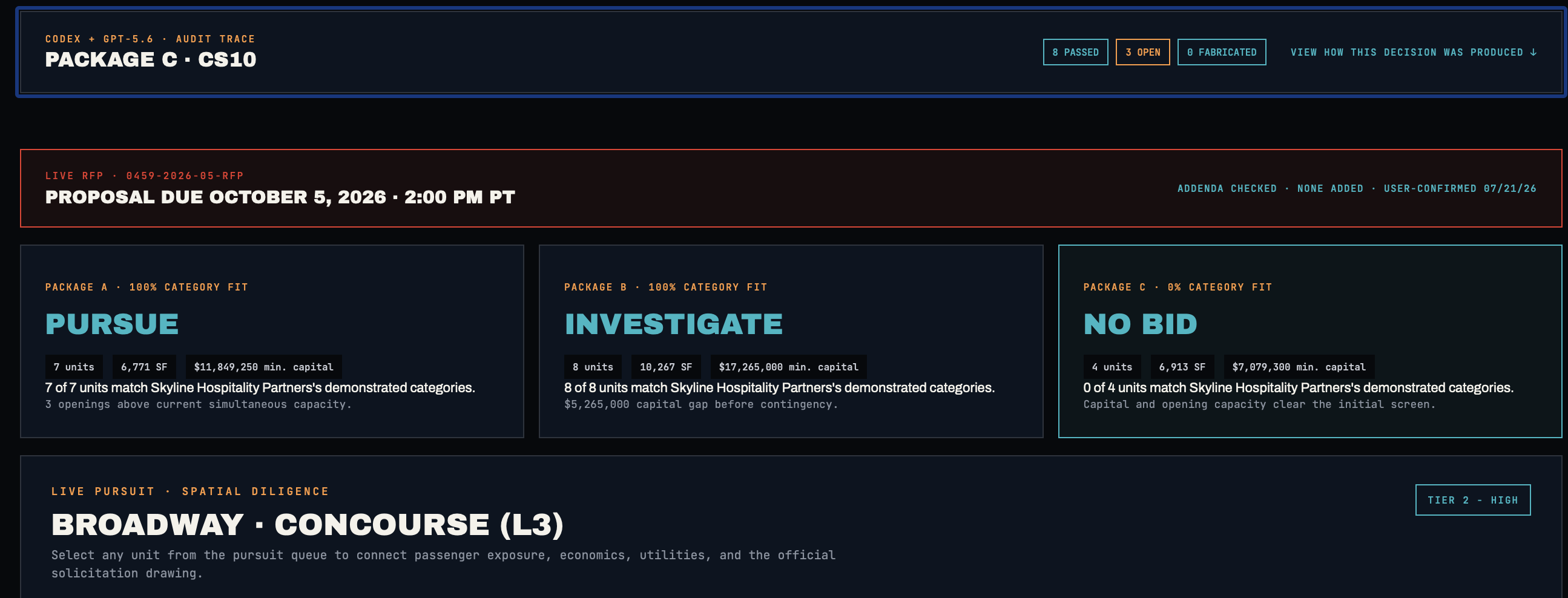
Codex + GPT‑5.6 auditable decision trace
-
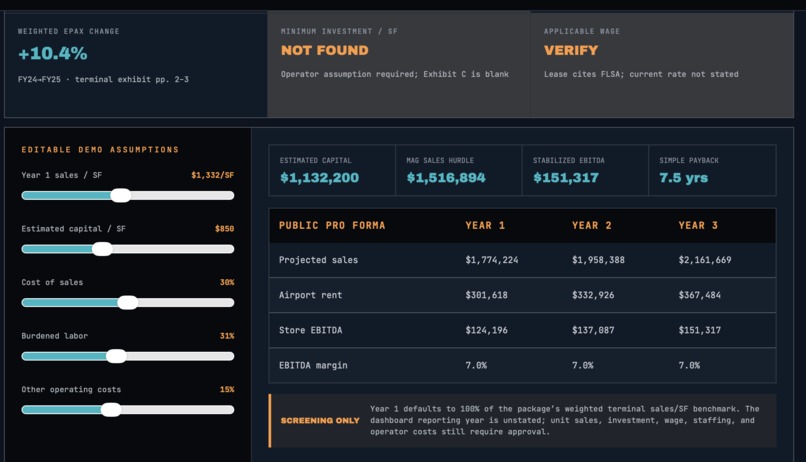
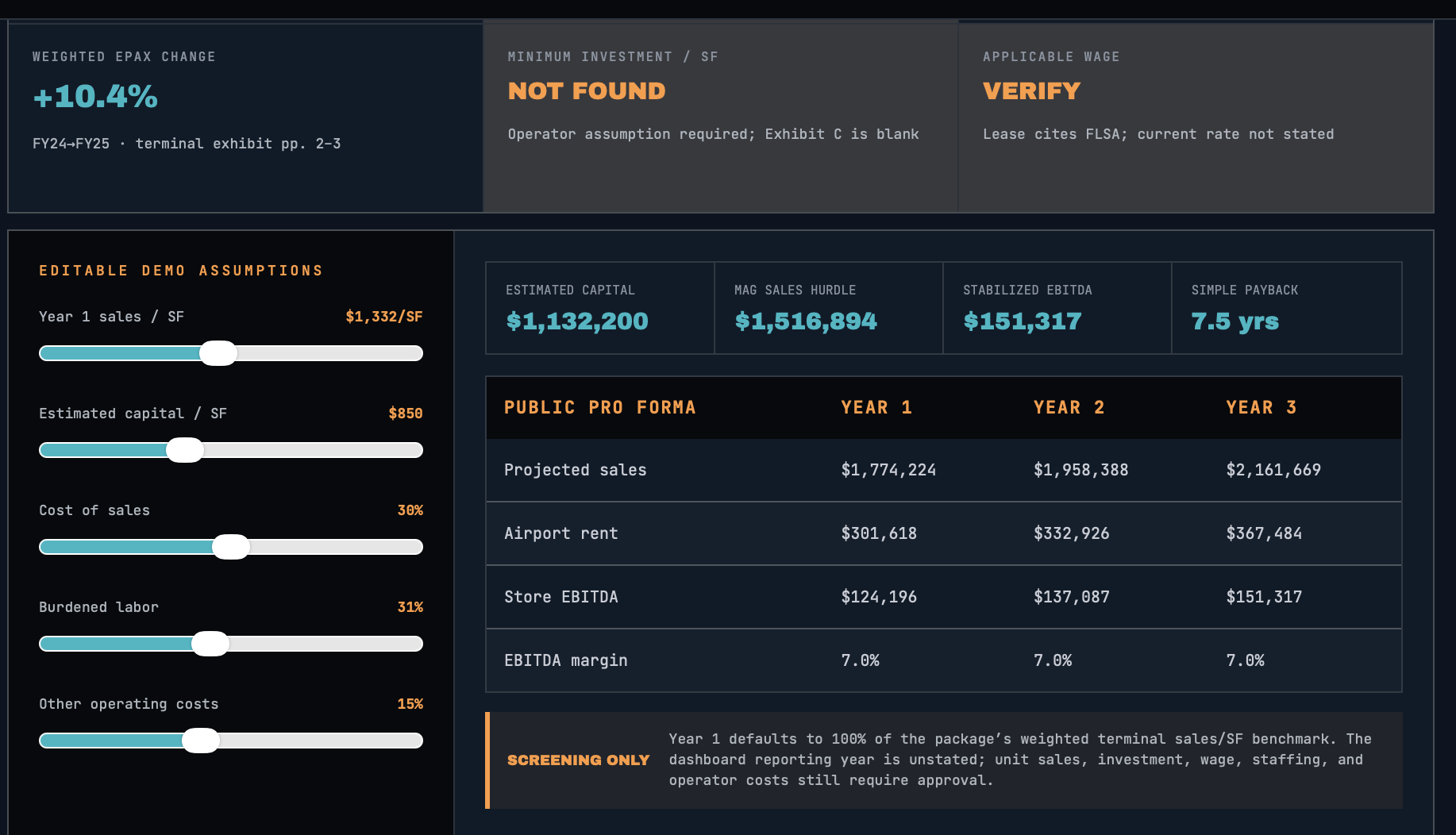
Editable public-data feasibility model
-
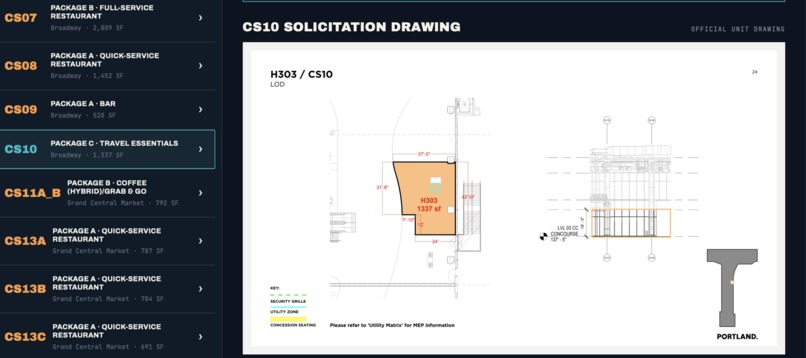
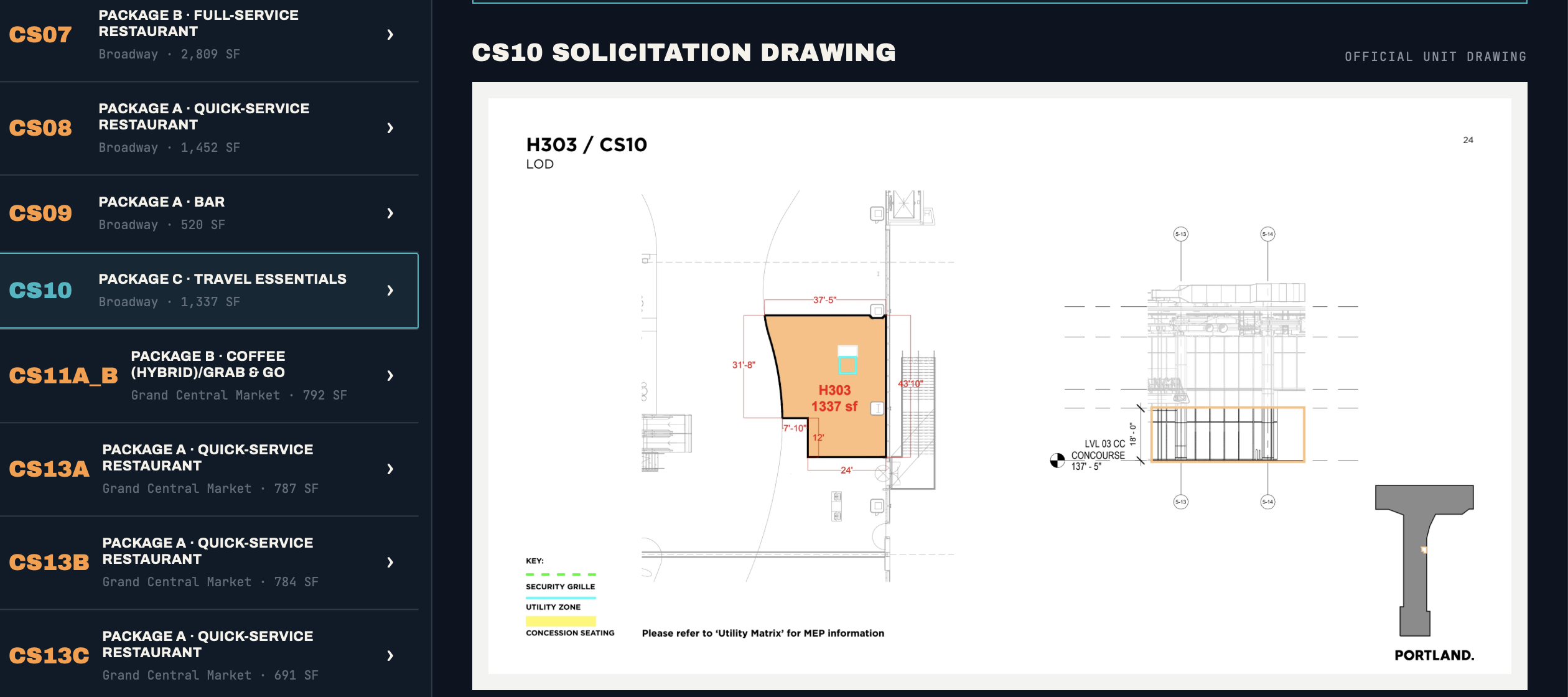
Source-linked lease outline drawing
-
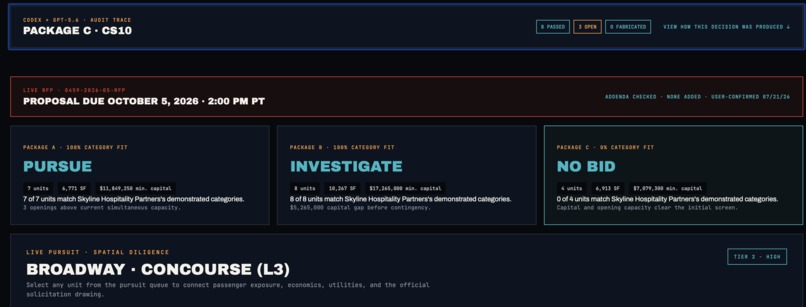
Bid recommendation engine
Inspiration
Airports in the US are focused on adding local and small businesses to their concessionaire mix. Small businesses want to get to the captive audience and massive traffic of airport concourses. But pursuing them means navigating hundreds of pages of procurement documents, financial requirements, terminal plans, construction standards, compliance obligations, and changing addenda. I previously led a $180 million airport concessions program, where I watched emerging operators struggle to compete because the market was opaque and the cost of evaluating an opportunity was high. While I was reviewing concessionaire bids, I was also helping construct what became the successful developer proposal that secured my company a 23-year contract to redevelop BWI Airport’s concessions program. I saw important investment and procurement decisions being made with fragmented data, surface-level analysis, and sometimes relationships and instinct. Smaller operators often lacked the time and resources to determine which opportunities genuinely fit their businesses. The thing of the build is important because last year, the U.S. Department of Transportation submitted October 2025 interim final rule that changed how disadvantage is established under the ACDBE program. Longstanding partnership strategies were disrupted, increasing uncertainty for airports and operators, and many operators now have to change their business model.
I built ConcourseGPT to prove out a thesis:
Can the data ingestion capabilities of AI turn public airport-procurement data into a faster, more transparent pursuit decision while keeping necessary business judgments under human control?
What it does
ConcourseGPT converts airport concession RFPs, terminal drawings, public operating data, and award records into traceable opportunity intelligence that allows for quick, accurate judgments on whether to pursue an RFP or not. The demo includes three different procurement conditions:
- DFW RFP 0051324: A completed procurement containing 18 awarded packages and 38 offered spaces. ConcourseGPT connects the RFP packages to published winners, terminal maps, lease-outline drawings, sales benchmarks, and source conflicts.
- IAD Tier 2 East: An incomplete public-outcome case containing 15 units. ConcourseGPT preserves confirmed, inferred, ambiguous, and unresolved award mappings instead of presenting every match as fact.
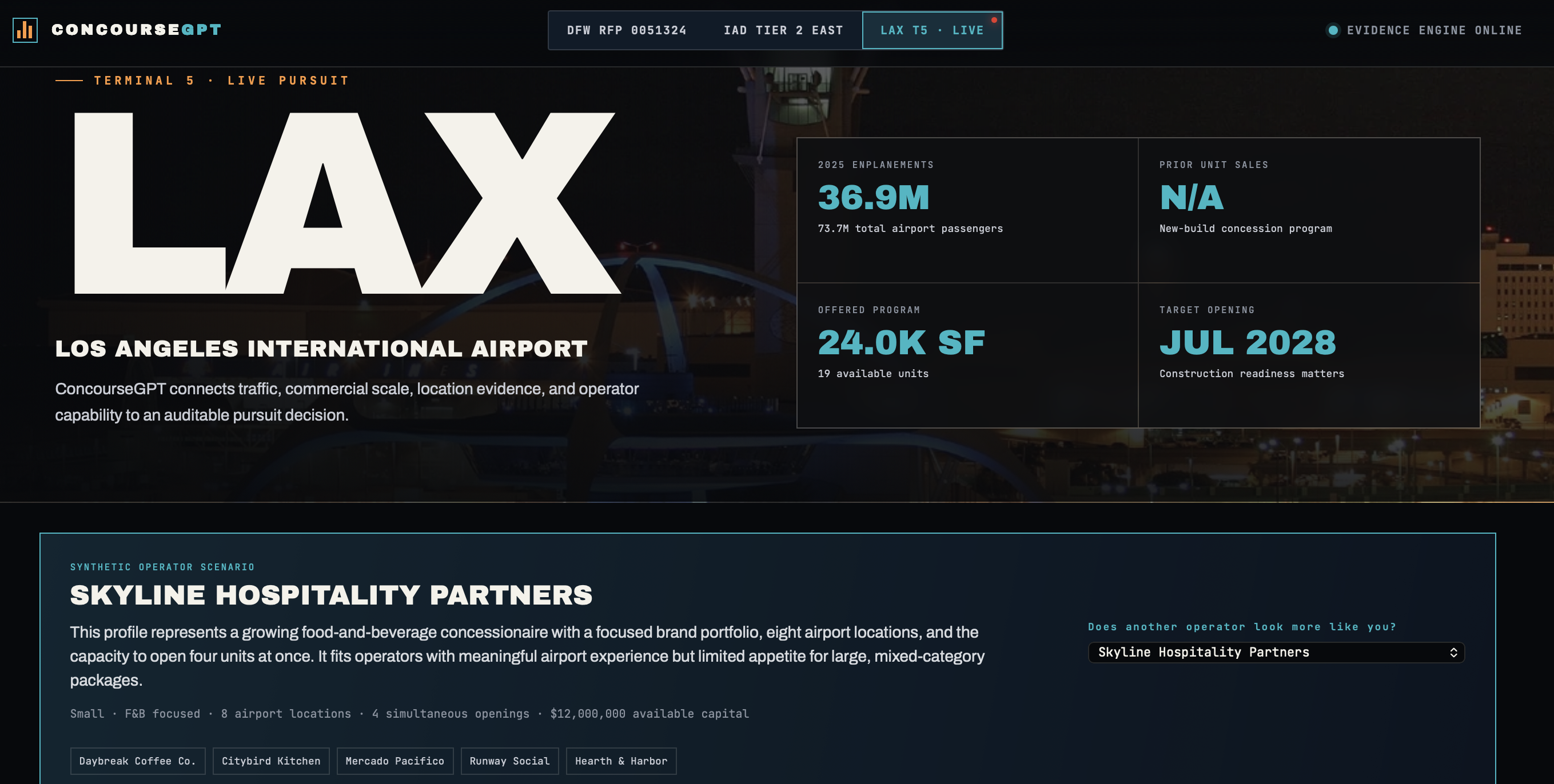
- LAX Terminal 5: A live, pre-award procurement containing 19 units. ConcourseGPT evaluates package fit, required capital, passenger exposure, construction timing, and preliminary unit economics. I selected LAX because so many concessionaires are resistant to bidding there given he labor requirements and the tool helps to clarify real vs. perceived risk. Users can select among representative concessionaires with different brand portfolios, operating capabilities, opening capacity, and available capital. The system then:
- Ranks the most relevant packages or units.
- Produces a preliminary Bid, Investigate, Hold, or No Bid recommendation.
- Explains the primary reason for the score.
- Opens the underlying unit and lease-outline drawing.
- Connects public sales, passenger, rent, investment, and area data.
- Generates an editable public-data pro forma.
- Recalculates sales, rent, EBITDA, and payback as assumptions change.
- Flags missing information and conflicting evidence.
- Produces actionable next steps.
- Identifies decisions requiring human approval.
- Exposes an audit trace showing how the recommendation was produced.
- Exports an evidence package or executive pursuit brief. ConcourseGPT is not designed to replace staff, but to free up their time, energy, and capital to submit better proposals. It gives them a cited and commercially useful starting point.
How I built it
I am an airport-concessions operator and advisor, not a software engineer. ConcourseGPT is my first software product. I supplied the domain expertise: how concessionaires evaluate locations, capital requirements, permitted uses, rent structures, passenger exposure, operating capacity, partnership requirements, and long-term value. GPT‑5.6 was used for document interpretation. It helped reason across long RFPs, exhibits, tables, addenda, financial requirements, and drawing context. It identified controlling facts, category relationships, missing information, and areas of uncertainty. Codex turned that domain logic into a working system. It helped:
- Traverse and organize the RFP source folders.
- Extract and normalize package, unit, award, concept, and financial records.
- Join award results to units and labeled lease-outline drawings.
- Audit incorrect drawing mappings and source conflicts.
- Generate structured application datasets.
- Implement operator-specific scoring.
- Build the editable pro forma models.
- Create the terminal maps and opportunity-detail workflows.
- Add evidence statuses and human-approval controls.
- Build the visible Codex and GPT‑5.6 audit trace.
- Add automated production and rendering checks.
- Package and deploy the working application.
- Prepare a reproducible private repository for reviewers. The application is self-contained and does not require an API key, API credits, database, or external account to test.
Challenges I ran into
The most difficult challenge was maintaining an honest evidence boundary. Public airport records are rarely clean or complete. Award announcements may name a company and concept without identifying the exact unit. Package summaries and lease-outline drawings can look similar. Operator names can vary between documents, and some public records support several plausible mappings rather than one definitive answer. Other challenges included:
- Deterministically connecting winners, packages, units, and LOD filenames.
- Detecting drawings that displayed a package summary instead of the actual LOD.
- Distinguishing prior-year comparable sales from a forecast.
- Preventing Year 1 sales from defaulting below the stated historical benchmark.
- Separating public facts from editable operator assumptions.
- Designing useful analysis without confidential proposals or financial statements.
- Making unresolved evidence visible without making the interface unusable.
- Translating airport-industry judgment into consistent scoring logic.
- Creating a responsive interface that remained readable with long company and concept names. These challenges changed the product from a document-summary tool into an evidence-aware decision system.
Accomplishments that I’m proud of
The greatest accomplishment is that ConcourseGPT now performs a complete, actionable workflow instead of merely summarizing an RFP. The final build:
- Structures three real airport procurement cases.
- Screens 18 DFW packages, 15 IAD units, and 19 live LAX units.
- Connects 38 DFW spaces to labeled lease-outline drawings.
- Ranks opportunities differently for operators with different capabilities and capital.
- Incorporates public sales, enplanement, area, rent, and investment information.
- Produces editable pro formas with explicit Sales/SF assumptions.
- Recalculates sales, rent, EBITDA, and payback in real time.
- Preserves conflicts, ambiguity, and unavailable information.
- Blocks unresolved evidence from receiving unsupported automatic recommendations.
- Provides actionable next steps and human-approval checkpoints.
- Exposes how GPT‑5.6 interpretation and Codex engineering contributed to each decision.
- Runs in a standard desktop or mobile browser without credentials.
- Passes its production build, rendering test, and code-quality checks. I am especially proud that Codex enabled me to turn years of specialized industry knowledge into my first functional software product, something that two years ago would be unthinkable.
What I learned
I learned that domain-specific AI requires more than a capable model. A trustworthy product also needs:
- A clearly defined evidence boundary.
- Structured records and deterministic identifiers.
- Source provenance.
- Explicit assumptions.
- Visible uncertainty.
- Repeatable tests.
- Human review for consequential decisions. I also learned that an apparently simple question—“Which airport unit should this operator pursue?”—requires several different forms of reasoning. Commercial fit, capital capacity, sales potential, construction timing, compliance, evidence quality, and the operator’s broader strategy must be considered together. Finally, I learned that Codex can do more than generate code. It can help a domain expert inspect source materials, formalize judgment, identify inconsistencies, build an interface, test behavior, and continuously improve a deployed product.
What’s next for ConcourseGPT
The next step is to turn ConcourseGPT from a procurement-analysis application into an intelligence layer for airport commercial activity. Future development includes:
- Live monitoring of airport RFPs and addenda.
- Private operator profiles using verified financial and operating inputs.
- Portfolio-wide bid/no-bid recommendations.
- Brand authorization and operating-capability tracking.
- Competitor, bidder, and award intelligence.
- Proposal compliance matrices with source citations.
- Airport-specific wage and construction-cost data.
- Scenario analysis for rent, capital structure, and partnership terms.
- Opportunity alerts tailored to each operator.
- A structured graph connecting airports, terminals, units, concepts, operators, brands, bidders, and awards.
- Analysis of underperforming concessions that could be repositioned or acquired.
- Tools for structuring agreements to improve profitability and long-term enterprise value. The long-term vision is for ConcourseGPT to help operators and investors identify genuine commercial advantage—not only by finding the right space, but by understanding how to pursue, structure, operate, and ultimately maximize the value of that opportunity.
Built With
- chatgpt
- codex

Log in or sign up for Devpost to join the conversation.