-
-
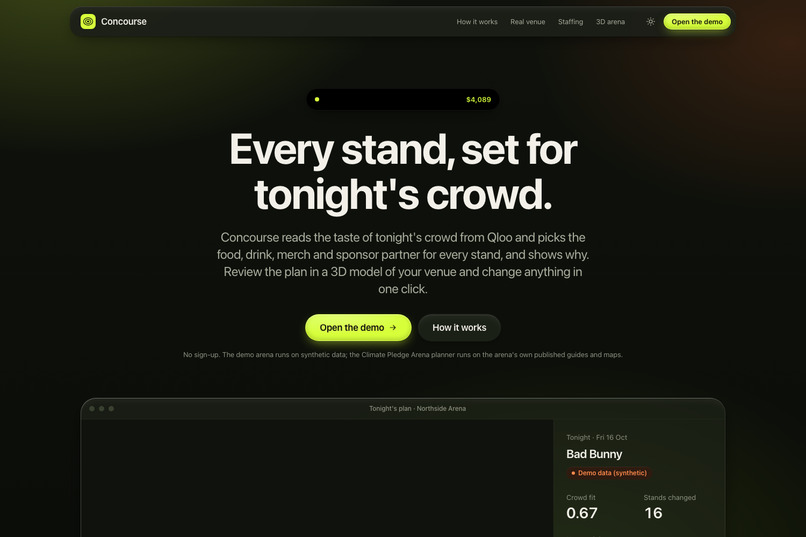
Every stand, set for tonight's crowd
-
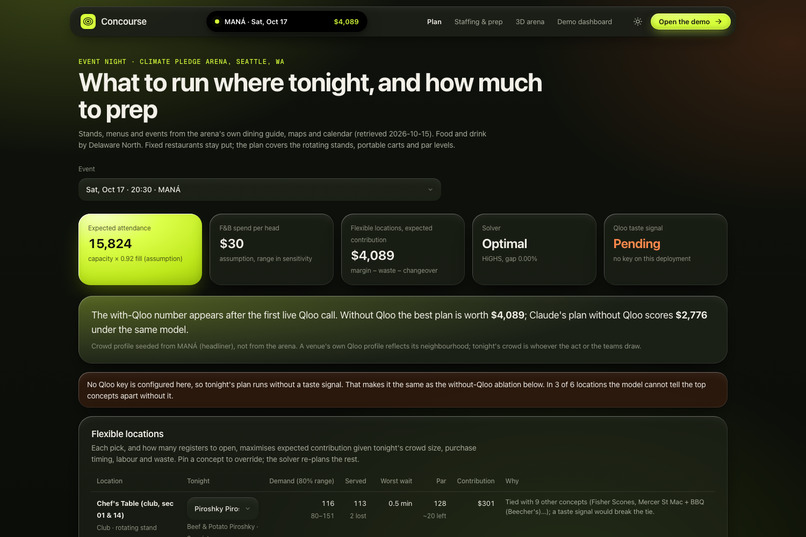
Event-night plan for Climate Pledge Arena: exact HiGHS solver, ablation against Claude without Qloo
-
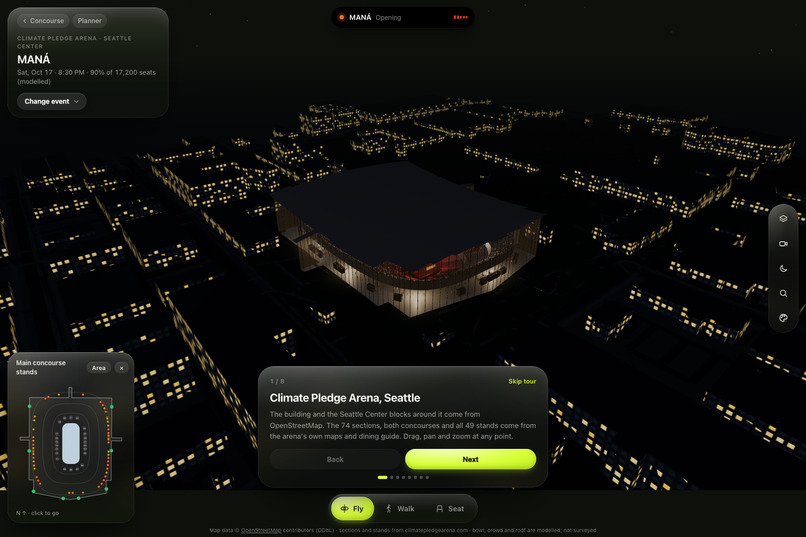
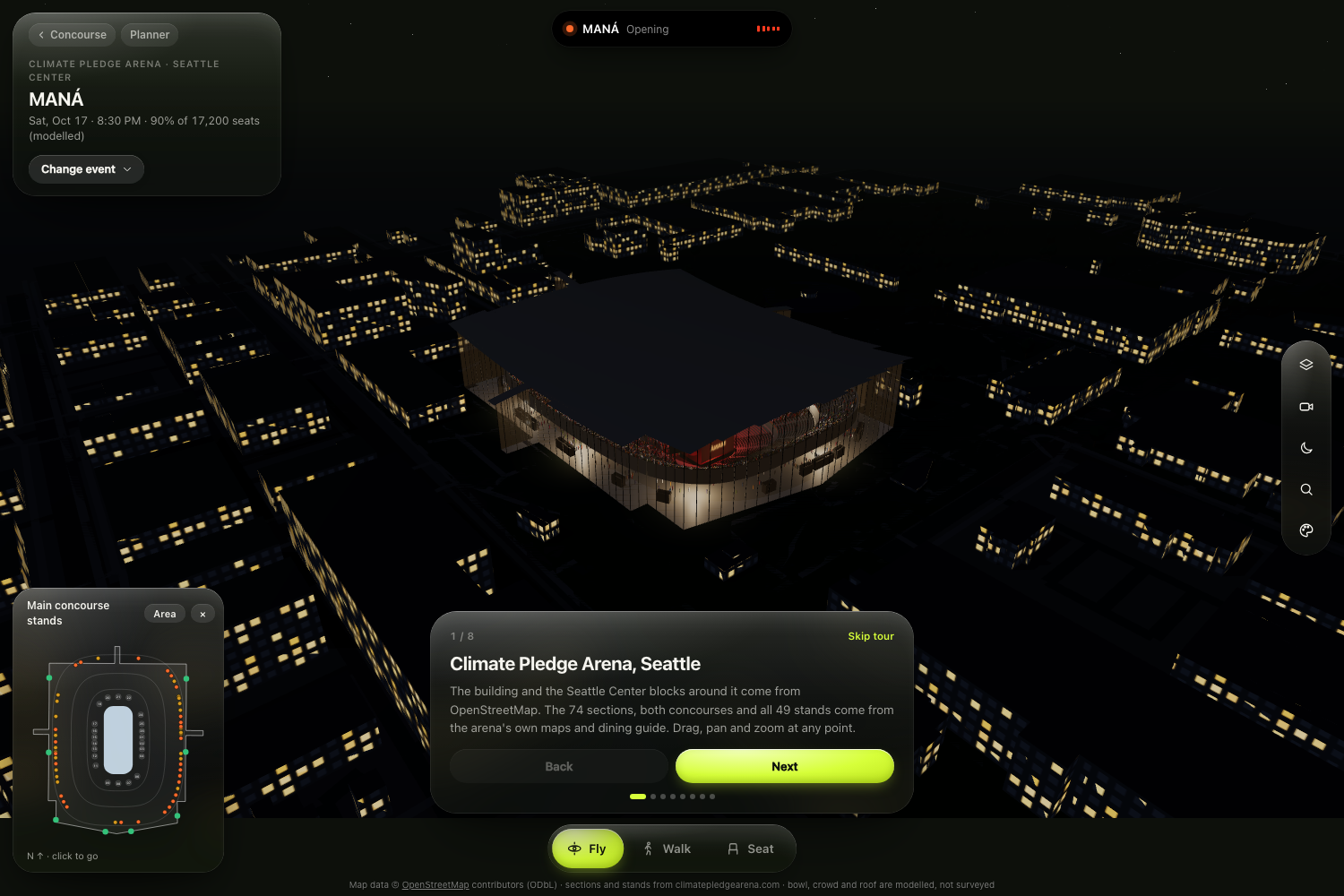
3D Climate Pledge Arena from OpenStreetMap, with the arena's real sections and stands
-
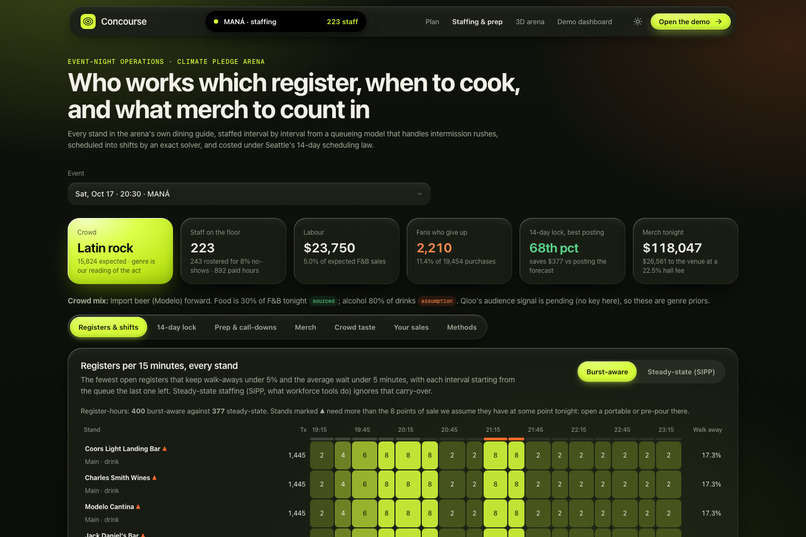
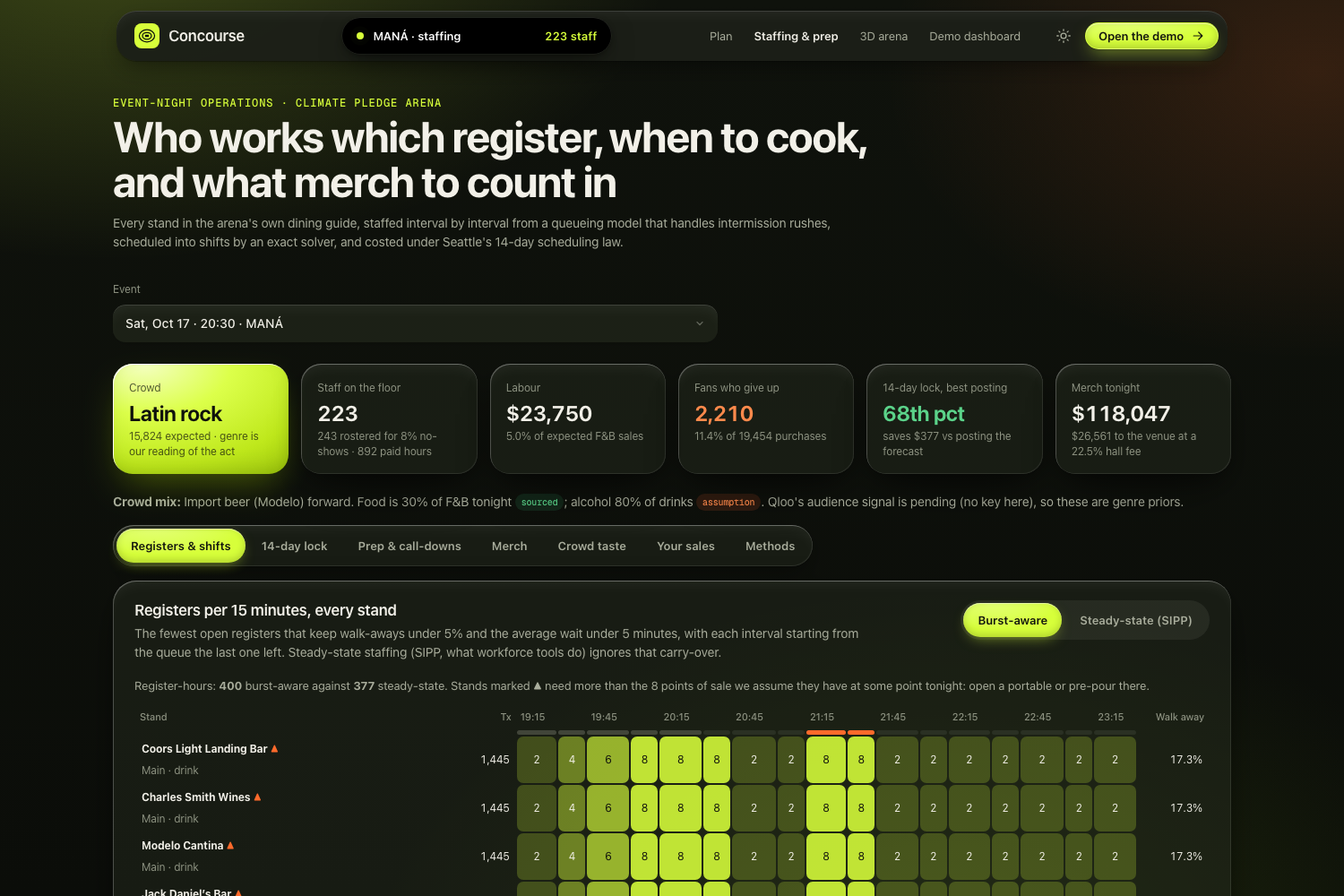
Staffing: registers per 15 minutes, 14-day roster lock under Seattle's scheduling law
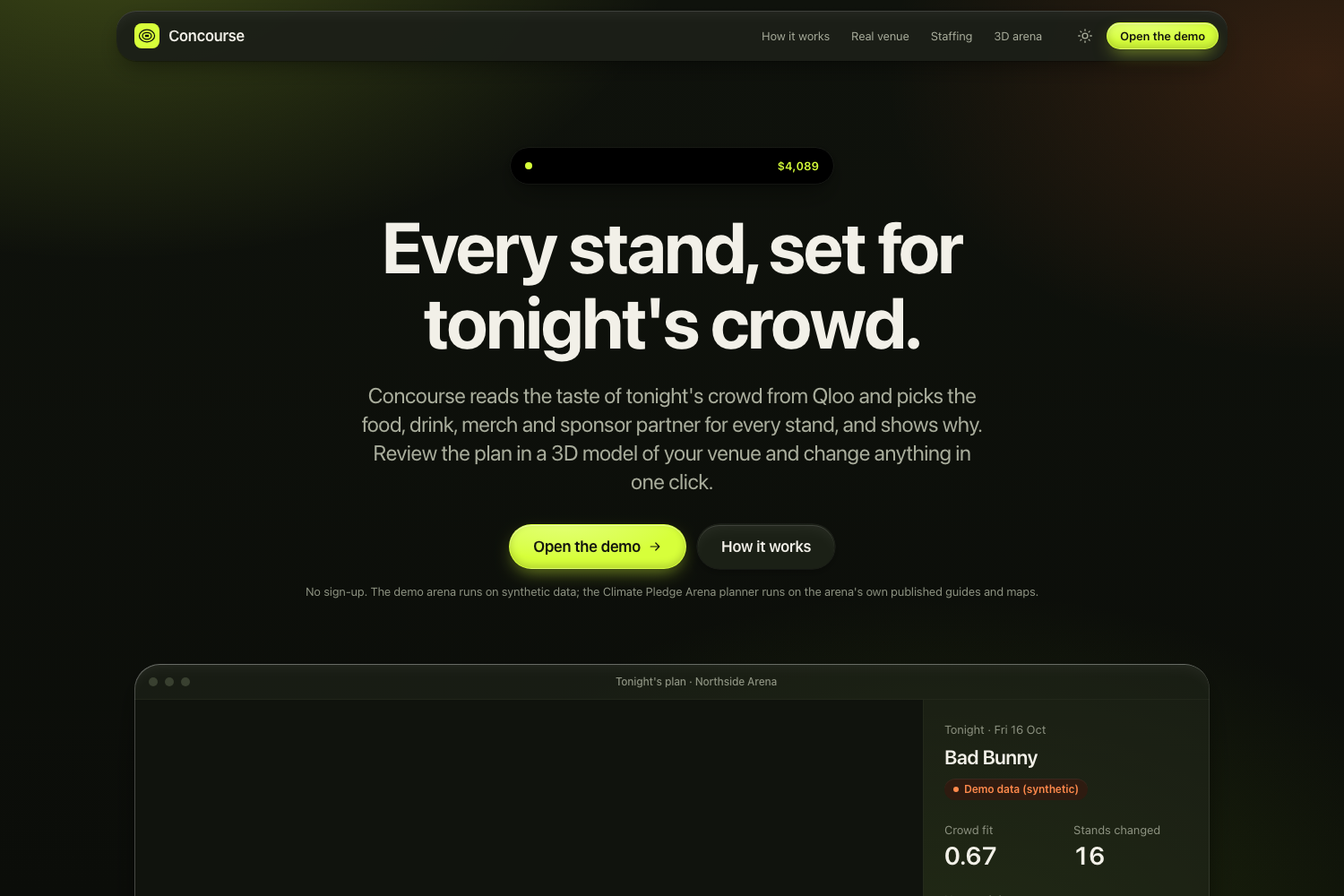
**Every arena in the world has the same blind spot: it has to staff, stock and theme a night weeks before it knows who is walking in. Concourse closes it.
Give it tonight's act and it uses Qloo's taste graph to read the crowd that act draws, then a stack of exact operations-research models turns that read into the whole night: what to run at every flexible stand, how much to prep and when, how many registers to open every 15 minutes, which shifts to lock 14 days out, and what merch to count in, size by size. Every number carries a dollar figure and a reason.**
Sales history tells a venue what sold last time. Qloo tells it who is coming this time. Concourse turns the second into an operating plan.
Try it: concourse-eosin.vercel.app (no login) · Code: github.com/danielAsaboro/concourse (MIT)
Inspiration: one real night
On Saturday, Oct 17, MANÁ played Climate Pledge Arena in Seattle (CPA). Delaware North runs the food and drink there. To get that night right, its team had to decide, well before the doors opened:
- Which shifts to post, 14 days out. Seattle's Secure Scheduling Ordinance requires schedules two weeks ahead. Every employer-made change after that owes "predictability pay": an extra hour for each added or moved shift, half pay for hours cut, and a cancelled show is no excuse. A CPA concessions provider paid $353,280.76 to 685 workers in 2025, partly for unpaid schedule-change pay.
- What the bars pour and the kitchens cook. A ballgame runs about 55–60% food; a concert about 70% drinks (SBJ, "Menu mix"). Country leans to bourbon, pop to vodka, and younger crowds are drinking less alcohol (Pollstar).
- How much to cook before the break. Overproduction is about half of all foodservice waste (Waste360 / Leanpath), and the opposite failure is the stand that runs out at the intermission rush.
- What merch to bring, by size. Merch behaviour swings by genre: about 16% of country fans buy, 37% of K-pop fans at $48 a head, and Latin per-head fell to $7.46 in 2025 (atVenu fan spending report).
The arena already knows tailoring pays. For Lady Gaga's three nights it turned its biggest marketplace into "BodeGAGA" and won Pollstar's 2026 Best Special Event F&B Program. Its marketing VP said: "It takes a lot to change over a concession stand for one concert night, let alone three." That work is done by hand, so most nights get the default menu, the default pour list and a schedule posted on a guess.
The problem
Venues commit staff, stock and menus days or weeks before an event, for crowds they have never served. Their forecasts come from sales history, and a first-time act has none.
The large concessionaires already have analytics teams (Delaware North Analytics, Levy's E15). They forecast from what sold last time. What they lack is a signal about who is coming and what they like before any sales exist. That is the gap Qloo fills, and it is the gap Concourse is built around.
Impact
- Labour, priced by law. In Seattle a late guess has a statutory cost. Concourse prices it: for each event it finds the posting that minimises expected predictability pay plus over- and under-staffing, and shows the saving against posting the naive forecast.
- Lines and lost sales. 45% of fans say they abandoned a concession line in the past year (Oracle fan survey, vendor data). Concourse sizes registers to a walk-away target interval by interval, including the intermission burst that steady-state staffing tools miss.
- Waste and stockouts. Par levels come from a newsvendor model per stand and per hold window, not a flat buffer.
- Workers and fans. Schedules that hold, stands that stay open and stocked. No fan identities, no surge pricing: everything works at crowd level.
What Concourse does
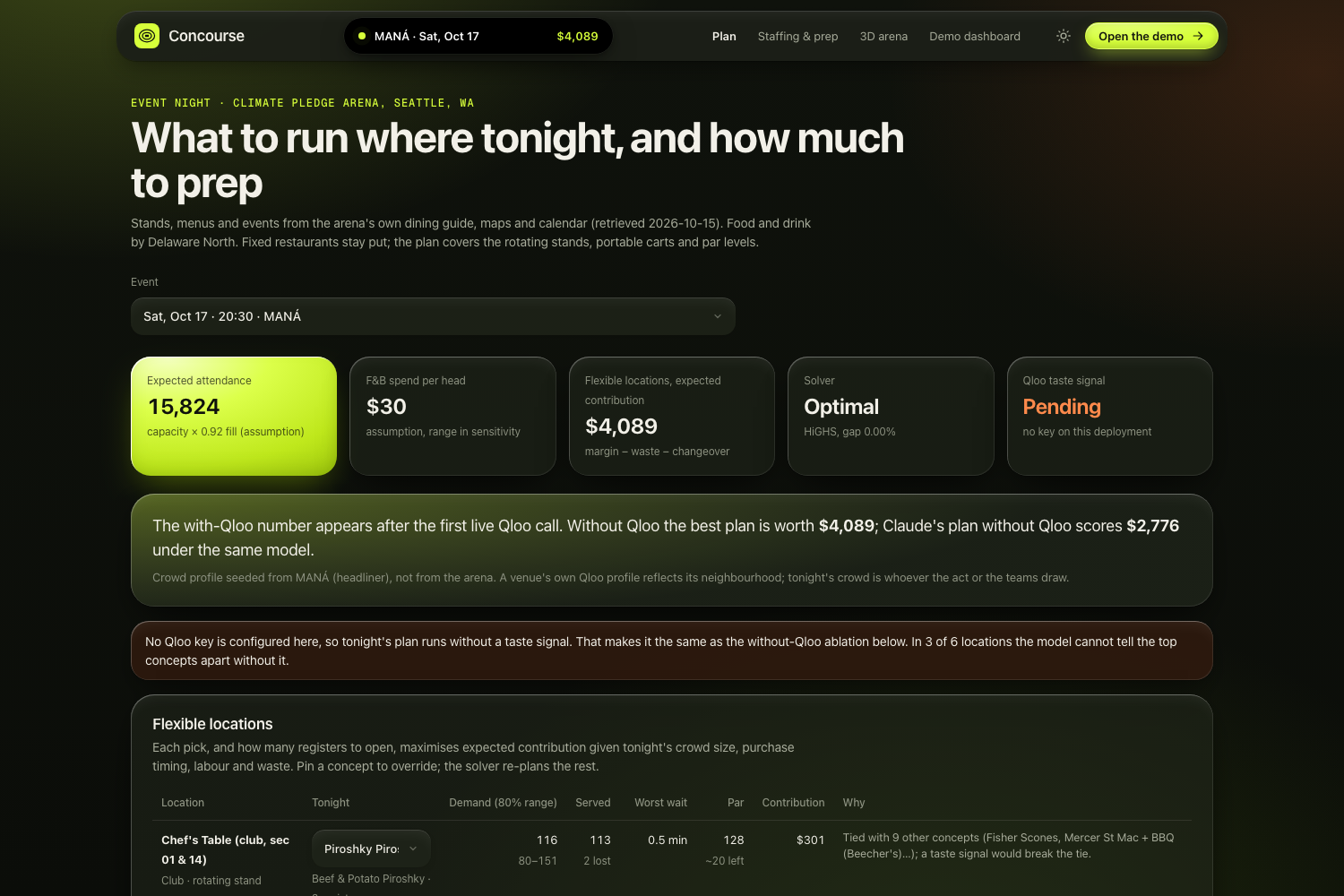
Pick an event on CPA's real calendar. Concourse builds one plan for that night across four pages:
- Plan (
/night). Which concept runs at each of the arena's flexible locations (Chef's Table, The Pepsi Marketplace and the portable points), with registers, expected demand (80% range), served transactions, worst wait, par level and contribution for each, plus why. It shows the Pareto front of money against queues, the break-even taste gap for every pick, and the without-Qloo ablation. Pin any concept and the solver re-plans the rest. - Staffing & prep (
/ops). Registers per 15 minutes at every stand, the shift roster, the 14-day lock with its predictability-pay cost, prep waves and call-downs, merch by item and size, the crowd's taste, and a "your sales" tab where the operator's own POS history takes over the forecast. - 3D arena (
/venue). Fly over, walk the concourse, or sit in any seat in a model of the real building (OpenStreetMap footprint, the arena's 74 sections, both concourses and all 49 stands from its own maps), coloured by fit, wait or served transactions. - Agents. A Claude tool-use agent answers operator questions ("what changes from last night?") and swaps stands through tools that call Qloo. An MCP endpoint exposes
list_events,plan_event,staff_event,merch_plan,erlang_a,erlang_c,newsvendorandtextbook_checksto any other agent, and/llms.txtdescribes the API.
Why this matters beyond one arena
Multi-use arenas serve a hockey crowd one night and a K-pop crowd the next out of the same stands, with the same staff roster and the same stockroom. F&B, merch and event labour are each planned today from last season's spreadsheet, and a first-time act has no row in it. Concourse turns Qloo's taste graph into an operating decision with money attached: the kind of use that makes taste data a budget line for a venue, not a marketing curiosity. The engine plans any venue whose dining guide and maps are published, which is nearly all of them.
How we built it
Next.js (App Router) and TypeScript on Vercel, react-three-fiber for the arena, and an exact MIP solver (HiGHS, compiled to WebAssembly) running server-side. Every model is plain TypeScript in lib/deep and lib/ops:
| Question an operator asks | Method | Code |
|---|---|---|
| How many people, buying what, when? | Attendance × level share × F&B per head × food/drink share, split into doors, intermissions and play windows; a Qloo affinity moves demand by exp(β·z), with z standardised within tonight's single Qloo call | planner.ts |
| Which concept at each flexible stand? | Integer program solved exactly with HiGHS: one concept and a register count per location, each concept once, equipment fit, pouring exclusivity, pins; objective is margin × incremental share − waste − changeover − labour | solver.ts |
| How long are the lines? | Time-varying Erlang A (M/M/c+M) from the Kolmogorov forward equations, carrying the queue between 15-minute intervals; steady-state SIPP shown beside it, following Green, Kolesar & Whitt (2007) | erlangA.ts, staffing.ts |
| Which shifts? | Dantzig shift-covering integer program, solved exactly | lp.ts |
| What does the 14-day rule cost? | Two-stage newsvendor in labour hours, with Seattle's predictability-pay table from SHRR ch. 120 and the 2026 $21.30 minimum wage | seattle.ts |
| How much to cook, and when to call the runner? | Newsvendor per hold window, reorder point over the runner's lead time, Washington's 4-hour time-as-control rule | prep.ts, newsvendor.ts |
| What merch, in what sizes? | atVenu genre priors, multi-item newsvendor with carry-over salvage (Lagrangian), Dirichlet size curve, Erlang A merch lines with faster walk-aways during the set | merch.ts, inventory.ts |
| How do my own sales change this? | Analog-event weights and conjugate Gamma–Poisson shrinkage, plus in-event updates for call-downs | forecast.ts |
| Does Qloo actually matter? | Without-Qloo ablation, baselines (keep what runs now, last similar event, a recorded Claude-without-Qloo plan, most popular), one-at-a-time sensitivity on every assumption, break-even affinity gap per location | analysis.ts |
Every economic input lives in economics.ts with its value, range, status (sourced, derived or assumption) and source. The venue itself (stands, items, levels, events) is in climate-pledge-arena.json, each entry carrying the URL it came from: the arena's dining guide, arena maps, team stores, event pages and pouring-rights announcements (Molson Coors, Modelo, PepsiCo).
How it uses Qloo
Qloo is the only source of the taste signal, and it is used where sales history is thin: before a first-time act. Full write-up: docs/qloo.md.
/searchresolves tonight's headliner (or the home and visiting teams). The crowd is seeded from the act, never from the arena, whose own Qloo profile reflects its neighbourhood rather than the touring audience./v2/tags+/v2/insightswithfilter.type=urn:tagandfilter.results.tagsranks every candidate concept's cuisine against the crowd in one call. Qloo scores our shortlist of concepts already operating in the building; it never invents a stand./v2/insightswithfilter.type=urn:demographicsgives the crowd's age and gender skew, which drives the drink mix and the merch size curve./v2/insightswithfilter.locationscouts the places near the arena that tonight's crowd likes, as context for a themed item./v2/analysis/comparecontrasts tonight's crowd with last night's for the agent's "what changes?" answer.
Calls are server-only (the key never reaches the browser), time out at 10 s, and fail closed with a named state (NO_SIGNAL, TIMEOUT, HTTP_ERROR…). A failed call is never shown as a low score. Every request is listed in the on-page evidence ledger.
Why Qloo, and not an LLM alone
On the MANÁ night (Sat, Oct 17), the best plan without Qloo is worth $4,089 of modelled contribution on the flexible stands. Claude's plan without Qloo, recorded as a baseline, scores $2,776 under the same model. A general-purpose LLM plans from the theme of the act; Qloo knows the crowd it actually draws. In 3 of 6 flexible locations the economics alone cannot tell the top concepts apart, so the decision comes down to taste, which is exactly the signal Qloo provides. Concourse shows, for every location, the affinity gap that flips the pick, so an operator sees precisely where Qloo earns its place in the plan.
For the same night, /ops staffs 223 people for 892 paid hours ($23,750 of labour, 5.0% of expected F&B sales). Burst-aware staffing needs 400 register-hours where steady-state staffing says 377: the steady-state tools under-staff the intermission. Posting the 14-day schedule at the optimal level instead of the forecast saves an expected $377 in predictability pay and staffing error for that one night.
Pre-registered predictions. We put the method on the record: we wrote predictions for five real CPA events (MANÁ, Kraken v Red Wings, Kacey Musgraves, Gorillaz, Garth Brooks) to predictions/2026-10-15.json and published its SHA-256 (09dfdede…6950295). The file is never edited, so anyone can score it against stand-level POS counts or timed queue counts. A venue tool should be held to that standard.
Research
We read operators, fans and workers before writing code. Highlights:
- Operators: the BodeGAGA program and CPA's earlier artist tie-ins (Eric Church bourbon, a plant-based Billie Eilish menu) are chef-driven, by hand. Delaware North's CPA GM: "we're in a constant labor shortage… we're always short" (Front Office Sports). Concessions job postings name "minimize in-event call-downs" as a KPI.
- Fans: at CPA the complaint that stuck was price (the "$9 Life Water" on opening night), and the venue answered with a value menu, not surge pricing. So Concourse never touches price.
- Staffing science: the decision rule for which staffing method to use comes from Green, Kolesar & Whitt (2007). Our own worked example showed steady-state SIPP misjudges a 15-minute intermission burst, which is why the queue is carried between intervals.
- Law: Seattle's Secure Scheduling rules, Q&A and minimum wage, linked above, are encoded directly.
Testing and checks
28 model tests run with npx tsx --test lib/deep/*.test.mts lib/ops/*.test.mts: Erlang C against a published worked example, Erlang A reducing to Erlang C, transient Erlang A converging to stationary, the 400-transactions-in-15-minutes burst against an independent solver, the newsvendor against a hand calculation, the HiGHS solver against exhaustive search on 40 random instances, and planner properties (feasibility, ablation identity, pins, monotonicity). The textbook_checks MCP tool runs the same checks against the live deployment.
Challenges
- Two buyers, one plan. The venue owns the fan experience; the concessionaire owns labour and waste. The plan had to speak to both, so contribution and worst wait sit on one Pareto front and the operator picks the trade-off.
- No public per-caps for CPA. Delaware North withheld them at the Kraken's request, so per-head spend is a labelled assumption anchored on public filings and swept in the sensitivity view.
- Bursty demand. Standard workforce tools assume steady state. Arena demand is a wall of people at intermission, so we had to solve the time-varying queue.
Built to be trusted
Every assumption carries its range and source, is swept in a sensitivity view, and is paired with a break-even, so an operator sees which inputs would change the answer and can plug in their own. The plan is a starting point the venue's own sales history then sharpens (Gamma–Poisson shrinkage in forecast.ts), not a black box that replaces their team. Everything works at crowd level: no fan identities, no surge pricing.
Who it is for
Delaware North's GM, executive chef and analytics team at Climate Pledge Arena, and the venue's F&B and retail lead. It is a starting point their own sales history then updates, not a replacement for their forecast.
What's next
- Score the five pre-registered CPA events against real stand-level sales, with and without Qloo, and publish the result.
- A one-month pilot at one arena: the real partner list and POS feed, nightly plans, measured against sell-through, waste and predictability-pay hours.
- Generalise the venue file so any multi-use arena can be loaded from its own dining guide and maps.
Disclosures
Solo entry by Daniel Asaboro, built during the submission period. AI coding assistants were used. Venue geometry © OpenStreetMap contributors (ODbL).
Built With
- anthropic-sdk
- claude
- highs
- mcp
- next.js
- qloo
- react
- react-three-fiber
- three.js
- typescript
- vercel
