-
-
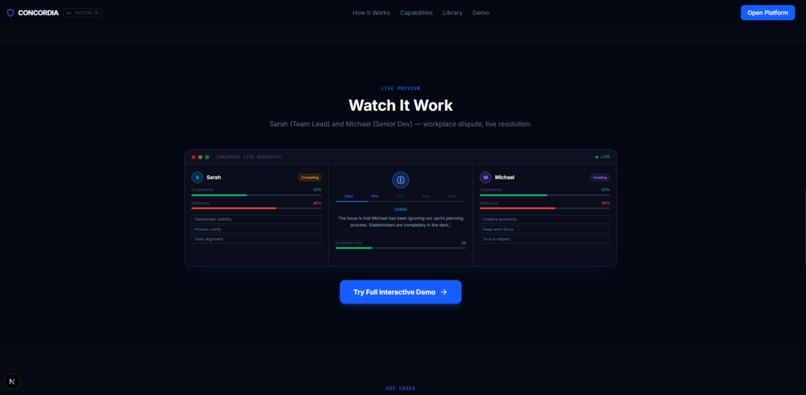
Demo
-
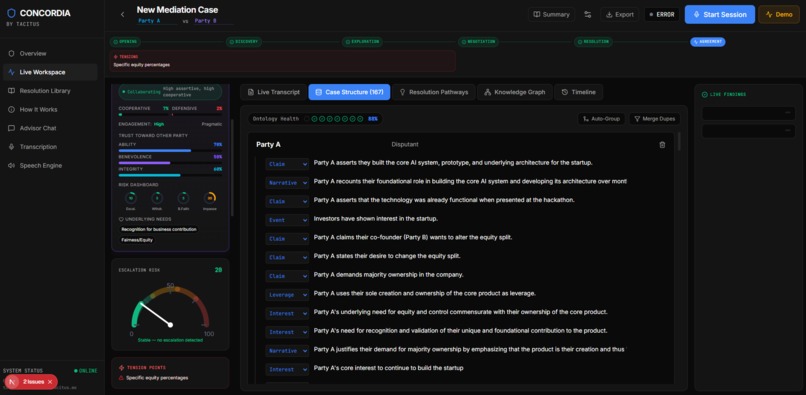
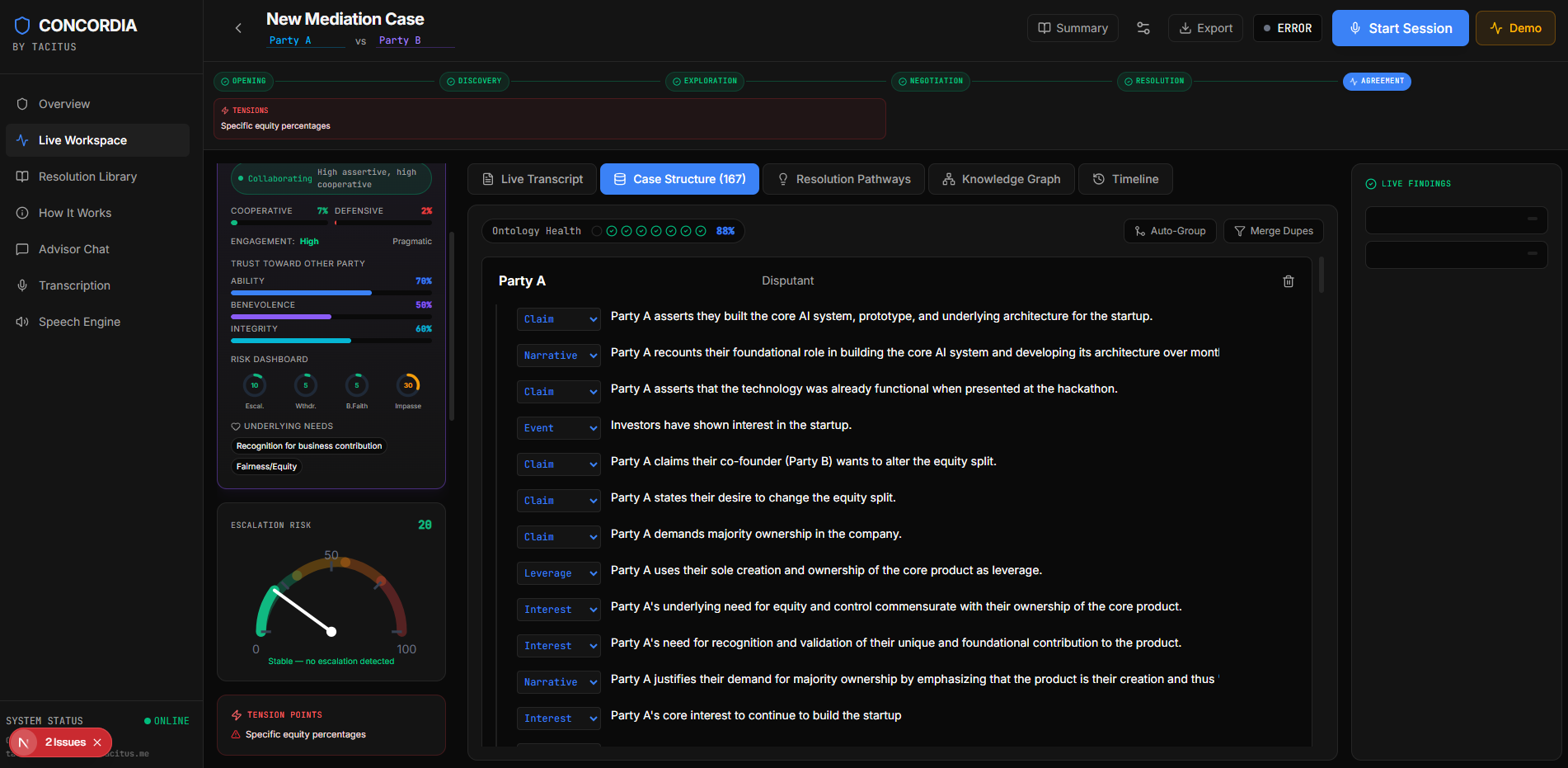
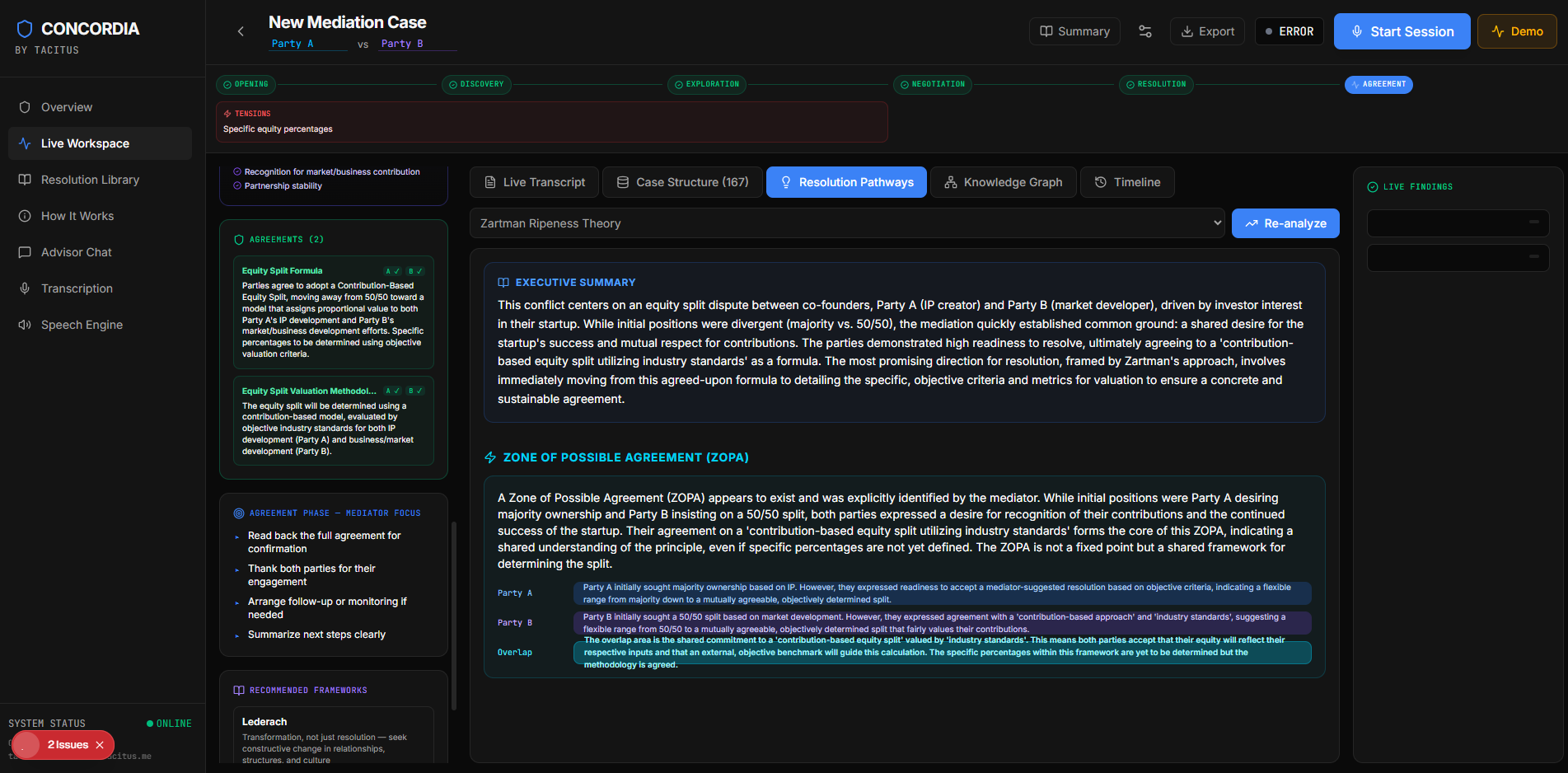
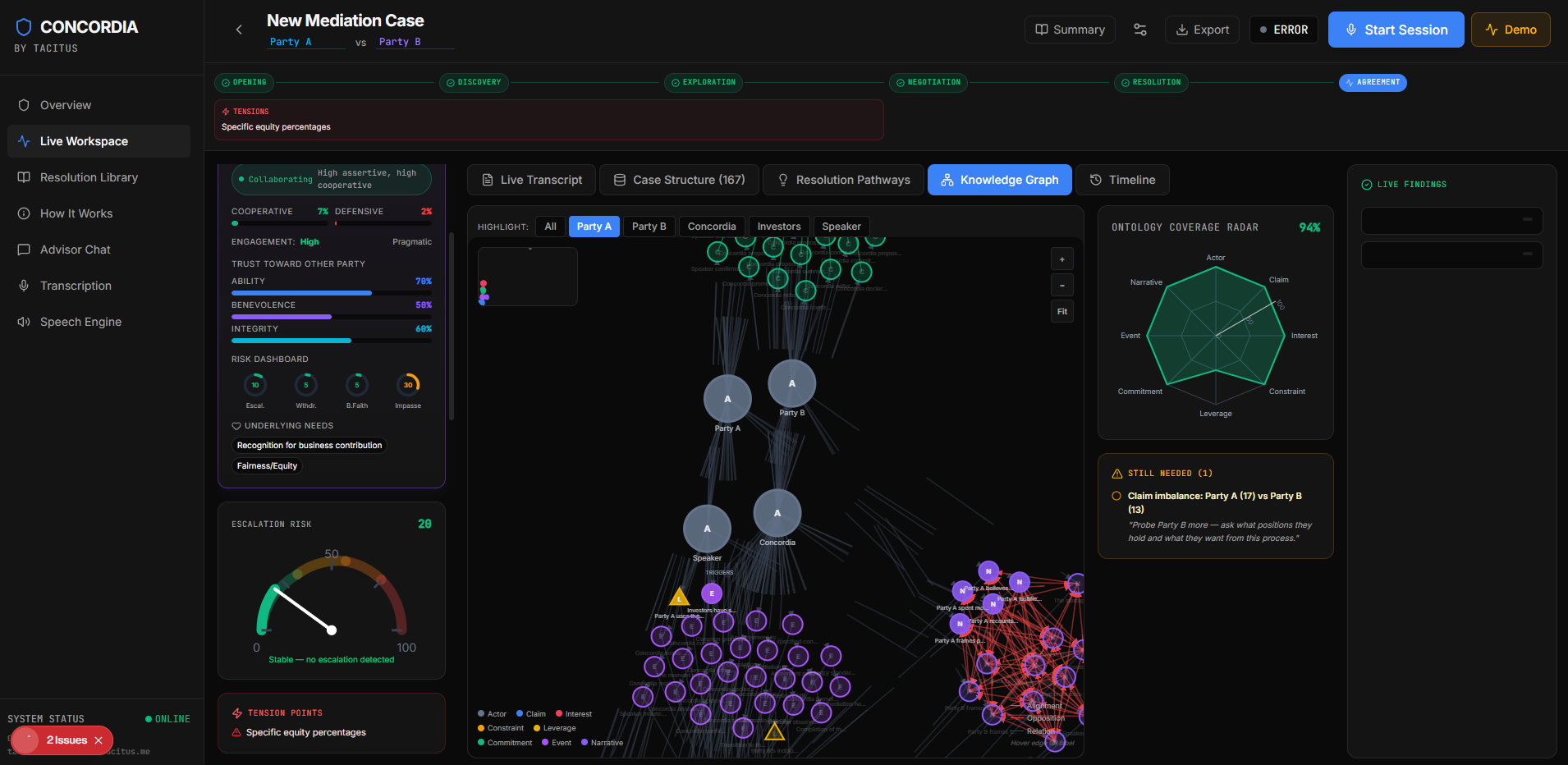
extraction of TACITUS Ontology primitives -- Actors, Leverages.. etc
-
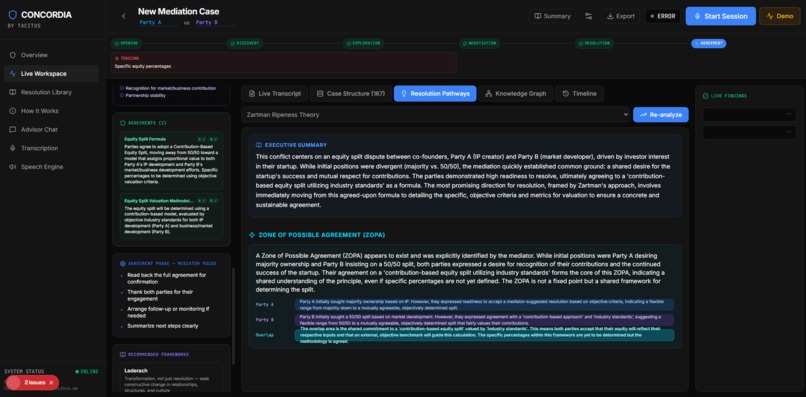
example of negotiation outcome
-
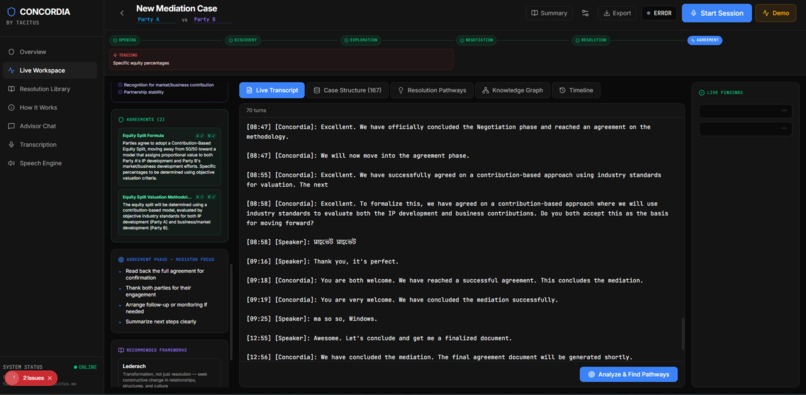
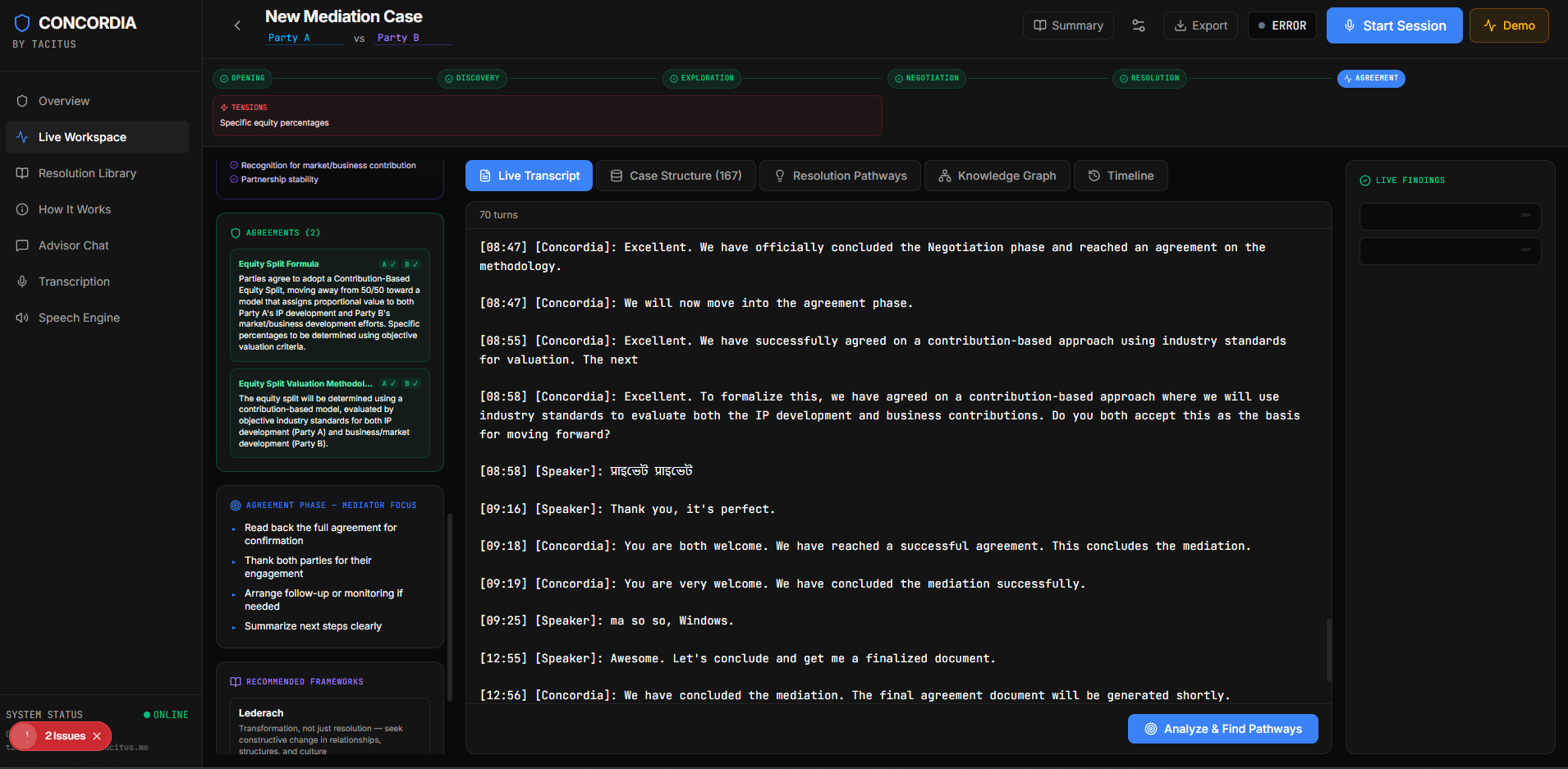
Live transcript
-
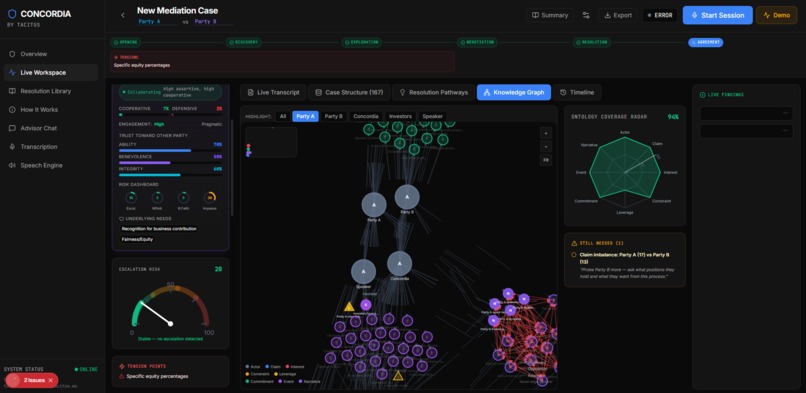
Creation of Live Knowledge Graph about the Conflict
-
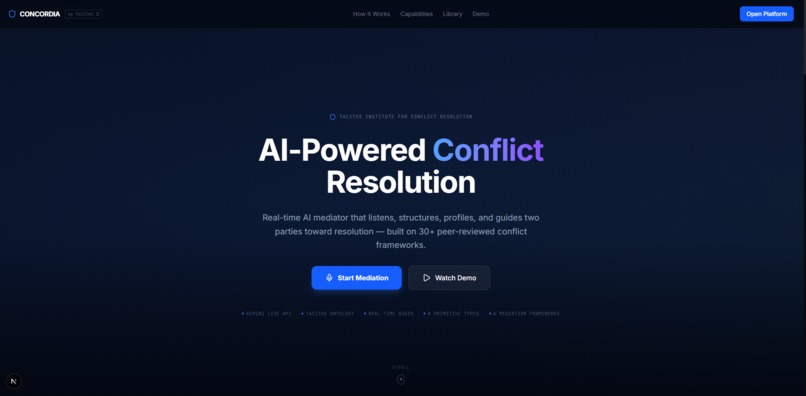
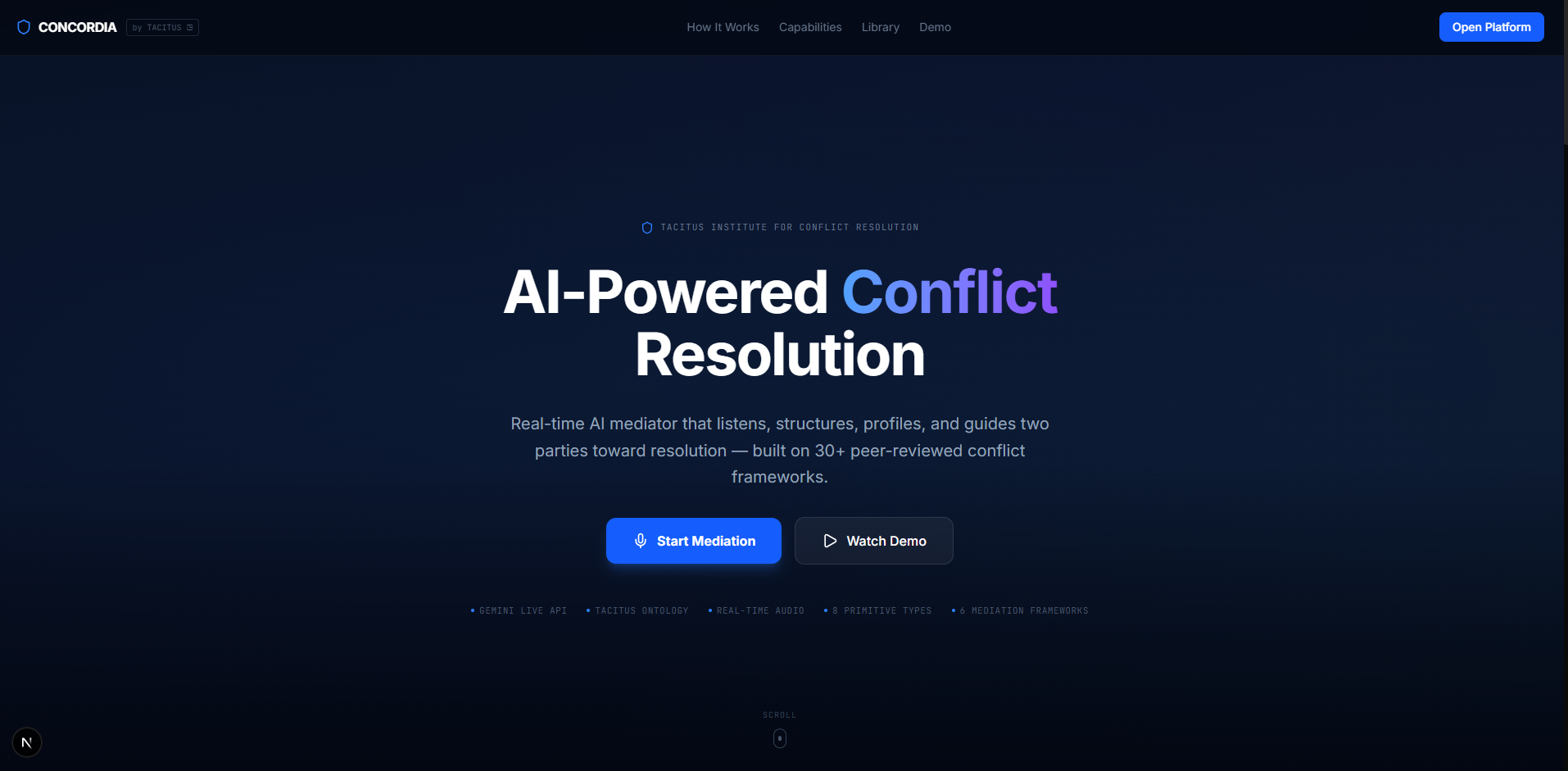
Landing Page
Inspiration
What it does
How we built it
Challenges we ran into
Accomplishments that we're proud of
What we learned
What's next for CONCORDIA by TACITUS# CONCORDIA — Real-Time AI Mediation
Inspiration
CONCORDIA was inspired by years working in conflict environments where the hardest problem is not lack of information — but lack of structure.
As a Political Affairs Officer at the United Nations, I worked on complex disputes where mediators and analysts spend enormous effort reconstructing who said what, what interests are driving positions, and where escalation begins.
Conflicts unfold through messy conversations. Claims, emotions, narratives, and incentives quickly become tangled.
This led to a simple question:
What if AI could make conflicts legible in real time?
CONCORDIA builds on the TACITUS Conflict Grammar, an ontology designed to represent disputes through eight primitives:
Actors, Claims, Interests, Constraints, Leverage, Commitments, Events, and Narratives.
Instead of treating conversations as unstructured text, the system transforms them into a live conflict map that both humans and AI can reason about.
The goal is not to replace mediators — but to augment their judgment with structured conflict intelligence.
What We Built
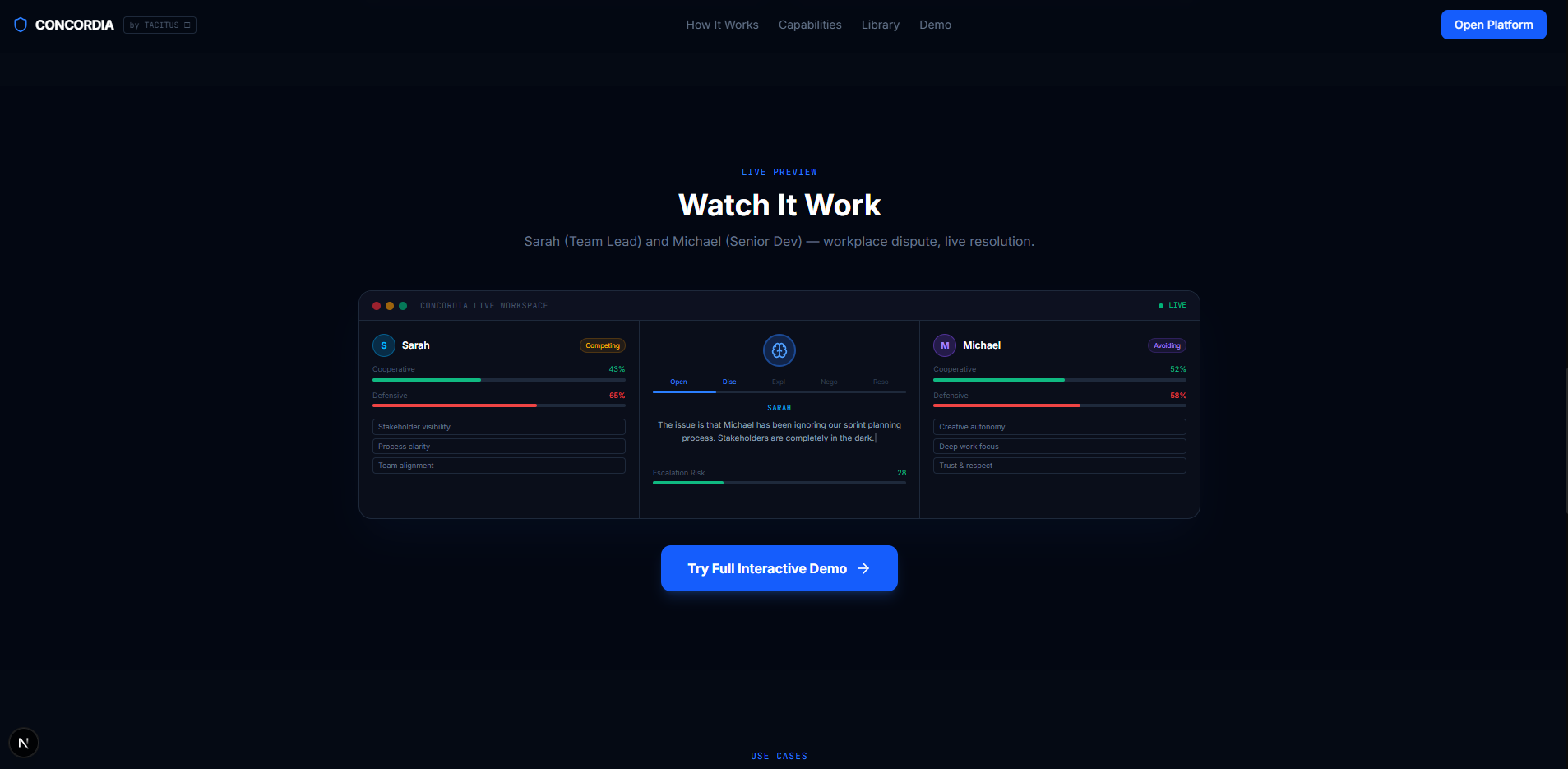
CONCORDIA is a real-time AI mediation platform.
Two participants can join a live session and speak naturally while an AI mediator:
- listens and responds in real time
- extracts conflict primitives from speech
- maps the dispute into a live knowledge graph
- detects escalation patterns
- suggests resolution pathways
The system integrates multiple negotiation frameworks, including Principled Negotiation (Fisher & Ury), Glasl’s escalation model, Nonviolent Communication, and identity-based conflict theory.
It also includes practical resolution tools such as blind bidding, agreement generation, and structured case summaries.
How We Built It
CONCORDIA combines modern AI infrastructure with structured reasoning.
Frontend
- Next.js 15
- React 19
- Tailwind CSS
- D3.js conflict graph
Backend
- Node.js WebSocket server for live sessions
- REST APIs for analysis, summarization, and document ingestion
AI
- Google Gemini 2.0 Flash Live for real-time audio mediation
- structured extraction of conflict primitives
- dynamic reasoning over negotiation frameworks
The result is a system that turns conversation into computable conflict intelligence.
Challenges
The biggest challenges were:
- Real-time AI interaction with low latency audio streaming
- translating messy human conversation into structured conflict primitives
- designing escalation detection models grounded in mediation research
- building a system that remains transparent and trustworthy in sensitive situations
Looking Forward
CONCORDIA is part of a broader effort through TACITUS to build infrastructure for conflict intelligence.
By combining AI, structured ontologies, and negotiation theory, we hope to make complex disputes more understandable — and ultimately easier to resolve.
Built With
- an-ontology-that-converts-unstructured-conversation-into-structured-conflict-intelligence.-deployment-uses-docker-and-google-cloud-run
- and-conflict-analysis.-visualization-and-analytics-are-powered-by-d3.js-and-recharts
- and-react-19-for-the-frontend
- d3.js
- gemini
- genai
- next.js-15
- node.js
- speech-understanding
- tacitus
- tacitus.meontology
- vitest
- while-the-system-architecture-is-structured-around-the-tacitus-conflict-grammar
- with-a-node.js-websocket-server-enabling-real-time-audio-mediation-sessions.-the-platform-uses-the-google-gemini-2.0-flash-live-api-for-live-multimodal-ai-interaction

Log in or sign up for Devpost to join the conversation.