About Concord
Concord is a semantic consistency analysis system for software artifacts. It examines whether different sources of truth—documentation, API specifications, and tests—describe the same externally observable behavior.
The system is designed to surface behavioral drift, conflicting assertions, and coverage gaps that are invisible to traditional linters, test runners, or schema validators.
Concord does not attempt to prove systems right or wrong. Instead, it makes implicit assumptions explicit, and shows where those assumptions agree, diverge, or silently exist in only one place.
What Concord Does
Given a repository snapshot, Concord:
- Ingests structured Evidence objects describing observed behavior from multiple artifacts.
- Deterministically transforms evidence into canonical behavioral claims using a closed-world, rule-driven pipeline.
- Groups claims into behavioral units representing a single observable behavior under a specific condition.
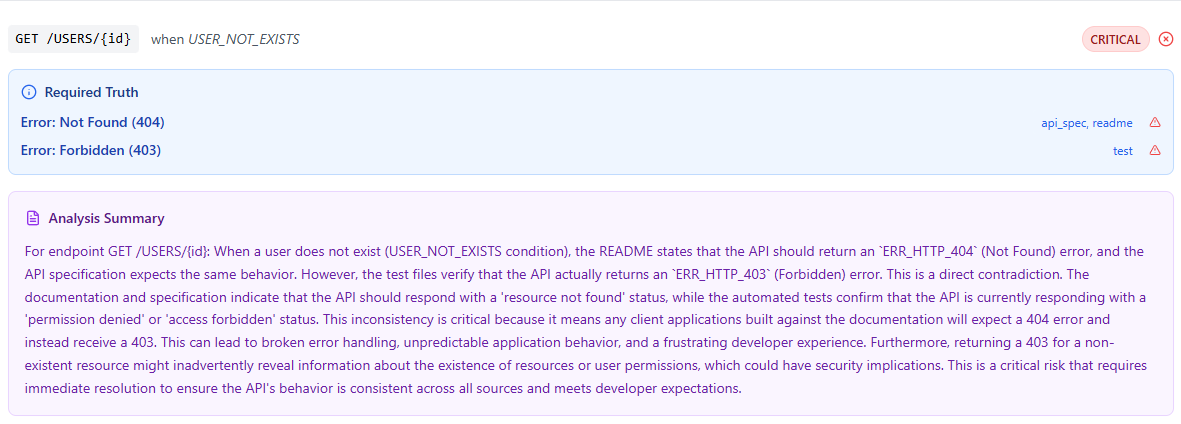
- Performs fact-preserving analysis to detect structural conditions such as contradictions, undocumented behavior, or implementation-only assumptions.
- Applies a separate heuristic evaluation layer to provide risk context, confidence, and coverage signals.
- Presents results through risk-driven and coverage-driven views that support engineering judgment.
Every reported finding is traceable back to concrete source locations.
Core Design Principles
Evidence-first reasoning
Claims are not freely inferred. They are emitted only when structured evidence passes strict admission, normalization, and assertion rules. Unsupported or ambiguous observations are explicitly rejected rather than guessed.
Closed behavioral vocabulary
All claims belong to a bounded set of behavioral categories and assertion namespaces. This prevents scope creep and eliminates hallucinated semantics.
Separation of concerns
The system enforces a hard boundary between:
- factual analysis (what is present),
- heuristic evaluation (contextual risk),
- and presentation or policy decisions.
No single layer is allowed to silently influence another.
Determinism by construction
Once evidence is ingested, Concord’s behavior is deterministic. The same inputs produce the same claims, findings, and evaluations.
Role of Gemini
Gemini is used only upstream to produce structured, typed Evidence objects from source artifacts.
Gemini does not:
- decide contradictions,
- assign risk,
- merge claims,
- or influence evaluation logic.
All downstream reasoning operates on explicit data structures and deterministic rules.
Output Model
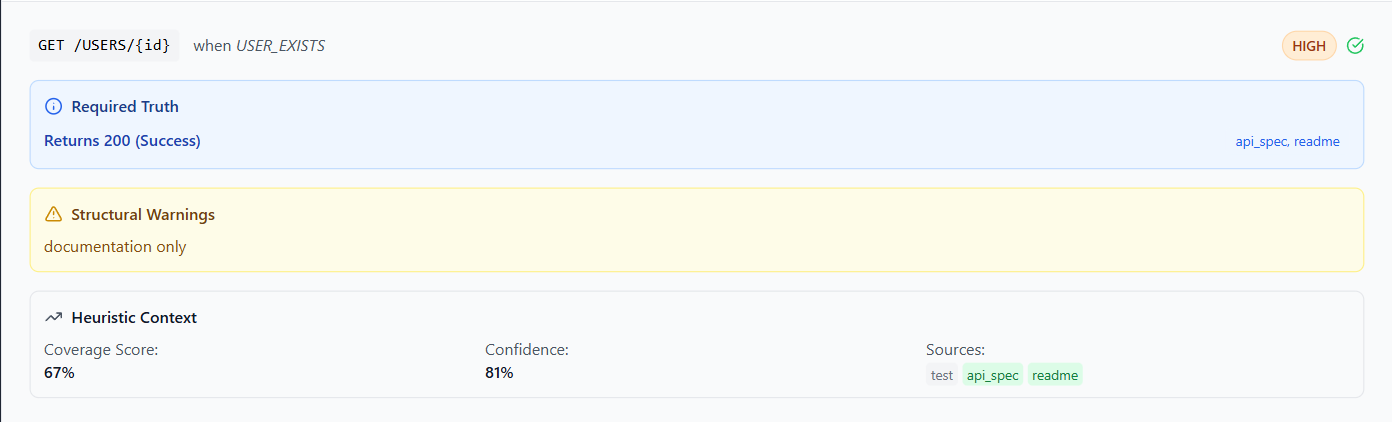
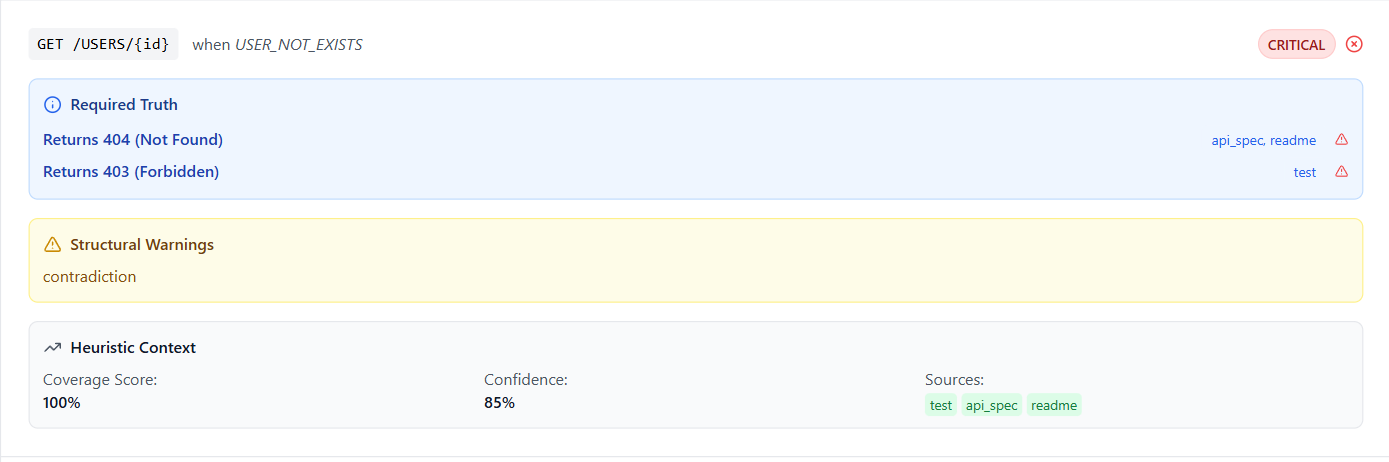
Concord’s primary unit of analysis is a behavioral unit, which includes:
- the endpoint, condition, and behavioral category,
- the set of assertions and their sources,
- structural warnings (e.g. contradiction, documentation-only behavior),
- heuristic context such as confidence and coverage,
- an assigned risk band (critical → low).
Results are aggregated into endpoint summaries and risk-focused views, allowing teams to quickly identify where semantic agreement breaks down.
Internal diagnostics (such as rejected claims) are preserved for transparency and can be surfaced on demand.
Why This Matters
In real systems, failures often arise not from broken code, but from misaligned expectations:
- tests enforcing behavior that was never documented,
- specs describing guarantees that tests don’t verify,
- documentation drifting quietly away from reality.
Concord makes these mismatches visible before they turn into production incidents.
In One Sentence
Concord reveals where your code, tests, and documentation disagree about what your system does.


Log in or sign up for Devpost to join the conversation.