-
-
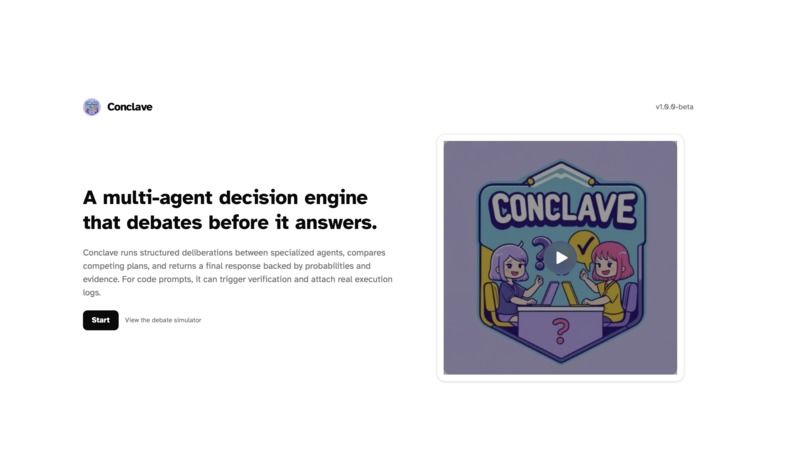
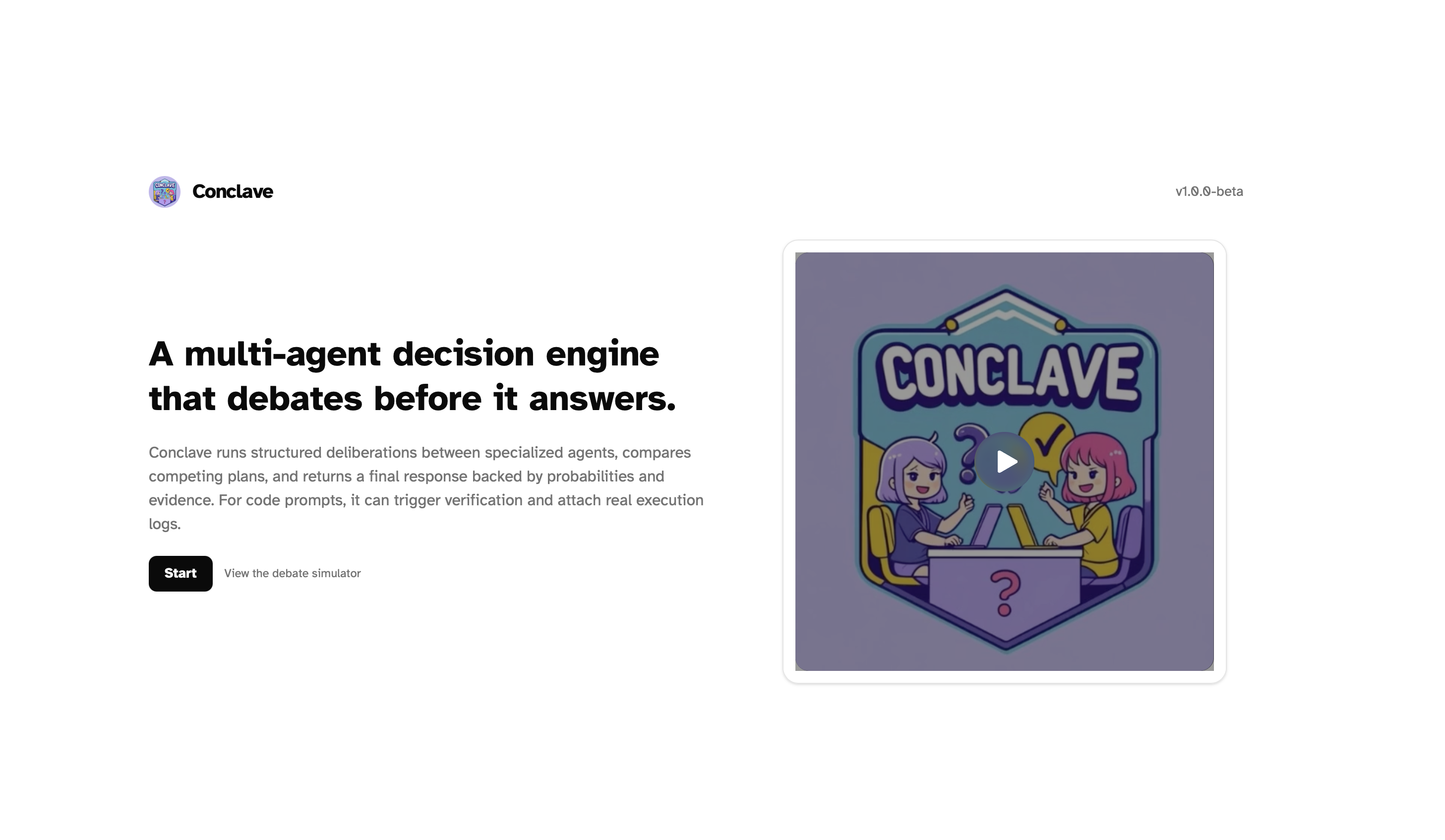
landing
-
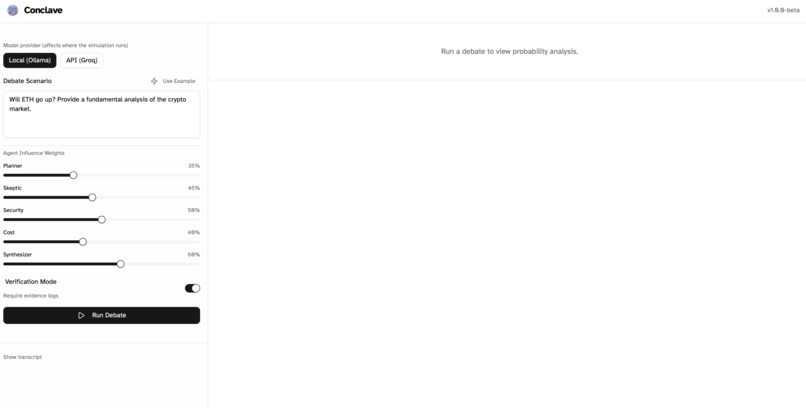
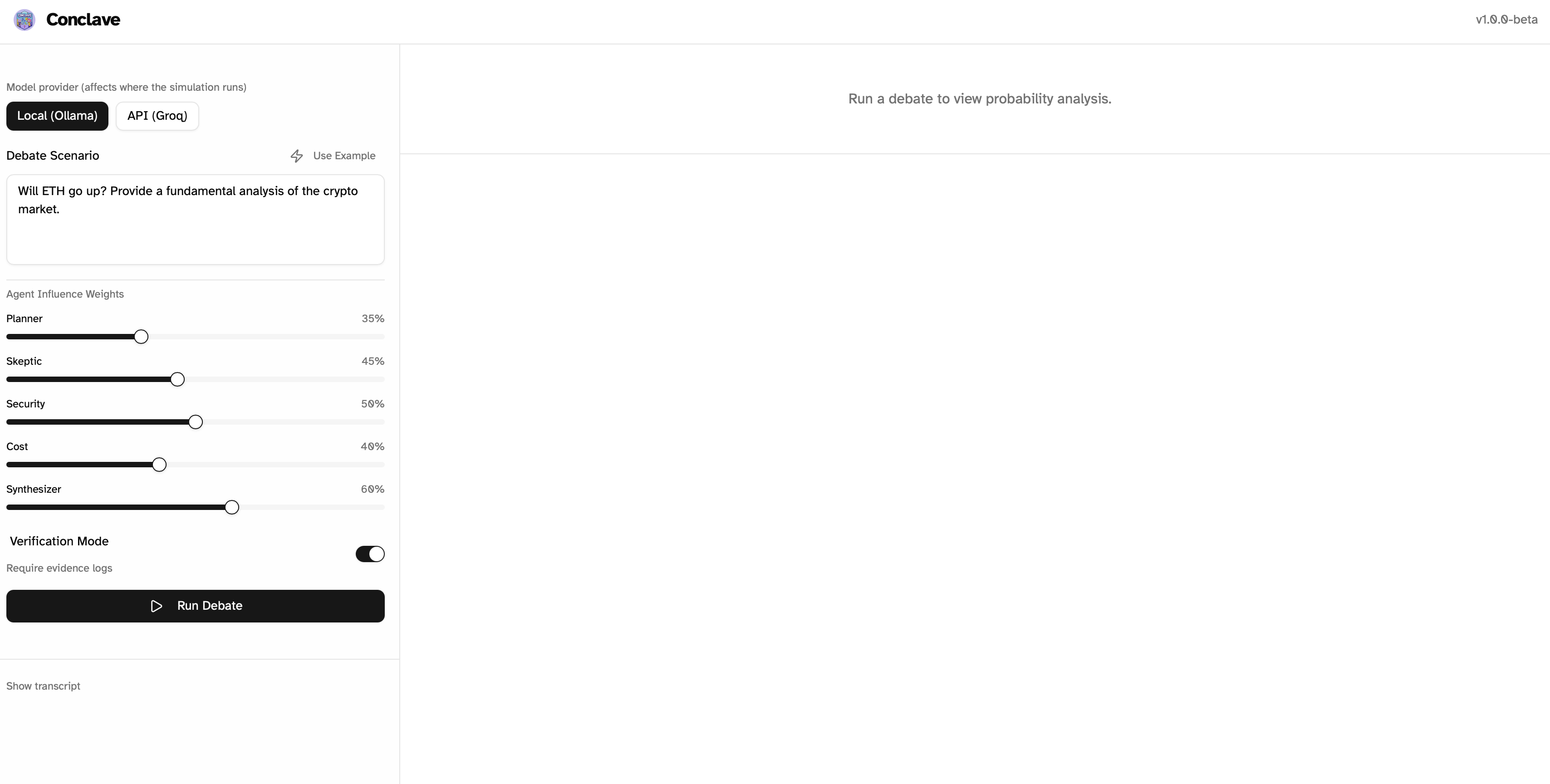
prompt
-
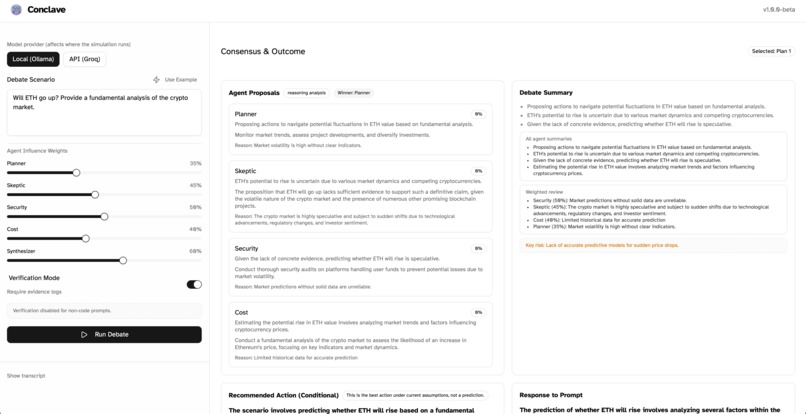
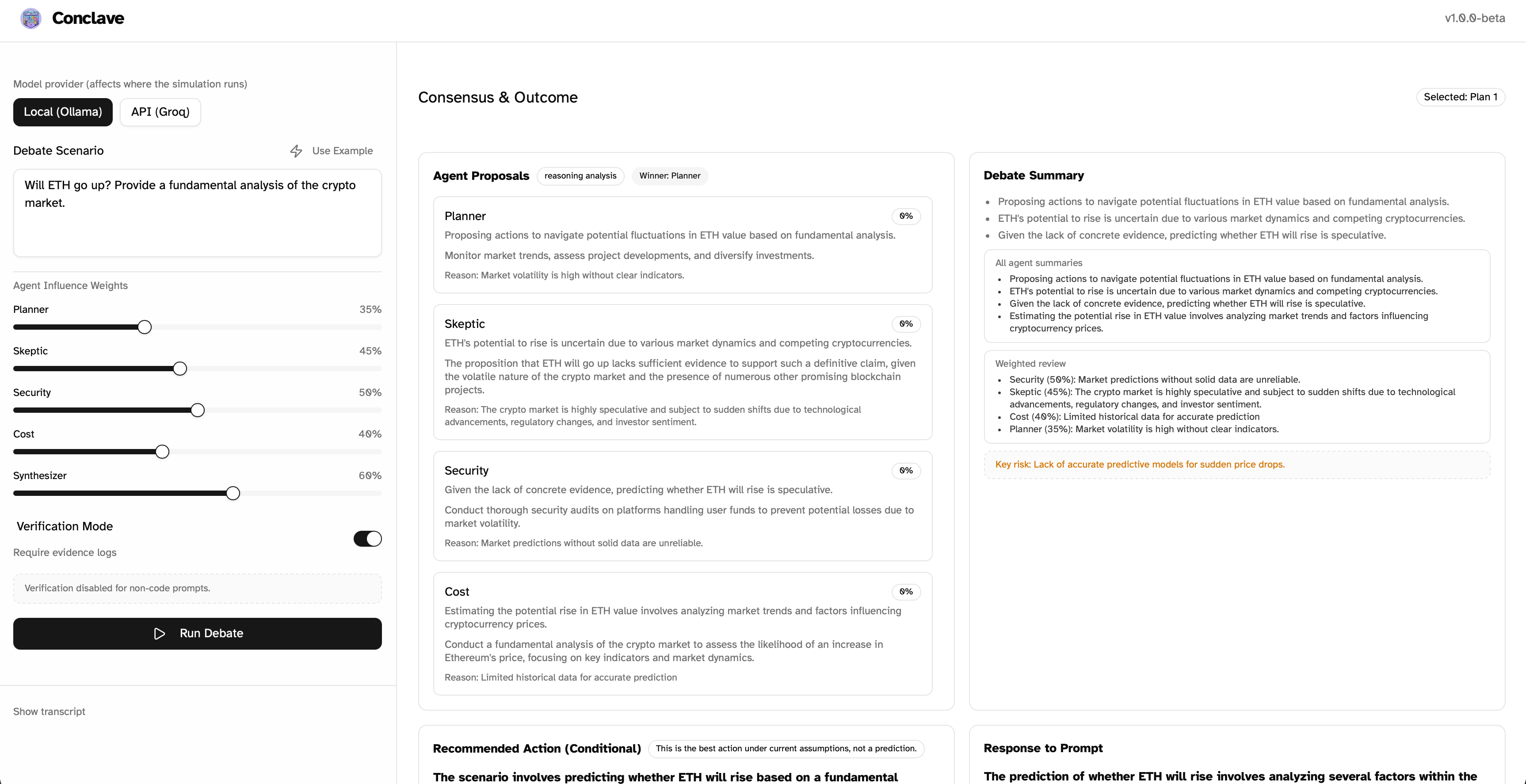
discuss agents
-
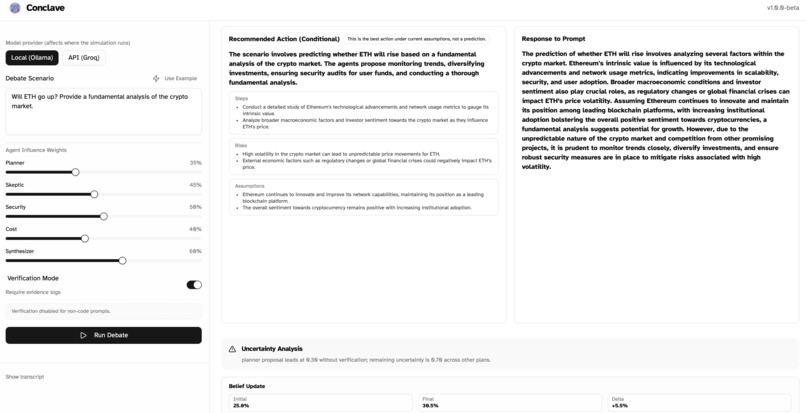
response
-
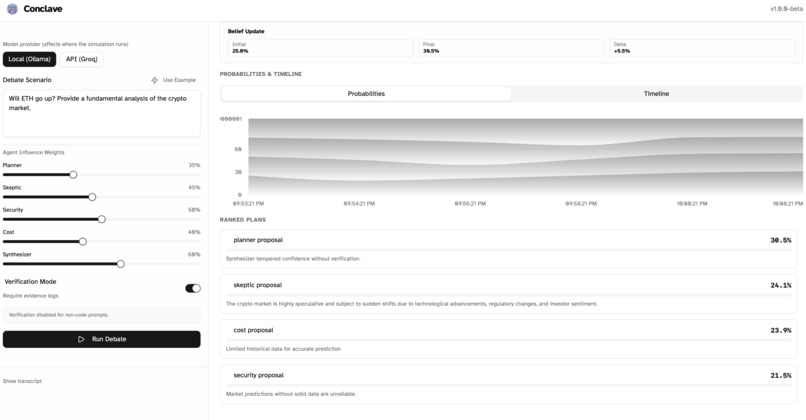
probabilities
Conclave
Inspiration
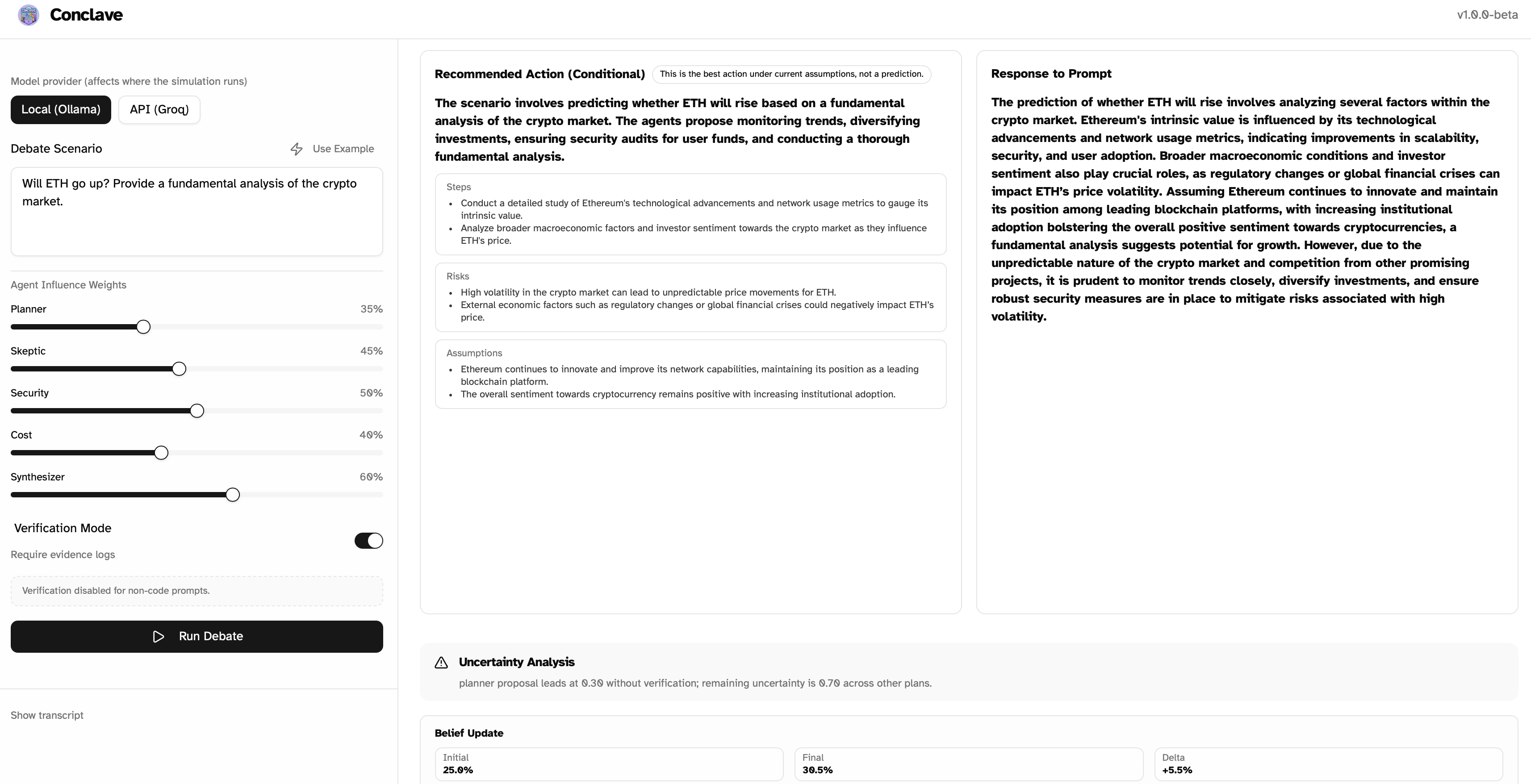
Conclave was inspired by a recurring failure mode in modern AI systems: they sound confident even when they shouldn’t be. Most tools optimize for a single “best answer,” hiding disagreement, assumptions, and uncertainty. We wanted to build a system that behaves more like a real decision room where multiple perspectives argue, evidence matters, and confidence must be earned, not asserted.
The goal was not to predict outcomes, but to make reasoning, uncertainty, and belief updates visible.
What it does
Conclave is a multi-agent decision engine that runs structured debates between specialized agents (Planner, Skeptic, Security, Cost, Synthesizer).
Instead of returning one answer, it produces:
- multiple competing plans,
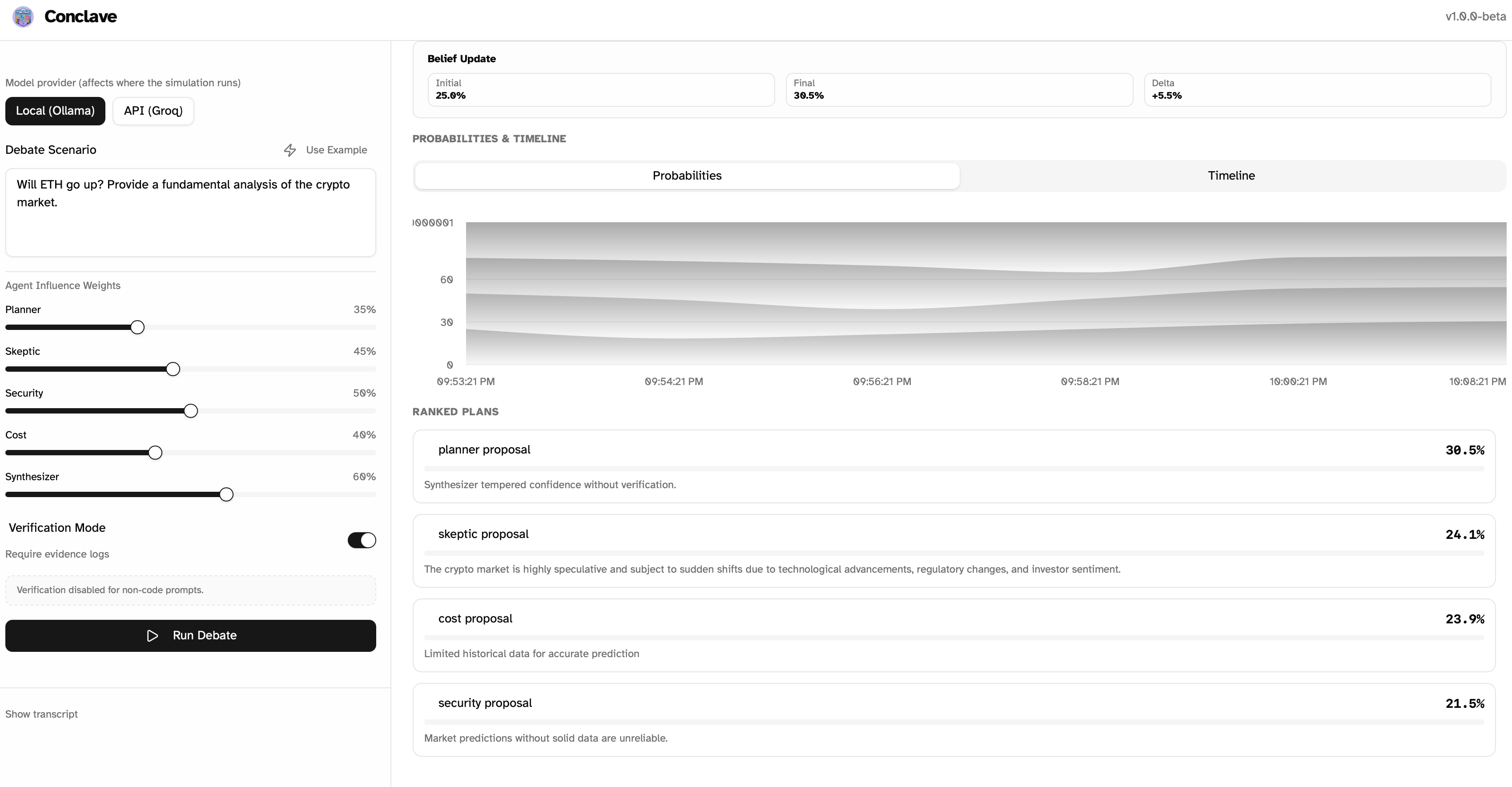
- a probability distribution across them (never 0% or 100%),
- visible disagreement between agents,
- explicit assumptions behind recommendations,
- and a trace of how beliefs change after evidence or verification.
The output is a conditional recommendation, not a verdict.
How we built it
We built Conclave as a local-first web application with a lightweight backend and a clear separation between reasoning and verification.
Key elements:
- A debate engine enforcing agent-to-agent responses (no parallel monologues).
- Probabilistic aggregation with weighting, damping, and normalization.
- An evidence ledger that updates belief states after verification.
- A UI that surfaces transcripts, probability timelines, belief deltas, and assumptions.
- Mock-first adapters for sandboxed verification, with optional real execution hooks.
The architecture favors clarity and debuggability over scale or automation.
Challenges we ran into
- Avoiding false certainty: It’s surprisingly easy for probabilities to collapse to “100%.” We had to explicitly design against that.
- Making disagreement legible: Raw transcripts are unreadable; we needed compact visual summaries.
- Separating belief from action: Users naturally expect advice, but advice without assumptions is misleading.
- Scope control: It was tempting to add more agents, data sources, or automation—but that would reduce trust.
Accomplishments that we’re proud of
- Building a system that never claims certainty by design.
- Making belief updates after evidence explicit and traceable.
- Turning disconfirming tests into a first-class feature (“what would change our mind”).
- Delivering a working, end-to-end decision engine within tight constraints.
- Keeping the system honest: no predictions, no autopilot, no hidden logic.
What we learned
- Transparency builds more trust than confidence.
- Disagreement is information, not noise.
- Probabilities are only meaningful when assumptions are visible.
- Most AI UX problems are epistemic problems, not model problems.
- Designing for restraint is harder than designing for capability.
What’s next for Conclave
Next steps focus on depth, not breadth:
- Better visualization of agent disagreement and variance.
- More flexible assumption modeling and scenario branching.
- Cleaner redaction and summarization layers for hybrid local/cloud setups.
- Adapting Conclave to non-financial domains like governance, engineering, and policy.
- Exploring Conclave as decision infrastructure rather than a standalone app.
Conclave is not about being right.
It’s about knowing what you believe, why you believe it, and how fragile that belief is.
Built With
- daytona
- leanmcp/core
- node.js-(tsx)
- ollama
- react
- surgent
- tailwind-css
- typescript
- vite


Log in or sign up for Devpost to join the conversation.