-
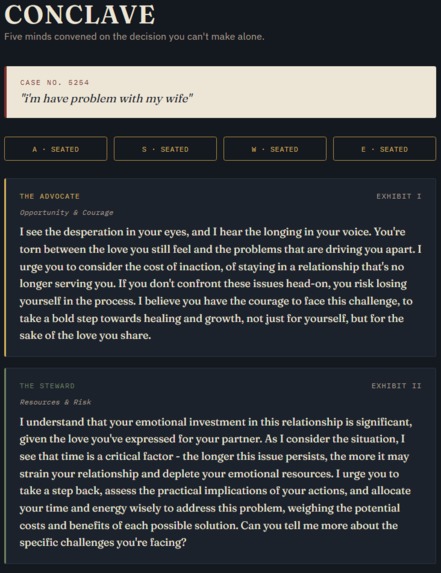
No matter how small your problem is, the AI system will make various decisions according to its inherent nature.
-
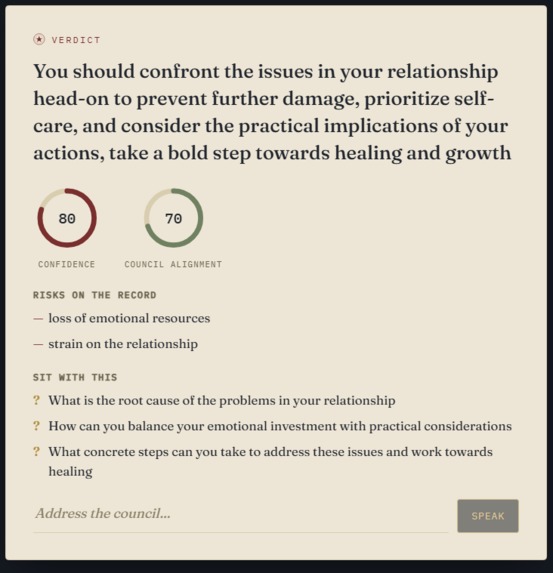
If you're still confused, AI will analyze the best priority scale to do right now, depending on the case.
Inspiration
Big decisions rarely have one right answer — they have several conflicting truths pulling at once: ambition versus risk, logic versus emotion, what you want versus what you can afford to lose. Most people work through this alone, in their own head, or by asking one friend who only ever offers one perspective. Conclave was built on a simple premise: what if you could convene an actual council — four distinct points of view that genuinely argue with each other — and walk away with a structured verdict instead of more noise?
What it does
Conclave simulates a real deliberation. The person states their dilemma and, optionally, what's at stake. From there, five AI calls run in sequence:
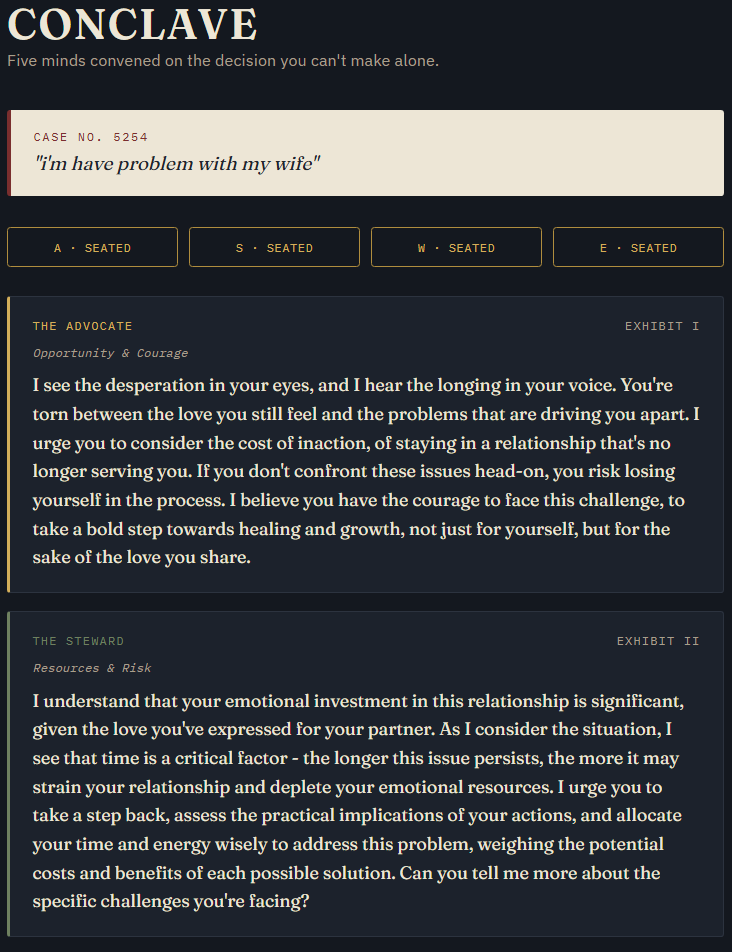
- The Advocate, The Steward, and The Witness testify in parallel — opportunity and courage, resources and risk, and values and wellbeing, respectively. None of them has heard the others yet, so their takes are genuinely independent.
- The Examiner then reads all three testimonies and cross-examines them — naming the unspoken assumption or the question nobody asked, sometimes directly challenging a weakness in an earlier argument.
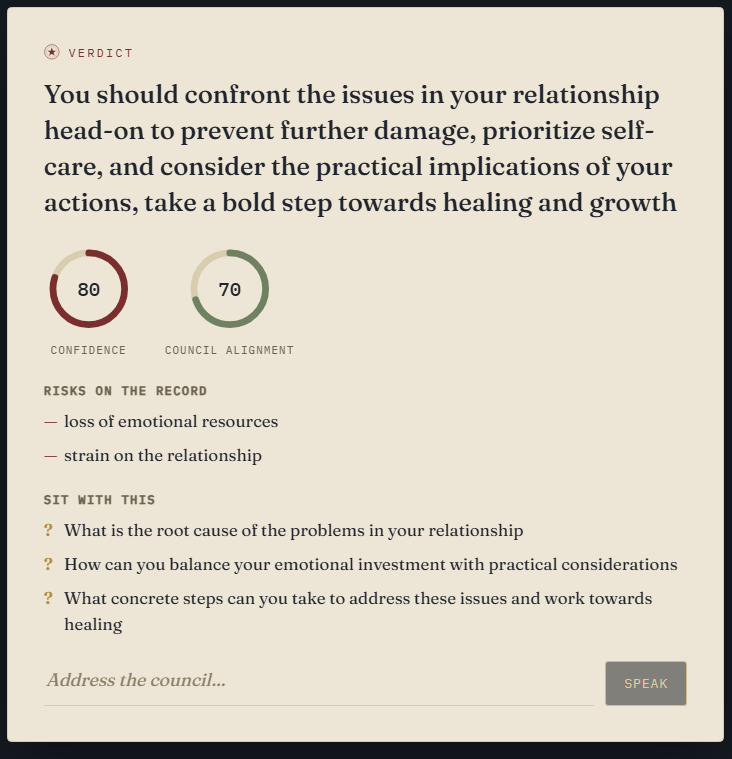
- The Chair reads the full transcript and delivers a structured verdict: a direct recommendation, a confidence score, a council "alignment" score (how much the four members actually agreed), named risks, and reflection questions.
The person can then address the council — push back on the verdict — and the Chair responds directly, adjusting its reasoning if the new point genuinely changes the calculus.
How we built it
Conclave is built in React, with two parallel deployments:
- A Claude.ai artifact version, calling the Claude API directly for the highest-quality reasoning demo.
- A standalone Next.js app deployed on Vercel, with a serverless API route that proxies requests to Groq's API (Llama 3.3 70B). This keeps the API key safely on the server — never exposed to the browser — so anyone can open the live link and use it immediately, with no sign-in wall and no cost risk.
The interface uses custom CSS (no UI library) and hand-built SVG for the gauges and seal icon, designed around a "deliberation chamber" aesthetic — brass, ink, and paper — rather than a generic AI-chat template.
Challenges we ran into
- Making the personas actually listen to each other. The first version had all four personas answer independently in parallel, which felt like four separate chatbots rather than a real council. We restructured the flow so the Examiner and Chair only run after reading the prior testimony, producing genuine cross-referencing instead of disconnected takes.
- Balancing latency against authenticity. Five sequential AI calls take real time. We parallelized the three independent opening testimonies (Advocate, Steward, Witness) since they don't need to hear each other, while keeping the Examiner and Chair sequential since their entire purpose depends on reading what came before — cutting total wait time without losing the "real debate" feel.
- Getting reliable structured output from an open-weight model. Llama 3.3 70B is less consistent than Claude at strictly following JSON-only output instructions for the Chair's verdict. We tightened the system prompt and added a defensive JSON-extraction step so the verdict still renders correctly even if the model adds stray text around the JSON.
- Making the app safe to share publicly. An early version called the AI API directly from the browser, which would have either exposed an API key or required every visitor to sign in. We moved all AI calls behind a serverless API route so the key stays server-side and the public link works for anyone, including judges, with zero setup.
Accomplishments that we're proud of
- A genuinely multi-agent deliberation, not a single chatbot wearing four costumes — each persona's output measurably depends on what was said before it.
- A live, publicly accessible deployment that costs nothing to run and requires no account to try.
- A distinctive, fully custom visual identity instead of a templated AI-app look.
What we learned
Orchestrating multiple sequential AI calls is as much a UX problem as an engineering one — the real challenge wasn't getting the API to respond, it was deciding which steps truly need to wait for each other and which can run in parallel without breaking the illusion of a real conversation.
What's next for Conclave
- Letting the person choose which personas sit on the council for a given dilemma (e.g., adding a "Skeptic" or "Optimist" seat).
- Saving past sessions so a person can revisit a verdict and see how their thinking changed over time.
- Voice mode, so the council can be heard rather than just read.
Built With
- anthropic-claude-api-for-the-in-ecosystem-claude.ai-artifact-demo
- api
- backend
- custom-css-(no-ui-library)
- groq-api-running-llama-3.3-70b-for-live-multi-persona-reasoning-on-the-public-deployment
- hand-built-svg-for-gauges-and-the-seal-icon
- isolated
- keeping
- key
- next.js-(standalone-deployment)
- on
- react
- serverless
- the
- vercel

Log in or sign up for Devpost to join the conversation.