Concierge
Planning a trip today means becoming the API between five different websites.
You search for flights on one site, compare hotels on another, make a restaurant reservation somewhere else, book activities, then arrange transportation between everything. Even AI agents struggle with this because most websites expose information through interfaces designed for humans to click through, not structured capabilities that agents can reliably use.
Concierge explores a different future: a web where services are built for both people and agents.
With Concierge, a traveler can simply say:
“I’m going to Paris for 5 days next month. Find me a good flight, a hotel near the city center, two great dinners, a Louvre experience, and airport transportation. Keep the total under $2,500 and ask me before making any purchase over $200.”
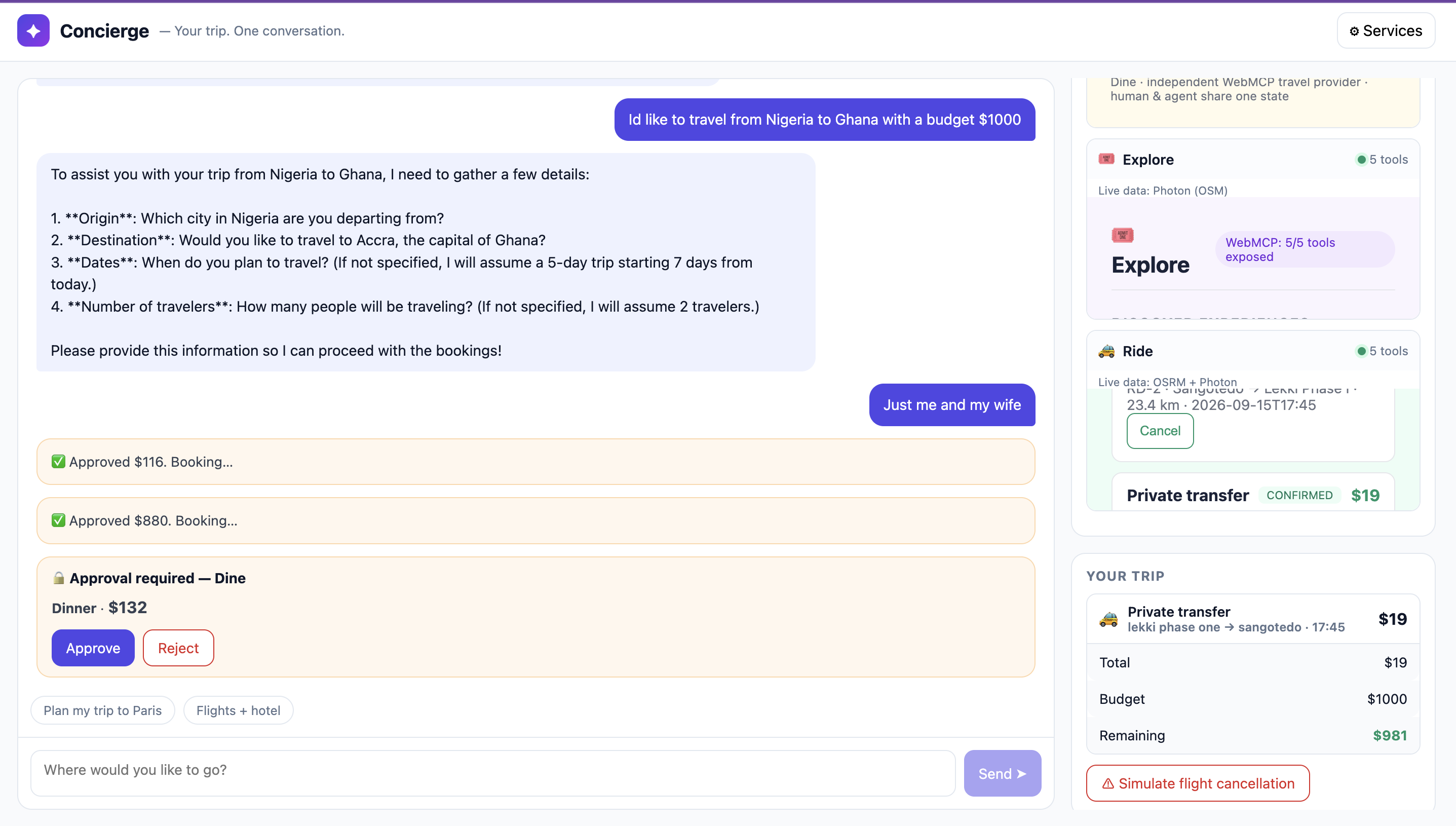
Instead of manually operating each service, Concierge coordinates the trip across independent WebMCP-enabled services:
FlyNow → flights Stayly → hotels Dine → restaurants Explore → activities Ride → transportation
Each service exposes structured capabilities through WebMCP. Concierge can discover and use those capabilities rather than relying on fragile UI guessing.
The result is not another travel chatbot that simply recommends links. It is an experiment in an agent-native travel ecosystem, where specialized websites can become capabilities that an agent can compose into a complete real-world task.
The human remains in control. Concierge can present the complete itinerary, explain its decisions, compare alternatives, and request approval before consequential actions such as larger purchases. The traveler can intervene at any point.
Why WebMCP matters
The important part of this project is not simply putting an AI chatbox on a travel website.
Each provider is independently useful to a human, but also exposes machine-readable tools for agents. This creates a composable ecosystem:
Human → Concierge → WebMCP services → Real-world task
A flight provider doesn't need to know about hotels. A hotel provider doesn't need to know about restaurants. Concierge composes their capabilities around the user's goal.
This demonstrates what becomes possible when websites stop being destinations that agents have to navigate and start becoming capabilities agents can use.
What we built
We created a lightweight ecosystem of WebMCP-enabled travel services and a Concierge interface that brings them together.
The provider applications intentionally resemble familiar travel products so the experience feels immediately understandable, while their underlying capabilities are exposed specifically for agent interaction.
The Concierge experience focuses on the difficult part: understanding a high-level travel goal, coordinating multiple services, maintaining context across them, handling dependencies, presenting the resulting plan to the human, and knowing when to ask for approval.
What we learned
Building this exposed an important distinction between an ordinary AI application and an agent-native web application.
An agent shouldn't have to interpret every button, infer every form field, or scrape every page. When a website explicitly exposes what an agent can do, the website becomes dramatically easier to compose with other services.
Concierge is our exploration of what happens when that principle is applied to an entire workflow rather than a single website.
The long-term vision is bigger than travel: a web where people state what they want, and interoperable websites provide the capabilities needed to make it happen.
Built With
- ai
- openai
- travel
- webmcp

Log in or sign up for Devpost to join the conversation.