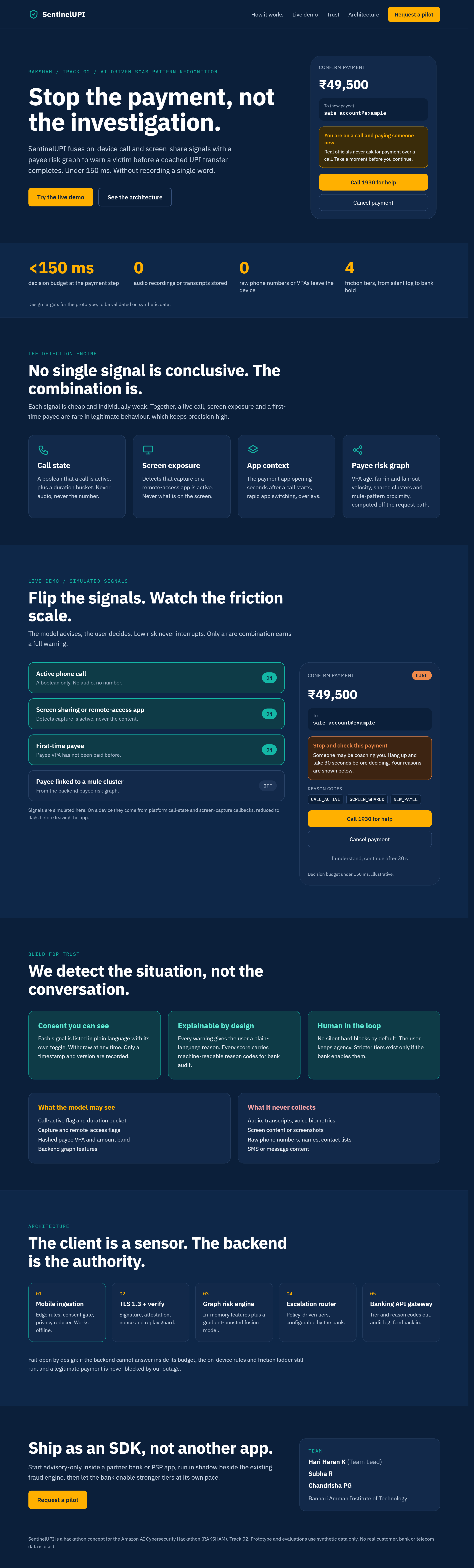
You are an expert enterprise UX/UI designer and AI cybersecurity startup founder. I need you to generate the complete, production-ready content and detailed structural guidelines for a high-impact, professional Round 1 Idea Submission PDF (Pitch Deck + Architectural Overview) for the Amazon AI Cybersecurity Hackathon (RAKSHAM).
The submission must target Track 02: AI-Driven Scam Pattern Recognition (UPI/Banking/Wallet Contexts)[cite: 1]. The tone must be intensely professional, data-driven, engineering-focused, and strictly compliant with all evaluation rubrics[cite: 3]. Avoid generic buzzwords; use rigorous technical and financial ecosystem terminology.
Team & Institutional Details to Include:
- Project Name: SentinelUPI (or a similarly high-impact professional name like "AegisUPI" or "TrustNet AI")
- Team Lead: Hari Haran K
- Team Members: Subha R, Chandrisha PG
- Institution: Bannari Amman Institute of Technology
Strict Formatting & Content Requirements per Section:
PART 1: PITCH DECK (Max 10 Slides)
Generate the exact slide-by-slide content, layout structure, and copy for Slides 1 to 10.
- Slide 1: Title & Executive Hook (Project Name, Track 02, Team Roster: Hari Haran K, Subha R, Chandrisha PG, Bannari Amman Institute of Technology, and a punchy one-sentence value proposition)[cite: 1, 2].
- Slide 2: Threat Scenario & Ecosystem Harm (Deep-dive into AI-scripted "Digital Arrest" and simultaneous screen-share/active-call UPI scams targeting Indian users)[cite: 1, 3].
- Slide 3: Current User Journey vs. Proposed Workflow (Side-by-side comparison illustrating how traditional retrospective bank fraud checks fail versus proactive real-time telemetry interception)[cite: 2, 3].
- Slide 4: Core Multi-Signal Detection Engine (Technical breakdown of client-side edge telemetry fusing active call states, screen-sharing permissions, app context shifts, and backend VPA risk graphs)[cite: 2, 4].
- Slide 5: Data Governance, Provenance & Privacy (Explicit data minimization policy: zero raw PII, zero audio recording storage, use of synthetic UPI transaction datasets)[cite: 2, 4].
- Slide 6: Responsible AI & Alert Fatigue Mitigation (Balancing security with usability: handling false positives via non-intrusive contextual warnings rather than hard blocks)[cite: 1, 3, 4].
- Slide 7: Adversarial Defense & Misuse Safeguards (Mitigating client-side tampering, payload verification, and fraudster heuristic adaptation)[cite: 4].
- Slide 8: 48-Hour Finale Prototype Execution Plan (Scoped, realistic MVP roadmap: Flutter client UI, local heuristic rule engine, FastAPI mock backend)[cite: 2, 3].
- Slide 9: Adoption, Integration & Scale Strategy (Seamless integration pathway into bank/UPI SDK ecosystems with strict adherence to $<150\text{ms}$ latency budgets)[cite: 3].
- Slide 10: Appendix & Mandatory AI Disclosures (Full transparency list covering synthetic data generation scripts, open-source libraries, and third-party tools)[cite: 2].
PART 2: ARCHITECTURAL OVERVIEW (Max 3 Pages/Slides)
Generate the detailed structural text and ASCII/structural layout blueprints for the 3 architecture pages:
- Page 1: End-to-End System Architecture Diagram (Clear text-based layout representation showing Mobile Client Ingestion Layer $\rightarrow$ TLS 1.3 Transport $\rightarrow$ Feature Store & Graph Risk Engine $\rightarrow$ Action/Escalation Router $\rightarrow$ Banking API Gateway)[cite: 2].
- Page 2: Data Flow, Model Boundaries & Privacy Controls (Detailed processing pipeline, encryption standards, consent capture mechanisms, and zero-trust telemetry verification)[cite: 2, 4].
- Page 3: Validation, Fail-safes & 48-Hour Build Timeline (Precision/recall optimization targets, fail-open system fault tolerance, and hour-by-hour finale execution plan)[cite: 2, 3].
Please output the complete content cleanly, using professional formatting, clear headings, bullet points, and explicit design callout boxes for the mandatory "Build for Trust" criteria[cite: 4].

Log in or sign up for Devpost to join the conversation.